New Book – Circling Marx: Essays 1980-2020

Peter Beilharz with a collection of essays on Marx

t11editor's avatarthesis eleven

A new book of essays by Peter Beilharz, Sichuan University

Circling Marx: Essays 1980-2020 (Brill, 2020)
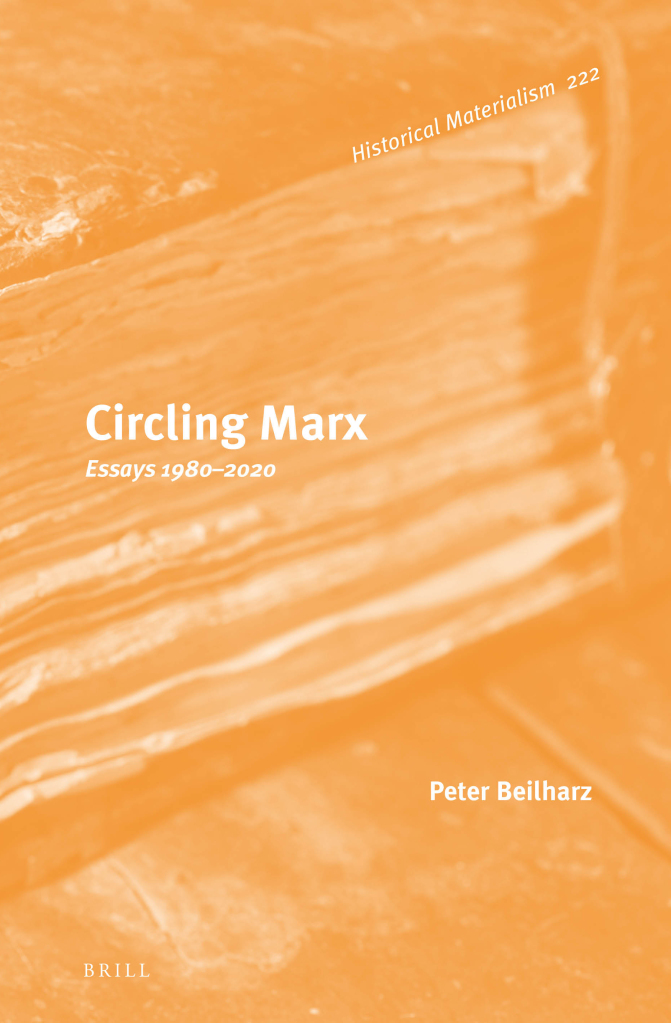
Karl Marx circles us, and we him. This reflects the power of his legacy, but it also indicates the nature of the intellectual process. We move around objects of interest and insight, working by successive approximations. Peter Beilharz has been circling Marx for forty years. This volume of essays expands the metaphor by working through three circles in the history of Marxism. The first works with Marx; the second with the classical legacy, through to Bolshevism and western marxism; the third steps closer to the present , in thinkers such as Bauman, Heller and Castoriadis. Read together, these essays represent a lifetime’s engagement with Marx and his intellectual consequences.
View original post

Posted in Uncategorized | Leave a comment

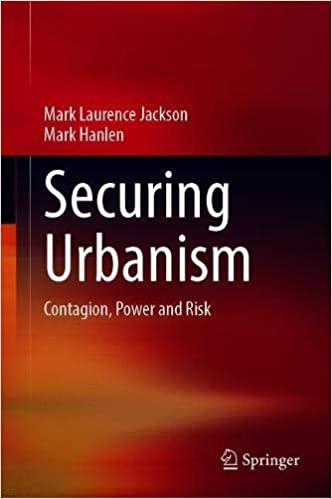
Mark Laurence Jackson and Mark Hanlen, Securing Urbanism: Contagion, Power and Risk – Springer, January 2021

Mark Laurence Jackson and Mark Hanlen, Securing Urbanism: Contagion, Power and Risk – Springer, January 2021

This book is concerned with developing an in-depth understanding of contemporary political and spatial analyses of cities. In the three-part development of the book’s overall argument or premise, the reader is taken in Part I through a range of contemporary critical and political understandings of urban securitizing. This is followed by an historical urban landscape of emerging liberalism and neo-liberalism, in nineteenth-century Britain and twentieth-century United States, respectively. These case-study historical chapters enable the introduction of key political issues that are more critically assayed in Parts II and III. With Part II, the reader is introduced in depth to a series of spatial analyses undertaken by Michel Foucault that have been crucial for especially late-twentieth and twenty-first century urban theory and political geography. With Part III the full ramifications of a paradigmatic shift are explored at the level of rethinking territory, population and design.

This book is timely and useful for readers who want to develop a stronger understanding of what the book’s researchers term a new political paradigm in urban planning, one ultimately governed by global economic forces that define the end of probability.

Just an expensive hardback and slightly cheaper e-book at present, unfortunately.

Posted in Michel Foucault, urban/urbanisation | 2 Comments

Henry V: Historical and Literary Territories at War – videos of 11 December 2020 conference

Online Conference Henry V: Historical and Literary Territories at War (edited)

A selection of the papers and discussions from the 11/12/2020 online conference on Henry V: Historical and Literary Territories at War / Territoires d’histoire, territoires littéraires en guerre (Université Toulouse Jean Jaurès) Programme : https://cas.univ-tlse2.fr/accueil-cas… 

Go further with our speakers’ books and articles: 

Stuart Elden, Shakespearean Geographies (University of Chicago Press, 2018) 

Jean Christophe Mayer, Representing France and the French in Early Modern Drama (University of Delaware Press, 2008) 

Nathalie Rivère de Carles; Diplomatic Parrhesia and the Ethos of Trustworthiness in Hotman’s The Ambassador and Shakespeare’s Henry V. Journal of Medieval and Early Modern Studies 1 September 2020; 50 (3): 609–631. doi: https://doi.org/10.1215/10829636-8626481

Valerie Toureille, Jeanne d’Arc (Perrin, 2020) 

Arnaud Baudin, Valérie Toureille (dir) UN ROI POUR DEUX COURONNES. TROYES 1420 (Snoeck, 2020) 

Patrick Gray, Shakespeare and War, Critical Survey ; 30, 2018. https://doi.org/10.3167/cs.2018.300102

Posted in Shakespearean Territories, Uncategorized, William Shakespeare | Leave a comment

Derek Gregory on the end of his teaching career

Derek Gregory on the end of his teaching career at his blog Geographical Imaginations.

I gave my last UBC lecture on 2 December (below), but I shall – of course! – continue my research and writing. So this isn’t retirement yet – and my tenure as Peter Wall Distinguished Professorship isn’t up yet either – but it does bring me to the end of a long teaching career.

It’s well worth a read. At the end of the post, he talks of the current writing plans:

As I write this, it’s neither a Monday nor the 1st of the month. I may be turning a page on my teaching career, but – as I said at the outset – the research and the writing will continue apace. I have two books in prospect.  Reach from the Sky will bring together my work on genealogies and geographies of aerial violence, and Purple Testament – a title I’ve taken (if you’ve read this far, you will know how doubly appropriate this is) from Shakespeare’s Richard II: ‘the purple testament of bleeding war’ – which extends my work on trauma geographies and woundscapes from the First World War to Afghanistan and Syria.

Posted in Uncategorized | Leave a comment

New Left Review new blog – Sidecar

New Left Review has a new blog – Sidecar

Posted in Uncategorized | Leave a comment

Michel Foucault, Interview with Madeleine Chapsal (2020)

A new translation of an important 1966 interview with Foucault, available open access.

Clare O'Farrell's avatarFoucault News

Michel Foucault, Interview with Madeleine Chapsal, The Journal of Continental Philosophy Translated by Mark G. E. Kelly, Volume 1, Issue 1, 2020, Pages 29-35

DOI: 10.5840/jcp2020876

Abstract
In this 1966 interview, published here in English translation for the first time, Michel Foucault positions himself as a representative of a ‘generation’ of French thinkers who turned towards the analysis of ‘structures’ and away from the phenomenological approaches that had previously dominated French philosophy. In this, Foucault claims inspiration not only from older French scholars—namely Georges Dumézil, Jacques Lacan, and Claude Lévi-Strauss—but also from the science of genetics.

View original post

Posted in Uncategorized | Leave a comment

Rob Kitchin, ‘Writing Fiction as Scholarly Work’ at LSE Impact of Social Sciences

Rob Kitchin, Writing Fiction as Scholarly Work at LSE Impact of Social Sciences

Writing for academic publication is highly stylised and formalised. In this post Rob Kitchin describes how writing fiction has shaped his own academic praxis and can provide scholars with an expanded range of conceptual tools for communicating their research.

Posted in Uncategorized | Leave a comment

Stuart Elden, ‘Foucault as Translator of Binswanger and von Weizsäcker’ – video abstract and open access article

Stuart Elden, ‘Foucault as Translator of Binswanger and von Weizsäcker‘ –

The video abstract for this open access article is now available:

Foucault’s Introduction to a translation of Ludwig Binswanger’s essay ‘Dream and Existence’ was published in late 1954. The translation was credited to Jacqueline Verdeaux, with Foucault acknowledged for the notes. Yet Verdeaux herself indicates the intensely collaborative nature of their working process and the translation. In 1958, Victor von Weizsäcker’s Der Gestaltkreis was published in French as Le Cycle de la structure, translated by Foucault and Daniel Rocher. Foucault went on to translate and introduce Immanuel Kant’s Anthropology as his secondary doctoral thesis. His engagement with Kant and Binswanger’s ideas has been discussed in the literature, but his role as translator has generally been neglected. His engagement with von Weizsäcker is almost never mentioned. This article critically discusses Foucault’s role in the Binswanger and von Weizsäcker translations, comparing the German originals with the French texts, and showing how this is a useful additional element to the story of the early Foucault.

The article comes from the research for The Early Foucault, which is forthcoming with Polity in June 2021.

Posted in Ludwig Binswanger, Michel Foucault, The Early Foucault, Uncategorized | 1 Comment

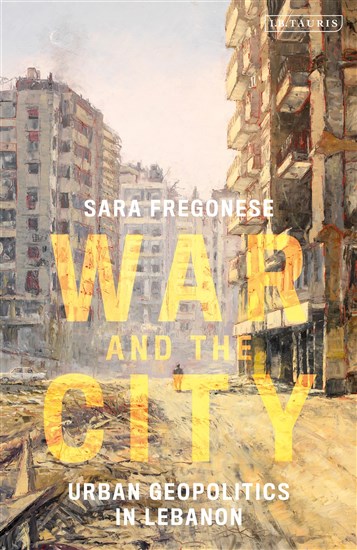
Interview with Sara Fregonese on War and the City: Urban Geopolitics in Lebanon (New Texts Out Now)

Interview with Sara Fregonese on War and the City: Urban Geopolitics in Lebanon at New Texts Out Now

Jadaliyya (J): What made you write this book?

Sara Fregonese (SF): This book is the result of my doctoral research (2004-2008), to which I then added a layer of historical detail about the administrative changes in 1840s Mount Lebanon and their impact on today’s sectarian politics. I also integrated a chapter on more recent sustained urban clashes in 2008 that partly encompasses my postdoctoral research around sovereignty and non-state armed groups (2009-2012) and their relation with the idea and practice of the State.

What made me write the book was, firstly, a disciplinary frustration with the lack of attention (in western scholarship at least) given to the representations and narrations of non-state actors and sub-national spaces of the civil war in Lebanon. We see a lot of grand scale geopolitical analysis around the 1975-1990 events, but less enquiry linking the kind of geopolitical reasoning from international relations and political science, with spatial accounts of what was actually happening at the urban level during the conflict. 

Posted in Uncategorized | Leave a comment

Rosemary-Claire Collard, Animal Traffic – Duke University Press, Sept 2020 (open access introduction + New Books discussion)

Now with a link to a discussion at New Books – https://newbooksnetwork.com/animal-traffic

stuartelden's avatarProgressive Geographies

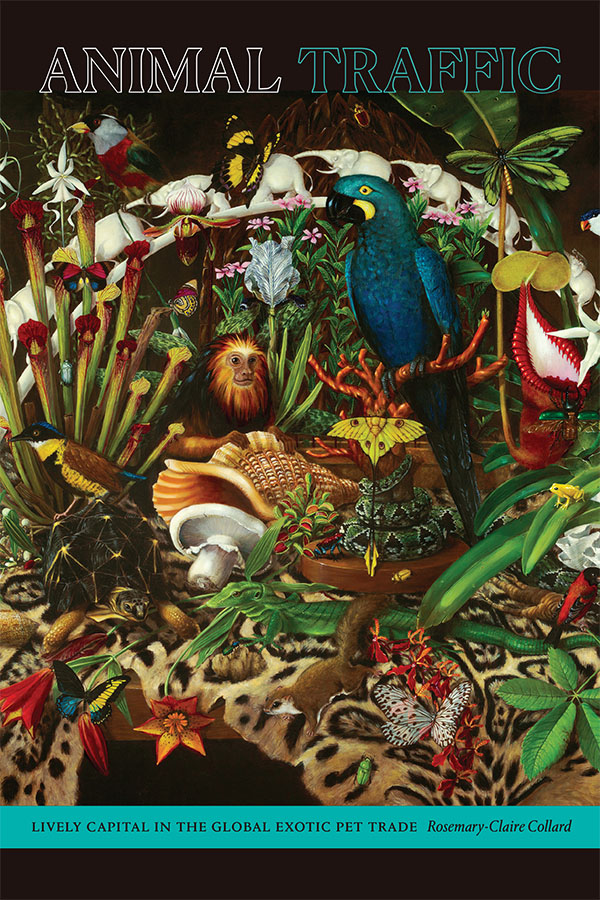
978-1-4780-1092-0_prRosemary-Claire Collard, Animal Traffic: Lively Capital in the Global Exotic Pet Trade – Duke University Press, September 2020. The Introduction is open access here.

Update: there is a discussion on the New Books podcast here.

Parrots and snakes, wild cats and monkeys—exotic pets can now be found everywhere from skyscraper apartments and fenced suburban backyards to roadside petting zoos. In Animal Traffic Rosemary-Claire Collard investigates the multibillion-dollar global exotic pet trade and the largely hidden processes through which exotic pets are produced and traded as lively capital. Tracking the capture of animals in biosphere reserves in Mexico, Guatemala, and Belize; their exchange at exotic animal auctions in the United States; and the attempted rehabilitation of former exotic pets at a wildlife center in Guatemala, Collard shows how exotic pets are fetishized both as commodities and as objects. Their capture and sale sever their ties to complex socio-ecological…

View original post 283 more words

Posted in Uncategorized | 1 Comment