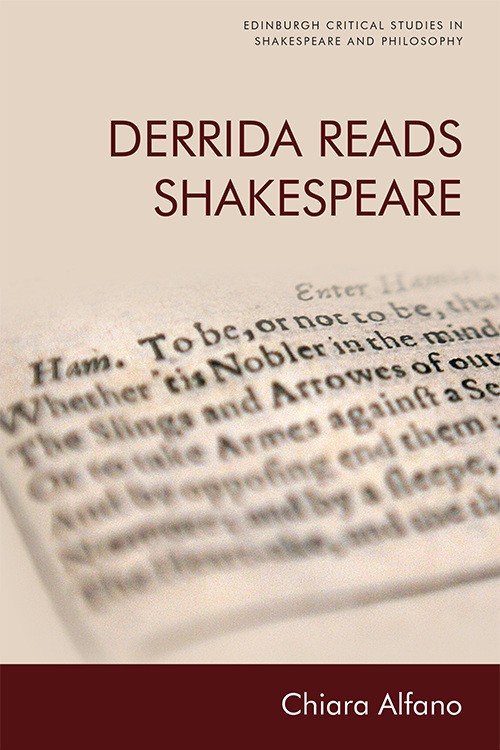
Chiara Alfano, Derrida Reads Shakespeare – Edinburgh University Press, 2020

Chiara Alfano, Derrida Reads Shakespeare – Edinburgh University Press, 2020

Looks really interesting, but shame about the prohibitive price, even for the e-book…
Explores Jacques Derrida’s distinctive approach to Shakespeare

Offers the first comprehensive and accessible account and discussion of Derrida’s engagement with Shakespeare

Challenges the way we have traditionally come to think about the interdisciplinary relationship between literature and philosophy, as well as literary genius

Contextualises Derrida’s readings of Shakespeare within his wider philosophical project and discusses in how far they relate to – or are distinct from – his engagement with other dramatic or literary works

This book brings to light Derrida’s rich and thought-provoking discussions of Shakespearean drama. Contextualising Derrida’s readings of Shakespeare’s Romeo and JulietHamletThe Merchant of Venice and King Lear within his wider philosophical project, Alfano explores what draws Derrida to Shakespeare and what makes him particularly suitable for philosophical thought. The author also makes the case for Derrida’s singular understanding of the relationship between philosophy and Shakespeare and his radical idea of what literary genius is.


Posted in William Shakespeare | Leave a comment

Rebecca Buxton and Lisa Whiting (eds.), The Philosopher Queens – Unbound, September 2020

Rebecca Buxton and Lisa Whiting (eds.), The Philosopher Queens – Unbound, September 2020

For all the young women and girls sitting in philosophy class wondering where the women are, this is the book for you. This collection of 21 chapters, each on a prominent woman in philosophy, looks at the impact that women have had on the field throughout history. From Hypatia to Angela Davis, The Philosopher Queens will be a guide to these badass women and how their amazing ideas have changed the world. 

This book is written both for newcomers to philosophy, as well as all those professors who know that they could still learn a thing or two. This book is also for those many people who have told us that there are no great women philosophers. Please pledge, read this book and then feel free to get back to us.

Posted in Uncategorized | Leave a comment

Michel Serres and The Natural Contract – discussion with Christopher Watkin at Hermetix

Michel Serres and The Natural Contract – discussion with Christopher Watkin at Hermetix

Christopher Watkin is Senior Lecturer in French Studies at Monash University, he is also the author of French Philosophy Today and Michel Serres: Figures of Thought. In this episode we discuss Michel Serres’ text The Natural Contractalongside discussion on ecology, pollution, possession and nature. 

Christopher’s book on Serres can be purchased here.

Thanks to dmf for this link.

Update: the whole series is listed here – there are other discussions of Serres, and much more.

Posted in Uncategorized | 2 Comments

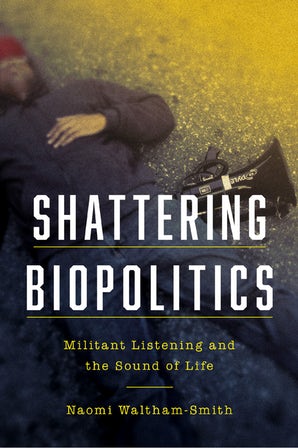
Naomi Waltham-Smith, Shattering Biopolitics: Militant Listening and the Sound of Life – Fordham University Press, July 2021

Naomi Waltham-Smith, Shattering Biopolitics: Militant Listening and the Sound of Life – Fordham University Press, 2021

No other details as yet on the Fordham page, but good to see this book listed as forthcoming.

Naomi’s Warwick page says the following:

My second monograph, Shattering Biopolitics: Militant Listening and the Sound of Life (forthcoming with Fordham University Press for the Commonalities series), develops my interests in the role of sound and listening in the philosophical tradition from Plato to contemporary French thought. It examines how sound is imbricated in the politics of life as it is theorised in the thought of Derrida, Cixous, Agamben, and Malabou, exploring the ramifications for the politics of sound, listening, and voice today.

Posted in Uncategorized | 1 Comment

Hermione Lee, ‘What is Biography?’ (British Academy)

Hermione Lee, ‘What is Biography?‘ (British Academy)

Posted in Uncategorized | Leave a comment

Books received – Port-Royal, Gregory, Roussel, Dumézil, Said, Love

Jeff Love’s biography of Alexandre Kojève, Edward Said’s Beginnings – both in recompense for review work, and some second-hand books for various things, mainly in relation to the Foucault work. Foucault introduced the Port-Royal Grammaire, and the issue of Langages has an earlier version of his text. The ex-library book is Derek Gregory, Regional Transformation and Industrial Revolution: A Geography of the Yorkshire Woollen Industry it was mentioned on Twitter recently, and I realised it was the only book of his that I didn’t have a copy of.

Posted in Derek Gregory, Edward Said, Georges Dumézil, Michel Foucault, The Archaeology of Foucault | 1 Comment

Department for Education guidance ‘Higher education: reopening buildings and campuses’

The Department for Education guidance ‘Higher education: reopening buildings and campuses‘ was posted very early this morning. Necessary, but deeply concerning, reading.

On this topic, see also my list of pieces from SAGE, Independent SAGE and others here and here; and a lot more on covid-19 can be found here – Geographers, sociologists, philosophers etc. on covid-19

Update 11 Sept: Universities are being forced to lie about being COVID safe (Open Democracy)

Update 12 Sept: Rachel Hall, ‘I suppose you’re stuck with these people’: the students facing an uncertain new term (The Guardian)

Jim Dickinson, Revised guidance for England on universities and Covid-19 means tiers before Christmas (WONKHE)

Sarah Kraus, Reopening Universities Isn’t Just a Threat to Staff and Students – It’s a Threat to Communities Too (NovaraMedia)

Update 13 Sept: Nervous students return to Bristol University: ‘For the sake of my studies I need to’ (The Observer)

John Wright, Coronavirus doctor’s diary: Will universities be able to avoid spreading the virus? (BBC News)

Update 14 Sept: Jonathan Peters, Coronavirus: Students return to socially-distanced university campuses (BBC News – Scotland)

Posted in Uncategorized | Leave a comment

The collapse of the Covid-secure campus

Another important piece – also added to the previous list

lizmorrish's avatarAcademic Irregularities

We are now into September 2020 and plans to allow students to come back to university campuses are proceeding. Universities have been required by the Office for Students to inform new and returning students what they might be able to expect in terms of teaching (online or face to face) in 2020/2021 and how quality, standards and a good student experience will be maintained.

However, evidence is emerging that even the high degree of planning for Covid-secure campuses that has happened over the summer might not be enough to prevent students, staff and communities from spreading the virus.

Nobody, apparently, wants to be the second campus to tell students they are going to be studying totally online; the University of Cambridge made an early decision in May to go to online classes for the next academic year.

By contrast, the University of Bolton was the first to release extensive and…

View original post 1,236 more words

Posted in Uncategorized | Leave a comment

SAGE guidance on the risks of covid-19 and teaching at UK universities in 2020/21 – updated

I first shared this over the weekend, when it got little notice. Compared to most of the stuff I post on this blog, this is really important. So reblogging it now, with some additional links at the bottom.

My previous list of pieces on universities is here; and a lot more on covid-19 can be found here – Geographers, sociologists, philosophers etc. on covid-19

stuartelden's avatarProgressive Geographies

The SAGE (Scientific Advisory Group for Emergencies) guidance Principles for Managing SARS-CoV-2 Transmission Associated with Higher Education was published on Friday evening [4 Sept 2020] (though dated to the previous day). It can be downloaded here. It is important, though disturbing reading. The Executive Summary gives a good indication:

There is a significant risk that Higher Education (HE) could amplify local and national transmission, and this requires national oversight.It is highly likely that there will be significant outbreaks associated with HE, and asymptomatic transmission may make these harder to detect. Outbreak response requires both local plans and coordinated national oversight and decision-making.

It is essential to develop clear strategies for testing and tracing, with effective support to enable isolation.Universities are good locations to pilot approaches such as population case detection (PCD). Enhanced testing in response to suspected outbreaks is likely to be beneficial in detecting and preventing…

View original post 427 more words

Posted in Uncategorized | Leave a comment

Edgar de Picciotto International Prize awarded to Saskia Sassen

The Edgar de Picciotto International Prize for 2020 has been awarded to Saskia Sassen. She joins a very impressive set of previous winners – Amartya Sen, Saul Friedländer, Paul Krugman and Joan Wallach Scott.

The Edgar de Picciotto International Prize was created as a tribute and token of thanks to Mr Edgar de Picciotto. His generous donation of CHF 20 million enabled the Graduate Institute to finance a considerable part of the Student House. Mr de Picciotto and his family have greatly supported and participated in the realisation of the Institute’s mission by facilitating the hosting of students from all over the world.

The Edgar de Picciotto International Prize – awarded every two years and worth CHF 100,000 – is intended to reward an internationally renowned academic whose research has contributed to enhancing the understanding of global challenges and whose work has influenced policy-makers.

Posted in Saskia Sassen, Uncategorized | 1 Comment