SAGE guidance on the risks of covid-19 and teaching at UK universities in 2020/21 – updated

The SAGE (Scientific Advisory Group for Emergencies) guidance Principles for Managing SARS-CoV-2 Transmission Associated with Higher Education was published on Friday evening [4 Sept 2020] (though dated to the previous day). It can be downloaded here. It is important, though disturbing reading. The Executive Summary gives a good indication:

There is a significant risk that Higher Education (HE) could amplify local and national transmission, and this requires national oversight. It is highly likely that there will be significant outbreaks associated with HE, and asymptomatic transmission may make these harder to detect. Outbreak response requires both local plans and coordinated national oversight and decision-making.

It is essential to develop clear strategies for testing and tracing, with effective support to enable isolation. Universities are good locations to pilot approaches such as population case detection (PCD). Enhanced testing in response to suspected outbreaks is likely to be beneficial in detecting and preventing ongoing transmission.

Safe provision of student education needs to be based on a hierarchy of risk. This includes reducing in-person interaction, segmentation of students and environmental controls, including mitigating aerosol transmission risk through ventilation and use of face coverings.

Accommodation and social interactions are likely to be a high-risk environment for transmission to occur. Strategies to mitigate transmission risk include segmentation of students to co-locate courses or year groups, and good communication on behaviour and hygiene in household and social environments.

There need to be specific strategies to consider the wider physical and mental health of students and staff, beyond COVID-19. This will include maximising the influenza vaccination programme to minimise co-infection risks and providing support to mental health programmes.

Communication strategies are a critical part of minimising transmission risks associated with HE. Guidance on how to behave is more likely to be adhered to if people understand the reasons they are asked to take certain actions, and if it is co- produced with the staff and students who will be affected by it.

There are news stories about it here –

Rebecca Speare-Cole, Significant outbreaks of Covid-19 linked to universities are highly likely, says Sage (Evening Standard)

Ian Sample and Richard Adams, Students returning at Christmas could seed new coronavirus outbreaks, scientists warn (The Guardian)

Will Hazell, Coronavirus latest: ‘Significant risk’ universities could ‘amplify’ virus and seed it nationally by Christmas, Sage scientists say (iNews)

Not directly on this guidance, but Alexandra Topping, Class of 2021: how will you learn at university? (The Guardian) is worth a read.

And a recent editorial by Gavin Yarney, Covid-19: re-opening universities is high risk in the British Medical Journal is also important.

My previous list of pieces on universities is here; and a lot more on covid-19 can be found here – Geographers, sociologists, philosophers etc. on covid-19

I’ll update this with other relevant pieces.

Update 6 Sept: Sian Griffiths, Make universities Covid-safe or risk strikes, warns union (The Times – paywall)

Coronavirus: ‘Critical moment’ as students return to university (BBC News)

Glen O’Hara, What’s really going on in Britain’s universities? (CAPX)

Update 8 Sept: Larissa Kennelly, Coronavirus: ‘I paid for my student house, now all my lectures are online’ (BBC News)

Update 9 Sept: Sally Brown, The first weeks may be critical for the 2020 cohort (WONKHE)

Rille Raaper, Chris Brown, Anna Llewellyn, The Sudden Dissolution of the University Campus: Where do students get support from? (The Post-Pandemic University)

Expendable Assets: Staff and Students in the Pandemic University (Punk Academic)

Liz Morrish, The Collapse of the COVID-secure Campus (Academic Irregularities)

Update 10 Sept: the Department for Education guidance is here

Posted in Universities | 3 Comments

William Davies, This is Not Normal: The Collapse of Liberal Britain – Verso, August 2020

William Davies, This is Not Normal: The Collapse of Liberal Britain – Verso, August 2020

What just happened and how did we get into this mess?

Since 2016, the UK has been in a crisis of its own making; this is not the fault of Brexit but of a larger problem of our politics. The status of political parties, the mainstream media, public experts and officials have all been disrupted. Along the way, there have been shocking and exhilarating events: the unforeseen 2017 election result, the horrific details of Grenfell Tower and the Windrush scandal, the sudden rise and fall of the Brexit Party. As the ‘mainstream’ of politics and media has come under attack, the basic norms of public life have been thrown into question.

This Is Not Normal takes stock of a historical moment that no longer recognises itself. Davies tells the story of the apparently chaotic and irrational events, and extracts their underlying logic and long-term causes. What we are seeing are the effects of the 2008 financial crash, the failure of the British neoliberal project, the dying of Empire, and the impact of the changes that technology and communications have had on the idea of the public sphere as well as the power of information. This is an essential book for anyone who wants to make sense of this current moment.

Posted in Uncategorized | 1 Comment

Rob Kitchin and Alistair Fraser, Slow Computing: Why We Need Balanced Digital Lives – Bristol University Press, September 2020

Rob Kitchin and Alistair Fraser, Slow Computing: Why We Need Balanced Digital Lives – Bristol University Press, September 2020

The book has a companion website where the first chapter and coda are available to download.

Digital technologies should be making life easier. And to a large degree they are, transforming everyday tasks of work, consumption, communication, travel and play. But they are also accelerating and fragmenting our lives affecting our well-being and exposing us to extensive data extraction and profiling that helps determine our life chances.

Initially, the COVID-19 pandemic lockdown seemed to create new opportunities for people to practice ‘slow computing’, but it quickly became clear that it was as difficult, if not more so, than during normal times.

Is it then possible to experience the joy and benefits of computing, but to do so in a way that asserts individual and collective autonomy over our time and data? 

Drawing on the ideas of the ‘slow movement’, Slow Computing sets out numerous practical and political means to take back control and counter the more pernicious effects of living digital lives.

Posted in Uncategorized | Leave a comment

Keith Dowding, It’s the Government, Stupid: How Governments Blame Citizens for their own Policies – Bristol University Press, September 2021

Keith Dowding, It’s the Government, Stupid: How Governments Blame Citizens for their own Policies – Bristol University Press, September 2021

Governments have developed a convenient habit of blaming social problems on their citizens, including homelessness, gun crime, obesity, drug addiction and problem gambling.

In this new book, Keith Dowding calls for us to stop scapegoating fellow citizens and to demand more from our governments, who have the real power and responsibility to alleviate social problems.

Watch Keith introduce the book here and listen to him talk about the arguments of the book in more detail in this podcast. You can also read his article on the LSE British Politics and Policy blog.

“Everyone – voters and politicians – should read this book.”Matt Matravers, University of York

“Throws down the gauntlet to political philosophers … Timely and important.”Miriam Bankovsky, La Trobe University

Posted in Uncategorized | Leave a comment

The Post-Pandemic University, September 18th

Building the Post-Pandemic University – details of an online conference on September 18, 2020.

Mark's avatarThe post-pandemic university

September 18th, Faculty of Education, University of Education

Organising committee: Mark Carrigan, Michele Martini, Hannah Moscovitz, Susan Robertson, Milan Stürmer

Social distancing could, perhaps, better be described as ‘physical distancing’, given that we are finding new ways to enjoy social interactions digitally whether or not we are in the same room. Whatever we choose to call it, however, it is just one of the ways in which the COVID-19 pandemic is likely to pose challenges for universities as the new academic year looms large on the horizon. How exactly will higher education be transformed by these events? What sort of university can we expect – or hope – to emerge from the crisis? And how can we begin to shape that university now?

These are the questions we’ll be addressing in the first Post-Pandemic University conference on September 18th. The conference will take place using Zoom, as we feel…

View original post 327 more words

Posted in Uncategorized | Leave a comment

Books received – Kristeva, Lévi-Strauss, Huffer, Palti, Löwith, Barthes, Stanek

Some books in recompense for review work from Columbia University Press, and a copy of Łukasz Stanek, Architecture in Global Socialism: Eastern Europe, West Africa and the Middle East in the Cold War, sent by the publisher.

Posted in Claude Lévi-Strauss, Hannah Arendt, Julia Kristeva, Martin Heidegger, Michel Foucault, Roland Barthes | 1 Comment

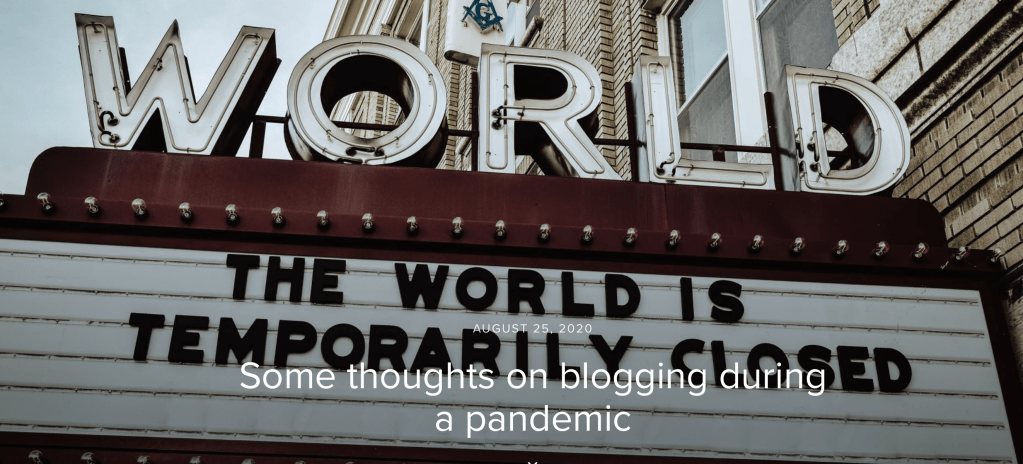
Mark Carrigan, Some thoughts on blogging during a pandemic

Mark Carrigan, Some thoughts on blogging during a pandemic

Mark’s book, Social Media for Academics, is now in its second edition.

Posted in Uncategorized | 1 Comment

Frictionless sovereignty – special issue of b20 online

frictionless sovereignty | special issue

b2o: an online journal is an online-only, free-to-read, peer-reviewed journal published by the boundary 2 editorial collective, with a standalone Editorial Board.

Volume 5, Issue 2 (August 2020)
Special Issue: Frictionless Sovereignty
Special Issue editor: Ryan Bishop

  1. Ryan Bishop, “Frictionless Sovereignty: An Introduction”
  2. Sarah Hayden, “Liquid Citizenship, Liquid Voice and Sensorial Sovereignty”
  3. Ryan Bishop and Tania Roy, “Frictionless Sovereignty and the Oceanic Claim: Bio-Aesthetic Engagements”
  4. Joseph Owen, “Details, Details, Details: Carl Schmitt’s Borderline Critique of Anticipation”
  5. Arne De Boever, “Futures of Sovereignty (Necropolitics in America)”
  6. Ryan Bishop and AbdouMaliq Simone, “Extending Sovereignty in the Light of Black Urbanity”
  7. Mihaela Brebenel, “Embodied Frictions and Frictionless Sovereignty”
  8. Paul Hegarty, “Polar Sovereignty”
  9. Dimitris Vardoulakis, “The Antinomy of Frictionless Sovereignty: Inverse Relations of Authority and Authoritarianism”
Posted in Uncategorized | Leave a comment

Important pieces on the dangers of reopening UK campuses in September – updated

Now updated with some more links

stuartelden's avatarProgressive Geographies

In the UK, the next academic year begins in September or early October. While most universities have said lectures will be delivered online, they seem to be keen to have some face-to-face teaching of smaller classes. Some important pieces are now being written saying that all teaching – perhaps except for some lab or practice-based classes – should be done online. Experience in the US, where teaching starts earlier in the year, seems to suggest this is necessary.

[updated – new links added at end of list]

Warwick UCU, Five Red Lines Redux: Move Fall Teaching Online

Jim Dickinson, A month to go, and still lots of questions to answer (WONKHE)

Independent Sage, Behaviour Group Consultation Statement on Universities in the context of SARS-CoV-2

– David Batty, Make Covid-19 tests compulsory for students, say scientists (The Guardian)

– Jim Dickinson, Universities get some Indie SAGE advice on reopening campuses in…

View original post 197 more words

Posted in Uncategorized | 1 Comment

Abolition: Critique and Praxis 13/13 including session on ‘Beyond the Punitive Society’

The next season of the Critique and Praxis: 13/13 seminars run by Bernard Harcourt at Columbia Center for Contemporary Critical Thought will be on the theme of Abolition.

The series will include a session on Thursday, January 7, 2021 on ‘Beyond the Punitive Society‘, co-hosted with Warwick’s Centre for Post-Kantian Philosophy. I’ll be one of the speakers, along with Bernard, Miguel Beistegui, Claire Blencowe, Daniele Lorenzini, Irene Dal Poz, and Federico Testa.

The session will be conducted by video link, and will take place in the US afternoon and UK evening -currently 12:15 – 2:45 pm EST / 5:15-7:45 pm UK time, but check the official listing for the final time. There are some excellent sessions in this series – full schedule here.

[I’ve updated the time of the session, but do check the CCCCT website for the official details]

Posted in Bernard E. Harcourt, Conferences, Michel Foucault, Uncategorized | Leave a comment