Caitríona Ní Dhúill, Metabiography: Reflecting on Biography – Palgrave, March 2020

Caitríona Ní Dhúill, Metabiography: Reflecting on Biography – Palgrave, March 2020.

Just hardback and e-book at present unfortunately.Ni Dhuill 2020 - Metabiography.jpg

This book explores the contradictions of biography. It charts shifting approaches to the writing and reading of biographies, from post-hagiographical attitudes of the Enlightenment, heroic biographies of Romanticism and irreverent modernist portraits through to contemporary experiments in politically committed and hybrid forms of life writing. The book shows how biographical texts in fact destabilise the models of historical visibility, cultural prominence and narrative coherence that the genre itself seems to uphold. Addressing the fraught relationships between genre and gender, private and public, image and text, life and narrative that play out in the modern biographical tradition, Metabiography suggests new possibilities for reading, writing and thinking about this enduringly popular genre.

Posted in Uncategorized | Leave a comment

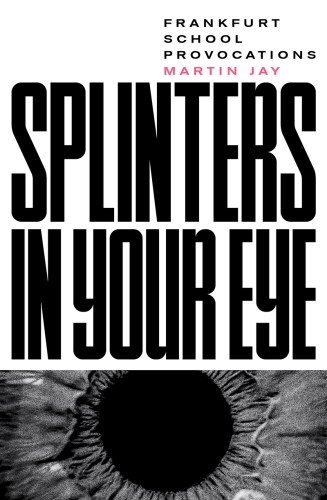
Martin Jay, Splinters in Your Eye: Frankfurt School Provocations – Verso, July 2020, and discussion at New Books Network

9781788736015-a33d49593bf9fd61413ebc7f444e701fMartin Jay, Splinters in Your Eye: Frankfurt School Provocations – Verso, July 2020.

There is a discussion at New Books Network with Ryan Tripp. Thanks to dmf for this link.

Although successive generations of the Frankfurt School have attempted to adapt Critical Theory to new circumstances, the work done by its founding members continues in the twenty-first century to unsettle conventional wisdom about culture, society and politics. Exploring unexamined episodes in the school’s history and reading its work in unexpected ways, these essays provide ample evidence of the abiding relevance of Horkheimer, Adorno, Benjamin, Marcuse, Löwenthal, and Kracauer in our troubled times. Without forcing a unified argument, they range over a wide variety of topics, from the uncertain founding of the School to its mixed reception of psychoanalysis, from Benjamin’s ruminations on stamp collecting to the ironies in the reception of Marcuse’s One-Dimensional Man, from Löwenthal’s role in Weimar’s Jewish Renaissance to Horkheimer’s involvement in the writing of the first history of the Frankfurt School. Of special note are their responses to visual issues such as the emancipation of colour in modern art, the Jewish prohibition on images, the relationship between cinema and the public sphere, and the implications of a celebrated Family of Man photographic exhibition. The collection ends with an essay tracing the still metastasising demonisation of the Frankfurt School by the so-called Alt Right as the source of “cultural Marxism” and “political correctness,” which has gained alarming international resonance and led to violence by radical right-wing fanatics.

“In this sizzling collection of essays, Martin Jay demonstrates again that he is the unsurpassed reader of the group of thinkers known as the “Frankfurt School.” In fact, he challenges the false unity and coherence of ideas and views often imposed upon them, including his own earlier writings on the subject. Practicing episodic and fragmentary historiography, he uncovers astonishingly novel angles of interpretation as well as demonstrating brilliant re-readings of known texts. An absolute pleasure to read”

Posted in Uncategorized, Walter Benjamin | Leave a comment

Francesco Biagi, Henri Lefebvre’s Critical Theory of Space – Palgrave, October 2020

9783030523664Francesco Biagi, Henri Lefebvre’s Critical Theory of Space – Palgrave, October 2020

Just an expensive hardback and not-much-cheaper e-book at present, unfortunately.

Originally published in Italian and translated into English for the first time, Henri Lefebvre’s Critical Theory of Space offers a rigorous analysis and revival of Lefebvre’s works and the context in which he produced them. Biagi traces the historical-critical time-frame of Lefebvre’s intellectual investigations, bringing to light a theoretical constellation in which historical methods intersect with philosophical and sociological issues: from Marxist political philosophy to the birth of urban sociology; from rural studies to urban and everyday life studies in the context of capitalism. Examining Lefebvre’s extended investigations into the urban sphere as well as highlighting his goal of developing a “general political theory of space” and of innovating Marxist thought, and clarifying the various (more or less accurate) meanings attributed to Lefebvre’s concept of the “right to the city” (analysed in the context of the French and international sociological and philosophical-political debate), Henri Lefebvre’s Critical Theory of Spaceultimately brings the contours of Lefebvre’s innovative perspective—itself developed at the end of the “short twentieth century”—back into view in all its richness and complexity.

Posted in Henri Lefebvre, Uncategorized | Leave a comment

Hervé Guibert: Living Without a Vaccine (2020)

?collid=books_covers_0&isbn=9781635901238&type=Introduction to a new edition of Hervé Guibert’s memoir To the Friend Who Did Not Save my Life.

Clare O'Farrell's avatarFoucault News

Andrew Durbin Hervé Guibert: Living Without a Vaccine, New York Review of Books, June 12, 2020,

Adapted from the introduction to a new edition of Hervé Guibert’s To the Friend Who Did Not Save My Life, published by Semiotext(e) / Native Agents and MIT Press.

In 1988 the French novelist and photographer Hervé Guibert was diagnosed with HIV. Two years later, Éditions Gallimard published To the Friend Who Did Not Save My Life, a stark autobiographical book about his desperate effort to gain access to an experimental “AIDS vaccine.” To the Friend made Guibert both wealthy and famous, especially after an appearance on the French TV show Apostrophes.
[…]

The central and most arresting portrait is of Guibert’s mentor, the philosopher Muzil, based on Michel Foucault, whose death the writer repeatedly returns to in the first half of the novel.

Guibert’s gripping revelation, in the…

View original post 149 more words

Posted in Uncategorized | Leave a comment

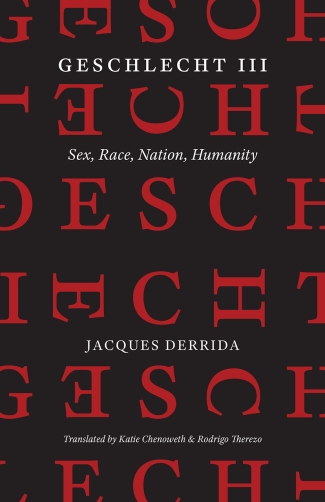
Jacques Derrida, Geschlecht III: Sex, Race, Nation, Humanity – University of Chicago Press, July 2020

9780226677460Jacques Derrida, Geschlecht III: Sex, Race, Nation, Humanity – University of Chicago Press, July 2020.

Speaking of Derrida, his text Geschlecht III, first published in French in 2018, edited by Geoffrey Bennington, Katie Chenoweth, and Rodrigo Therezo has now been translated by Katie Chenoweth and Rodrigo Therezo.

A significant event in Derrida scholarship, this book marks the first publication of his long-lost philosophical text known only as “Geschlecht III.” The third, and arguably the most significant, piece in his four-part Geschlecht series, it fills a gap that has perplexed Derrida scholars. The series centers on Martin Heidegger and the enigmatic German word Geschlecht, which has several meanings pointing to race, sex, and lineage. Throughout the series, Derrida engages with Heidegger’s controversial oeuvre to tease out topics of sexual difference, nationalism, race, and humanity. In Geschlecht III, he calls attention to Heidegger’s problematic nationalism, his work’s political and sexual themes, and his promise of salvation through the coming of the “One Geschlecht,” a sentiment that Derrida found concerningly close to the racial ideology of the Nazi party.

Amid new revelations about Heidegger’s anti-Semitism and the contemporary context of nationalist resurgence, this third piece of the Geschlecht series is timelier and more necessary than ever. Meticulously edited and expertly translated, this volume brings Derrida’s mysterious and much awaited text to light.


Posted in Jacques Derrida, Martin Heidegger, Uncategorized | 1 Comment

Jacques Derrida, Le Calcul des Langues – Seuil, June 2020 – previously unpublished manuscript, edited by Geoff Bennington and Katie Chenoweth

145582_couverture_Hres_0Jacques Derrida, Le Calcul des Langues – Seuil, June 2020

News of a previously unpublished manuscript by Derrida, edited by Geoff Bennington and Katie Chenoweth.

Texte énigmatique et entièrement inédit, Le Calcul des langues marque la première tentative de Jacques Derrida d’écrire un livre en deux colonnes. Annoncé comme ” à paraître ” sur la quatrième de couverture de l’Archéologie du frivole (1973) mais jamais publié du vivant de l’auteur, le tapuscrit de ce projet inachevé fut retrouvé chez Derrida après son décès. La publication posthume de ce texte fort original met au jour un véritable laboratoire typographique où, avant l’écriture de l’un de ses textes les plus célèbres, Glas (1974), Derrida ose couper la page en deux en vue de repenser la relation entre philosophie et écriture.

Poursuivant une réflexion sur les sciences du langage au XVIIIe siècle entamée avec De la grammatologie (1967), Derrida propose ici une lecture en partie double de L’Art d’écrire de Condillac. Mais à la différence de Glas, dont les deux colonnes confrontent un philosophe (Hegel) à un auteur littéraire (Genet), Le Calcul des langues confronte Condillac à lui-même. Si la colonne de gauche propose une exégèse plutôt conventionnelle et méthodologique de L’Art d’écrire, celle de droite divague sans cesse, multipliant les digressions en direction de Freud et d’autres penseurs, à la recherche d’un plaisir de l’écriture qui échapperait à la philosophie.

Lecture de Condillac en deux colonnes, donc, mais aussi en ” deux styles ” comme l’indique le sous-titre (” Distyle “), cet ouvrage tout à fait singulier dans le corpus derridien donne à lire l’une des plus belles expérimentations de l’écriture déconstructrice.


Posted in Jacques Derrida, Uncategorized | 2 Comments

Gilbert Humbert (1928-2020)

A brief obituary of one of the composers Foucault knew in the 1950s.

Clare O'Farrell's avatarFoucault News

Notice nécrologique sur Gilbert Humbert
Patrick Négrier

Gilbert Humbert, né en 1928, et compagnon de Michel Foucault en 1951, est décédé le 14 mai 2020. Ancien élève d’Olivier Messiaën, il eut une vie composite et composante. Composite d’abord en raison du fait qu’il fut successivement ou à la fois un pasteur protestant (1962-67), un militant du parti communiste, un musicien professeur de musique (1955-88) doublé d’un musicologue, et un poète, comme il le dit lui-même dans le poème suivant en se rappelant en 1996 la chambre de bonne qu’il possédait dans le XIXème arrondissement de Paris : « Tu étais au sixième étage et chaque jour on t’offrait le potage. Tu te croyais politicien, musicien, théologien et même un peu poète. Trement dit : un otage. Voilà qu’un jour tu déménages sans deviner qu’arrivera, s’aménageant, te succédant ton premier-né » (« Petit pote, en 1953 » dans Le Disque rayé). De son ministère de…

View original post 1,265 more words

Posted in Uncategorized | Leave a comment

Les Cahiers du GRM – theme issue on Pratiques et expériences de l’enquête (open access – papers in English, French and Italian)

Les Cahiers du GRM – theme issue on Pratiques et expériences de l’enquête – edited by Andrea Cavazzini (open access)

Du XIXe siècle à aujourd’hui, l’enquête militante a souvent joué le rôle d’un retour au réel par-delà les paradigmes théoriques et politiques figés en autoreproduction idéologique : à la fois confrontation des programmes politiques et des paradigmes théoriques à la matérialité des rapports sociaux, voire à la composition économique, idéologique et politique des classes exploitées etprocessus de transformation mutuelle des enquêteurs et des enquêtés par la recherche commune d’une connaissance plus riche et d’une orientation plus efficace, l’enquête représente la sortie de la pensée et de l’action de l’auto-enfermement dans le toujours-identique des ordres discursifs et des pratiques réduites à rituels.

Ainsi, l’enquête peut apparaître comme la tentative de se réapproprier une capacité d’autonomie et d’autodétermination et comme une entreprise de connaissance indissociable de cette réappropriation – expression d’une demande de savoir et de la recherche d’une plus grande puissance d’agir, l’enquête est une pratique dont l’étude peut éventuellement fournir un contre-poison à la méditation nostalgique ou morose des vestiges du passé et des constructions intellectuelles. Autrement dit, l’enquête est le lieu où l’étude du passé révolutionnaire peut devenir autre chose que la contemplation d’une image et s’ouvrir à la réappropriation de la pensée par le réel.

Posted in Uncategorized | Leave a comment

The Archaeology of Foucault update 1: Organisation, textual comparisons and a working timeline

IMG_3385 copy.jpeg

After an initial burst of enthusiasm, I’m already beginning to realise the scale of some of the tasks ahead of me with this book.

The final chapter of The Early Foucault discusses the way History of Madness was initially received, from some of the early reviews to Foucault’s interview in Le Monde and some radio programmes. That takes the story roughly up to the end of 1961, which is when Foucault finished writing Birth of the Clinic, and starts writing Raymond Roussel.  As I say in The Early Foucault, these books take the story beyond what I cover there, and already anticipate this new study. There are many more continuities between the supposed periods of Foucault’s work than are often suggested. A first draft of Birth of the Clinic was completed just six months after History of Madness was defended, and Foucault calls it the ‘out-takes’ from the earlier book. But François Delaporte’s work for the Pléiade Œuvres suggests that work on the text continued for another year, in parallel to the work on Raymond Roussel.

The first chapter of this book will be on Medicine, and Birth of the Clinic is obviously the key text. But the two editions of that text from 1963 and 1972 are quite different and as I’ve indicated before, the English translation is a peculiar hybrid of the two, rather than a consistent translation of one of them. The edition of the text in the Œuvres is unfortunately not complete in its annotation, and some way short of a critical edition. The only way I can do the work required is to sit with the two French editions, pen in hand, and mark up the differences. I have previously done this this kind of comparison for Maladie mentale et personnalité and Maladie mentale et psychologie, and for the way Histoire de la folie was abridged in 1964. I discuss the way those texts changed in The Early Foucault, and you can see the analysis of the first here. I buy additional copies of the more recent version to annotate in this way – first editions of these books are expensive.

With Naissance de la clinique it’s a bigger job than Maladie mentale, given the length of the text, and at least with Maladie mentale the English translation is consistently of the second edition. With Birth of the Clinic there will be the additional job of working out how Sheridan got from the two French source texts to the English – sometimes he switches edition mid-sentence. Additionally, the current French edition of the text has different pagination from the second edition, though there are no other changes as far as I’m aware. So, the first task was going through the most recent edition, comparing page breaks and writing the pagination of the second edition in the margins. If I can find a cheap copy of the second edition I may do the reverse. This is slow, boring work, but I’m hopeful it will save me time later.

There is some initial comparison of the texts which I did over a year ago here. Doing the whole thing is a major task. At the moment I’ve worked through the Introduction and the first five chapters, and I’m finding lots of things that hadn’t been highlighted in previous comparisons. Writing in the margins isn’t easy, and  so in a few instances I’m making copies of the first edition pages and inserting them. The plan is that I can then use this working copy to compare to the English, probably marking up a copy of that to show the way Sheridan switched between the first and second editions. He clearly had sight of some of the changes, but since he didn’t translate the second edition entirely, I can only assume he had either translated the first and then did a (not very careful) comparison to the second; or was given an (incomplete) indication of the changes to the second while that new French edition was in press.

The other mechanical task with Birth of the Clinic concerns its bibliography. When I was in Uppsala earlier this year, I was interested in how much Foucault actually used the Bibliotheca Walleriana for the History of Madness. Checking the reference list of that book to the catalogue was revealing, in that Foucault didn’t cite books held in the collection very often – contrary to his own recollection and reports in the biographies about how crucial it was. I say a bit more about that here. I’m curious about how this matches up for Birth of the Clinic too, so I’ve begun doing that checking. I have a copy of the catalogue of the Bibliotheca Walleriana, so I can do the work at home, at least initially, but again, it’s a slow process.

One of the other research tools I’ve used for writing these books is a detailed timeline. Defert provides a very helpful timeline in Dits et écrits, which is abbreviated but also emended in Œuvres. I use this as my starting point, but then as I’ve worked on different periods, I fill in details of all the things I can precisely date – lectures, press conferences, interviews, etc. I add in dates from other sources such as the biographies, news reports, memoirs of friends, notes to texts etc. I then have this as a working tool as I do the research, both to add to continually, and also to consult as I go. Among other things, it allows me to read across different registers of work. With Foucault: The Birth of Power, for example, it allowed me to see days or weeks where Foucault gave a lecture at the Collège de France, organised a press conference or attended a protest, gave an interview or signed a petition. These different types of work are often read as distinct, but I found it helpful to be able to relate them chronologically and thematically. It also allowed me to note discrepancies between various sources, which then become puzzles that I try to resolve. With The Early Foucault, where there was correspondence or other sources, I could fill in more detail. I spent a lot of time with Swedish newspapers to reconstruct the titles of public lectures for which there appeared to be no other source, for example. The years 1962-1969, the rough period of this new book, were quite empty in my working timeline, so I’m beginning to fill in detail there.

Of course, there are more interesting things to do. As well as the major books from this period – Birth of the Clinic, Raymond Roussel, The Order of Things, The Archaeology of Knowledge – there are a lot of shorter texts, most of which are in Dits et écrits, several of which haven’t been translated. There are collections of other pieces from the archive, such as Language, Madness and Desire and Folie, langage, littérature, the interviews with Claude Bonnefoy in Speech Begins After Death, and the two courses on sexuality from Clermont-Ferrand and Vincennes. While I’ve read these, I’ve not yet worked on them in detail. There is a lot more in the archive, much of which I’ve surveyed before, but need to work on much more closely as soon as that’s possible again. In particular, the draft versions of The Archaeology of Knowledge will become a major focus at some point, as well as the other lecture courses from this period, and Foucault’s preparatory reading notes. There are other questions which I want to explore which will (hopefully) lead me in different directions in terms of research. And, as ever, the point of writing a book is to find out things I don’t yet know are important.

So, the question over the next few months, before term begins, is how much I do the work with the published texts, how much I do the more mechanical work, and how much I’m able to think about archival research. I’m hopeful I can get to the archive for a week later this month to complete The Early Foucault, but I fear things will be restricted again before too long. If I can do the short trip to complete The Early Foucault without difficulty then I could get back to Paris again before term starts. But equally I’m resigned to having to wait until the Christmas break or even 2021 before I can do the next longer visit. Getting to the US to do the planned work at Yale, Princeton and possible Irvine will likely to have to wait for longer. I’ve been able to get an extension to the small grant I have for this work, so I’m not under immediate time pressure to spend or lose it. This is doubly fortunate, since internal research allowances at Warwick have been frozen for the rest of this year and next.


A little more on this book is here, and updates for The Early Foucault here. A list of the resources on this site relating to Foucault – bibliographies, audio and video files, some textual comparisons, some short translations, etc. – can be found here.

Posted in Michel Foucault, The Archaeology of Foucault, Uncategorized | Leave a comment

Geographers, sociologists, philosophers etc. on covid-19 – list updated

Geographers, sociologists, philosophers etc. on covid-19

This list continues to be updated, though less frequently than before. Recently added pieces include:-

Tim Christiaens and Stijn De Cauwer, The Biopolitics of Immunity in Times of COVID-19: An Interview with Roberto Esposito (Antipode)

Félix Tréguer, Gestion techno-policière d’une crise sanitaire (Sciences Po); translated as The State and Digital Surveillance in Times of the Covid-19 Pandemic (web version at Sciences Po; pdf at HAL Archives)

William Connolly, New Viral Crossings and Old Academic Divisions (The Contemporary Condition)

Kavita Datta and Vincent Guermond, Remittances in Times of Crisis: Reflections on Labour, Social Reproduction, and Digitisation during Covid-19 (Antipode)

Roger Keil, Maria Kaika, Tait Mandler and Yannis Tzaninis, Global urbanization created the conditions for the current coronavirus pandemic (The Conversation)

Andy Merrifield, Over the Rainbow — Pynchon and the Pandemic (blog)

Klaus Dodds , Vanesa Castan Broto , Klaus Detterbeck , Martin Jones , Virginie Mamadouh , Maano Ramutsindela , Monica Varsanyi , David Wachsmuth & Chih Yuan Woon, The COVID-19 pandemic: territorial, political and governance dimensions of the crisis (Territory, Politics, Governance)

Journal of Australian Political Economy No 85, Winter 2020 (via PPE)

James Tyner, Freedom, fatal convictions, and the face mask (University of Minnesota Press blog)

Alberto Toscano, Beyond the Plague State (Historical Materialism)

Jean-Luc Nancy and Jean-François Bouthors, ‘Only democracy can allow us to accept the lack of control over our history’ (Verso blog)

Simon Cook and Sam Hayes, Covid-19 and the changing geographies of exercise (Geography Directions)

Matthew Shaw, The untold story of university libraries in lockdown (WONKHE)

The full list is here.

Posted in Uncategorized | Leave a comment