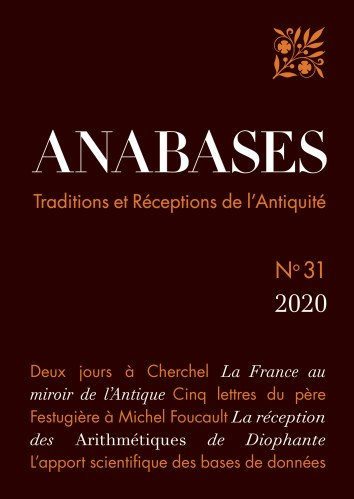
Five letters from père Festugière to Michel Foucault (1956-1957), edited by Pierre Vesperini, Anabases (requires subscription)

Vesperini 2020 - Festugiere FoucaultPierre Vesperini,“« Un gentil mécréant, avec qui l’on entre aussitôt dans le seul monde qui compte »: Cinq lettres du père Festugière à Michel Foucault (1956-1957)”, Anabases 31, 2020, 125-130.

André-Jean Festugière was known to me as the translator of Artemidorus, Onirocritica, which Foucault discusses in the The Care of the Self and the Subjectivity and Truth lectures. I discuss that reading at length in Foucault’s Last Decade. I also knew that in 1956, Foucault invited Festugière to Uppsala to speak at the Maison de France.

Now Pierre Vesperini has published the letters which Festugière sent to Foucault – Foucault’s letters have unfortunately not been found – and they are an interesting insight into an intellectual friendship. Another footnote to The Early Foucault, and an unexpected indication of a line to follow for a future project.

Posted in Michel Foucault, The Early Foucault, Uncategorized | 1 Comment

Lynne Huffer, Foucault’s Strange Eros – Columbia University Press, June 2020

9780231197151Lynne Huffer, Foucault’s Strange Eros – Columbia University Press, June 2020

What is the strange eros that haunts Foucault’s writing? In this deeply original consideration of Foucault’s erotic ethics, Lynne Huffer provocatively rewrites Foucault as a Sapphic poet. She uncovers eros as a mode of thought that erodes the interiority of the thinking subject. Focusing on the ethical implications of this mode of thought, Huffer shows how Foucault’s poetic archival method offers a way to counter the disciplining of speech.

At the heart of this method is a conception of the archive as Sapphic: the past’s remains are, like Sappho’s verses, hole-ridden, scattered, and dissolved by time. Listening for eros across fragmented texts, Huffer stages a series of encounters within an archive of literary and theoretical readings: the eroticization of violence in works by Freud and Eve Kosofsky Sedgwick, the historicity of madness in the Foucault-Derrida debate, the afterlives of Foucault’s antiprison activism, and Monique Wittig’s Sapphic materialism. Through these encounters, Foucault’s Strange Eros conceives of ethics as experiments in living that work poetically to make the present strange. Crafting fragments that dissolve into Sapphic brackets, Huffer performs the ethics she describes in her own practice of experimental writing. Foucault’s Strange Eros hints at the self-hollowing speech of an eros that opens a space for the strange.

In a provocative take on eros as a verb—as erosion of the thinking subject bound by grids of intelligibility that define her identity—Huffer offers the splendid final installment of her Foucault trilogy. Forcefully written with a capacious imagination, this book exemplifies the enviable rewards of a sustained in-depth engagement with Foucault as an ethopoietic thinker.
Rey Chow, author of Not Like a Native Speaker: On Languaging as a Postcolonial Experience

In this innovative and intimate work, Huffer recuperates from the work of Michel Foucault a philosophy of eros with the potential to replace the unduly dominant orders of sexuality. Eros would always be murmuring and calling for various forms of release, including the release of ‘self from self.’ The consequences of eros’ broad scope and elusiveness, are shown to encompasses the full range of Foucault’s work, and to challenging our understanding of freedom, intimacy, passion, ethics, and selfhood.
Penelope Deutscher, author of Foucault’s Futures: A Critique of Reproductive Reason

Foucault’s Strange Eros challenges its readers to describe aptly, to touch delicately their seeking, mortal, embodied selves. The book elicits and sustains their interest. It rejoices on some pages to weep on others, but it is animated throughout by generous reading and creative responding.
Mark Jordan, author of Convulsing Bodies: Religion and Resistance in Foucault

Bowing, bending down, and keeping watch over Foucault’s work, Lynne Huffer listens for Foucault’s Strange Eros and its ethical call. Huffer reads Foucault as a poet, allowing us to hear the discontinuous Sapphic murmur beneath philosophy’s Platonic ground. This is an inspired work of love and a tour de force.
Sverre Raffnsøe, editor in chief of Foucault Studies and author of Michel Foucault: A Research Companion

Foucault’s Strange Eros is a haunting and beautiful book. In this final book in her Foucault trilogy, Lynne Huffer once again returns to the theme of Foucault’s erotic ethics. Drawing on Anne Carson’s new translations and writings on Sappho, she identifies a queer feminist erotic, a non-phallic creative capacity for new relational forms. In this light, Foucault’s genealogies are revealed as rooted in a poignant ethical sensibility—that of a loving and vigilant guardian of the lost ‘little ones’ in the archives, one who uncovers traces of unnecessary and intolerable suffering, and events that did not take place. This is what is meant by thought of the outside—impossible thought, or thoughts and experiences erased and rendered impossible within present conditions of possibility. Thus, Huffer deepens our appreciation of genealogy as an ethical practice of freedom, of eros—a practice that might loosen our attachments to present understandings of self and world—to ways of living that create unnecessary suffering and violence.
Jana Sawicki, Williams College

Thanks to Peter Gratton for the alert.

Posted in Michel Foucault, Uncategorized | Leave a comment

Jennifer Forestal, Menaka Philips (eds.), The Wives of Western Philosophy: Gender Politics in Intellectual Labor – Routledge, January 2021

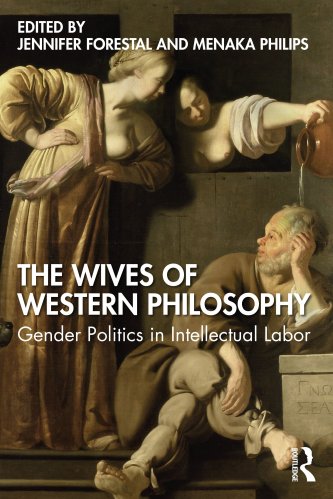
9780367897895Jennifer Forestal, Menaka Philips (eds.), The Wives of Western Philosophy: Gender Politics in Intellectual Labor – Routledge, January 2021
The Wives of Western Philosophy examines the lives and experiences of the wives and women associated with nine distinct political thinkers—from Socrates to Marx—in order to explore the gendered patterns of intellectual labor that permeate the foundations of western political thought.

Organized chronologically and representative of three eras in the history of political thought (Ancient, Early Modern and Modern), nine critical biographical chapters explore the everyday acts of intellectual labor and partnership involving these ‘wives of the canon.’ Taking seriously their narratives as intimate partners reveals that wives have labored in remarkable ways throughout the history of political thought. In some cases, their labors mark the conceptual boundaries of political life; in others, they serve as uncredited resources for the production of political ideas. In all instances, however, these wives and intimates are pushed to the margins of the history of political thought.

The Wives of Western Philosophy brings these women to the center of scholarly interest. In so doing, it provides new insights into the intellectual biographies of some of the most famed men in political theory while also raising important questions about the gendered politics of intellectual labor which shapes our receptions of canonical texts and thinkers, and which sustain the academy even today.

The Wives of Western Philosophy offers a fascinating revisionary history of the women most closely associated with the men who have long dominated the canon of Western political philosophy. By looking at the tradition of Western political thought through the lens of these women’s lives and writings, from Xanthippe to Harriet Taylor Mill, the contributors overturn and challenge the gender biases that have unreflectively pervaded past scholarship and teaching in the field.”

Eileen Hunt Botting, Professor of Political Science, University of Notre Dame

“Abundantly insightful, characterized by an exuberant harmony of purpose and feminist intent, this fresh and inventive collection of essays brings the figure of the “wife” — as thinker, coauthor, concept, and collaborator — out of the shadows cast by heteropatriarchal histories of Western political thought. If you haven’t met the real “wives of political theory” here brought to light, you’ll be thoroughly acquainted by the time you finish this spirited book. The essays are both valuable biographical works that redeem female intellectual labors and illuminating examples of how “reading gender” opens up new ways to understand the production of canonical texts.”

Mary G. Dietz, John Evans Professor of Political Science, Northwestern University

Posted in Uncategorized | Leave a comment

Caitríona Ní Dhúill, Metabiography: Reflecting on Biography – Palgrave, March 2020

Caitríona Ní Dhúill, Metabiography: Reflecting on Biography – Palgrave, March 2020.

Just hardback and e-book at present unfortunately.Ni Dhuill 2020 - Metabiography.jpg

This book explores the contradictions of biography. It charts shifting approaches to the writing and reading of biographies, from post-hagiographical attitudes of the Enlightenment, heroic biographies of Romanticism and irreverent modernist portraits through to contemporary experiments in politically committed and hybrid forms of life writing. The book shows how biographical texts in fact destabilise the models of historical visibility, cultural prominence and narrative coherence that the genre itself seems to uphold. Addressing the fraught relationships between genre and gender, private and public, image and text, life and narrative that play out in the modern biographical tradition, Metabiography suggests new possibilities for reading, writing and thinking about this enduringly popular genre.

Posted in Uncategorized | Leave a comment

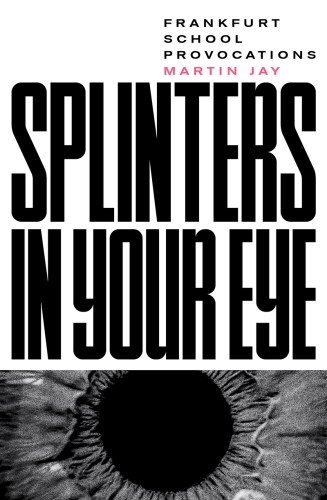
Martin Jay, Splinters in Your Eye: Frankfurt School Provocations – Verso, July 2020, and discussion at New Books Network

9781788736015-a33d49593bf9fd61413ebc7f444e701fMartin Jay, Splinters in Your Eye: Frankfurt School Provocations – Verso, July 2020.

There is a discussion at New Books Network with Ryan Tripp. Thanks to dmf for this link.

Although successive generations of the Frankfurt School have attempted to adapt Critical Theory to new circumstances, the work done by its founding members continues in the twenty-first century to unsettle conventional wisdom about culture, society and politics. Exploring unexamined episodes in the school’s history and reading its work in unexpected ways, these essays provide ample evidence of the abiding relevance of Horkheimer, Adorno, Benjamin, Marcuse, Löwenthal, and Kracauer in our troubled times. Without forcing a unified argument, they range over a wide variety of topics, from the uncertain founding of the School to its mixed reception of psychoanalysis, from Benjamin’s ruminations on stamp collecting to the ironies in the reception of Marcuse’s One-Dimensional Man, from Löwenthal’s role in Weimar’s Jewish Renaissance to Horkheimer’s involvement in the writing of the first history of the Frankfurt School. Of special note are their responses to visual issues such as the emancipation of colour in modern art, the Jewish prohibition on images, the relationship between cinema and the public sphere, and the implications of a celebrated Family of Man photographic exhibition. The collection ends with an essay tracing the still metastasising demonisation of the Frankfurt School by the so-called Alt Right as the source of “cultural Marxism” and “political correctness,” which has gained alarming international resonance and led to violence by radical right-wing fanatics.

“In this sizzling collection of essays, Martin Jay demonstrates again that he is the unsurpassed reader of the group of thinkers known as the “Frankfurt School.” In fact, he challenges the false unity and coherence of ideas and views often imposed upon them, including his own earlier writings on the subject. Practicing episodic and fragmentary historiography, he uncovers astonishingly novel angles of interpretation as well as demonstrating brilliant re-readings of known texts. An absolute pleasure to read”

Posted in Uncategorized, Walter Benjamin | Leave a comment

Francesco Biagi, Henri Lefebvre’s Critical Theory of Space – Palgrave, October 2020

9783030523664Francesco Biagi, Henri Lefebvre’s Critical Theory of Space – Palgrave, October 2020

Just an expensive hardback and not-much-cheaper e-book at present, unfortunately.

Originally published in Italian and translated into English for the first time, Henri Lefebvre’s Critical Theory of Space offers a rigorous analysis and revival of Lefebvre’s works and the context in which he produced them. Biagi traces the historical-critical time-frame of Lefebvre’s intellectual investigations, bringing to light a theoretical constellation in which historical methods intersect with philosophical and sociological issues: from Marxist political philosophy to the birth of urban sociology; from rural studies to urban and everyday life studies in the context of capitalism. Examining Lefebvre’s extended investigations into the urban sphere as well as highlighting his goal of developing a “general political theory of space” and of innovating Marxist thought, and clarifying the various (more or less accurate) meanings attributed to Lefebvre’s concept of the “right to the city” (analysed in the context of the French and international sociological and philosophical-political debate), Henri Lefebvre’s Critical Theory of Spaceultimately brings the contours of Lefebvre’s innovative perspective—itself developed at the end of the “short twentieth century”—back into view in all its richness and complexity.

Posted in Henri Lefebvre, Uncategorized | Leave a comment

Hervé Guibert: Living Without a Vaccine (2020)

?collid=books_covers_0&isbn=9781635901238&type=Introduction to a new edition of Hervé Guibert’s memoir To the Friend Who Did Not Save my Life.

Clare O'Farrell's avatarFoucault News

Andrew Durbin Hervé Guibert: Living Without a Vaccine, New York Review of Books, June 12, 2020,

Adapted from the introduction to a new edition of Hervé Guibert’s To the Friend Who Did Not Save My Life, published by Semiotext(e) / Native Agents and MIT Press.

In 1988 the French novelist and photographer Hervé Guibert was diagnosed with HIV. Two years later, Éditions Gallimard published To the Friend Who Did Not Save My Life, a stark autobiographical book about his desperate effort to gain access to an experimental “AIDS vaccine.” To the Friend made Guibert both wealthy and famous, especially after an appearance on the French TV show Apostrophes.
[…]

The central and most arresting portrait is of Guibert’s mentor, the philosopher Muzil, based on Michel Foucault, whose death the writer repeatedly returns to in the first half of the novel.

Guibert’s gripping revelation, in the…

View original post 149 more words

Posted in Uncategorized | Leave a comment

Jacques Derrida, Geschlecht III: Sex, Race, Nation, Humanity – University of Chicago Press, July 2020

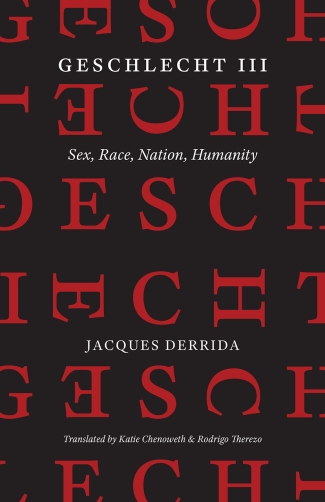
9780226677460Jacques Derrida, Geschlecht III: Sex, Race, Nation, Humanity – University of Chicago Press, July 2020.

Speaking of Derrida, his text Geschlecht III, first published in French in 2018, edited by Geoffrey Bennington, Katie Chenoweth, and Rodrigo Therezo has now been translated by Katie Chenoweth and Rodrigo Therezo.

A significant event in Derrida scholarship, this book marks the first publication of his long-lost philosophical text known only as “Geschlecht III.” The third, and arguably the most significant, piece in his four-part Geschlecht series, it fills a gap that has perplexed Derrida scholars. The series centers on Martin Heidegger and the enigmatic German word Geschlecht, which has several meanings pointing to race, sex, and lineage. Throughout the series, Derrida engages with Heidegger’s controversial oeuvre to tease out topics of sexual difference, nationalism, race, and humanity. In Geschlecht III, he calls attention to Heidegger’s problematic nationalism, his work’s political and sexual themes, and his promise of salvation through the coming of the “One Geschlecht,” a sentiment that Derrida found concerningly close to the racial ideology of the Nazi party.

Amid new revelations about Heidegger’s anti-Semitism and the contemporary context of nationalist resurgence, this third piece of the Geschlecht series is timelier and more necessary than ever. Meticulously edited and expertly translated, this volume brings Derrida’s mysterious and much awaited text to light.


Posted in Jacques Derrida, Martin Heidegger, Uncategorized | 1 Comment

Jacques Derrida, Le Calcul des Langues – Seuil, June 2020 – previously unpublished manuscript, edited by Geoff Bennington and Katie Chenoweth

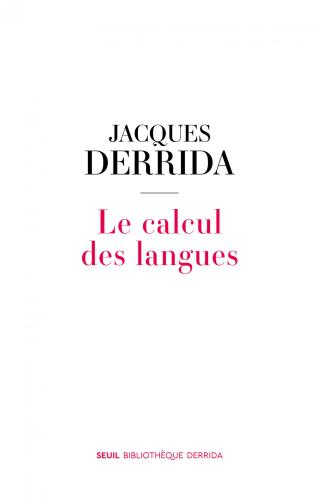
145582_couverture_Hres_0Jacques Derrida, Le Calcul des Langues – Seuil, June 2020

News of a previously unpublished manuscript by Derrida, edited by Geoff Bennington and Katie Chenoweth.

Texte énigmatique et entièrement inédit, Le Calcul des langues marque la première tentative de Jacques Derrida d’écrire un livre en deux colonnes. Annoncé comme ” à paraître ” sur la quatrième de couverture de l’Archéologie du frivole (1973) mais jamais publié du vivant de l’auteur, le tapuscrit de ce projet inachevé fut retrouvé chez Derrida après son décès. La publication posthume de ce texte fort original met au jour un véritable laboratoire typographique où, avant l’écriture de l’un de ses textes les plus célèbres, Glas (1974), Derrida ose couper la page en deux en vue de repenser la relation entre philosophie et écriture.

Poursuivant une réflexion sur les sciences du langage au XVIIIe siècle entamée avec De la grammatologie (1967), Derrida propose ici une lecture en partie double de L’Art d’écrire de Condillac. Mais à la différence de Glas, dont les deux colonnes confrontent un philosophe (Hegel) à un auteur littéraire (Genet), Le Calcul des langues confronte Condillac à lui-même. Si la colonne de gauche propose une exégèse plutôt conventionnelle et méthodologique de L’Art d’écrire, celle de droite divague sans cesse, multipliant les digressions en direction de Freud et d’autres penseurs, à la recherche d’un plaisir de l’écriture qui échapperait à la philosophie.

Lecture de Condillac en deux colonnes, donc, mais aussi en ” deux styles ” comme l’indique le sous-titre (” Distyle “), cet ouvrage tout à fait singulier dans le corpus derridien donne à lire l’une des plus belles expérimentations de l’écriture déconstructrice.


Posted in Jacques Derrida, Uncategorized | 2 Comments

Gilbert Humbert (1928-2020)

A brief obituary of one of the composers Foucault knew in the 1950s.

Clare O'Farrell's avatarFoucault News

Notice nécrologique sur Gilbert Humbert
Patrick Négrier

Gilbert Humbert, né en 1928, et compagnon de Michel Foucault en 1951, est décédé le 14 mai 2020. Ancien élève d’Olivier Messiaën, il eut une vie composite et composante. Composite d’abord en raison du fait qu’il fut successivement ou à la fois un pasteur protestant (1962-67), un militant du parti communiste, un musicien professeur de musique (1955-88) doublé d’un musicologue, et un poète, comme il le dit lui-même dans le poème suivant en se rappelant en 1996 la chambre de bonne qu’il possédait dans le XIXème arrondissement de Paris : « Tu étais au sixième étage et chaque jour on t’offrait le potage. Tu te croyais politicien, musicien, théologien et même un peu poète. Trement dit : un otage. Voilà qu’un jour tu déménages sans deviner qu’arrivera, s’aménageant, te succédant ton premier-né » (« Petit pote, en 1953 » dans Le Disque rayé). De son ministère de…

View original post 1,265 more words

Posted in Uncategorized | Leave a comment