Some open access books and journal article] on Protests, Policing and Race – updated

Some open access books and journal articles on Protests, Policing and Race

Cambridge University Press (until July 12, 2020)

Verso Books (not sure of end date; 40% of other books at present)

Bristol University Press/Policy Press

Update: Taylor & Francis has made some books and articles available here.

will add others if I see them – please add in comments

Update 2:

Update 28 June 2020

Political Geography has some papers open access here.


Posted in Uncategorized | 1 Comment

Two reviews of Shakespearean Territories (University of Chicago Press, 2018) by Sarah Dustagheer and Karen Culcasi

9780226559193Two generous and thoughtful reviews of Shakespearean Territories (University of Chicago Press, 2018)

– Karen Culcasi in Journal of Historical Geography (open access)

– Sarah Dustagheer by Social and Cultural Geography (requires subscription, unfortunately)

Here’s the beginning of the first review:

Stuart Elden’s latest book Shakespearean Territories provides, as the title aptly indicates, an examination of how an expansive corpus of Shakespearean literature and plays dealt with the idea and concept of territory. Elden has been a leader in bringing the complexity of the concept of territory into focus within geography for more than a decade now. Alongside his two other books Terror and Territory (2009) and The Birth of Territory (2013), Shakespearean Territories forms a triad examination into the concept of territory. This triad is an unparalleled accomplishment, providing countless contributions to theorizing territory. [continues here]

and given it requires subscription, most of the second:

Shakespearean Territories is a unique book: an account of Shakespeare’s canon, which offers some insightful literary analysis, written by a professor of political theory and geography. Stuart Elden’s monograph draws on Shakespeare’s plays to examine the political, geographical, economic and legal complexities of the concept and practice of ‘territory’. In doing so, Elden is able to demon- strate what he describes as Shakespeare’s ‘profound political geographical imagination’ (p. 1). Elden is well-placed to undertake such work, having a track record in examining territory in previ- ous monographs, The Birth of Territory and Terror and Territory. However, his aim is not simply to use Shakespeare as an exemplar of previous arguments, but rather to ‘open up news ways of thinking’ and ‘to push [him] further in developing this account of the contested and complicated concept and practice of territory’ (p. 3)…

For the most part, Elden offers in-depth readings of Shakespeare’s language and ideas in chapters that focus on one or two plays. Weaker chapters on colonial territories and measuring territo- ries cover a larger number of plays, rather than focused case studies, and subsequent readings can feel rushed. The balance between the quotation of primary text, secondary criticism and the author’s own analysis is sometimes out of kilter; I was left wanting more of the latter. Yet Elden’s intellec- tual ambition and risk-taking is appealing. He brings into dialogue a wide range of subjects – colonialism, navigation, cartography, military technology – that may well be covered in more detail elsewhere but do benefit from being examined alongside one another. In the book’s ‘Coda’, Elden notes the ‘significant transition’ (p. 240) England undergoes during Shakespeare’s career, which spanned the latter part of Elizabeth I’s reign and the early years of James I’s. Elizabeth and James had different ideas about some of the key concepts Elden examines, colonialism, for instance, and ruled under shifting social and economic circumstances. More of a sense of the nuances between Elizabethan and Jacobean conceptualization of territory would have been welcome throughout the book. Yet, this criticism is perhaps unfair to a book that is groundbreaking in its dual aims of illu- minating Shakespeare’s plays, while also examining territory, a contested, complex and transhistorical concept, and thereby appealing to a wide number of scholarly audiences.

My thanks to Karen and Sarah for their generous engagement with this work.
 

Posted in Shakespearean Territories, Territory, Uncategorized | Leave a comment

Josephat Ezenwajiaku, State Territory and International Law – Routledge, July 2020

9780367353988Josephat Ezenwajiaku, State Territory and International Law – Routledge, July 2020


This book proposes a re-interpretation of Article 2(4) of the Charter of the United Nations to read, or at least include, respect for the inviolability of State territory.

While States purport to obey the prohibition of the Use of Force, they frequently engage in activities that could undermine international peace and security. In this book the author argues that State practice, opinio juris, as well as contentious and advisory opinions of the International Court of Justice, have promoted the first limb of Article 2(4). Although wars between States have decreased, the maintenance of international peace and security remains a mirage, as shown by the increase in intra- and inter-State conflicts across the world. The author seeks to initiate a rethinking of the provision of Article 2(4), which the International Court of Justice has described as the cornerstone of the United Nations. The author argues that the time is ripe for States to embrace an evolutive interpretation of Article 2(4) to mean respect, as opposed to the traditional view of the threat, or the use, of force. He also evaluates the discourse regarding territorial jurisdiction in cyberspace and argues that the efforts made by the international community to apply Article 2(4) to cyberspace suggest that the article is a flexible and live instrument that should be adjusted to address the circumstances that endanger international peace and security.

This book will engineer a serious debate regarding the scope of Article 2(4), which before now has always been limited to the threat or use of force. As a result, it will be of interest to academics and students of public international law, as well as diplomats and policymakers.

Available as expensive hardback and cheaper (though not cheap) e-book.

Posted in Territory, Uncategorized | 3 Comments

Richard J. King, Ahab’s Rolling Sea: A Natural History of Moby Dick – University of Chicago Press, November 2019

9780226514963Richard J. King, Ahab’s Rolling Sea: A Natural History of Moby Dick – University of Chicago Press, November 2019

Missed this when it came out, but looks a very interesting study of a great novel.

Although Herman Melville’s Moby-Dick is beloved as one of the most profound and enduring works of American fiction, we rarely consider it a work of nature writing—or even a novel of the sea. Yet Pulitzer Prize–winning author Annie Dillard avers Moby-Dick is the “best book ever written about nature,” and nearly the entirety of the story is set on the waves, with scarcely a whiff of land. In fact, Ishmael’s sea yarn is in conversation with the nature writing of Emerson and Thoreau, and Melville himself did much more than live for a year in a cabin beside a pond. He set sail: to the far remote Pacific Ocean, spending more than three years at sea before writing his masterpiece in 1851.

A revelation for Moby-Dick devotees and neophytes alike, Ahab’s Rolling Sea is a chronological journey through the natural history of Melville’s novel. From white whales to whale intelligence, giant squids, barnacles, albatross, and sharks, Richard J. King examines what Melville knew from his own experiences and the sources available to a reader in the mid-1800s, exploring how and why Melville might have twisted what was known to serve his fiction. King then climbs to the crow’s nest, setting Melville in the context of the American perception of the ocean in 1851—at the very start of the Industrial Revolution and just before the publication of On the Origin of Species. King compares Ahab’s and Ishmael’s worldviews to how we see the ocean today: an expanse still immortal and sublime, but also in crisis. And although the concept of stewardship of the sea would have been entirely foreign, if not absurd, to Melville, King argues that Melville’s narrator Ishmael reveals his own tendencies toward what we would now call environmentalism.

Featuring a coffer of illustrations and an array of interviews with contemporary scientists, fishers, and whale watch operators, Ahab’s Rolling Sea offers new insight not only into a cherished masterwork and its author but also into our evolving relationship with the briny deep—from whale hunters to climate refugees.

Posted in Uncategorized | Leave a comment

Frédéric Keck, Avian Reservoirs: Virus Hunters and Birdwatchers in Chinese Sentinel Posts – Duke University Press, January 2020

Updated with a link to a review.

stuartelden's avatarProgressive Geographies

978-1-4780-0698-5_prFrédéric Keck, Avian Reservoirs: Virus Hunters and Birdwatchers in Chinese Sentinel Posts – Duke UP, January 2020

I’d missed this when it came out early this year, so thanks to Sebastien Nobert for the link. Clearly written some time ago, but especially timely at the moment.

Update: there is a review at LSE Review of Books by Justin Lau.

After experiencing the SARS outbreak in 2003, Hong Kong, Singapore, and Taiwan all invested in various techniques to mitigate future pandemics involving myriad cross-species interactions between humans and birds. In some locations microbiologists allied with veterinarians and birdwatchers to follow the mutations of flu viruses in birds and humans and create preparedness strategies, while in others, public health officials worked toward preventing pandemics by killing thousands of birds. In Avian Reservoirs Frédéric Keck offers a comparative analysis of these responses, tracing how the anticipation of bird flu pandemics has changed relations…

View original post 216 more words

Posted in Uncategorized | Leave a comment

Forensic Architecture reconstruction of 2011 Mark Duggan shooting

Forensic Architecture reconstruction of 2011 Mark Duggan shooting

905459575_1920x1080

Their own webpage is here; see also the report in The Guardian

As the report says, “FA’s work on the case will feature in an exhibition on police violence in London curated by activist group Tottenham Rights, at the Institute of Contemporary Arts in autumn 2020”.


Posted in Uncategorized | Leave a comment

David Lambert and Peter Merriman (eds.), Empire and mobility in the long nineteenth century – Manchester University Press, June 2020
9781526126382David Lambert and Peter Merriman (eds.), Empire and mobility in the long nineteenth century – Manchester University Press, June 2020

Mobility was central to imperialism, from the human movements entailed in exploration, travel and migration to the information, communications and commodity flows vital to trade, science, governance and military power. While historians have written on exploration, commerce, imperial transport and communications networks, and the movements of slaves, soldiers and scientists, few have reflected upon the social, cultural, economic and political significance of mobile practices, subjects and infrastructures that underpin imperial networks, or examined the qualities of movement valued by imperial powers and agents at different times. This collection explores the intersection of debates on imperial relations, colonialism and empire with emerging work on mobility. In doing this, it traces how the movements of people, representations and commodities helped to constitute the British empire from the late-eighteenth century through to the Second World War.

Currently only available as an expensive hardback, unfortunately.

Posted in Uncategorized | Leave a comment

‘Thinking with Soils: Material Politics and Social Theory’ and ‘Conceiving Soils and Humans in the Anthropocene’

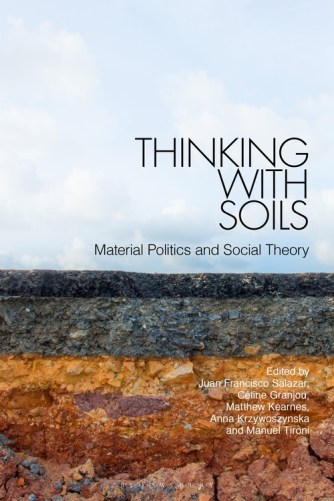
9781350109599Juan Francisco Salazar, Céline Granjou, Matthew Kearnes, Anna Krzywoszynska, Manuel Tironi (eds.), Thinking with Soils: Material Politics and Social Theory – Bloomsbury, June 2020

This book presents a novel and systematic social theory of soil, and is representative of the rising interest in ‘the material’ in social sciences. Bringing together new modes of ‘critical description’ with speculative practices and methods of inquiry, it contributes to the exploration of current transformations in socioecologies, as well as in political and artistic practices, in order to address global ecological change.

The chapters in this edited volume challenge scholars to attend more carefully to the ways in which they think about soil, both materially and theoretically. Contributors address a range of topics, including new ways of thinking about the politics of caring for soils; the ecological and symbiotic relations between soils; how the productive capacities and contested governance of soils are deployed as matters of political concern; and indigenous ways of knowing and being with soil.

m_coverimageThis is another expensive hardback unfortunately. Some of the same contributors are part of a theme section of Environmental Humanities on ‘Conceiving Soils and Humans in the Anthropocene’, edited by Anna Krzywoszynska and Greta Marchesi.

Those papers seem to be open access, including the introduction “Towards a Relational Materiality of Soils“.

Posted in Uncategorized | Leave a comment

Geographers, sociologists, philosophers etc. on covid-19 – list updated, including some pieces on the future of universities

Geographers, sociologists, philosophers etc. on covid-19 – this list continues to be updated, though more sporadically. Particularly recent updates include some pieces on the future of universities.

Posted in Uncategorized | 1 Comment

Domenico Losurdo, Nietzsche: The Aristocratic Radical – Historical Materialism series, Brill 2019; Haymarket November 2020

9789004270954Domenico Losurdo, Nietzsche: The Aristocratic Radicalhardback Brill 2019; paperback Haymarket November 2020

Good to see news of the forthcoming paperback publication of this major study.

Translated by Gregor Benton. With an Introduction by Harrison Fluss.

Perhaps no philosopher is more of a conundrum than Nietzsche, the solitary rebel, poet, wayfarer, anti-revolutionary Aufklärer and theorist of aristocratic radicalism. His accusers identify in his ‘superman’ the origins of Nazism, and thus issue an irrevocable condemnation; his defenders pursue a hermeneutics of innocence founded ultimately in allegory. In a work that constitutes the most important contribution to Nietzschean studies in recent decades, Domenico Losurdo instead pursues a less reductive strategy. Taking literally the ruthless implications of Nietzsche’s anti-democratic thinking – his celebration of slavery, of war and colonial expansion, and eugenics – he nevertheless refuses to treat these from the perspective of the mid-twentieth century. In doing so, he restores Nietzsche’s works to their complex nineteenth-century context, and presents a more compelling account of the importance of Nietzsche as philosopher than can be expected from his many contemporary apologists.

Originally published in Italian by Bollati Boringhieri Editore as Domenico Losurdo, Nietzsche, il ribelle aristocratico: Biografia intellettuale e bilancio critico, Turin, 2002.

Full details including Table of Contents here.

Update: there is a review essay in Historical Materialism.

Update 2: there is a review at Marx and Philosophy

Update 3: and a discussion at the New Books Network

Posted in Friedrich Nietzsche, Uncategorized | 2 Comments