
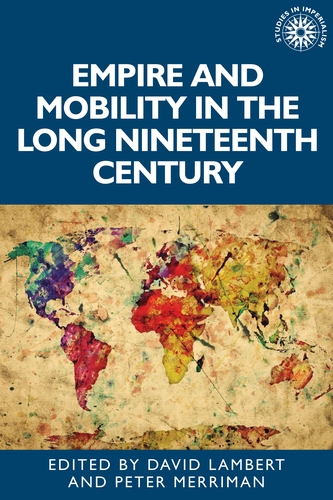
 David Lambert and Peter Merriman (eds.), Empire and mobility in the long nineteenth century – Manchester University Press, June 2020
Mobility was central to imperialism, from the human movements entailed in exploration, travel and migration to the information, communications and commodity flows vital to trade, science, governance and military power. While historians have written on exploration, commerce, imperial transport and communications networks, and the movements of slaves, soldiers and scientists, few have reflected upon the social, cultural, economic and political significance of mobile practices, subjects and infrastructures that underpin imperial networks, or examined the qualities of movement valued by imperial powers and agents at different times. This collection explores the intersection of debates on imperial relations, colonialism and empire with emerging work on mobility. In doing this, it traces how the movements of people, representations and commodities helped to constitute the British empire from the late-eighteenth century through to the Second World War.
Currently only available as an expensive hardback, unfortunately.
 Juan Francisco Salazar, Céline Granjou, Matthew Kearnes, Anna Krzywoszynska, Manuel Tironi (eds.),
  This is another expensive hardback unfortunately. Some of the same contributors are part of a theme section of Environmental Humanities on ‘
 Domenico Losurdo, Nietzsche: The Aristocratic Radical –

 I was very sorry to hear of the death of

 Romanic Review theme issue: – “
 Cat Moir,
