Marlon Salomon, Obituary, François Delaporte (1941 – 2019)

An obituary for François Delaporte from last year.

Clare O'Farrell's avatarFoucault News

Marlon Salomon, Obituary, François Delaporte (1941 – 2019)
Transversal: International Journal for the Historiography of Science (6) 2019: 115-123

DOI: 10.24117/2526-2270.2019.i6.11

On the 28th of May, the French philosopher and historian of sciences, François Delaporte died in Amiens at the age of 78. He was an emeritus professor at the Université de Picardie Jules Verne (UPJV). His death is an irreparable loss to the philosophy and historiography of the sciences.
[…]

From 1966, Delaporte began to regularly attend Canguilhem’s courses, and soon after in May of 1968, he began his master’s studies under his professor’s guidance. Two years later, he presented his master’s dissertation, on issues surrounding the notion of vegetality in the eighteenth century.

Delaporte then started to work on a doctoral thesis (troisième cycle). Georges Canguilhem, however, could no longer advise him, since he would retire in 1971, so Canguilhem asked Michel Foucault, who used to attend the…

View original post 394 more words

Posted in Uncategorized | Leave a comment

Two new Sloterdijk translations from Polity – After God and Infinite Mobilisation

Two new Sloterdijk translations from Polity – After God, translated by Ian Alexander Moore, and Infinite Mobilisation, translated by Sandra Berjan.

agHere’s the press description for After God.

In his Critique of Cynical Reason, Peter Sloterdijk pursued an enlightenment of the Enlightenment in both its beginnings and the present. After God is dedicated to the theological enlightenment of theology. It ranges from the period when gods reigned, through the rule of the world-creator god to reveries about the godlike power of artificial intelligence. The path of this self-enlightening theology, which is carried out here by a non-theologian, must begin well before Nietzsche’s declaration of the death of God, and it must move beyond this dictum to explore the present and the future.

Since the early 20th century we have seen how the metaphysical twilight of the gods, which has preoccupied philosophers and theologians, has been accompanied by an earthly twilight of the souls.  The emergence of psychoanalysis, and more recently the development of the neuro-cognitive sciences, have secularized the old Indo-European concept of the soul and transferred many accomplishments of the human mind to computerized machines.  What remains of the eternal light of the soul after the artificial lights have been turned on?  Have the inventors of AI thrust themselves into the position vacated by the death of god?  Perhaps the distinction between God and idols will soon re-emerge here for the citizens of modernity, only this time in a technological and political register. For them, theological enlightenment – which is completely different from an instinctive rejection of religion – will be a fateful task.

This new work by one of the most original thinkers today will appeal to students and scholars across the humanities and social sciences, as well as anyone interested in religion, philosophy and critical theory today.
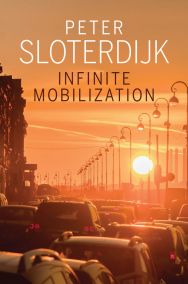
imand for Infinite Mobilization:

The core of what we refer to as ‘the project of modernity’ is the idea that human beings have the power to bring the world under their control, and hence it is based on a ‘kinetic utopia’: the movement of the world as a whole reflects the implementation of our plans for it.  

But as soon as the kinetic utopia of modernity is exposed, its seemingly stable foundation cracks open and new problems appear: things don’t happen according to plan because as we actualize our plans, we set in motion other things that we didn’t want as unintended side-effects. We watch with mounting unease as the self-perpetuating side-effects of modern progress overshadow our plans, as a foreign movement breaks off from the very core of the modern project supposedly guided by reason and slips away from us, spinning out of control. What looked like a steady march towards freedom turns out to be a slide into an uncontrollable and catastrophic syndrome of perpetual mobilization. And precisely because so much comes about through our actions, these developments turn out to have explosive consequences for our self-understanding, as we begin to realize that, so far from bringing the world under our control, we are instead the agents of our own destruction.

In this brilliant and insightful book Sloterdijk lays out the elements of a new critical theory of modernity understood as a critique of political kinetics, shifting the focus of critical theory from production to mobilization and shedding new light on a world facing the growing risk of humanly induced catastrophe.

My reading guide is here – Where to start with reading Peter Sloterdijk? It’s out-of-date in terms of recent English translations, and could use some updating. I’ll try to do that soon. Update: I’ve added in the last few English translations here. Let me know if I’ve missed any.

Update 2: Thanks to Kai Frederick Lorentzen for the alert that After God is not a new book in German, but a compilation of texts, with one new chapter. See the German discussion here. And to clear up any confusion, Infinite Mobilization is a translation of the German text Eurotaoismus.

Posted in Peter Sloterdijk, Uncategorized | 1 Comment

Historicizing Foucault: Stuart Elden on Tracing Foucault’s Ideas from Discipline and Punish to the History of Sexuality

Elden-9Historicizing Foucault: Stuart Elden on Tracing Foucault’s Ideas from Discipline and Punish to the History of Sexuality – part 1 of a longer interview at the Journal of History of Ideas blog, conducted earlier this month. My thanks to Anne Schult and Jonas Knatz for the invitation to do this and some interesting questions. Part 2 is here.


Stuart Elden is Professor of Political Theory and Geography at University of Warwick. His publication series on Foucault includesFoucault’s Last Decade (Polity, 2016),Foucault: The Birth of Power (Polity, 2017), The Early Foucault (Polity, forthcoming), and The Archaeology of Foucault (Polity, forthcoming). Beyond Foucault, he most recently authoredShakespearean Territories (University of Chicago Press, 2018) andCanguilhem (Polity, 2019). He runs a blog at www.progressivegeographies.com.

Jonas Knatz is a PhD Student in New York University’s History Department. He works on 20th century European intellectual history.

Anne Schult a PhD Candidate in New York University’s History Department. Her current research focuses on the intersection of migration, law, and demography in 20th-century Europe.

Part 1 continues here; part 2 is here.

Posted in Books, Foucault's Last Decade, Foucault: The Birth of Power, Michel Foucault, Shakespearean Territories, The Archaeology of Foucault, The Early Foucault, Theory, Uncategorized | 1 Comment

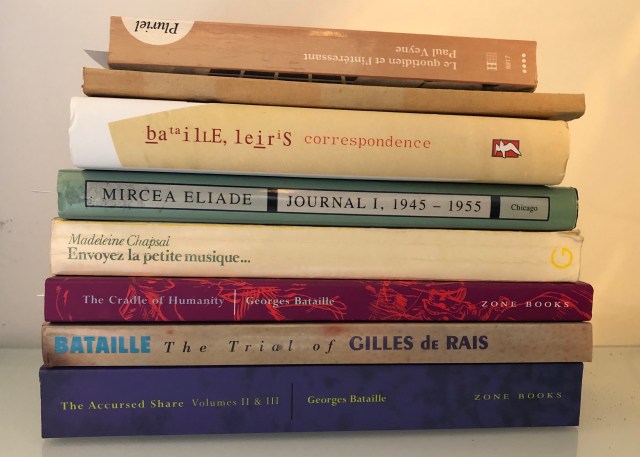
Books received – Veyne, Dumézil, Bataille & Leiris, Eliade, Chapsal

IMG_3249 copy

Trying to keep second-hand booksellers in business… a pile of recently bought books, including Paul Veyne’s memoirs, the English translation of the Bataille-Leiris correspondence, the first volume of Mircea Eliade’s journals, a collection of interviews by Madeleine Chapsal, and some more Bataille translations for the bibliography project.

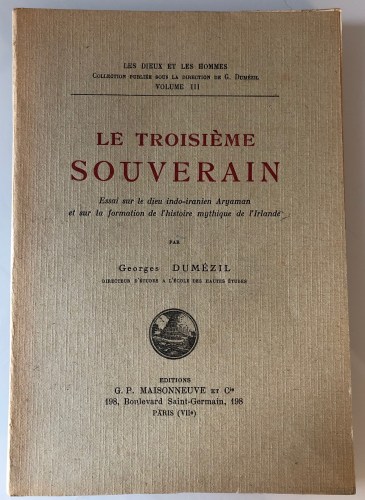
IMG_3250The book with the unmarked spine is perhaps the most intriguing, certainly in terms of its provenance. It’s a copy of Georges Dumézil’s 1949 book Le troisième souverain, which compares Indo-Iranian and Irish myth. According to a stamp in the book, and the bookseller’s description, this was one of the copies owned by Dumézil himself, sold in the auction of his library at the end of 1987.  While it’s nice to have that copy, it’s a bit sad to think his library was scattered in that way. I know some of it was donated to the Bibliothèque interuniversitaire des langues orientales in Paris. But unlike other thinkers such as Derrida at Irvine, Canguilhem at the ENS, Gillian Rose at Warwick, or (in part) Foucault at Yale, it’s unfortunate there isn’t a single place where his books can be consulted.
 

Posted in Georges Bataille, Georges Dumézil | Leave a comment

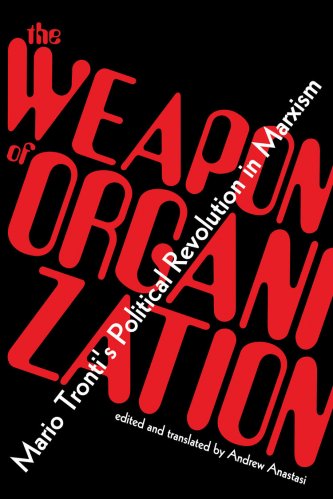
Mario Tronti, The Weapon of Organization: Mario Tronti’s Political Revolution in Marxism, edited and translated by Andrew Anastasi – Common Notions, September 2020

image-assetMario Tronti, The Weapon of Organization: Mario Tronti’s Political Revolution in Marxism, edited and translated by Andrew Anastasi – Common Notions, September 2020

Never before translated texts powerfully present Italian autonomist Marxist Mario Tronti’s resonance with contemporary questions of revolutionary organization.

Mario Tronti was the principal theorist of the radical political movement of the 1960s known in Italy as operaismo and in the Anglophone world as Italian workerism, a current which went on to inform the development of autonomist Marxism. His “Copernican revolution”—the proposal that working class struggles against exploitation propel capitalist development, which can only be understood as a reaction that seeks to harness this antagonism—has inspired dissident leftists around the world.

Tronti’s influence as a theorist thus already reaches far beyond Italy to activists and writers working in different sectors on different problems historically and geographically. While his imposing and acclaimed Workers and Capital has only recently appeared in English translation, Tronti has influenced many of the most creative social and political theorists of our time.

Antonio Negri and Michael Hardt have long acknowledged the influence of Tronti on their thinking, drawing especially on his inversion of strategy and tactics in their influential collaborations. Tronti’s work in the 1960s also furnished important building blocks for a Marxist feminist critique of unwaged labor—as developed by Mariarosa dalla Costa, Silvia Federici, and many others working on social reproduction theory—as Tronti showed how capitalist control extends beyond the factory to all of society. Fred Moten and Stefano Harney have echoed Tronti’s calls for a radical antagonism “within and against” institutions and the state.

The Weapon of Organization is a crucial introduction to Tronti, presenting a variety of never-before-translated texts—personal letters, public talks, published articles. With an incisive and provocative introduction that situates Tronti and highlights his relevance to contemporary political struggle, Anastasi translates and restores key writing from the birth of Italian operaismo—days of street fighting and theorizing for a renewed age of revolution. Tronti’s goal, Anastasi writes, was not to become a revered thinker but to participate in the destruction of capitalist society.


Posted in Uncategorized | 1 Comment

Samantha Rose Hill, Where to start with Hannah Arendt’s work

The whole thread is worth reading.

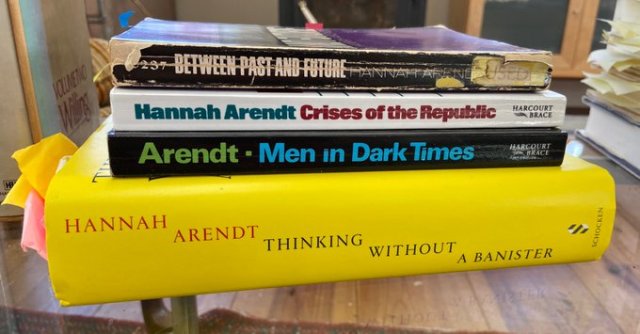
People often ask me where they should start with Hannah Arendt’s work. These are my most common suggestions.

For those who want a taste before committing to the longer works:

Politics: Crises

Theory: Between Past & Future

A sense of Arendt: Men in Dark Times

Overview: Thinking

ESW1i0fX0AEcjNP

Posted in Hannah Arendt, Uncategorized | Leave a comment

Christopher Watkin, “So you want to read Michel Serres? Start here”

9781474405744A very useful reading guide from Christopher Watkin, author of the recently published Michel Serres: Figures of Thought from Edinburgh University Press.

I recently received an email from someone wanting to get into Michel Serres’s writing in English translation, and asking where to start. Here are some thoughts, to which I hope to add over time. The suggestions of primary and secondary material below are not meant tobe exhaustive, but to provide a jumping off point for people coming to Serres’s work for the first time, or wanting to dive deeper into his thought. If you think I’ve missed anything important, drop me an email or post a comment below.

Summary. Where should I start?

If you want five key publications that will give you as near as possible the full “Serres package” in English translation, here’s what I would read: 1) Hermes: Literature, Science, Philosophy, 2) The Birth of Physics, 3) The Parasite, 4) The Five Senses, 5) The Natural Contract.

More here.

Posted in Michel Serres, Uncategorized | Leave a comment

Georges Bataille’s Oeuvres complètes and English translations – addition of Vols I and II to the list

I’ve done some further updating to the list of works in Georges Bataille’s Oeuvres complètes and other French collections and the English translations.

The main work is the list of articles in Volume I, and the posthumous texts of Volume II, have now been added. This took some work, and as before, I am sure I have missed some translations, especially in journals. There are two or sometimes three translations of some texts, and others don’t seem to have been translated at all. It’s largely unsystematic for the short pieces – one of the reasons why I hope what I’ve done is helpful.

This work is still in progress – I have a draft of the post-war articles in Volume XI and some notes on those in Volume XII. I’ll add these soon, hopefully.

There remain two texts in English where I’ve not yet been able to identify the French source.

  • “Sacrifice”, October 36, 61-74 – there are texts with this title in Vols I and II, but not this text (from 1939-40)
  • “Notes on the Publication of ‘Un Cadavre’”, The Absence of Myth, 30-33 (c. 1929 or 1930?) [Update: I’ve now located the original French of this text, which was published as “La publication d’«Un Cadavre» (15 janvier 1930)”, Le Pont de l’Épée 41, 1969, 141-45; partially included in the notes to Oeuvres Vol XI, 571-72; and the full text reprinted in Georges Bataille and Michel Leiris, Echanges et correspondence, edited by Louis Yvert, Paris: Gallimard, 2004, 73-80. It is also translated as “The Publication of ‘A Corpse’ (15 January 1930)”, in Georges Bataille and Michel Leiris, Correspondence, translated by Liz Heron, London: Seagull, 2008, 63-69.]

Any help on the first of these, or additions and corrections to the main listing, would be much appreciated.

Bataille in English


Posted in Georges Bataille, Uncategorized | 3 Comments

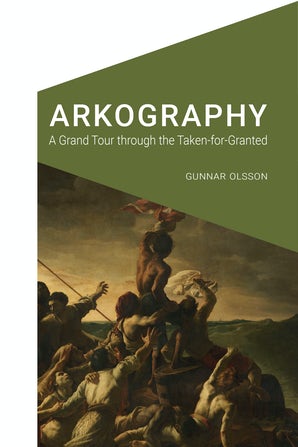
Gunnar Olsson, Arkography: A Grand Tour through the Taken-for-Granted – University of Nebraska Press, May 2020

9781496219473Gunnar Olsson, Arkography: A Grand Tour through the Taken-for-Granted – University of Nebraska Press, May 2020

In this fascinating text Gunnar Olsson tells the story of an arkographer, who with Pallas Athene’s blessings, travels down the Red River Valley, navigates the Kantian Island of Truth, and takes a house-tour through the Crystal Palace, the latter edifice an imagination grown out of Gunnael Jensson’s sculpture Mappa Mundi Universalis. This travel story carries the arkographer from the oldest creation epics extant to the power struggles of today—nothing less than a codification of the taken-for-granted, a mapping of the no-man’s-land between the five senses of the body and the sixth sense of culture. By constantly asking how we are made so obedient and predictable, the explorer searches for the present-day counterparts to the biblical ark, the chest that held the commandments and the rules of behavior that came with them—hence the term “arkography,” a word hinting at an as-yet-unrecognized discipline.

In Arkography Olsson strips bare the governing techniques of self-declared authorities, including those of the God of the Old Testament and countless dictators, the latter supported by a horde of lackeys often disguised as elected representatives and governmental functionaries. From beginning to end, Arkography is an illustration of how every creation epic is a variation on the theme of chaos turning into cosmic order. A palimpsest of layered meanings, a play of things and relations, identity and difference. One and many, you and me.

This book is a significant contribution to what might be configured as the meeting points between academic geography, Western philosophy, critical social science, and arts-humanistic experimentation. It is the major reference point, the go-to source, for anyone wishing to familiarize themselves with the extraordinarily rich arc of Olsson’s thinking over the past four-plus decades.”—Christopher Philo, professor of geography at the University of Glasgow

“Olsson continues to be an exciting thinker because he situates key problems within the field of geography in the broader contexts of Western humanism. . . . A fun, weird, inspiring, and engaging theoretical work. . . . It is a fascinating contribution that will likely be viewed as the capstone work of a major thinker.”—Keith Woodward, assistant professor of geography at the University of Wisconsin–Madison

Posted in Gunnar Olsson, Uncategorized | 2 Comments

Joseph Pugliese, Biopolitics of the More-Than-Human: Forensic Ecologies of Violence – Duke University Press, November 2020

dup_imagena_prJoseph Pugliese, Biopolitics of the More-Than-Human: Forensic Ecologies of Violence – Duke University Press, November 2020

News from Derek Gregory of what sounds like a really interesting and important book.

In Biopolitics of the More-Than-Human Joseph Pugliese examines the concept of the biopolitical through a nonanthropocentric lens, arguing that more-than-human entities—from soil and orchards to animals and water—are actors and agents in their own right with legitimate claims to justice. Examining occupied Palestine, Guantánamo, and sites of US drone strikes in Afghanistan, Pakistan, Somalia, and Yemen, Pugliese challenges notions of human exceptionalism by arguing that more-than-human victims of war and colonialism are entangled with and subject to the same violent biopolitical regimes as humans. He also draws on Indigenous epistemologies that invest more-than-human entities with judicial standing to appeal for an ethico-legal framework that will enable the realization of ecological justice. Bringing the more-than-human world into the purview of justice, Pugliese makes visible the ecological effects of human war that would otherwise remain outside the domains of biopolitics and law.

Praise

“A mesmerizing exploration of the more-than-human dimensions of later modern war that is never less than deeply human. Linguistically inventive, analytically sobering—you keep wondering why it has taken us so long to see like this—Joseph Pugliese’s vision of forensic ecology initiates an arrestingly novel critique of military violence. At once profoundly political and deeply ethical, this is a magnificently vital achievement.” — Derek Gregory, Peter Wall Distinguished Professor and Professor of Geography, University of British Columbia

“Joseph Pugliese’s reconfiguration of biopolitics does not simply take the politics of populations and life and extend its range to include the more than human; the very threshold between the human and ‘other’ lifeforms falls away. What is revealed is a new political-legal ethics entirely: not a question of how ‘we’ humans grant rights to others, but of how the more-than-human offers itself as an imperative to rethink the anthropocentrism of European law. Exploring indigenous and non-Western cosmologies provides a way to think about life, value, and politics that does not rely on the dignity of the human and its concomitant violence for all that is other than human. It’s rare to read a book that combines such theoretical dexterity with fascinating empirical analysis of some of our most pressing ethical issues.” — Claire Colebrook, author of Death of the PostHuman: Essays on Extinction

Posted in Uncategorized | Leave a comment