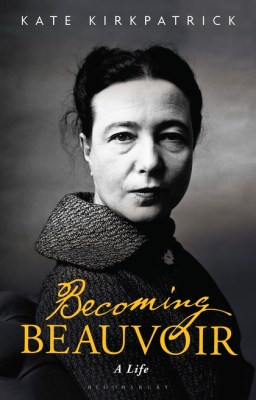
Kate Kirkpatrick, Becoming Beauvoir: A Life – Bloomsbury, 2019 (and short piece in The Guardian)

9781350047174.jpgKate Kirkpatrick, Becoming Beauvoir: A Life – Bloomsbury, 2019

“One is not born a woman, but becomes one”, Simone de Beauvoir

A symbol of liberated womanhood, Simone de Beauvoir’s unconventional relationships inspired and scandalised her generation. A philosopher, writer, and feminist icon, she won prestigious literary prizes and transformed the way we think about gender with The Second Sex. But despite her successes, she wondered if she had sold herself short.

Her liaison with Jean-Paul Sartre has been billed as one of the most legendary love affairs of the twentieth century. But for Beauvoir it came at a cost: for decades she was dismissed as an unoriginal thinker who ‘applied’ Sartre’s ideas. In recent years new material has come to light revealing the ingenuity of Beauvoir’s own philosophy and the importance of other lovers in her life.

This ground-breaking biography draws on never-before-published diaries and letters to tell the fascinating story of how Simone de Beauvoir became herself.

Short piece in The Guardian – Was Simone de Beauvoir as feminist as we thought?

Update: good piece on the book in The New Statesman

Posted in Simone de Beauvoir, Uncategorized | Leave a comment

Warwick IAS WIRL-COFUND 2 year early career fellowships

The Institute of Advanced Study (IAS) at the University of Warwick is pleased to announce that up to five fellowships will be available in 2019 as part of the Warwick Interdisciplinary Research Leadership programme (WIRL-COFUND). The WIRL-COFUND fellowships are jointly funded by the University of Warwick and the European Union through the Marie Skłodowska Curie COFUND scheme (Grant Agreement 713548). The fellowships will provide the opportunity for outstanding early career researchers from around the world to spend two years at Warwick, developing their independent research and undertaking training which will help them develop into the next generation of research leaders.

These two-year fellowships will offer successful applicants the opportunity to accelerate their research careers by developing their own independent research ideas in a world-leading research environment whilst undertaking a specific programme of advanced training delivered through the IAS Academic Careers and Leadership Programme.

Five 2-year independent Fellowships will be available to outstanding early career researchers, with successful candidates starting in September 2020.

Candidates are strongly encouraged to be in contact with host academic departments and mentors prior to applying.

Applications will be accepted from 1 October to 30 November 2019. Full details of the scheme can be found at www.warwick.ac.uk/wirl

Posted in Uncategorized | Leave a comment

Two four-year post-doctoral positions, University of Warwick – ‘Neoliberal Terror: The Radicalisation of Social Policy in Europe’

The Department of Politics and International Studies at the University of Warwick have two post-doctoral positions available, and seek your help sharing the vacancies.  Each post-doc has a fixed four-year term of employment, working on the European Research Council funded project ‘Neoliberal Terror: The Radicalisation of Social Policy in Europe’. This project investigates the political, economic and discursive mechanisms which have brought counterterrorism into European health and social care sectors. Doctors, nurses and social care professionals are now responsible for noticing, checking and sharing signs of radicalisation as part of national terrorism prevention programs. The project tests the hypothesis that neoliberalism contextualises and influences the diffusion of Countering Violent Extremism policies.

The closing date for both positions is the 31st October.

The qualitative position is centred around a large discourse analysis of European policies, speeches and instruments relating to CVE (Countering Violent Extremism), but will also involve some research interviews with practitioners. The vacancy can be found here.

The quantitative position is centred around building an index of CVE expansion across European nations, then performing a regression analysis to test the association between CVE expansion and neoliberal social/economic indicators. The vacancy can be found here.

For further information, please contact Dr Charlotte Heath-Kelly at C.Heath-Kelly@warwick.ac.uk

Posted in Uncategorized | Leave a comment

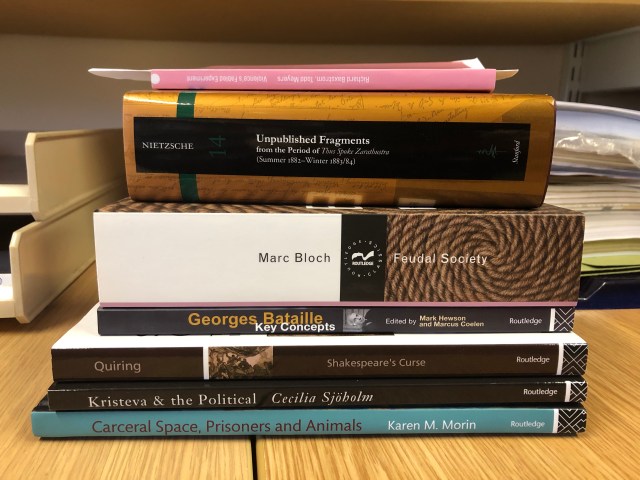
Books received – Baxstrom & Meyers, Nietzsche, Bloch, Bataille, Quiring, Sjöholm, Morin

books.jpg

Richard Baxstrom & Todd Meyers, Violence’s Failed Experiment; Friedrich Nietzsche, Unpublished Fragments from the Period of Thus Spoke Zarathustra; Marc Bloch, Feudal Society; Mark Hewson and Marcus Coelen, Georges Bataille: Key Concepts; Björn Quiring, Shakespeare’s Curse; Cecilia Sjöholm, Kristeva and the Political; and Karin M. Morin, Carceral Space, Prisoners and Animals. Richard and Todd kindly sent a copy of their book and the others were recompense for review work.

Posted in Friedrich Nietzsche, Georges Bataille, Julia Kristeva, Uncategorized, William Shakespeare | 1 Comment

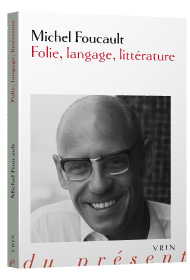
Michel Foucault, Folie, langage, littérature (2019)

Michel Foucault, Folie, langage, literature – the latest in this series from Vrin, making available a number of previously unpublished lectures from the archive.

Clare O'Farrell's avatarFoucault News

Michel Foucault, Folie, langage, littérature
Édition établie par H.-P. Fruchaud, D. Lorenzini et J. Revel. Introduction par J. Revel. Vrin 2019

La folie, le langage et la littérature ont longtemps occupé une place centrale dans la pensée de Michel Foucault. Quels sont le statut et la fonction du fou dans nos sociétés « occidentales », et en quoi se différencient-t-ils de ce qu’ils peuvent être dans d’autres sociétés? Mais également : quelle étrange parenté la folie entretient-elle avec le langage et la littérature, qu’il s’agisse du théâtre baroque, du théâtre d’Artaud ou de l’œuvre de Roussel? Et, s’il s’agit de s’intéresser au langage dans sa matérialité, comment l’analyse littéraire s’est-elle elle-même transformée, en particulier sous l’influence croisée du structuralisme et de la linguistique, et dans quelle direction évolue-t-elle?

Les conférences et les textes, pour la plupart inédits, réunis ici illustrent la manière dont, à partir des années 1960 et pendant…

View original post 61 more words

Posted in Uncategorized | Leave a comment

New issue of Radical Philosophy published

rp205_cover-565x800.jpgThe new Radical Philosophy issue is now online, with a dossier in memoriam of Sabah Mahmood, and contributions by Angela Davis, Elsa Dorlin, Gayatri Chakravorty Spivak and many others.

Open access here – https://www.radicalphilosophy.com

Posted in Uncategorized | Leave a comment

New issue of New Perspectives published

New issue of New Perspectives published – open access

Editorial

1. Looking. Again.

Benjamin Tallis

Essay

James Der Derian
2. A Quantum of Insecurity

Research Articles

Julia Bethwaite & Anni Kangas
3. Parties, Pavilions and Protests: The Heteronomous World Politics of the Russian Pavilion at the Venice Biennale

József Golovics

4. Addressing the EU’s East-West Brain Drain: Why a Tax Solution Would Be in Vain

Forecast

5. Russia and the World: IMEMO Forecast 2019

Forum

6. Publicism, Truth-Pluralism and the Usefulness Problem in International Relations
Patrick Thaddeus Jackson, Emma Mc Cluskey, Maximilian Mayer, Nicholas Ross Smith, Seán Molloy & Nicholas Michelsen

Cultural Cut

7. Prague at the End of History
Derek Sayer

Posted in Uncategorized | Leave a comment

The Early Foucault Update 27: Paris, Wales, Kant

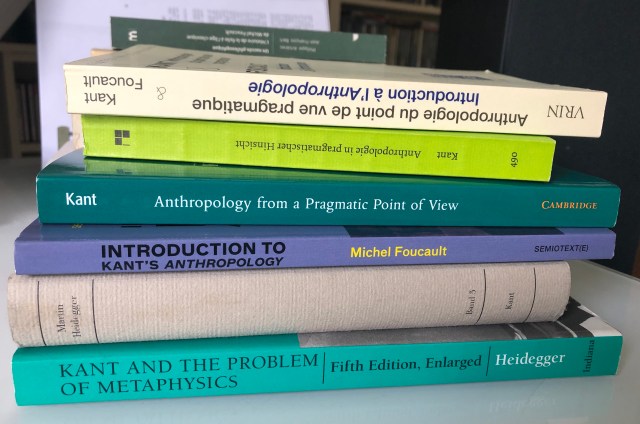
Kant.jpgThankfully, this book manuscript has been the main focus again of work over the past month.

I’ve been continuing to work on Foucault’s relation to Dumézil, on Foucault’s time in Warsaw and Hamburg, and other things in the later 1950s. I had a couple of days in Paris where I was able to resolve a lot of small issues with texts that I can’t access in the UK, as well as return to a box of materials at the archive. Work included rechecking material on microfilm and newspapers, tiny details that perhaps cumulatively add up to something. Following up a reference in one of Didier Eribon’s studies led me to a text that isn’t in any of the Foucault anthologies and which I’d previously not known about. No UK libraries seem to have a copy, but I found a second-hand copy online, so that’s on the way.

For the last ten days of September, before term started, I was on a writing retreat in Denbighshire, North Wales. I booked a small apartment in the middle of nowhere, took a box of books, the laptop and the bike and tried to concentrate on this manuscript, interspersed with some good rides in the hills. I’ve done this the past two summers in the Peak District. The weather was glorious for the first few days; dreadful for the second half. There are some really tough roads round here, for which my guide was Simon Warren’s Cycling Climbs of Wales, with Horseshoe Pass and The Road to Hell being two of the more memorable. Bwlch Pen Barras was easily the toughest I attempted.

The main work task has been comparing Foucault’s French translation of Kant’s Anthropology with both the German original and Robert Louden’s English version. At some point I may consult other English translations and Alain Renault’s more recent French one. I’ve been trying to work out the choices Foucault made for key terms, and how consistent he was in these. I’ve been doing this work along the same kinds of lines as the work I did on Foucault’s co-translations of Binswanger and von Weizsäcker, which I discuss in an earlier chapter of the manuscript. With this text, Foucault was building on work he’d done for a course on philosophical anthropology he gave in Lille and Paris a few years before. That course is also discussed in another chapter of my manuscript, and there are plans for it to be published in the next few years. The translation of the Anthropology was made in Hamburg between 1959 and 1960 and together with a long introduction served as Foucault’s secondary thesis. The translation was published in 1964, with a brief ‘Notice Historique’ drawn from the long Introduction. I first read the Introduction in 2004 at IMEC, but it has been available in both French and English for a decade now.

This comparative work is helped immeasurably by the way that the three main texts I’m using have the pagination of the Akademie Ausgabe in their margins, so it doesn’t take long to locate a passage in each language. (This is the case for the 2009 edition of Foucault’s translation, with his Introduction; though not the edition he published himself in 1964.) The German edition I’m using also has a useful index, with page and line number. But that is keyed to the edition’s pagination, not the Akademie Ausgabe’s, which adds another step into every cross reference. It’s slow work, but it is interesting and I think it has yielded something worth saying.

I’d originally planned to write a separate section on the Introduction, but in the chapter I’ve drafted the discussion of the Introduction and the translation are thematically linked. At his thesis defence Foucault was accused of having written an Introduction that owed more to Nietzsche than to Kant, and there are certainly traces of that influence. But it’s also a serious piece of Kant scholarship, discussing textual problems alongside vocabulary, the relation to other parts of Kant’s work, and obsessed with issues of dating.

Scholarship on the Anthropology has moved on a lot since Foucault did this work in 1959-60. In part this is due to the labours of Werner Stark, who edited the extant student transcripts for a later volume of the Akademie Ausgabe. I got to meet Werner and Robert Louden through the work Eduardo Mendieta and I did when we co-edited a book entitled Reading Kant’s Geography, in which they both wrote chapters. Physical Geography was a lecture course Kant gave for almost forty years. The Anthropology was initially part of the Geography, and then they were delivered as separate courses for many years. The Geography was published late in Kant’s life, not by Kant but apparently with his support, in an edition whose relation to lecture materials is much debated. Kant prepared the Anthropology for publication himself. and uniquely among his books his manuscript survives. There are suggestions that Foucault consulted that manuscript when preparing the translation, but I’m not sure that it is quite that simple.

The manuscript is housed in the library of the University of Rostock. Foucault did the translation in Hamburg, and Rostock and Hamburg are just over 100 miles apart. But in 1959-60 they were in different countries – Rostock was the major seaport of the German Democratic Republic. It would have been a very difficult journey to make, and it’s not at all clear to me that Foucault actually made it. Even if he could, I’m not sure how easy it would have been to consult the manuscript at the time.

The new academic year starts today, and I do nearly all my teaching this term. I’m hoping to keep going with the writing during this time, with the main thing left to do for this book working on the History of Madness itself. My entire book is really leading up to this, and while it’s a text I know quite well, and wrote about in Mapping the Present back in 2001, I’m looking forward to working on it again in the light of all the research I’ve done on the period of its writing.

The previous updates on this project are here; and the previous books Foucault’s Last Decade and Foucault: The Birth of Power are both available from Polity. The related book Canguilhem is also out, and is discussed a bit more here. Several Foucault research resources such as bibliographies, short translations, textual comparisons and so on, produced while doing the work for these books, are available here.

Posted in Cycling, Eduardo Mendieta, Georges Dumézil, Immanuel Kant, Michel Foucault, The Early Foucault, Uncategorized | 1 Comment

Books received – Dumézil, Kant, Lichnerowicz et. al., Magazine littéraire

Some second-hand books bought recently, mainly by Georges Dumézil, but also the Akademie Textausgabe of Kant’s Anthropologie, and the proceedings of a Collège de France seminar. I can’t remember seeing a typo on a book’s spine before…

Books.jpg


Posted in Georges Dumézil, Immanuel Kant, Uncategorized | Leave a comment

Henri Lefebvre’s former house in Navarrenx for sale

Screenshot 2019-09-29 at 13.45.58Screenshot 2019-09-29 at 13.46.43

Henri Lefebvre’s former house in Navarrenx for sale

Thanks to Andy Merrifield for the link – from May 2019, and not sure it is still for sale.

Posted in Henri Lefebvre, Uncategorized | Leave a comment