Bradley Garrett, ‘Prepping for the apocalypse: bunkers, bullets and billionaires’, ABC radio

Bradley Garrett, ”Prepping for the apocalypse: bunkers, bullets and billionaires‘, ABC radio

Doomsday Prepping, or equipping oneself to survive an imminent apocalypse, has morphed from the activity of a small sub-culture to become a multi-billion dollar industry.

For some Americans, investing in a modest, subterranean bunker with a blast door, has become a feasible alternative to a holiday home.

Meanwhile, Silicon Valley’s super-rich have been building extravagant doomsday bunkers in remote parts of New Zealand, complete with underground cinemas, pools, cryogenic facilities and helipads.

Dr Bradley Garrett is an urban geographer, interested in how we inhabit the spaces we build, and what that says about society on the whole.

He’s also an urban explorer, accomplished at breaking into abandoned, subterranean spaces such as underground tunnels and disused Cold War bunkers.

Brad’s current research project on ‘prepping’, undertaken for the University of Sydney, has seen him visit the sites of new and re-purposed bunker developments around the world, talking with wealthy developers, devout Mormons, and ‘mom and pop’ investors.

He says the notion of planning for a future threat is not entirely irrational. He also has plans for a bunker of his own.

Thanks to dmf for this link.

Posted in Uncategorized | 3 Comments

Kathryn Medien, ‘Foucault in Tunisia: The encounter with intolerable power’, The Sociological Review 2019

Kathryn Medien, ‘Foucault in Tunisia: The encounter with intolerable power‘, The Sociological Review, 2019, https://doi.org/10.1177/0038026119870107 (requires subscription)

In September 1966, 10 years after Tunisia officially gained independence from French colonial rule, Michel Foucault took up a three-year secondment, teaching philosophy at the University of Tunis. This article offers an account of the time that Foucault spent in Tunisia, documenting his involvement in the anti-imperial, anti-authoritarian struggles that were taking place, and detailing his organizing against the carceral Tunisian state. Through this account, it is argued that Foucault’s entrance into political activism, and his associated work in developing a new analytic of power, was fundamentally motivated by his encounter with the neocolonial operatives of power that he witnessed and resisted while in Tunisia. In tracing the anti-colonial and anti-imperial struggles taking place concurrent to Foucault’s development of his analytic of power, albeit struggles that are shown to not take centre stage in his subsequent works, this article concludes by suggesting that taking seriously the scholar-activist archive presented may offer us a set of radical Foucauldian tools for resistance.

Posted in Michel Foucault, Uncategorized | 1 Comment

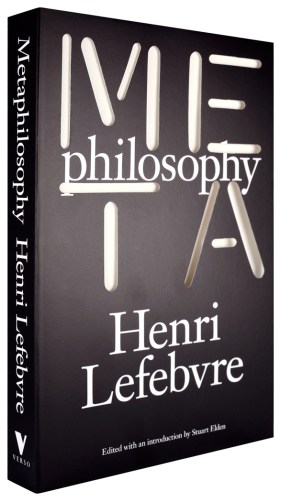
Free download of Henri Lefebvre, Metaphilosophy, Verso until September 7, 2019

Free download link expires Saturday morning, UK time.

stuartelden's avatarProgressive Geographies

Meta-Philosophy.jpgDownload Metaphilosophy by Henri Lefebvre – for free! – until Saturday, September 7th!
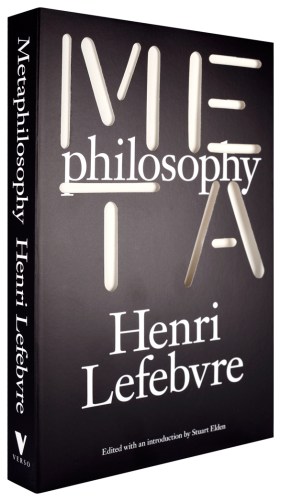
Until September 7th, we’re giving away the ebook edition of Henri Lefebvre’s Metaphilosophy. An essential book on our Philosophy: Verso Student Reading list, and a key text in Lefebvre’s oeuvre, Metaphilosophy is a milestone in contemporary thinking about philosophy’s relation to the world.

Ends Saturday, September 7th at 10.00 BST – if you have clicked through to this page after that time then you have missed this free ebook download.

Metaphilosophy
by Henri Lefebvre Edited by Stuart Elden Translated by David Fernbach

In Metaphilosophy, Henri Lefebvre works through the implications of Marx’s revolutionary thought to consider philosophy’s engagement with the world. Lefebvre takes Marx’s notion of the “world becoming philosophical and philosophy becoming worldly” as a leitmotif, examining the relation between Hegelian–Marxist supersession and Nietzschean overcoming. Metaphilosophy is conceived of as a transformation of philosophy, developing it into a programme…

View original post 157 more words

Posted in Uncategorized | Leave a comment

‘Migration, Affect and Political Space’: An International Political Sociology and Geography Seminar, Goldsmiths College London, 9 October 2019

‘Migration, Affect and Political Space’: An International Political Sociology and Geography Seminar, Goldsmiths College London, 9 October 2019

Organised by Dr Martina Tazzioli (Goldsmiths College, London) and Dr Angharad Closs Stephens (Swansea University).

Against a backdrop of heightened attention to borders and those who cross them, as well as to the emotions, moods and gestures of political life, this seminar seeks to address the politics of migration and affect together. It arises from our suspicion that current practices of governance––of sorting, categorising, counting and expelling lives, need to be addressed alongside questions about the politics of knowledge and the poetics of style. This seminar will bring together debates, contributions and methodological approaches in International Political Sociology and Geography and explore different ways of addressing questions about affect (as the capacity to move and be moved, as well as ways of orienting ourselves in the world) together with migration (addressing movement, boundaries, mobilization, crossings and borders).

In mobilizing affect and migration as analytical lenses, we are interested in developing other entry points for responding to ‘populist’ times – of heightened racism, far-right nationalism, the fortification of borders and the purification of ideas about identity and citizenship: how we might respond to these urgent times beyond a language of catastrophe and without reproducing some of the sovereign terms, categories and dreams that are currently being energized? How, in taking affect and migration as opening provocations, might we uncover alternative entry points to thinking political space, collective movements and ways of writing about politics? Given the limits of returning to organize around the categories of ‘the people’, ‘class’, and ‘identity’, what other understandings of collective formations, political movements and political space might we develop?

Speakers:

Claudia Aradau, Angharad Closs Stephens, Jason Dittmer, Jef Huysmans, Debbie Lisle, Rahul Rao, Martina Tazzioli

Chairs: Brenna Bhandar; David Brenner; Sanjay Seth

Spaces are limited. To register, please follow this link:
https://www.eventbrite.co.uk/e/migration-affect-and-political-space-an-international-political-sociology-and-geography-seminar-tickets-71642186709

This event is primarily aimed at PhD candidates and early career scholars but all are welcome.

If you register then later find you are unable to attend, we kindly ask that you let us know so that we may give your place to someone else. Contact: Dr Angharad Closs Stephens (a.c.stephens@swansea.ac.uk) and Dr Martina Tazzioli (martina.tazzioli@gold.ac.uk).

This event is being funded by the Centre for Postcolonial Studies (Goldsmiths College); Political Economy Research Centre (Goldsmiths College); Doing IPS Research Hub; and the London Interdisciplinary Social Science Doctoral Training Partnership.
Posted in Conferences, Uncategorized | 2 Comments

Free download of Henri Lefebvre, Metaphilosophy, Verso until September 7, 2019

Meta-Philosophy.jpgDownload Metaphilosophy by Henri Lefebvre – for free! – until Saturday, September 7th!

Until September 7th, we’re giving away the ebook edition of Henri Lefebvre’s Metaphilosophy. An essential book on our Philosophy: Verso Student Reading list, and a key text in Lefebvre’s oeuvre, Metaphilosophy is a milestone in contemporary thinking about philosophy’s relation to the world.

Ends Saturday, September 7th at 10.00 BST – if you have clicked through to this page after that time then you have missed this free ebook download.

Metaphilosophy
by Henri Lefebvre Edited by Stuart Elden Translated by David Fernbach


In Metaphilosophy, Henri Lefebvre works through the implications of Marx’s revolutionary thought to consider philosophy’s engagement with the world. Lefebvre takes Marx’s notion of the “world becoming philosophical and philosophy becoming worldly” as a leitmotif, examining the relation between Hegelian–Marxist supersession and Nietzschean overcoming. Metaphilosophy is conceived of as a transformation of philosophy, developing it into a programme of radical worldwide change. The book demonstrates Lefebvre’s threefold debt to Hegel, Marx and Nietzsche, but it also brings a number of other figures into the conversation, including Sartre, Heidegger and Axelos. A key text in Lefebvre’s oeuvre, Metaphilosophy is also a milestone in contemporary thinking about philosophy’s relation to the world.

Reviews

Metaphilosophy establishes Lefebvre’s place among the twentieth century’s very greatest Marxist thinkers. Arguing that the idea of philosophy can only be realized by going beyond philosophy itself, Lefebvre opens philosophy up to the concerns of everyday life and love, mass media and synthetics, consumerism and nuclear apocalypse, in a breathtakingly original vision of what truly radical thought might be. First written in French half a century ago, the remarkable challenges that it poses remain as significant as ever. There will not be a more important work of philosophy published this decade.”

Posted in Henri Lefebvre, Uncategorized | 3 Comments

Hannah Arendt and Shakespeare programme, Sept 7, 2019

Details of the next Shakespeare in Philosophy seminar

kingstonshakespeareseminar's avatarKingston Shakespeare Seminar

KINGSTON SHAKESPEARE SEMINAR AT GARRICK’S TEMPLE

SATURDAY 7 SEPTEMBER 2019

Arendt and Shakespeare symposium image

HANNAH ARENDT AND SHAKESPEARE

09.30: Coffee (Temple Pavilion) 

10.00:  Chair: Richard Wilson (Kingston University)

Avraham Oz (University of Haifa):
‘Arendt, Shakespeare and the Banality of Nationhood’

11.00: Coffee (Temple Pavilion) 

11.30: Chair: Hannah Crawforth (King’s College University of London) 

Cecilia Sjöholm (Södertörn University):
‘Arendt and Shakespeare: Voices in the Belly’

Paul Kottman (New School New York):
‘On Sea-Changes and Metamorphoses’

13.00 Lunch (Bell Inn, Hampton)

14.00: Chair: Detlef Wagenaar (Saxion University, Netherlands)   

Björn Quiring (Trinity College Dublin):
‘Karl Kraus and Hannah Arendt on Macbeth and the Great Totalitarian Fiction’

Paul Dahlgren (Georgia Southwestern State University):
‘Arendt’s Shakespeare Revisited’ 

15.30: Tea (Temple Pavilion) 

16.00: Chair: Richard Burt (University of Florida)

Caroline Lion (University of Birmingham):
‘Hannah Arendt’s Worst Nightmare’

Howard Caygill (Kingston University:
‘Shakespeare in Dark Times’

17.30: Round Table Discussion


Tickets are £20 (includes tea…

View original post 16 more words

Posted in Uncategorized | Leave a comment

Natalie Oswin, Global City Futures: Desire and Development in Singapore – UGA Press, 2019

9780820355023.jpgNatalie Oswin, Global City Futures: Desire and Development in Singapore – UGA Press, 2019

Global City Futures offers a queer analysis of urban and national development in Singapore, the Southeast Asian city-state commonly cast as a leading “global city.” Much discourse on Singapore focuses on its extraordinary socioeconomic development and on the fact that many city and national governors around the world see it as a developmental model. But counternarratives complicate this success story, pointing out rising income inequalities, the lack of a social safety net, an unjust migrant labor regime, significant restrictions on civil liberties, and more.

With Global City Futures Natalie Oswin contributes to such critical perspectives by centering recent debates over the place of homosexuality in the city-state. She extends out from these debates to consider the ways in which the race, class, and gender biases that are already well critiqued in the literature on Singapore (and on other cities around the world) are tied in key ways to efforts to make the city-state into not just a heterosexual space that excludes “queer” subjects but a heteronormative one that “queers” many more than LGBT people. Oswin thus argues for the importance of taking the politics of sexuality and intimacy much more seriously within both Singapore studies and the wider field of urban studies.

Posted in Uncategorized | Leave a comment

Duncan Kelly, Politics and the Anthropocene – Polity, August 2019

Politics-and-the-Anthropocene_selected-e1538131440588Duncan Kelly, Politics and the Anthropocene – Polity, August 2019

The Anthropocene has become central to understanding the intimate connections between human life and the natural environment, but it has fractured our sense of time and possibility. What implications does that fracturing have for how we should think about politics in these new times?

In this cutting-edge intervention, Duncan Kelly considers how this new geological era could shape our future by engaging with the recent past of our political thinking. If politics remains a short-term affair governed by electoral cycles, could an Anthropocenic sense of time, value and prosperity be built into it, altering long-established views about abundance, energy and growth? Is the Anthropocene so disruptive that it is no more than a harbinger of ecological doom, or can modern politics adapt by rethinking older debates about states, territories, and populations?

Kelly rejects both pessimistic fatalism about humanity’s demise, and an optimistic fatalism that makes the Anthropocene into a problem too big for politics, best left to the market or technology to solve. His skilful defence of the potential for democratic politics to negotiate this challenge is an indispensable guide to the ideas that matter most to understanding this epochal transformation.

Posted in Uncategorized | Leave a comment

Marcel M. van der Linden and Gerald Hubmann (eds.), Marx’s Capital: An Unfinishable Project? Haymarket, 2019
book.jpgMarcel M. van der Linden and Gerald Hubmann (eds.), Marx’s Capital: An Unfinishable Project? Haymarket, 2019

Good to see this is now available in paperback

For almost 150 years, scholars have been debating how to interpret Marx’s seminal work Capital while they had access to just some of Marx’s economic manuscripts. This changed in 2013 with the publication of all the known economic writings of Marx and Engels in the Marx-Engels Gesamtausgabe (MEGA). One can now reconstruct the lines of intellectual development, and one can also explore in detail how Friedrich Engels went about compiling volumes II and III of Capital from the vast legacy of manuscripts that Marx left behind after his death in 1883. It should be possible, now, to develop a more comprehensive and accurate picture of Marx as an economic theoretician. This volume of essays aims to initiate this process.

Contributors are: Christopher J. Arthur, Matthias Bohlender, Timm Graßmann, Jorge Grespan, Gerald Hubmann, Heinz D. Kurz, Marcel van der Linden, Kenji Mori, Fred Moseley, Lucia Pradella, Geert Reuten, Regina Roth, and Carl-Erich Vollgraf.

Posted in Friedrich Engels, Karl Marx, Uncategorized | Leave a comment

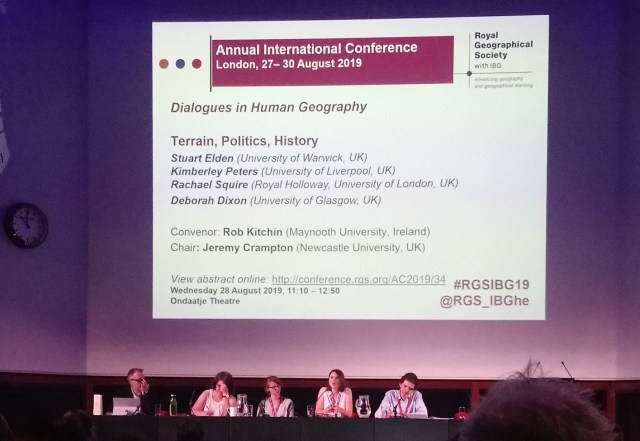
‘Terrain, Politics, History’, Dialogues lecture at the RGS-IBG conference (audio recording)

Yesterday I gave the Dialogues in Human Geography lecture at the RGS-IBG conference at the Royal Geographical Society in London on the theme of ‘Terrain, Politics, History’.

It was chaired by Jeremy Crampton and had responses from Kimberley Peters, Rachael Squire and Deborah Dixon. The Dialogues format is that the paper, the responses and then a reply from me appear in the journal. Although I’d had to send a written text a month ago, I didn’t see the responses beforehand, and so had to reply to them without time to really digest their ideas. Hopefully the written reply will do them more justice. There were also some good questions from the audience, and it was becoming a good discussion until we ran out of time.

An audio recording of my lecture part is available here – the amplification cut out at one point, and there is a slight echo, but hopefully it’s listenable.

Many thanks to all, especially Jeremy, Kim, Rachael and Deborah, and to Rob Kitchin who initially invited me. While I’m clear that this will be the last talk and paper on the topic for a while, the generous responses did make me think it might be worth further developing in the future.

Update: the published version of the lecture is now available in the journal as ‘Terrain, Politics, History‘ – if you can’t access through an institution then contact me.

IMG_0200.JPG

Posted in Conferences, terrain, Territory, Uncategorized | 1 Comment