Arthur Bradley, Unbearable Life: A Genealogy of Political Erasure – Columbia University Press, October 2019

9780231193399.jpg

Arthur Bradley, Unbearable Life: A Genealogy of Political Erasure – Columbia University Press, October 2019

In ancient Rome, any citizen who had brought disgrace upon the state could be subject to a judgment believed to be worse than death: damnatio memoriae, condemnation of memory. The Senate would decree that every trace of the citizen’s existence be removed from the city as if they had never existed in the first place. Once reserved for individuals, damnatio memoriae in different forms now extends to social classes, racial and ethnic groups, and even entire peoples. In modern times, the condemned go by different names—“enemies of the people;” the “missing,” the “disappeared,” “ghost” detainees in “black sites”—but they are subject to the same fate of political erasure.

Arthur Bradley explores the power to render life unlived from ancient Rome through the War on Terror. He argues that sovereignty is the power to decide what counts as being alive and what does not: to make life “unbearable,” unrecognized as having lived or died. In readings of Augustine, Shakespeare, Hobbes, Robespierre, Schmitt, and Benjamin, Bradley asks: What is the “life” of this unbearable life? How does it change and endure across sovereign time and space, from empires to republics, from kings to presidents? To what extent can it be resisted or lived otherwise? A profoundly interdisciplinary and ambitious work, Unbearable Life rethinks sovereignty, biopolitics, and political theology to find the radical potential of a life that neither lives or dies.

In this book, Arthur Bradley identifies the antinomical point of crossing, hitherto obscure, between the paradigms of biopolitics and political theology in the sovereign prerogative of making life, or death, never happen. It is a conceptual passage of extreme interest that, by rethinking the performative role of negation, widens the boundaries of political ontology. The sources used—ancient, modern, and contemporary—place this work at the center of current philosophical and political debate. Roberto Esposito, author of Immunitas: The Protection and Negation of Life

Arthur Bradley poses here a dramatic and unsettling challenge: to think a new natality. Not a renaissance, but a powerful call for ‘future political children’ to be born, who would break the cycles of a sovereign power intent on erasing countless existences that, beyond annihilation, would simply never have been. By way of Augustine, Shakespeare, Hobbes, Schmitt, and others, Unbearable Life presents us with a generalized martyrology, reading with unceasing insights the remarkable figures of Cacus and of Jephthah’s daughter, of Robespierre and the Zapatistas, in order to diagnose and combat a nihilopolitics that, older and stronger than we wish to admit, very much persists today. Gil Anidjar, author of Blood: A Critique of Christianity

There is no ‘murderous consent’ organized by the state more radical and absolute than the one that declares the very existence of an individual or a community to be intolerable. What sovereign power then organizes is that individual or community’s confinement to a state of inexistence that culminates in its erasure. Because such consent takes us to the heart of the modern theological-political imaginary, it is important to write its genealogy. Revisiting anew the thought of Foucault, Augustine, Shakespeare, Hobbes, Schmitt, and Benjamin, this is what the decisive analyses of Unbearable Life propose: a plunge into the roots of the violence that the contemporary world does not stop imposing upon us with increasing urgency. Marc Crépon, author of Murderous Consent: On the Accommodation of Violent Death
Posted in Uncategorized | Leave a comment

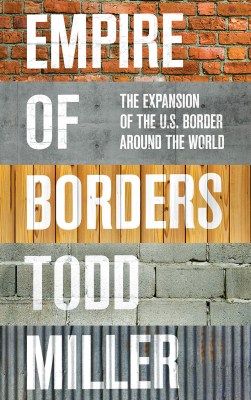
Todd Miller, Empire of Borders: The Expansion of the US Border around the World, Verso, 2019

EB.jpgTodd Miller, Empire of Borders: The Expansion of the US Border around the World, Verso, 2019

The United States is outsourcing its border patrol abroad—and essentially expanding its borders in the process.

The twenty-first century has witnessed the rapid hardening of international borders. Security, surveillance, and militarization are widening the chasm between those who travel where they please and those whose movements are restricted. But that is only part of the story. As journalist Todd Miller reveals in Empire of Borders, the nature of US borders has changed. These boundaries have effectively expanded thousands of miles outside of US territory to encircle not simply American land but Washington’s interests. Resources, training, and agents from the United States infiltrate the Caribbean and Central America; they reach across the Canadian border; and they go even farther afield, enforcing the division between Global South and North.

The highly publicized focus on a wall between the United States and Mexico misses the bigger picture of strengthening border enforcement around the world.

Empire of Borders is a tremendous work of narrative investigative journalism that traces the rise of this border regime. It delves into the practices of “extreme vetting,” which raise the possibility of “ideological” tests and cyber-policing for migrants and visitors, a level of scrutiny that threatens fundamental freedoms and allows, once again, for America’s security concerns to infringe upon the sovereign rights of other nations.

In Syria, Guatemala, Kenya, Palestine, Mexico, the Philippines, and elsewhere, Miller finds that borders aren’t making the world safe—they are the frontline in a global war against the poor.

“An indispensable guide to our bunkered, barb-wired world. For more than a decade, well before Donald Trump landed in the White House, Miller’s reporting has revealed the conceits of globalization, documenting the slow, steady garrisoning of US politics behind ever more brutal border policies. Now, with Empire of Borders, he looks outward, to a world overrun with so many border walls it looks more like a maze than a shared planet. If there’s a way out, Miller will find it.”
– Greg Grandin, author of The End of the Myth: From the Frontier to the Border Wall in the Mind of America

Posted in Boundaries, Uncategorized | Leave a comment

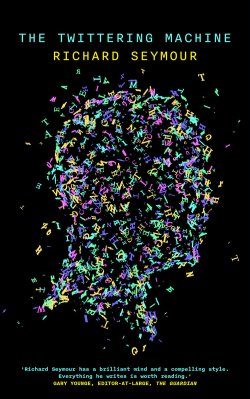
Richard Seymour, The Twittering Machine, Indigo, 2019; reviewed by Will Davies in The Guardian

The+Twittering+Machine+COVER.jpgRichard Seymour, The Twittering Machine, Indigo, 2019; reviewed by Will Davies in The Guardian

In surrealist artist Paul Klee’s The Twittering Machine, the bird-song of a diabolical machine acts as bait to lure humankind into a pit of damnation. Leading political writer and broadcaster Richard Seymour argues that this is a chilling metaphor for our relationship with social media.

Former social media executives tell us that the system is an addiction-machine. We are users, waiting for our next hit as we like, comment and share. We write to the machine as individuals, but it responds by aggregating our fantasies, desires and frailties into data, and returning them to us as a commodity experience.

Through journalism, psychoanalytic reflection and insights from users, developers, security experts and others, Seymour probes the human side of the machine, asking what we’re getting out of it, and what we’re getting into.

‘Richard Seymour has a brilliant mind and a compelling style. Everything he writes is worth reading.’ – Gary Younge, Editor-at-Large, Guardian

‘One of our most astute political analysts.’ – China Miéville, author of October: The Story of the Russian Revolution

Posted in Uncategorized | Leave a comment

Books received – Neil Brenner, New State Spaces, and books from Duke University Press

IMG_0374.jpg

A copy of Neil Brenner’s New Urban Spaces: Urban Theory and the Scale Question, sent by Neil, and some books from Duke University Press in recompense for review work. They are Stuart Hall, Essential Essays and Cultural Studies 1983; Ann Laura Stoler, Duress, Ernesto Bassi, An Aqueous Territory, Jason Dittmer, Diplomatic Material, Elizabeth Povinelli, GeontologiesLauren Berlant and Kathleen Stewart, The Hundreds and collections edited by Kregg Hetherington on Infrastructure, Environment and the Life in the Anthropocene and by Suzanne Guerlac and Pheng Cheah on Derrida and the Time of the Political.

Posted in Jacques Derrida, Neil Brenner, Stuart Hall, Territory, Uncategorized | Leave a comment

Teo Ballvé, The Frontier Effect: State Formation and Violence in Colombia – Cornell University Press, 2020

Teo Ballvé, The Frontier Effect: State Formation and Violence in Colombia – Cornell University Press, 2020

No details yet on the Cornell site, but it is part of the Cornell Series on Land: New Perspectives on Territory, Development, and Environment. Really good to see Teo’s work about to be published in book form.

Posted in Uncategorized | 2 Comments

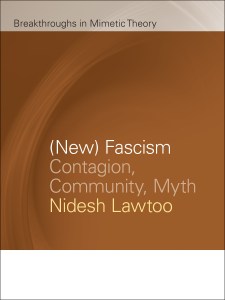
Nidesh Lawtoo, (New) Fascism: Contagion, Community, Myth – Michigan State Press, August 2019

50-1D0-45A4-50-9781611863291.jpgNidesh Lawtoo, (New) Fascism: Contagion, Community, Myth – Michigan State Press, August 2019

Fascism tends to be relegated to a dark chapter of European history, but what if new forms of fascism are currently returning to the forefront of the political scene? In this book, Nidesh Lawtoo furthers his previous diagnostic of crowd behavior, identification, and mimetic contagion to account for the growing shadow cast by authoritarian leaders who rely on new media to take possession of the digital age. Donald Trump is considered here as a case study to illustrate Nietzsche’s untimely claim that, one day, “ ‘actors,’ all kinds of actors, will be the real masters.” In the process, Lawtoo joins forces with a genealogy of mimetic theorists—from Plato to Girard, through Nietzsche, Tarde, Le Bon, Freud, Bataille, Lacoue-Labarthe, and Nancy, among others—to show that (new) fascism may not be fully “new,” let alone original; yet it effectively reloads the old problematics of mimesis via new media that have the disquieting power to turn politics itself into a fiction.
Posted in Uncategorized | Leave a comment

Videos of Plenaries from Truth, Fiction, Illusion: Worlds & Experience’ Conference 2019 – Malpas, Elden, Margaroni, Mbembe, Stiegler

Full playlist here – plenaries by Jeff Malpas, Stuart Elden, Maria Margaroni, Bernard Stiegler, Achille Mbembe and discussion between Mbembe and Stiegler.

Posted in Achille Mbembe, Bernard Stiegler, Jeff Malpas, Uncategorized | 3 Comments

Douglas Armato of University of Minnesota Press on ‘The Value of University Presses’ – statement and discussion

Douglas Armato of University of Minnesota Press on ‘The Value of University Presses’ – updated statement here; discussion here.

Posted in Publishing, Uncategorized | 1 Comment

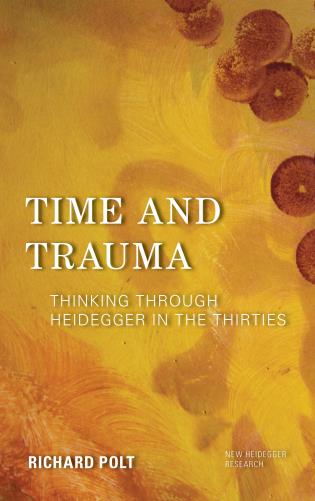
Richard Polt, Time and Trauma: Thinking Through Heidegger in the Thirties reviewed at NDPR by Thomas Sheehan

9781786610515Also at NDPR, Thomas Sheehan reviews Richard Polt’s Time and Trauma: Thinking Through Heidegger in the Thirties.

In the Anglophone world, few if any know the Heidegger of the 1930s better than Richard Polt. His co-translation of three Heidegger courses from that period, together with his major monograph on Heidegger’s 1936-38 Beiträge zur Philosophie, have set a high bar for scholarship on the middle Heidegger and have made an indispensible contribution to it.

With his latest book Polt gathers work he has done over the last ten years and brings it to bear on what he calls “the dark new philosophical landscape” of Heidegger in the 1930s. The result is four strongly argued chapters devoted to three distinct topics…

Posted in Martin Heidegger, Uncategorized | Leave a comment

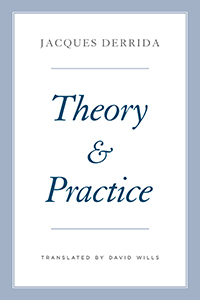
Jacques Derrida, Theory and Practice reviewed at NDPR by Edward Baring

9780226572345Jacques Derrida, Theory and Practice – his 1976-77 ENS lecture course – is reviewed at NDPR by Edward Baring, author of the excellent The Young Derrida and French Philosophy, 1945-1968.

Jacques Derrida’s Theory and Practice, a seminar he taught at the École Normale Supérieure (ENS) over the academic year 1976-1977, has all the signs of being a highly provocative text. As the publisher’s blurb notes, here Derrida engages with the Marxist tradition, long before any purported “political turn” or his ground-breaking Specters of Marx (1993). The promise of provocation is only heightened by the fact that Derrida frames his engagement with a reading of the antihumanist Marxist Louis Althusser, who was his colleague at the ENS and thus the teacher and mentor of many of the students he was addressing in the course…

Posted in Jacques Derrida, Uncategorized | Leave a comment