The Early Foucault update 25 – back after a long break on other projects

It’s been over five months since I posted an update on The Early Foucault, and it is only in the last couple of weeks that I’ve really been back at work on the manuscript. In the spring and early summer I gave a number of lectures on Shakespeare, some connected to Foucault, but not to the early work, and a few presentations on terrain. The last of those, “Terrain, Politics, History”, will be given at the RGS-IBG conference at the end of August as the Dialogues in Human Geography lecture. Because there will be three responses, I had to send it off a month before. These, and other duties, took me away from the focus on Foucault’s early career. After the Dialogues lecture I have no other speaking commitments in the diary, though it’s likely I’ll be speaking about the Foucault work in New York in the spring. At the moment I am trying hard to say ‘no’ to any requests to speak that are not on Foucault (even some very appealing ones): I need to give this work my full attention again.

Part of the reason for this is that in March, I received the good news that I’d been awarded a a British Academy/Leverhulme small grant for a project entitled ‘The Early Foucault: Retracing Intellectual History through Archival Sources’. This will fund a series of archival trips in the next academic year – to France, Germany, Sweden and the USA. Some of that is necessary work for this book, and some will be preparatory for the fourth and final book in this series, which is intended to look at the 1960s.

My most recent work on Foucault has been to make a careful comparison of the two versions of his inaugural lecture at the Collège de France, published as L’ordre du discours. The results of this work – which are outside the period I’m currently focusing on, but were informed by an anonymous correspondent – can be found here.

At the end of June at the Warwick Continental Philosophy Conference I gave a brief talk on Foucault’s work on psychology in the early 1950s. I said something about his Maladie mentale et personnalité book, and in particular the revisions for the 1962 version, and also discussed the two book chapters on psychology which appeared in 1957, the Binswanger translation and introduction, and the lectures on psychology from Lille and the ENS. All of these are discussed in much more detail in the book manuscript. There was a live video stream of the whole event, but I’m not sure this is still available. An audio recording of my comments is here.

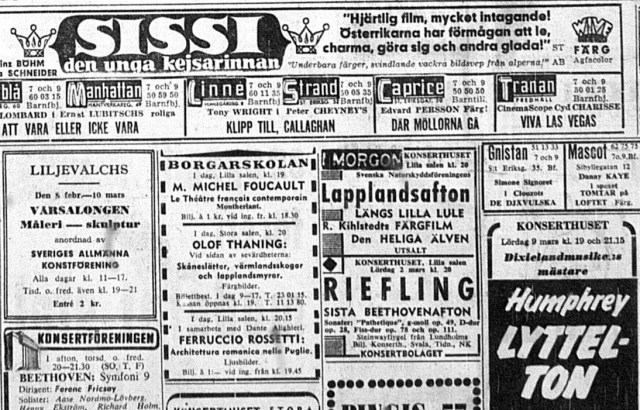
In July, I spent a few long days in the Newsroom at the British Library, working through old Swedish newspapers on microfilm. Some of Foucault’s lectures in the late 1950s in Sweden were announced in the papers, and with relatively few sources for his time there, it seemed worthwhile to do this work. I’ve been able to piece together an almost complete chronology of the titles of these lectures for two of the years he was there. I’ve also been doing some work on Foucault’s time in Hamburg between 1959-60, with the help of one of my PhD students, Melissa Pawelski.

The next major task will be working on Foucault’s translation of Kant’s Anthropology, with the plan of writing something on the choices made in rendering this German text into French, as well as discussing his introduction. This was Foucault’s main project while in Hamburg.

The previous updates on this project are here; and the previous books Foucault’s Last Decade and Foucault: The Birth of Power are both available from Polity. The related book Canguilhem is also now out, and is discussed a bit more here. Several Foucault research resources such as bibliographies, short translations, textual comparisons and so on, produced while doing the work for these books, are available here.
News clipping.jpg

Posted in Immanuel Kant, Michel Foucault, terrain, The Early Foucault, Uncategorized, William Shakespeare | 5 Comments

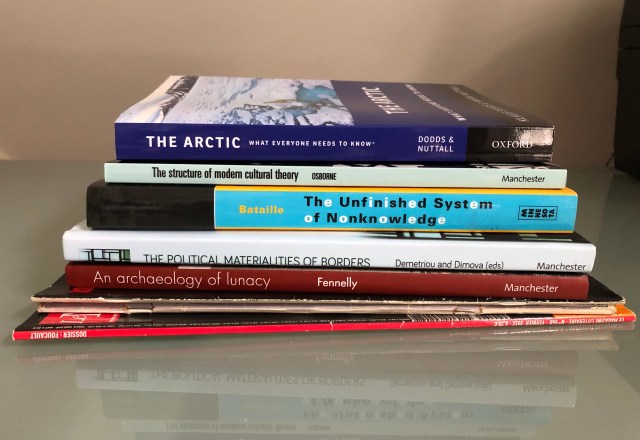
Books received – Dodds & Nuttall, Osborne, Bataille, Demetriou and Dimova, Fennelly, Magazine littéraire

Books received – Klaus Dodds & Mark Nuttall, The Arctic: What Everyone Needs to Know, Thomas Osborne, The Structure of Modern Cultural Theory, George Bataille, The Unfinished System of Knowledge, Olga Demetriou and Rozita Dimova, The Political Materialities of Borders, Katherine Fennelly, An Archaeology of Lunacy, and back issues of Magazine littéraire with sections on Foucault.

I bought the Magazine littéraire issues, and The Arctic was a gift from Klaus. The rest were recompense for review work.

books

Posted in Boundaries, Georges Bataille, Michel Foucault, Uncategorized | Leave a comment

24 Best New International Relations Books To Read In 2019 from Book Authority

24 Best New International Relations Books To Read In 2019 from Book Authority

Good to see a few more critical takes among the more mainstream works.

Posted in Uncategorized | Leave a comment

Len Lawlor’s From Violence to Speaking Out: Apocalypse and Expression in Foucault, Derrida and Deleuze reviewed in NDPR

Len Lawlor’s recent book reviewed – details of the book itself here https://edinburghuniversitypress.com/book-from-violence-to-speaking-out.html

Peter Gratton's avatarPHILOSOPHY IN A TIME OF ERROR

by my colleague Jeff Bell here.

View original post

Posted in Uncategorized | Leave a comment

Bryan Magee (1930-2019) – tribute by Henry Hardy and links to his TV discussions

Bryan Magee (1930-2019) – tribute by Henry Hardy and links to his TV discussions – with Isaiah Berlin, Herbert Marcus, AJ Ayer, Noam Chomsky, Iris Murdoch and many others. Thanks to Jo Wolff for the links.

The Great Philosophers was one of the first books I read which introduced me to Heidegger – transcripts of some of these TV discussions, first published in 1987.

Posted in Uncategorized | Leave a comment

Agnes Heller (1929-2019) – tribute at Daily Nous

heller-agnes-2-768x453I’m slow to link to the news about Agnes Heller (1929-2019), who died recently. There is a tribute at Daily Nous along with links to obituaries from ReutersHungary TodayDeutsche Welle, Le Monde.


Posted in Uncategorized | Leave a comment

Nadia Bou Ali and Rohit Goel (eds.), Lacan Contra Foucault: Subjectivity, Sex, and Politics, Bloomsbury, 2019 – reviewed at NDPR

9781350036888Nadia Bou Ali and Rohit Goel (eds.), Lacan Contra Foucault: Subjectivity, Sex, and Politics, Bloomsbury, 2019 – reviewed at NDPR. Sounds an interesting, if uneven collection. Shame about the prohibitive price.

This book grew out of a 2015 conference at the American University of Beirut. Its six chapters are technical and require prior familiarity with both Foucault and Lacan. Most of the authors have a background in both philosophy and psychoanalysis, but other disciplines are represented as well. The influence of the Slovenian approach to Lacan is particularly pronounced: at least four of the six contributors have studied or taught at the University of Ljubljana. Despite the title, only half of the chapters bear directly on the complex relationship between Foucault and Lacan. Lacan specialists are heavily represented in this volume, but Foucault scholars are missing.
Posted in Jacques Lacan, Michel Foucault, Uncategorized | Leave a comment

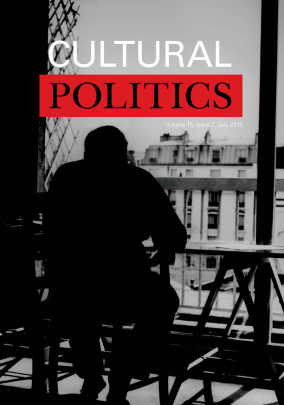
Remembering Paul Virilio: New Issue of Cultural Politics July 2019 (requires subscription)

cup_15_2_cover.pngRemembering Paul Virilio: New Issue of Cultural Politics July 2019 (requires subscription)


Posted in Paul Virilio, Uncategorized | Leave a comment

How We Read: Tales, Fury, Nothing, Sound, edited by Suzanne Conklin Akbari and Kaitlin Heller- Punctum, summer 2019

An excerpt from Irina Dumitrescu is available here – https://longreads.com/2019/07/22/reading-lessons/

stuartelden's avatarProgressive Geographies

how-we-read-cover-20190412How We Read: Tales, Fury, Nothing, Sound, edited by Suzanne Conklin Akbari and Kaitlin Heller- Punctum, summer 2019 – the follow-up to How We Write: Thirteen Ways of Looking at a Blank Page

What do we do when we read?

Reading can be an act of consumption or an act of creation. Our “work reading” overlaps with our “pleasure reading,” and yet these two modes of reading engage with different parts of the self. It is sometimes passive, sometimes active, and can even be an embodied form.

The contributors to this volume share their own histories of reading in order to reveal the shared pleasure that lies in this most solitary of acts – which is also, paradoxically, the act of most complete plenitude. Many of the contributors engage in academic writing, and several publish in other genres, including poetry and fiction; some contributors maintain an active online presence…

View original post 50 more words

Posted in Uncategorized | Leave a comment

Hannah Arendt and Shakespeare, September 7, 2019

The next in this sequence of workshops on Shakespeare in philosophy

kingstonshakespeareseminar's avatarKingston Shakespeare Seminar

David Garrick built his Shakespeare Temple beside the Thames at Hampton in 1755, as a place where ‘the thinkers of the world’ would meet to reflect on the plays. He hoped Voltaire would come. Now the Kingston Shakespeare Seminar is realising the great actor’s vision, with a series of symposia on

Shakespeare in Philosophy

Each of these Saturday events features talks by leading philosophers and Shakespeare scholars, coffee and tea in the riverside garden designed by Capability Brown, and lunch at the historic Bell Inn.

Arendt and Shakespeare

On Saturday September 7 2019 the Temple symposium will be on

HANNAH ARENDT AND SHAKESPEARE

with contributions from

Richard Burt, Howard Caygill, Paul Kottman,

Caroline Lion, Avraham Oz, Björn Quiring, Cecilia Sjöholm

To register for the event go to

https://arendtandshakespeare.eventbrite.co.uk

View original post

Posted in Uncategorized | Leave a comment