‘Tripping his brains out’ – Foucault in California reviewed in the TLS (and a clarification on chronology)

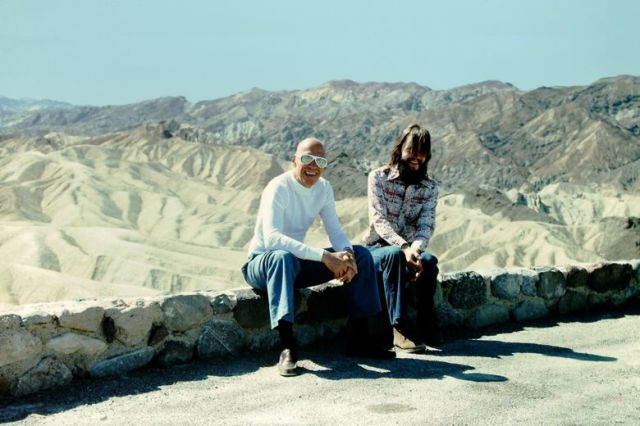
Tripping his brains out‘ – Simeon Wade’s memoir Foucault in California is reviewed in the TLS.

The piece generously quotes my work in Foucault’s Last Decade. But there is one key problem to the idea that this experience changed the course of Foucault’s History of Sexuality – these events occurred in May 1975, 15 months before Foucault finished the first volume. There is a story about how the series changed, which I’ve tried to tell, and which can doubtless be told in other ways, but chronology remains significant.

MF

Update: another review at LA Review of Books

Posted in Foucault's Last Decade, Michel Foucault, Uncategorized | 1 Comment

Achille Mbembe, The Idea of a Borderless World

Achille Mbembe, The Idea of a Borderless World

As the 21st century unfolds, a global renewed desire from both citizens and their respective states for a tighter control of mobility is evident. Wherever we look, the drive is towards enclosure, or in any case an intensification of the dialects of territorialisation and deterritorialisation, a dialectics of opening and closure. The belief that the world would be safer, if only risks, ambiguity and uncertainty could be controlled and if only identities could be fixed once and for all, is gaining momentum. Risk management techniques are increasingly becoming a means to govern mobilities. In particular the extent to which the biometric border is extending into multiple realms, not only of social life, but also of the body, the body that is not mine. [continues here]

Posted in Achille Mbembe, Uncategorized | 2 Comments

Catherine M. Soussloff: Foucault on Painting (2019)

Catherine M. Soussloff discusses her book Foucault on Painting

Clare O'Farrell's avatarFoucault News

Catherine M. Soussloff discusses her book Foucault on Painting, This Is Not A Pipe Podcast, April 25, 2019

Catherine M. Soussloff discusses her book Foucault on Painting with Chris Richardson. Soussloff, Professor of Art History, Visual Art & Theory, University of British Columbia and Professor Emeritus, University of California, Santa Cruz is the author of Foucault on Painting (University of Minnesota Press) and editor of Foucault on the Arts and Letters: Perspectives for the Twenty-First Century (Rowman and Littlefield). In 2015, she was Visiting Lecturer at the Collège de France. She has published articles and books on Jewish identity and visual culture (Jewish Identity in Modern Art History, California), the historiography of art history, early modern art theory, and contemporary issues in art, art history, and performance. Soussloff has held fellowships from the Institut d’Histoire de l’Art (INHA), Peter Wall Institute for Advanced Studies, the National Endowment for the…

View original post 75 more words

Posted in Uncategorized | Leave a comment

Canguilhem, Shakespeare, Snowdonia, Klagenfurt

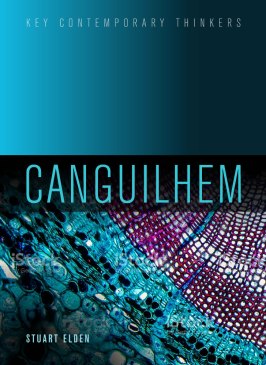
Canguilhem cover
Last week I was in Cambridge for a book launch for Canguilhem (Polity 2019). The event was introduced by Inanna Hamati-Ataya, and Simon Reid-Henry provided a generous and incisive reading of the book. There was a good discussion, and I’m grateful to all who attended.

Shakespearean Territories cover - CopyLater that week I was in London for the the fourth Denis Cosgrove lecture in the Geohumanities, where I spoke about ‘Shakespearean Landscapes’. That lecture built on the work in Shakespearean Territories (University of Chicago Press, 2018) but developed a reading of King LearMacbeth and Timon of Athens around a theme on which Denis Cosgrove did so much valuable work. Once again, I’m grateful to the organisers for the invitation, and the audience for attending and their questions.

Both the Canguilhem and ‘Shakespearean Landscapes’ events were audio recorded, and I’ll share when available.

The bank holiday weekend was spent cycling in southern Snowdonia, which was great.

Snowdonia.jpg

Hellfire Pass 1.jpeg

The top of Bwlch y Groes/Hellfire Pass

I’m now on my way to Klagenfurt for the Association for Philosophy and Literature conference. This is my first overseas conference in over a year. There I will be giving a lecture on ‘Foucault, Shakespeare and the Oath’, and taking part in a ‘Close Encounter’ session on my work organised by Peter Gratton, with Jessica Dubow, Adam Haaga, Matthew Hannah, and Jeff Malpas. I’m looking forward to both sessions, albeit with some trepidation, and catching up with a number of friends and hearing some fascinating speakers.

Posted in Canguilhem (book), Conferences, Cycling, Georges Canguilhem, Michel Foucault, Peter Gratton, Shakespearean Territories, Travel, Uncategorized, William Shakespeare | 3 Comments

Canguilhem (@politybooks, 2019) reviewed by Steve Hanson at Manchester Review of Books

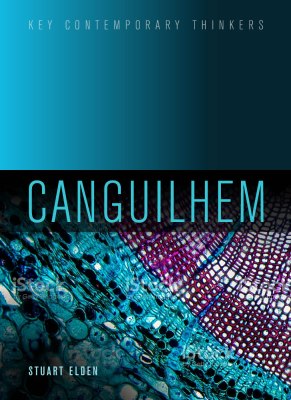
Canguilhem coverMy recent book Canguilhem (Polity, 2019) is reviewed by Steve Hanson at Manchester Review of Books (open access).

I went through this book on Georges Canguilhem by Stuart Elden in strides, thanks to his excellent explanatory craft. He lays out detailed research with an engaging narrative style and no gloss or loss. I hadn’t explored ‘King Cang’ in detail before and now I see how important he was. [continues here]

Posted in Canguilhem (book), Georges Canguilhem, My Publications, Uncategorized | 1 Comment

Books received – Protevi, Bataille, Spurgeon, Greenblatt and Wilson on Shakespeare

IMG_0173.jpg

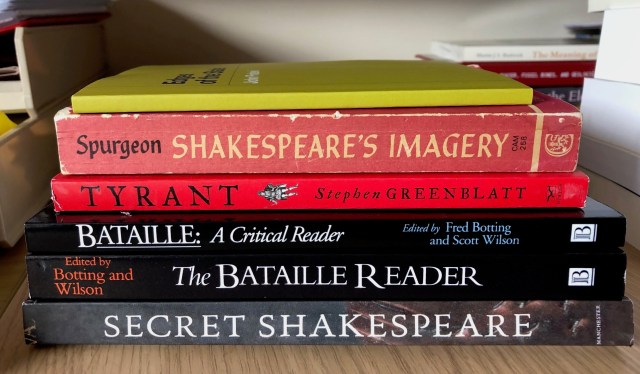
John Protevi’s Edges of the State, sent by the publisher;  two Bataille collections in recompense for review work, Stephen Greenblatt, Tyrant: Shakespeare on Power, Caroline Spurgeon’s classic Shakespeare’s Imagery and Richard Wilson, Secret Shakespeare.

Posted in Georges Bataille, John Protevi, Uncategorized, William Shakespeare | 1 Comment

Books received – review work for University of Chicago Press

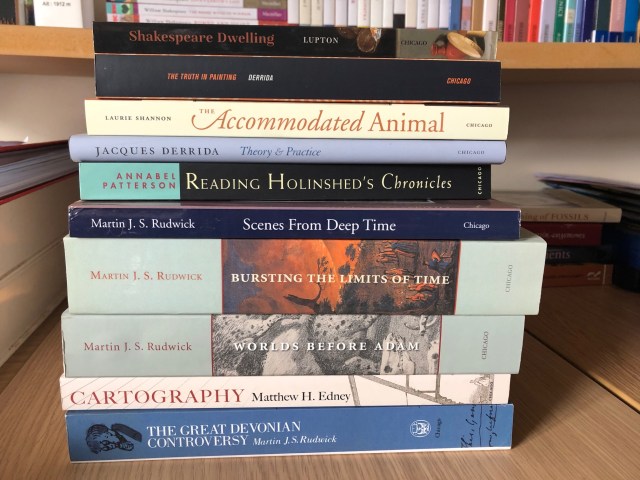
IMG_0172.jpgMainly a number of books by Martin J.S. Rudwick, but also Julia Lupton’s Shakespeare Dwelling, the translation of Derrida’s Theory and Practice seminar, Laurie Shannon, The Accommodated Animal, Matthew H. Edney’s Cartography and Annabel Paterson, Reading Holinshed’s Chronicles. I’m planning on reengaging with Rudwick’s work for the ‘Terrain, Politics, History” paper I’ll be giving in late August.

Posted in Jacques Derrida, terrain, Uncategorized, William Shakespeare | Leave a comment

Stuart Hall’s Archive: A One-Day Symposium and Policing the Crisis Today: Conjunctures of the Past and of the Present – Birmingham, 2 July 2019 (with pre-events in Birmingham 24 June and London 26 June)

Untitled

Policing the Crisis Today:
Conjunctures of the Past and of the Present
An open invitation to a study workshop
Monday 24 June
Ikon Gallery
1 Oozells Square
Birmingham, B1 2HS
10:00–14:00


Wednesday 26 June
New York University in London 
6 Bedford Square
London, WC1B 3RA
10:00–14:00
If you would like to attend, and for further details, please contact Dr Nick Beech: beechnick@me.com
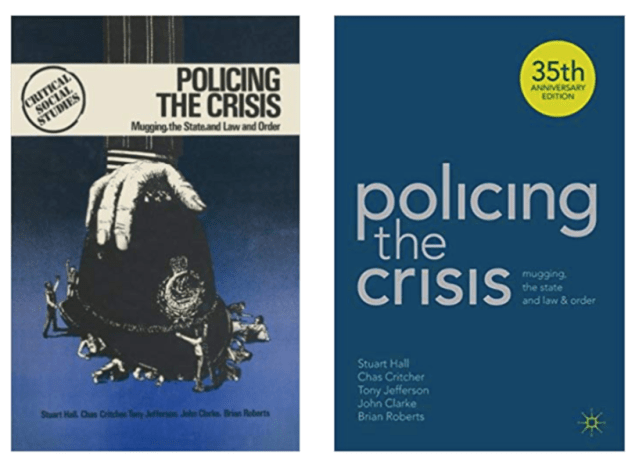
Policing the Crisis was a response to events concerning the robbery and injury of a man in Birmingham by three boys of mixed ethnic backgrounds. They were given long, exemplary sentences (twenty years, in one case). However, these events were not used to illustrate a pre-existing theoretical argument. Written over six years, the prolonged, difficult process of collective research served as the intellectual “laboratory” out of which the ideas, theories and arguments that animate the text was produced. The book ends by making connections and offering explanations that could not have been anticipated at the beginning.’
—Stuart Hall, Chas Critcher, Tony Jefferson, John Clarke, Brian Roberts, ’Preface to the Second Edition’ (2013), Policing the Crisis (1978/2013).
 
This year the Cadbury Research Library at the University of Birmingham opened Stuart Hall’s archive. To mark this event, a Symposium will be held on the 2 July 2019, providing an opportunity to consider the value of Hall’s archive for scholars, teachers and political activists critically engaged in the examination and transformation of our past and present (see https://stuarthallarchive.wordpress.com)
 
In preparation for the Symposium, two study sessions will be held, offering an opportunity to discuss one of the most profound works of cultural studies and Marxist social analysis in the twentieth century: Policing the Crisis (London: Macmillan, 1978), produced by Stuart Hall in collaboration with Chas Critcher, Tony Jefferson, John Clarke and Brian Roberts. The outcomes of these study sessions will be relayed to the Symposium and inform future research programmes and projects. 
For many inheritors of the New Left and cultural studies, Policing the Crisis has provided a guide to the political, economic and cultural transformation of Britain in the 1970s and beyond. It continues to inspire research and political activism within specific fields—particularly in the analysis of urbanism and urban crisis, class-conflict, policing, race, and media—as well as broader enquiries examining periods of political crisis and settlement. 
As a work, Policing the Crisis can be considered:
  • a theoretical model—providing concepts and categories for the critical analysis of capitalist crises, state coercion, hegemony, and racism
  • a methodological model—presenting a procedure of analysis that begins with ‘concrete’, lived experiences, and leads from these to the elaboration of deep social, political and cultural structures in transformation
  • a model of practice—as the product of sustained collaboration between the authors and a wider network of researchers and political activists, in dialogue, and supported by critical readings over a six year period
But it is doubtful that Hall and his co-authors would consider any simple mobilisation of their work in the present as at all adequate. Hall remarked that Antonio Gramsci’s work ‘often appears almost too concrete: too historically specific, too delimited in its references, too “descriptively” analytic, too time and context-bound’. This might be just as true of Policing the Crisis itself, and just as Hall argued that Gramsci’s ideas had to be ‘delicately dis-interred from their concrete and specific embeddedness and transplanted to new soil with considerable care and patience’, we may need to do the same with Hall’s work.
These two study sessions will ask—how might we ‘disinter’ the ideas contained in Policing the Crisis in the analysis and transformation of our present? Where would a Policing the Crisis project begin today, in what conditions, and by whom? The aim of the sessions is not a scholarly one, but an attempt to identify questions, research agendas, and political actions in the present that may be informed by a carefully ‘transplanted’ Policing the Crisis.
Posted in Stuart Hall, Uncategorized | Leave a comment

Henri Lefebvre, Hegel, Marx, Nietzsche or the Realm of Shadows – Verso, February 2020

71ZRRk3Z5OLI’m pleased to be able to share the news that Henri Lefebvre’s book Hegel, Marx, Nietzsche or the Realm of Shadows is forthcoming in English translation with Verso in early 2020. It’s not yet up on the Verso site [update Nov 2019 – it is now], but their US distributors have it listed, and it’s in some online stores.
I’ve known about this book for quite some time now – it’s in a very fine translation by David Fernbach, and it has an introduction by me. The cover is interesting too. I’m really pleased that this book will finally be available in English. It’s one of my favourite books by Lefebvre, and along with Metaphilosophy, one of his key philosophical works. It was published in 1975, immediately after The Production of Space, and just before his epic four-volume De l’État.

With the translation of Lefebvre’s philosophical writings, his stature in the English-speaking world continues to grow. Though certainly within the Marxist tradition, he consistently saw Marx as an ‘unavoidable, necessary, but insufficient starting point’. Unsurprisingly, Lefebvre always insisted on the importance of Hegel to understanding Marx. But the imposing Metaphilosophy also suggested the significance he ascribed to Nietzsche, in the ‘realm of shadows’ through which philosophy seeks to think the world. Lefebvre proposes here that the modern world is at the same time Hegelian in terms of the state; Marxist in terms of the social and society; and Nietzschean in terms of civilization and its values. As early as 1939, Lefebvre pioneered a French reading of Nietzsche that rejected the philosopher’s appropriation by fascism, bringing out the tragic implications of Nietzsche’s proclamation that ‘God is dead’ long before this approach was followed by such later writers as Foucault, Derrida and Deleuze. Forty years later, in the last of his philosophical writings, Lefebvre juxtaposes the contributions of the three great thinkers, in a text whose themes remain surprisingly relevant today.

I’ve also updated my guide – Where to start with reading Henri Lefebvre?

Posted in Friedrich Nietzsche, Georg Wilhelm Friedrich Hegel, Henri Lefebvre, Karl Marx | 3 Comments

Gatherings: The Heidegger Circle Annual – 2019 issue published and open access

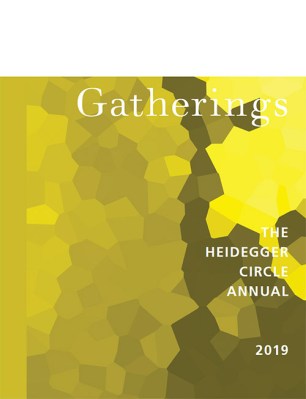
2019gatheringscover.jpgGatherings: The Heidegger Circle Annual has now been published – available open access.

The first piece, an archival text of William Richardson’s letter to Heidegger leading to the famous preface is especially interesting.


Download complete issue
Download individual texts:

Letter from the Editor
Richard Polt

From the Archives

William Richardson’s Questions for Martin Heidegger’s “Preface”
Edited, translated, and with a commentary by Richard Capobianco and Ian Alexander Moore

Articles

Accidental Origins: The Importance of Tuchē and Automaton for Heidegger’s 1922 Reading of Aristotle
Jennifer Gammage

Heidegger’s Epicureanism: Death, Dwelling and Ataraxia
Paul Gyllenhammer

The Place-Being of the Clearing and Language: Reading Thomas Sheehan Topologically
Onur Karamercan

From Matter to Earth: Heidegger, Aristotle, and “The Origin of the Work of Art”
Khafiz Kerimov

Symposium

Beyond Presence?
Jussi Backman, Taylor Carman, Daniel O. Dahlstrom, Graham Harman, Michael Marder, and Richard Polt

Book Reviews

Kevin Aho, ed., Existential Medicine: Essays on Health and Illness
Casey Rentmeester

Jussi Backman, Complicated Presence: Heidegger and the Postmetaphysical Unity of Being
Pascal Massie

Andrew Benjamin and Dimitris Vardoulakis, eds., Sparks Will Fly: Benjamin and Heidegger
Benjamin Brewer

Gregory Fried and Richard Polt, eds., After Heidegger?
Jessica Elkayam

Lawrence J. Hatab, Proto-Phenomenology and the Nature of Language: Dwelling in Speech I
Daniel O. Dahlstrom

Texts Cited

Posted in Uncategorized | Leave a comment