Barnes and Sheppard (eds.), Spatial Histories of Radical Geography: North America and Beyond – Wiley/Antipode June 2019

1119404711.jpgTrevor Barnes and Eric Sheppard (eds.), Spatial Histories of Radical Geography: North America and Beyond – Wiley/Antipode 2019 (two excerpts available)

A wide-ranging and knowledgeable guide to the history of radical geography in North America and beyond.

  • Includes contributions from an international group of scholars
  • Focuses on the centrality of place, spatial circulation and geographical scale in understanding the rise of radical geography and its spread
  • A celebration of radical geography from its early beginnings in the 1950s through to the 1980s, and after
  • Draws on oral histories by leaders in the field and private and public archives
  • Contains a wealth of never-before published historical material
  • Serves as both authoritative introduction and indispensable professional reference
Posted in Uncategorized | 2 Comments

Mark A. Wrathall, The Cambridge Heidegger Lexicon – CUP, December 2019

9781107002746.jpgMark A. Wrathall, The Cambridge Heidegger Lexicon – Cambridge University Press, December 2019

Martin Heidegger (1889–1976) was one of the most original thinkers of the twentieth century. His work has profoundly influenced philosophers including Jean-Paul Sartre, Simone de Beauvoir, Maurice Merleau-Ponty, Michel Foucault, Jacques Derrida, Hannah Arendt, Hans-Georg Gadamer, Jürgen Habermas, Charles Taylor, Richard Rorty, Hubert Dreyfus, Stanley Cavell, Emmanuel Levinas, Alain Badiou, and Gilles Deleuze. His accounts of human existence and being and his critique of technology have inspired theorists in fields as diverse as theology, anthropology, sociology, psychology, political science, and the humanities. This Lexicon provides a comprehensive and accessible guide to Heidegger’s notoriously obscure vocabulary. Each entry clearly and concisely defines a key term and explores in depth the meaning of each concept, explaining how it fits into Heidegger’s broader philosophical project. With over 220 entries written by the world’s leading Heidegger experts, this landmark volume will be indispensable for any student or scholar of Heidegger’s work.

Posted in Martin Heidegger, Uncategorized | Leave a comment

Three upcoming talks on Shakespeare – landscapes, Foucault, Kantorowicz and the oath

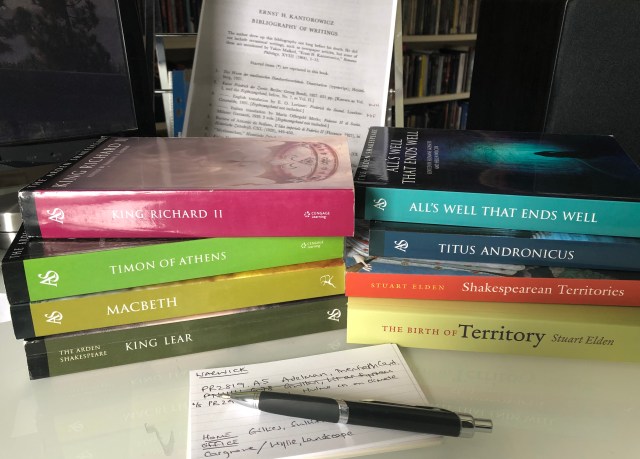
Shakespeare.jpgI have three upcoming talks on Shakespeare.

The first is the Fourth Denis Cosgrove lecture in the GeoHumanities, to be given at the British Academy on 23 May 2019, 6.30pm. I was asked to speak about the Shakespearean Territories book, and I will say something about that, but I’m also going to go a bit further with this work on Shakespeare and geography, and think about landscapes figure, or don’t, in some of his plays. I’ll speaking about King Lear, Macbeth and Timon of Athens, with some mention of other plays. The lecture and drinks reception are both free, but registration is required.

I’ll then be giving two papers on the oath in Shakespeare, drawn from what I hope will be a longer manuscript. There will be a bit of overlap between the two, but hopefully not much. The first will a plenary lecture to the Association for Philosophy and Literature conference to be held in Klagenfurt, Austria between 29 May and 2 June 2019. This one will be entitled ‘Foucault, Shakespeare and the Oath’. The second will be at a much smaller workshop on Ernst Kantorowicz and Shakespeare to be held at Garrick’s Temple to Shakespeare, Hampton, on 22 June 2019. I’ll also be speaking about oaths, linking Kantorowicz’s refusal of the University of California loyalty oath to his reading of medieval texts, and examining these themes in Shakespeare.

I imagine many of the speakers at the Kantorowicz event will be speaking about Richard II, which Kantorowicz analysed in The King’s Two Bodies. So for that event, I expect my main focus will be some of the other history plays and All’s Well That Ends Well. But I think in Austria I will discuss Richard II, along with other plays.

Posted in Conferences, Ernst Kantorowicz, Michel Foucault, Shakespearean Territories, Uncategorized, William Shakespeare | 2 Comments

Altering cartographies of climate change, Royal Academy, London, 15 April 2019

Later today in London

stuartelden's avatarProgressive Geographies

Altering cartographies of climate change, Royal Academy, London, 15 April 2019, 6.30-8pm

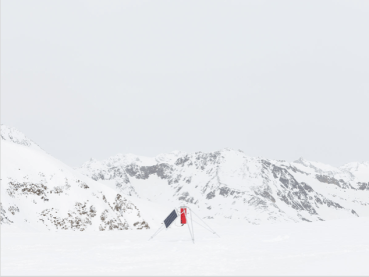
Italian Limes, Glacier 1.png

A panel discussion looking at both material and imagined borders, and the ways in which global warming challenges Western conceptions of territory.

In 2014, Studio Folder initiated the Italian Limes project to survey the fluctuations of the boundary line across the Alps in real time. As a continuation of this project, they have been fascinated by the effects climate change can have on geopolitical understandings of borders and the methods used to represent them.

In this conversation, our panellists will discuss topics of nationalism and cartography using the example of a “moving border” introduced by Italy, Austria, and Switzerland to acknowledge the volatility of the geographical features on Italy’s northern border. The latter is continuously shifting as a result of climate change and often contradicts its representations on official maps. They will both place this case study…

View original post 218 more words

Posted in Uncategorized | 2 Comments

Christopher Watkin, “Nancy is a thinker of Radical Emancipation”, with a response by Jean-Luc Nancy

Christopher Watkin, “Nancy is a thinker of Radical Emancipation”, with a response by Jean-Luc Nancy – plenary talk given at the ‘Thinking with Jean-Luc Nancy’ conference, University of Oxford, 29 March 2019.

Posted in Jean-Luc Nancy, Uncategorized | 1 Comment

Katarzyna Lecky, Pocket Maps and Public Poetry in the English Renaissance – OUP, Early Modern Literary Geographies, 2019

9780198834694Katarzyna Lecky, Pocket Maps and Public Poetry in the English Renaissance – OUP, 2019

This is the latest in the Early Modern Literary Geographies series.

Katarzyna Lecky explores how early modern British poets paid by the state adapted inclusive modes of nationhood charted by inexpensive, small-format maps. She explores chapbooks (‘cheapbooks’) by Edmund Spenser, Samuel Daniel, Ben Jonson, William Davenant, and John Milton alongside the portable cartography circulating in the same retail print industry. Domestic pocket maps were designed for heavy use by a broad readership that included those on the fringes of literacy. The era’s de facto laureates all banked their success as writers appealing to this burgeoning market share by drawing the nation as the property of the commonwealth rather than the Crown.

This book investigates the accessible world of small-format cartography as it emerges in the texts of the poets raised in the expansive public sphere in which pocket maps flourished. It works at the intersections of space, place, and national identity to reveal the geographical imaginary shaping the flourishing business of cheap print. Its placement of poetic economies within mainstream systems of trade also demonstrates how cartography and poetry worked together to mobilize average consumers as political agents. This everyday form of geographic poiesis was also a strong platform for poets writing for monarchs and magistrates when their visions of the nation ran counter to the interests of the government.

Posted in Uncategorized | Leave a comment

Sophie Chiari, Shakespeare’s Representation of Climate, Weather and Environment – EUP 2019

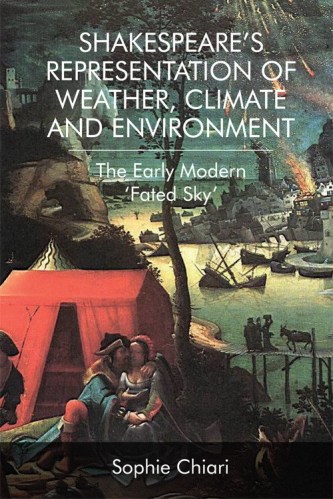
9781474442527_1.jpgSophie Chiari, Shakespeare’s Representation of Climate, Weather and Environment: The Early Modern ‘Fated Sky’ – Edinburgh University Press, 2019

Just an expensive hardback/e-book at the moment, but this looks very interesting. Her essay “Climatic Issues in Early Modern England: Shakespeare’s View of the Sky” in WIRES Climate Change is here, but requires subscription. (Thanks to James Tyner for the link to the shorter piece, which led me to the book.)

The first in-depth exploration of Shakespeare’s representations of climate and the sky

While ecocritical approaches to literary texts receive more and more attention, climate-related issues remain fairly neglected, particularly in the field of Shakespeare studies. This monograph explores the importance of weather and changing skies in early modern England while acknowledging the fact that traditional representations and religious beliefs still fashioned people’s relations to meteorological phenomena. At the same time, a growing number of literati stood against determinism and defended free will, thereby insisting on the ability to act upon celestial forces. Sophie Chiari argues that Shakespeare reconciles the scholarly approaches of his time with popular views rooted in superstition and promotes a sensitive, pragmatic understanding of climatic events. Taking into account the influence of classical thought, each of the book’s seven chapters addresses a different play where sky-related topics are crucial and considers the way climatic phenomena were presented on stage and how they came to shape the production and reception of Shakespeare’s drama.

Introduction
1. ‘We see / The seasons alter’: Climate Change in A Midsummer Night’s Dream
2. ‘[T]he fire is grown too hot!’: Romeo and Juliet and the dog days
3. ‘Winter and rough weather’: Arden’s sterile climate
4. Othello: Shakespeare’s À bout de souffle
5. ‘The pelting of [a] pitiless storm’: Thunder and lightning in King Lear
6. Clime and Slime in Anthony and Cleopatra
7. The I/Eye of the Storm: Prospero’s Tempest
Conclusion: ‘Under heaven’s eye’

Posted in Uncategorized, William Shakespeare | Leave a comment

Viet Thanh Nguyen – How not to bore your audience at a reading

Viet Thanh Nguyen – How not to bore your audience at a reading

Although this advice is for literary readings, there is a lot here that should be useful for academic presentations too.

Posted in Uncategorized | Leave a comment

FWJ Schelling, The Ages of the World (1811) – SUNY Press 2019

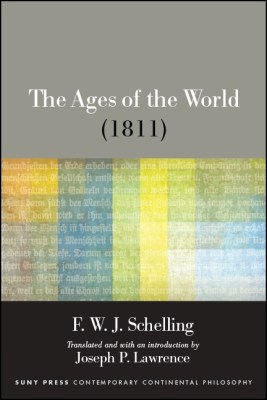
63961_cov.jpgFWJ Schelling, The Ages of the World (1811) – SUNY Press 2019, translated by Joseph P. Lawrence

The first English translation of the first of three versions of this unfinished work by Schelling.

In 1810, after establishing a reputation as Europe’s most prolific philosopher, F. W. J. Schelling embarked on his most ambitious project, The Ages of the World. For over a decade he produced multiple drafts of the work before finally conceding its failure, a “failure” in which Heidegger, Jaspers, Voegelin, and many others have discerned a pivotal moment in the history of philosophy. Slavoj Žižek calls this text the “vanishing mediator,” the project that, even while withheld and concealed from view, connects the epoch of classical metaphysics that stretches from Plato to Hegel with the post-metaphysical thinking that began with Marx and Kierkegaard. Although drafts of the second and third versions from 1813 and 1815 have long been available in English, this translation by Joseph P. Lawrence is the first of the initial 1811 text. In his introductory essay, Lawrence argues for the importance of this first version of the work as the one that reveals the full sweep of Schelling’s intended project, and he explains its significance for concerns in modern science, history, and religion.

Posted in Uncategorized | Leave a comment

David Beer, Portraits of a Pulsating Life: Georg Simmel’s Encounter with Rembrandt – at Berfrois

Rembrandt_-_Rembrandt_and_Saskia_in_the_Scene_of_the_Prodigal_SonDavid Beer, Portraits of a Pulsating Life: Georg Simmel’s Encounter with Rembrandt – at Berfrois

Georg Simmel’s Concluding Thoughts: Worlds, Lives, Fragments is now out with Palgrave.

In May 1913, German sociologist Georg Simmel wrote to the poet and essayist Margarete von Bendemann to express his joy at seeing some ‘magnificent Rembrandts’. The encounter got him thinking. His gushing praise might place him in the category of an enthusiastic fan, but Simmel’s interest went far beyond a mere affection for Rembrandt’s portraits. The following year, Simmel moved from Berlin to Strasbourg, taking up his first proper academic post at the age of 56, and developed an increasing interest in how to conceptualise life. Uncertain times in Europe and the wrench of leaving his beloved Berlin had an impact on both his writing and thinking. Life, experience and modernity had always been preoccupations for Simmel, but something changed. In pursuit of inspiration, Rembrandt’s portraits proved to be source of ideas and insight as Simmel sought out a new conceptual palette. These paintings seemingly gave Simmel a template for how to think about life. Suddenly, inspired by Rembrandt, the theories he had been wrestling with began to take shape.

Rather nervously, Simmel began work on a book about Rembrandt. He wasn’t quite sure of his approach and nor, having only tangentially written about art and art exhibitions in the past, was he confident in his analytical and aesthetic eye. His nerves didn’t actually settle until the book was published and began to sell well – it was eventually the best-selling of his books during his lifetime. The root of Simmel’s anxiety was the unusual nature of the volume he was working on. Cutting across bodies of knowledge and roaming around disciplines, this was an unconventional venture. On the surface it is a long essay in the philosophy of art, look more closely and something else is going on. As Simmel wrote in a letter to Salomon Friedlaender in October 1914, the book he was working on was to pose the ‘problem of life in art’. [continues here]

Posted in Uncategorized | Leave a comment