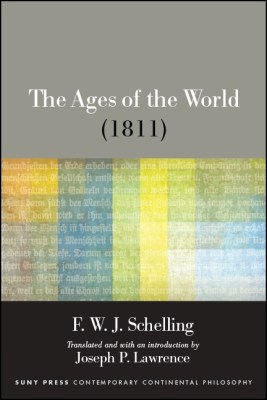
FWJ Schelling, The Ages of the World (1811) – SUNY Press 2019

63961_cov.jpgFWJ Schelling, The Ages of the World (1811) – SUNY Press 2019, translated by Joseph P. Lawrence

The first English translation of the first of three versions of this unfinished work by Schelling.

In 1810, after establishing a reputation as Europe’s most prolific philosopher, F. W. J. Schelling embarked on his most ambitious project, The Ages of the World. For over a decade he produced multiple drafts of the work before finally conceding its failure, a “failure” in which Heidegger, Jaspers, Voegelin, and many others have discerned a pivotal moment in the history of philosophy. Slavoj Žižek calls this text the “vanishing mediator,” the project that, even while withheld and concealed from view, connects the epoch of classical metaphysics that stretches from Plato to Hegel with the post-metaphysical thinking that began with Marx and Kierkegaard. Although drafts of the second and third versions from 1813 and 1815 have long been available in English, this translation by Joseph P. Lawrence is the first of the initial 1811 text. In his introductory essay, Lawrence argues for the importance of this first version of the work as the one that reveals the full sweep of Schelling’s intended project, and he explains its significance for concerns in modern science, history, and religion.

Posted in Uncategorized | Leave a comment

David Beer, Portraits of a Pulsating Life: Georg Simmel’s Encounter with Rembrandt – at Berfrois

Rembrandt_-_Rembrandt_and_Saskia_in_the_Scene_of_the_Prodigal_SonDavid Beer, Portraits of a Pulsating Life: Georg Simmel’s Encounter with Rembrandt – at Berfrois
Georg Simmel’s Concluding Thoughts: Worlds, Lives, Fragments is now out with Palgrave.

In May 1913, German sociologist Georg Simmel wrote to the poet and essayist Margarete von Bendemann to express his joy at seeing some ‘magnificent Rembrandts’. The encounter got him thinking. His gushing praise might place him in the category of an enthusiastic fan, but Simmel’s interest went far beyond a mere affection for Rembrandt’s portraits. The following year, Simmel moved from Berlin to Strasbourg, taking up his first proper academic post at the age of 56, and developed an increasing interest in how to conceptualise life. Uncertain times in Europe and the wrench of leaving his beloved Berlin had an impact on both his writing and thinking. Life, experience and modernity had always been preoccupations for Simmel, but something changed. In pursuit of inspiration, Rembrandt’s portraits proved to be source of ideas and insight as Simmel sought out a new conceptual palette. These paintings seemingly gave Simmel a template for how to think about life. Suddenly, inspired by Rembrandt, the theories he had been wrestling with began to take shape.

Rather nervously, Simmel began work on a book about Rembrandt. He wasn’t quite sure of his approach and nor, having only tangentially written about art and art exhibitions in the past, was he confident in his analytical and aesthetic eye. His nerves didn’t actually settle until the book was published and began to sell well – it was eventually the best-selling of his books during his lifetime. The root of Simmel’s anxiety was the unusual nature of the volume he was working on. Cutting across bodies of knowledge and roaming around disciplines, this was an unconventional venture. On the surface it is a long essay in the philosophy of art, look more closely and something else is going on. As Simmel wrote in a letter to Salomon Friedlaender in October 1914, the book he was working on was to pose the ‘problem of life in art’. [continues here]

Posted in Uncategorized | Leave a comment

Books received – Latour, Valverde, Kantorowicz, and the two versions of Foucault’s L’ordre du discours

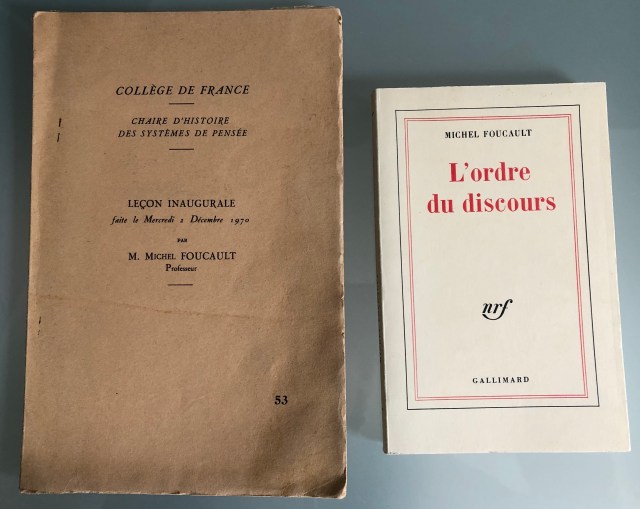
books.jpg

Bruno Latour’s Où atterrir?, Mariana Valverde’s study of Michel Foucault, now in paperback, and Ernst Kantorowicz, Oeuvres – which I mainly got for the biography by Alain Boureau. Also in the pile is a second-hand copy of Foucault’s L’ordre du discours – and the Collège de France publication of that lecture. I had no idea that the latter actually existed until recently, when I was alerted to differences between the versions. The original is very hard to find. I plan to make a systematic comparison of the two texts – which is why I’ve bought a copy of the Gallimard version to mark up. When I do, I’ll post about it here – previous such textual comparisons can be found here.

L'ordre du discours.jpg

Posted in Bruno Latour, Ernst Kantorowicz, Michel Foucault, Uncategorized | 1 Comment

Martín Arboleda — Planetary Mine: Territories of Extraction Under Late Capitalism (Verso, forthcoming January 2020)

Martín Arboleda – Planetary Mine: Territories of Extraction Under Late Capitalism, forthcoming with Verso.

asevillab's avatarmultipliciudades

So, I am breaking the silence on this blog again to share the good news that Martín Arboleda’s Planetary Mine: Territories of Extraction Under Late Capitalism will finally be out with Verso early next year — probably one of the books I am more excited to read soon, blending a political economy of extractive capitalism with planetary urbanization theory.

Planetary_mine_a

Planetary Mine rethinks the politics and territoriality of resource extraction, especially as the mining industry becomes reorganized in the form of logistical networks, and East Asian economies emerge as the new pivot of the capitalist world-system. Through an exploration of the ways in which mines in the Atacama Desert of Chile—the driest in the world—have become intermingled with an expanding constellation of megacities, ports, banks, and factories across East Asia, the book rethinks uneven geographical development in the era of supply chain capitalism. Arguing that extraction entails much more than the…

View original post 55 more words

Posted in Uncategorized | Leave a comment

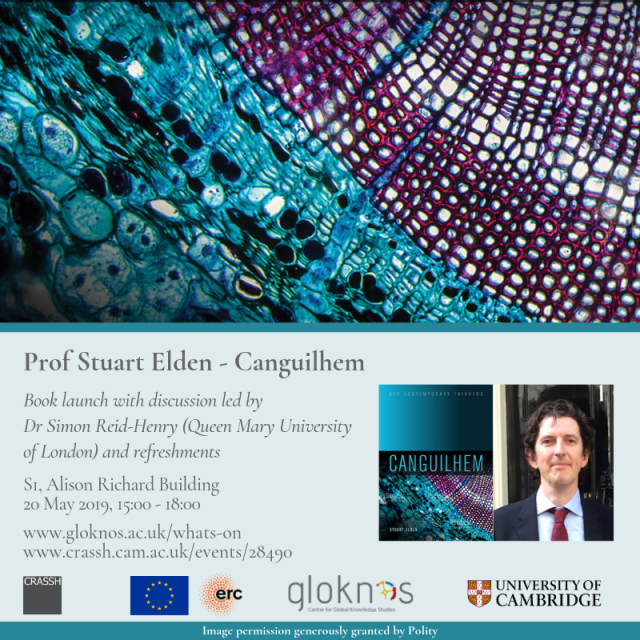
Book launch for Canguilhem, gloknos/CRASSH, University of Cambridge, 20 May 2019

Stuart Elden Square Soc.Med.png
On 20 May at 3pm there will be a book launch for my recently-published book Canguilhem, hosted by gloknos/CRASSH at the University of Cambridge. I’ll be in conversation with Inanna Hamati-Ataya and Simon Reid-Henry.

It will be held in S1, Alison Richard Building, University of Cambridge.

Full details here. Many thanks to Inanna for suggesting and organising this event, and to Simon for agreeing to be part of it.


Posted in Canguilhem (book), Georges Canguilhem, Uncategorized | Leave a comment

Centre Michel Foucault – nouveau site web (2019)

New website for the Centre Michel Foucault

Clare O'Farrell's avatarFoucault News

Centre Michel Foucault

Présentation
Le Centre Michel Foucault est une association fondée le 31 mai 1986 à l’initiative de chercheurs internationaux qui ont accompagné le développement du travail et de la pensée de Michel Foucault.

Initialement créé pour rassembler documents, archives et travaux liés à l’œuvre de Foucault, pour faciliter et coordonner des recherches se rapportant à sa pensée ou s’inspirant de ses orientations et de ses méthodes, et pour développer les échanges internationaux autour de cette œuvre, le Centre Michel Foucault a également accompagné durant les trois dernières décennies la publication des Dits et écrits puis des cours au Collège de France, en lien avec des activités de recherche menées à partir des archives déposées à l’Institut Mémoires de l’édition contemporaine et, depuis 2013, à la Bibliothèque nationale de France.

Le Centre Michel Foucault continue à ce jour d’accompagner la publication de cours, conférences et matériaux inédits, notamment la…

View original post 62 more words

Posted in Uncategorized | Leave a comment

Translating Philosophy and Theory – Style, Rhetoric and Concepts, Warwick, 11 May 2019

Translating Philosophy and Theory – Style, Rhetoric and Concepts, Warwick, 11 May 2019
One-day interdisciplinary conference at HRC Warwick

Saturday, 11th May 2019

Keynote speakers

Dr Lisa Foran, Lecturer in Philosophical Studies, Newcastle University, UK

Professor Andrew Benjamin, Kingston University London, UK / University of Technology, Sydney, Australia

conference registration is open – closes on 25th April.

A provisional programme is now available: Provisional Programme Conference TPT March-April 2019

Conference organised by Melissa Pawelski

Full details here.

Posted in Conferences, Uncategorized | Leave a comment

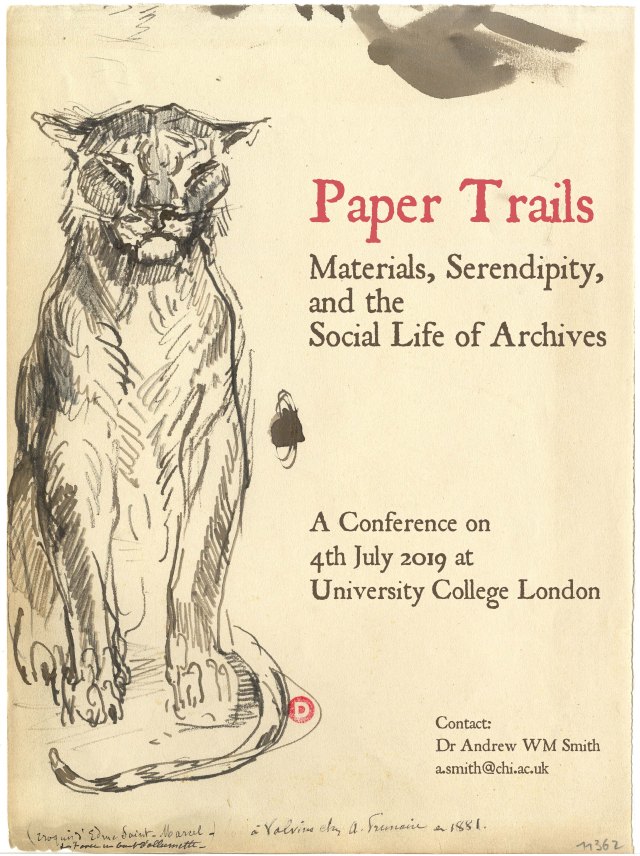
Paper Trails Conference, 4th July 2019, University College London

Paper Trails Conference, 4th July 2019, University College London

Andrew W M Smith's avatarDr Andrew W. M. Smith

Often there is
more than research inside the books we read. Bookmarks, train tickets,
receipts, and menus tucked into pages offer clues about the life of the book
itself. Yet the lives of our research material often go unmarked, lost between
the gaps in disciplinary boundaries and narrow definitions. The biographies of
books and documents can illuminate their contexts, as printed matter that is
sold, passed down or abandoned. What happens when we consider the three moments
of production, transmission, and reception together with our own research
stories? Documents, like people, have births, lives, and even deaths, so what
does it mean to investigate the biographies of texts, objects, and archival
records? Beyond the formal roles of cataloguing and archiving, what part do
researchers play in shaping the emergent archive?

This is not
strictly an intellectual history, nor even a material book history, but
something more like a social history…

View original post 378 more words

Posted in Uncategorized | Leave a comment

Altering cartographies of climate change, Royal Academy, London, 15 April 2019

Altering cartographies of climate change, Royal Academy, London, 15 April 2019, 6.30-8pm

Italian Limes, Glacier 1.png

A panel discussion looking at both material and imagined borders, and the ways in which global warming challenges Western conceptions of territory.

In 2014, Studio Folder initiated the Italian Limes project to survey the fluctuations of the boundary line across the Alps in real time. As a continuation of this project, they have been fascinated by the effects climate change can have on geopolitical understandings of borders and the methods used to represent them.

In this conversation, our panellists will discuss topics of nationalism and cartography using the example of a “moving border” introduced by Italy, Austria, and Switzerland to acknowledge the volatility of the geographical features on Italy’s northern border. The latter is continuously shifting as a result of climate change and often contradicts its representations on official maps. They will both place this case study into a wider context of the history of boundary making and discuss possible spatial interventions that correspond to a world where ecological processes are increasingly dominating geopolitical affairs.

This conversation is inspired by A Moving Border: Alpine Cartographies of Climate Change, published by Columbia University Press co-published by Columbia Books on Architecture and the City and ZKM | Karlsruhe in March 2019.

Speakers:

Andrea Bagnato is an architect, researcher and book editor whose research is focused on architecture and epidemiology. He is also the editor of SQM: The Quantified Home (2014).

Stuart Elden is Professor of Political Theory and Geography at The University of Warwick, whose research is at the intersection of politics, philosophy and geography. He is also the author of The Birth of Territory (2014).

Marco Ferrari is an architect, designer and co-founder of Studio Folder, an agency for visual and spatial research.

Susan Schuppli is an artist and researcher whose current work explores the ways in which toxic ecologies are producing an “extreme image” archive of material wrongs.

Isabelle Kirkham-Lewitt (chair) is a designer, writer, and editor. She is the assistant director of Columbia Books on Architecture and the City, and the managing editor of the Avery Review.

Benjamin West Lecture Theatre, Burlington Gardens, Royal Academy of Arts

£15, £9

Posted in terrain, Territory, Uncategorized | 1 Comment

Orienting Ourselves in the World: The Particular and the General, University of Manchester, 9 May 2019

Update: 5 April – just been told a few places are available, but be quick.

WORKSHOP
Orienting Ourselves in the World: The Particular and the General
Thursday 9 May 2019, 11am-5:30pm (coffee from 11, programme start at 11:30)
The University of Manchester, University Place 2.220
Speakers:
Molly Andrews (University of East London)
Amanda Beattie (Aston University)
Martin Coward (University of Manchester)
Naeem Inayatullah (Ithaca College)
Uma Kothari (University of Manchester)
Joe Turner (Sheffield University)
Convenors: Maja Zehfuss and Jenny Edkins
Organised by the Critical Global Politics Research Cluster, University of Manchester
When we think and act, we often – possibly always – bring together the particular and the general.  As we forge ways to lead our life, we do things that we experience as personal, unique.  At the same time, we do so in the context of our immigration status, racialization, gender, ideas about what constitutes love or the kind of education we aspire to.  The world becomes sensible to us through general ideas, even as we interpret, disrupt and produce our relationalities in profoundly personal ways.  This need to connect two apparently distinct ways of perceiving and indeed being in the world also give rise to different modes of generating scholarly work, one ostensibly abstract or analytic, the other engaging and personal.
In this context, the workshop asks:
•             How do we think the particular and the general together to orient ourselves in the world?
•             Does becoming ever more personal simultaneously approach the universal?
•             Does decolonization involve a rethinking of relations between the particular and the universal?
•             What implications does engaging with these questions have for our ways of being scholars?
•             What sort of responses does telling stories prompt that academic reflections don’t (and vice versa)?
•             Can fiction approach the universal more easily than non-fiction?
•             What role do theory and abstraction play in experiencing, thinking about and representing the particular?
The sessions of the workshop will combine brief analytic provocations and short stories designed to set the scene for a wide-ranging general conversation examining the questions at stake.
This is a free event but booking is required and places are limited. Please register here: https://www.eventbrite.co.uk/e/orienting-ourselves-in-the-world-the-particular-and-the-general-tickets-59225666563
This workshop is sponsored by the BISA Colonial, Postcolonial and Decolonial Working Group, the BISA Post-structural Politics Working Group and the University of Manchester.
Posted in Conferences, Jenny Edkins, Maja Zehfuss, Uncategorized | Leave a comment