Announcing Antipode’s 7th Institute for the Geographies of Justice, Mexico City, 17-21 June 2019

Details of the next Antipode Institute for the Geographies of Justice

Antipode Editorial Office's avatarAntipodeFoundation.org

Antipode’s 7th Institute for the Geographies of Justice

Antipode’s 7th Institute for the Geographies of Justice (IGJ) will take place in Mexico City, Mexico, from June 17th to 21st 2019.

To date, Antipode had hosted six Institutes for the Geographies of Justice (IGJ): Athens, Georgia, USA (2007), Manchester, UK (2009), Athens, Georgia, USA (2011), Durban, South Africa (2013), Johannesburg, South Africa (2015), Montréal, Québec, Canada (2017). We are delighted to announce that the 7th Institute will be held in Mexico City from June 17th to 21st 2019. Antipode’s 7th IGJ will provide an exciting opportunity to engage leading edge theoretical, methodological, and research-practice issues in the field of radical geography and social justice (both broadly defined), along with a range of associated professional and career development matters. This international meeting will be specifically designed to meet the needs…

View original post 392 more words

Posted in Uncategorized | Leave a comment

Georges Bataille on Nietzsche, the journal Acéphale and the Secret Society

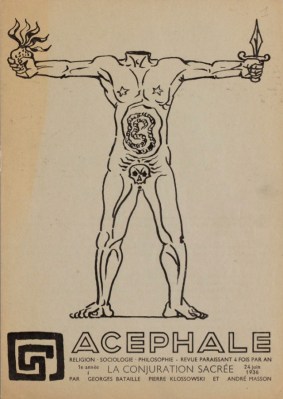
640px-Acephale_1_Jun_1936While I’ve mainly been consumed by start-of-term stuff, I have been following up on a few leads in relation to the Foucault work. One of these was a piece by Georges Bataille on Nietzsche, first published in his short-lived journal Acéphale. The British Library has copies of two original issues of Acéphale – both double issues, though still very short. Pdfs of the whole short run are available at Monoskop.

Bataille is a fascinating and disturbing figure, and I’ve just started reading Michel Surya’s biography of him. While looking in the BL catalogue, I found the Encyclopædia Acephalica, published by Atlas Press, which wasn’t quite what I was expecting, but provides a lot of other material by and related to Bataille. It had a useful bibliography which has suggested a few more things to look at. But what it revealed to me was that Acéphale wasn’t just the name of the journal, but also a secret society founded by Bataille. I’m not sure how far down this particular rabbit-hole I will go, but I found that there was a recent publication in English of a host of material related to this society.

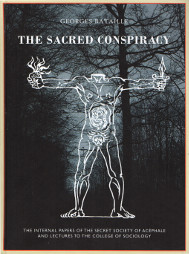
eclectics19It’s entitled The Sacred Conspiracy: The Internal Papers of the Secret Society of Acephale (Atlas Press, 2018). Here’s the publisher’s description:

This book recounts what must be one of the most unusual intellectual journeys of modern times, in which Georges Bataille — still best known outside of France as a highly wrought pornographer (The Story of the Eye etc.) — have spent the early Thirties in far-left groups opposing the rise of Fascism, abandoned that approach in order to transfer the struggle on to “the mythological plane”.

In 1937, he founded two groups in order to explore the combinations of power and the “sacred” at work in society (Bataille associated the sacred with expenditure, eroticism and death). The first group, the College of Sociology, gave lectures that were intended to reveal the hidden undercurrents within a society on the verge of catastrophe. Bataille and Roger Caillois produced some of their finest texts for these sessions, in which many of the most celebrated intellectuals of the period participated. The second group was Acéphale, a genuine secret society whose emblem was a headless figure that in part represented the death of God. This “ferocious” anti-religion enacted torch-lit rituals in a forest at night beneath an oak tree that has been struck by lightening. Until the discovery a few years ago of the group’s internal papers (which include theoretical texts, meditations, minutes of meetings, rules and prohibitions and even a membership list), almost nothing was known of its activities. Here is the story of what must be among the strangest associations in political, literary or occult history.

This book is the first to collect a representative selection of the writings of Bataille, and of those close to him, in the years leading up to the war. They judged that the time was right to confront the most intractable problems of the human condition head-on: how to live an integrated existence in a universe that was ruthless, absurd and indifferent? And how to oppose repressive and unequal social structures given the obvious impotence of the democracies and the political left when faced with far-right ideology? Such themes have a renewed resonance today.

The texts published here comprise lectures given to the College of Sociology by Bataille, Caillois and Michel Leiris, essays from the Acéphale journal and a large cache of the internal papers from the secret society. A desparate narrative unfolds, and Bataille risked all in this wholely unreasonable quest. With a few fellow travellers, he underook what he later described as a “journey out of this world”.

It looks compendious (480 pp.), richly-illustrated and affordable at £25, especially for such a big book. A quick check of Worldcat suggests no UK libraries have a copy, so it’s now on order.

Aside from Foucault reading the journal (there are notes on it in Paris), another link is that in the 1960s Foucault was part of a tribute issue of Critique to Bataille – a journal Bataille founded. This is the well-known ‘Preface to Transgression’ piece. But Foucault also wrote the brief preface to the first volume of Bataille’s Oeuvres complètes, published in 1970, which I don’t think has ever been translated. Foucault was clearly involved in some way with the planning of the Oeuvres complètes, since he used multiple copies of pages of a draft plan as scrap paper – they are found in multiple boxes of his papers in Paris. If I continue my work on Foucault for a book on the 1960s I’ll need to dig into this further, but for now I’m interested in finding out more about Bataille’s early work, especially around Nietzsche. And finally on that, I was surprised to realise that there was a new translation of his book On Nietzsche, which appeared in 2015 with SUNY Press, translated by Stuart Kendell. I only knew the earlier version, translated by Bruce Boone with Athlone/Continuum/Bloomsbury, which I bought and read probably 20 years ago.

Posted in Friedrich Nietzsche, Georges Bataille, The Early Foucault, Uncategorized | 11 Comments

The Early Foucault Update 20: Paris, some cautions and future work

EF20.jpgIt’s been steady progress in the last part of summer on the manuscript of The Early FoucaultI had a few days in Paris in mid-September, where I did my usual pattern of working in the Richelieu site of the Bibliothèque Nationale when it was open, and then heading to either the Mitterrand site or the Bibliothèque Sainte-Geneviève in the early evening. At the latter two libraries I was able to read and check a number of things I can’t access in London. The Richelieu site houses the Foucault fonds, and for the first time in all my visits here I looked at no new material. Instead I went back over the folders relating to Nietzsche, Histoire de la folie and the early courses from Lille and the ENS. Some of this was to recheck small details, and some to reread material which I am writing about. Although much of this material is due to be published, there are fragments of material which I think are unlikely to be included, and as I’ve mentioned before the editors are not simply transcribing the material. There is a good deal of interpretative work in their labours, and although I have the highest respect for what they do, and would rarely take a divergent view, I want to examine the material in the raw state as much as possible.

One thing I noticed this time, is that some of the other people looking at this material, whether editors, archivists or other researchers, are actually moving some of the material around a little. I have detailed notes of what I’ve previously read, and I note things like ‘b2f’ if I think a page is filed back to front, or when things are in the wrong number order. But on rereading things these were often put back into the ‘correct’ order. I’m scrupulous in leaving things exactly as I found them, and had assumed that others would be too. Some pages are numbered, but not all, and some have two sets of numbers. Some are labelled on recto and verso, some on recto only. Other pages are sometimes inserted in the middle of a sequence, sometimes of different style or paper. The original folders, often with Foucault’s handwriting, are generally enclosed in newer cleaner folders – some of the original ones are falling apart. Some of the slips of paper folded around sheets are Foucault’s; others are not.

It’s been noted before by me and others that the broadly thematic ordering of these materials is the way that Foucault left them, rather than another order which might make sense. We know that Foucault reorganized his reading notes as he worked on new projects, often bringing different sets of notes from quite different time periods together. He also took material from lecture courses to reuse when he was visiting another university, and sometimes wrote over part of the original material something which related to the new outlet. This is sometimes very confusing. Foucault dated almost nothing. Of course, these were his working folders, intended for his own teaching and research use, not in preparation for future researchers. Defert has added slips of paper to indicate provenance of material, and written on some of the folders. Many hands have handled these materials since Foucault, from Defert, to the librarians and archivists, to other researchers like me. What it means that we need to be really careful in claiming that an arrangement or order is solely down to Foucault.

We also need to be careful in terms of an orthodoxy that can exist. While there are many contrasts between the three biographies of Foucault (Eribon, Macey and Miller), there are moments where they all agree. In some ways this is not surprising – Eribon was an important source for both Macey and Miller. But other times all of them reference a single source for a claim. But if that source turns out to be even slightly incorrect or misleading, then its error gets replicated again and again, given that so many other accounts rely on the biographies – myself included. A few times checking back to that original source, and then checking something it says against another source raised something which didn’t seem quite right. Sometimes this is a long, and time-consuming dead end. But just occasionally, it opens up an intriguing new perspective on something. All the biographies remain valuable resources, since they are each the only sources for key claims – all did interviews which are otherwise unpublished, and many of those interviewees are no longer alive.

Many of the leads in the biographies opened up more questions than answers. Many of the figures in Foucault’s early career are well known. Others were, at least to me, obscure. So I have been reading up on some of his colleagues, publishers, mentors and others. Often this gives details that I can’t possibly use for this book, but just occasionally it helps me to make a connection that seems important. One dead end was trying to see if   Georges Duhamel (1884-1966) and Jacques Duhamel (1924-1977) were related. The former was a novelist, poet and president of the Academie française, and the latter a politician. They are not father and son, but both are connected to Foucault in the 1950s. Georges was responsible for Foucault entering the Fondation Thiers; Colette Duhamel, married to Jacques and later to Claude Gallimard, was his editor at La Table Ronde. More useful was the excellent first volume of the biography of Althusser by Yann Moulier Boutang. I read this in the 2002 reedition in two parts. But it only takes the story up to 1956. Will other volumes ever see the light of day? Following the lead of Edward Baring on the young Derrida and more generally Alan Schrift, I also went back to look at the French agrégation in the early 1950s. Foucault sat this demanding exam twice, passing on the second occasion. The curriculum for each year was set, so I went looking for details of the relevant years. This has led to a few more questions which will take some archival work to fully work through.

Just before term began, I printed the whole manuscript as it currently exists. I don’t print drafts very often – this is the first time for this manuscript. There are a couple of big holes – the discussion of the Kant translation and introduction, and History of Madness itself – and many smaller ones. There are also a whole lot of things to check, follow up, or revise. I have system of colour-coding when I highlight things that need work – for home, Warwick, London libraries, Paris and IMEC. It makes the text a bit messy, but I can both immediately see things that need resolving, and where I can do them. Several of these are things that will take little time, but it helps to be able to go through material and see what, if anything, I can try to resolve in the place I currently am.

I know that I need more trips to Paris, at least one to IMEC, and hopefully some time in Uppsala to continue the work for this book. Ideally I’d also get to Tübingen to look through the Binswanger papers, perhaps back to Yale, and even to Irvine…  But none of that will happen for a while, since it is now term time, and I also need to turn to the proofs of the Canguilhem book, which have just arrived.


The previous updates on this project are here; and the previous books Foucault’s Last Decade and Foucault: The Birth of Power are both available from Polity. Canguilhem is forthcoming in early 2019, and is discussed a bit more here. Several Foucault research resources such as bibliographies, short translations, textual comparisons and so on are available here.
Posted in Daniel Defert, Immanuel Kant, Jacques Derrida, Louis Althusser, Michel Foucault, The Early Foucault, Uncategorized | 1 Comment

Open access journals, guest editors, and a new means of exploitation

I’ve recently turned down an ‘invitation’ to serve as the editor of an article for a new open access journal. It’s actually with a recognised an reputable publisher, rather than these pop-up ones of dubious merit. Given its very broad remit, they need to find guest editors, as well as peer reviewers, for any submission.

Two things rankled about this. First, was their claim that acting as editor was less time, though more responsibility, than being a reviewer. I edited the Society and Space journal for nine years, and Foucault Studies for a couple. One is subscription based, one open access. I really think that the first part of the claim isn’t the case. I can review an article in a couple of hours. I can’t serve as editor for an article in that time, unless it is a simple reject before review or that very rare thing of an unconditional accept. An editor has to read the submission, decide reviewers, read the reports, balance their claims and maybe reread the paper, make a decision, write a decision letter, and unless it is a categorical reject, read a revision or resubmission, maybe get more reports, etc. Almost all submissions involve some correspondence with the author.

But I was also dismayed by the business practice. The journal requires an author processing charge from authors, but then outsources the editing to academics. As article editor I’d have been given access to journals for a short period (which I already have through Warwick) and a ‘free book’, though they were clear to exempt their most expensive titles. Doubtless the actual reviewers get even less. So where does the APC go? I recognise that there are other parts of the production process for accepted articles (copyediting, design, etc.), but the editorial part is crucial, and here it is clearly done on the cheap. Open access was supposed to be about freeing up the product of academic research, but it seems to now be about cutting costs and making profits for corporate publishers.

I said most of the above in my reply refusing to take on this work. I’m under no illusion that this one refusal will make any difference. But it seems that this practice is, as yet, relatively little known. What are others doing about such requests?


Posted in Publishing, Uncategorized | 3 Comments

Klaus Dodds and Mark Nuttall, The Arctic: What Everyone Needs to Know – OUP 2019

9780190649807.jpgKlaus Dodds and Mark Nuttall, The Arctic: What Everyone Needs to Know – OUP 2019

Conversations defining the Arctic region often provoke debate and controversy — for scientists, this lies in the imprecise and imaginary line known as the Arctic Circle; for countries like Canada, Russia, the United States, and Denmark, such discussions are based in competition for land and resources; for indigenous communities, those discussions are also rooted in issues of rights. These shifting lines are only made murkier by the threat of global climate change. In the Arctic Ocean, the consequences of Earth’s warming trend are most immediately observable in the multi-year and perennial ice that has begun to melt, which threatens ice-dependent microorganisms and, eventually, will disrupt all of Arctic life and raise sea levels globally.

In The Arctic: What Everyone Needs to Know®, Klaus Dodds and Mark Nuttall offer concise answers to the myriad questions that arise when looking at the circumpolar North. They focus on its peoples, politics, environment, resource development, and conservation to provide critical information about how changes there can, and will, affect our entire globe and all of its inhabitants. Dodds and Nuttall explore how the Arctic’s importance has grown over time, the region’s role during the Cold War, indigenous communities and their history, and the past and future of the Arctic’s governance, among other crucial topics.

Looks good, though depressing to see how frequently OUP refer to the registered trademark of ‘What Everyone Needs to Know‘.

Posted in Publishing, Uncategorized | Leave a comment

Books received – Wahl, Arendt, Foucault, Jaspers, Geroulanos, Bulpitt, Derrida, Gotman

books.jpg

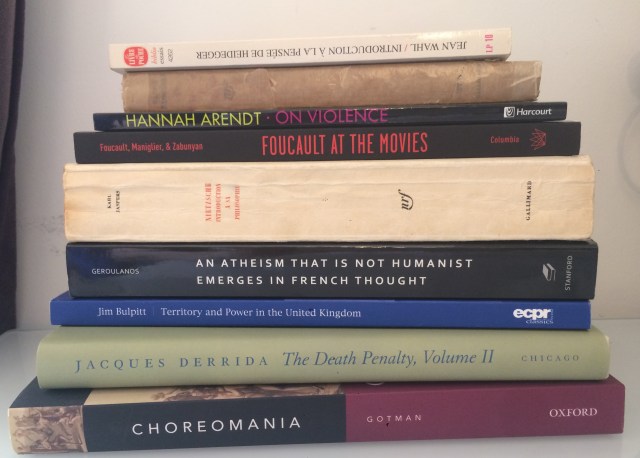
A mix of books for teaching and the Foucault research – Jean Wahl, Introduction à la pensée de Heidegger; the Henri Corbin early translation of works by Heidegger; Hannah Arendt, On Violence; Foucault at the Movies; the French translation of Karl Jaspers’s book on Nietzsche; Stefanos Geroulanos, An Atheism that is not Humanist Emerges in French Thought; Jim Bulpitt, Territory and Power in the United KingdomJacques Derrida, The Death Penalty, Volume II, and Kélina Gotman, Choreomania: Dance and Disorder.

Most were bought new or second-hand, though the Bulpitt book was recompense for review work, and Foucault at the Movies was sent by the publisher.

Posted in Hannah Arendt, Jacques Derrida, Martin Heidegger, Michel Foucault, Territory, Uncategorized | Leave a comment

On translating Foucault at the movies (2018)

Clare O’Farrell reflects on the translation of Foucault – Foucault at the Movies has just appeared with Colombia University Press

Clare O'Farrell's avatarFoucault News

Clare O’Farrell on Translating Foucault at the Movies, Columbia University Press blog, September 27, 2018

Today for National Translation Month we are presenting our film fans with a guest post from Clare O’Farrell who translated Foucault at the Movies by Michel Foucault, Patrice Maniglier, and Dork Zabunyan. In this post, O’Farrell gives a personal account of the challenges and opportunities that arose from this project. Foucault at the Movies brings together all of Foucault’s commentary on film, some of it available for the first time in English, along with important contemporary analysis and further extensions of this work. It offers detailed, up-to-date commentary, inviting us to go to the movies with Foucault.

Enter our drawing for a chance to win a copy of this book!

read more…

View original post

Posted in Uncategorized | Leave a comment

Tips for managing email as an academic – Veronika Cheplygina

Tips for managing email as an academic – Veronika Cheplygina has some good advice.

I’m a believer in Inbox Zero, but this doesn’t mean that all emails have yet been answered. It means that there is nothing kept in the inbox which I have already seen. The plan is the next time I see that email it will be when I have time to deal with it.

As I’ve mentioned before I use Sanebox as a filtering and snoozing function. It filters less important emails into other folders which I check regularly, but less frequently than the inbox. You can train it over time. You can also drop emails into folders so that they appear in your inbox tomorrow or next week. You can forward emails to an address to reappear at a specific time – handy if its directions to or an agenda for a meeting, etc. It’s like a virtual PA. I really can’t imagine trying to do email without it anymore.

I’ve not used plugins that allow you schedule when emails are sent. But I do save a lot of replies to drafts, and then send them at a later point – i.e. if I sort a lot of emails on a Sunday, I’ll send on a Monday morning.

Posted in Uncategorized | Leave a comment

Landscape as Territory – forthcoming book, Actar 2019, edited by Clara Olóriz Sanjuán and funded by Graham Foundation

1537805994.jpgSome good news from the Architectural Association. Clara Olóriz Sanjuán and her team have been awarded a grant from the Graham Foundation for an edited book on Landscape as Territory. Full details here. I have a piece in the book, based on a lecture I gave at the AA in 2015.

Landscape as Territory is a cartographic book project that critically addresses the agency of architects in the so-called “urban age,” through an understanding of territory as a design praxis through which consequential landscapes are produced. Territory, understood as a “political technology,” has the capacity to involve architects and designers into complex social, political, technical, legal, strategic, and economic processes that are both historical and geographical engines of contemporary urbanization. Territorial praxis is interrogated in a collection of threaded theory and design contributions where essays pose key questions that are addressed through projective cartographies, unfolding arguments related to three sections: (1) territory, (2) critical cartographies and (3) agency. This material proposes a critical reappropriation of cartographic tools, complicit in the production of territories, to question and expand the architect’s agency, beyond its current disciplinary confinements.

Posted in Territory, Uncategorized | Leave a comment

AA, Westminster and Greenwich collaborate on international symposium

Programme for an exciting event at the Architectural Association on 26 October. i’ll be in conversation with Neil Brenner and Jose Alfredo Ramirez.

The Landscape's avatarThe Landscape

Ed Wall (University of Greenwich), Lindsay Bremner (University of Westminster) and Alfredo Ramirez (Architecture Association) are co-organising a symposium on 26 October 2018 exploring Design Agency within Earth Systems.

Speakers include: Neil Brenner (UTL, Harvard GSD); Stuart Elden (Warwick University); El Hadi Jazairy and Rania Ghosn (Design Earth); Marti Franch (EMF Landscape Architecture) and Caroline Knowles (Goldsmiths).

Print8,000 metres above the sea level exists what climbers call the “death zone”. This altitude marks the limit for human habitation, above which our species cannot survive. We thrive in the “life zone” – the earth’s land surfaces and oceans, its geological layers beneath, the dynamic atmosphere above – all affected by gravitational magnetic forces beyond. This living world is constantly being transformed by our social, economic and political interactions revealing our intricate dependences on the earth and its systems. Terms such as…

View original post 48 more words

Posted in Uncategorized | Leave a comment