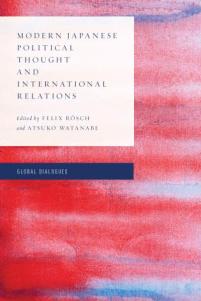
Modern Japanese Political Thought and International Relations, edited by Felix Rösch and Atsuko Watanabe – forthcoming in September 2018

9781786603678Modern Japanese Political Thought and International Relations, edited by Felix Rösch and Atsuko Watanabe – forthcoming in September 2018

In an ever more globalized world, sustainable global development requires effective intercultural co-operations. This dialogue between non-western and western cultures is essential to identifying global solutions for global socio-political challenges.

Modern Japanese Political Thought and International Relations critiques the formation of non-western International Relations by assessing Japanese political concepts to contemporary IR discourses since the Meji Restoration, to better understand knowledge exchanges in intercultural contexts. Each chapter focuses on a particular aspect of this dialogue, from international law and nationalism to concepts of peace and Daoism, this collection grapples with postcolonial questions of Japan’s indigenous IR theory.

Posted in Uncategorized | Leave a comment

Goldsmiths Annual Philosophy Lecture – Alienation & Freedom: Frantz Fanon – 1 June 2018, 4pm

Goldsmiths Annual Philosophy Lecture – Alienation & Freedom: Frantz Fanon – 1 June 2018, 4pm – free, but registration required

Jean Khalfa and Robert J.C. Young give the first Goldsmiths Annual Philosophy Lecture, on the hitherto unpublished and unavailable works of Frantz Fanon.

Since the publication of The Wretched of the Earth in 1961, Fanon’s work has been deeply significant for generations of intellectuals, philosophers and activists seeking to radically interrogate our understandings of violence, race, political subjectivity, mental illness and the challenges of decolonization. In CPCT’s first annual lecture, we are joined by the editors of the landmark collection Alienation and Freedom. This volume collects together unpublished and unavailable works comprising around half of Fanon’s entire output – which were previously inaccessible or thought to be lost. This book introduces audiences to a new Fanon, a more personal Fanon and one whose literary and psychiatric works, in particular, take centre stage. Khalfa and Young will explore how these writings provide new depth and complexity to our understanding of Fanon’s entire oeuvre, revealing more of his powerful thinking about identity, race and activism which remain remarkably prescient. The talk will shed new light on the work of a major 20th-century philosopher, and on newly available texts which oblige us to take a fresh look at the intellectual history of anti-colonial and post-colonial thought, as well as to address with Fanon some of the most pressing theoretical issues of our time.

The lecture will be followed by a response by Jane Hiddleston and will also feature a performance-reading of excerpts from the two plays by Fanon included in Alienation & Freedom: The Drowning Eye and Parallel Hands.

Jean Khalfa is a Senior Lecturer in French Studies at Trinity College, University of Cambridge. He is the editor of the first complete edition of Michel Foucault’s History of Madness (2006) and author of Poetics of the Antilles (2016) and an upcoming work on Frantz Fanon’s The Wretched of the Earth.

Robert J. C. Young, FBA, is Julius Silver Professor of English and Comparative Literature at New York University, USA. He is the author of White Mythologies (1990), Colonial Desire (1995), Postcolonialism: An Historical Introduction (2001), The Idea of English Ethnicity (2008), Empire, Colony, Postcolony (2015).

Jane Hiddleston is Exeter College Professor of Literatures in French at the University of Oxford, and the author, most recently of Writing after Postcolonialism: Francophone North African Literature in Transition.

All welcome.

https://cpct.uk/

https://www.gold.ac.uk/cpct/

Posted in Uncategorized | 1 Comment

April Update (a bit late…)

Jeff Veitch has a roundup of his recent work, including some generous comments about my Foucault’s Last Decade book.

Jeff D Veitch's avatarAncient Noise

April just flew by! It was filled with various different and competing projects, including publication editing, manuscript writing and applications… as well as too many hours on the bike. Here is my review of the month and look forward to May (which has already started at a sprint pace).

Writing

I had several writing projects in April and all seemed to move forward in various degrees. I had some reviewer comments to address for a publication chapter, which I started (unfortunately did not finish). I agreed with much of the reviewers assessment and suggestions, which was useful and I am happy with the direction the chapter is going. What caused some problems was the order of the original chapter had to be changed. I had divided the chapter into several sub-sections in the original layout, but merged a couple of sub-sections and had to rewrite most of the transitions and…

View original post 1,357 more words

Posted in Uncategorized | Leave a comment

Place, Space, and Hermeneutics (ed. Bruce Janz)

A long review of what looks like a very interesting – though expensive – collection.

Peter Gratton's avatarPHILOSOPHY IN A TIME OF ERROR

Reviewed here at Phenomenological Reviews. I contributed a chapter on Lefebvre (trying to make connections between his own thinking of place and Heidegger’s work in particular), but the whole collection is chockful of excellent writings, though given its price, you might want to get it through a library.

View original post

Posted in Uncategorized | Leave a comment

Miguel de Beistegui interview with 3am – Who are we today? Foucault: Proust: Deleuze

Miguel de Beistegui interview with 3am – Who are we today? Foucault: Proust: Deleuze

Miguel de Beistegui specialises in 20th century German and French philosophy, and has published books and articles in the following areas: ontology, metaphysics, aesthetics, ethics and politics. Initially specialising in the thought of Martin Heidegger, and in phenomenology in general, he has become convinced that philosophy needs to resist extreme specialisation and develop the conceptual tools to engage with our time. This means that it needs to bring together the various branches of philosophy, but also establish a dialogue between philosophy and the other disciplines, in the social as well as the natural sciences. Here he discusses Foucault and desire from a genealogical perspective, why ours is a civilisation of desire, aesthetics after metaphysics, metaphor, the hypersensible, the philosophical Proust, Deleuze and immanence, and Delueze and Heidegger.

Posted in Gilles Deleuze, Michel Foucault, Uncategorized | 1 Comment

Antipode Foundation Scholar-Activist Project and International Workshop Awards – application deadline 31 May 2018

Antipode Foundation Scholar-Activist Project and International Workshop Awards – application deadline 31 May 2018 – full details here.

As many will know, Antipode: A Radical Journal of Geography is owned by the Antipode Foundation, a charity registered here in the UK. The Foundation grants an exclusive right to publish the journal to Wiley, and the surplus received is reinvested in the wider critical geography community. As well as Antipode’s Lecture Series and the Institute for the Geographies of Justice, among other things the Foundation makes two kinds of grants. 2018 is the sixth year of the Antipode Foundation’s Scholar-Activist Project and International Workshop Awards.

Posted in Uncategorized | Leave a comment

Andreas Bieler and Adam David Morton, Global Capitalism, Global War, Global Crisis – now out with Cambridge

Now published. Book launch in Nottingham on 20 June 2018 – details here http://ppesydney.net/book-launch-global-capitalism-global-war-global-crisis/

stuartelden's avatarProgressive Geographies

9781108452632Andreas Bieler and Adam David Morton, Global Capitalism, Global War, Global Crisis – now out with Cambridge University Press

This book assesses the forces of social struggle shaping the past and present of the global political economy from the perspective of historical materialism. Based on the philosophy of internal relations, the character of capital is understood in such a way that the ties between the relations of production, state-civil society, and conditions of class struggle can be realised. Conceiving the internal relationship of global capitalism, global war, global crisis as a struggle-driven process is a major contribution of the book providing a novel intervention on debates within theories of ‘the international’. Through a set of conceptual reflections, on agency and structure and the role of discourses embedded in the economy, class struggle is established as our point of departure. This involves analysing historical and contemporary themes on the expansion of…

View original post 488 more words

Posted in Uncategorized | Leave a comment

Job Vacancy: Assistant Professor in Political Theory at University of Warwick

Applications are invited for an indefinite Assistant Professorship in Political Theory in the Department of Politics and International Studies (PAIS) at the University of Warwick. The position is open with respect to specialism within political theory, but preference will be given to candidates who are able and willing to teach modules addressing historical political thought.

Applications from female candidates and those from a minority ethnic background are particularly welcome as these groups are currently underrepresented within the Department.

The successful candidate will have a demonstrable track record of delivering high-quality research publications ahead of REF2021 and a commitment to securing external grant income in support of their research programme.

For an informal and confidential discussion about this opportunity, please contact Professor Simon Caney (s.caney@warwick.ac.uk).

For more information, and to apply, please see: https://atsv7.wcn.co.uk/search_engine/jobs.cgi?owner=5062452&ownertype=fair&jcode=1727017&vt_template=1457&adminview=1

Posted in Uncategorized | Leave a comment

Things to do and check when putting together a book or thesis manuscript

This is my list of things I do when pulling together a long manuscript like a book, often from separate files. I tend to delay pulling the separate chapters into a single file or two until quite late, as editing long documents can be a bit unwieldy. But there are certainly some benefits from having a single file.

A conversation with a near-to-completion PhD researcher made me think this might be useful for others. He asked what things he needed to do while putting his entire thesis together for submission. I was thinking of this as I finalized the draft of the Canguilhem book, so I thought I’d keep a note and put this post together.

Essential

Check your thesis or publisher style requirements – this should of course have been done long ago, but worth another look now.

If you put notes to yourself in the text, find them all, resolve and delete. By this I mean things like ‘check’, ‘find ref’, ‘link’ etc. I put these in square brackets, or highlight them, so a simple FIND can locate them all. You don’t want others seeing these. I also sometimes strike through text that might be deleted when editing, and you can search for this or other styles that may lurk in the text.

Style Issues

  • Consistent font, point size etc.
  • Consistent use of headings and subheadings – both in style and hierarchy
  • Uniform line spacing, spacing between paragraphs, indents, numbered and unnumbered lists.
  • Ensure all text is set to correct language (i.e. UK English) and spellcheck
  • Double-check spelling of proper names – ignore all or add to dictionary when spellchecking to catch errors on repeated uses
  • If you use foreign words, ensure they are spelled correctly, accents are correct, and transliteration is done consistently (there can be more than one correct way, but follow a consistent one).
  • Use page numbers, and make sure they actually run in sequence (this can get muddled if adding sections)
  • If you have phrases or expressions you overuse, this is a good time to search for them and replace some.

References 

  • Check all references are formatted correctly. If you use Endnote or other referencing software this should be straightforward, but always worth checking carefully.
  • If using notes, ensure full reference on first use, and short reference thereafter.
  • If using a reference list, then check all references appear in text, and vice versa.
  • Check and format the bibliography, if needed. Check rules for alphabetization.
  • Try not to use different editions of the same text, unless there is a point to this.
  • Include names of editors and translators.
  • If you or your publisher insist on ibid and op cit, check this all very carefully. It is very easy for these to get detached or disordered if you move text around.
  • As you merge endnotes from separate files, insert Chapter divides into the note file, and restart note numbering by section.

For more on reading and citing, though mainly for an earlier stage of the project, see here, and on double-checking references here

Text

  • Consistency on style of dates, centuries, numbers (one to ten, 11- or similar), etc.
  • Find double spaces and replace (unless you really want them there…)
  • Find spaces before punctuation marks; double punctuation marks, etc.
  • Single or double quotes – be consistent.
  • If using abbreviations, ensure they are defined on first use.
  • For names of people, first name on first use, surname thereafter, unless there might be confusion with common names.

General

  • Print and read at least once on paper instead of on screen.
  • Get someone else to read it.

I’m sure there are more. I’ll add more if I think of them, but suggestions or additions very welcome. (Ironically, I had a real job of getting this post to appear as I wanted.)

There are lots more suggestions and links about writing and publishing here.

Posted in Publishing, Writing | Leave a comment

Franco Farinelli, Blinding Polyphemus: Geography and the Models of the World

CI_14736606670.jpgFranco Farinelli, Blinding Polyphemus: Geography and the Models of the World, translated by Christina Chalmers and in Seagull Books Italian list.

This appeared over a year ago, but I didn’t realise this was in English until Alberto Toscano kindly gave me a copy today. Italian geographer friends have long told me of the importance of Farinelli’s work, and I’ve only read a little of it in French – this is the first book of his in English.

Today, we believe that the map is a copy of the Earth, without realizing that the opposite is true: in our culture, the Earth has assumed the form of a map. In Blinding Polyphemus, Franco Farinelli elucidates the philosophical correlation between cultural evolution and shifting cartographies of modern society, giving readers an interdisciplinary study that attempts to understand and redefine the fundamental structures of cartography, architecture and the notion of ‘space’.

Following the lessons of nineteenth-century critical German geography, this is a manual of geography without any map. To indicate where things are means already responding, in implicit and unreflective ways, to prior questions about their nature. Blinding Polyphemus not only takes account of the present state of the Earth and of human geography, it redefines the principal models we possess for the description of the world: the map, above all, as well as the landscape, subject, place, city and space.

Franco Farinelli is an Italian geographer who researches the intersections of cartography, logic, philosophy, politics and economics which underlie the phenomena of the built environment through history. He is a professor of human geography and head of the Department of Philosophy and Communication Studies at the Università di Bologna, and the president of the Italian Geographers Association. He has taught at Nordplan, the Università di Ginevra, University of California Los Angeles, Univeristy of California Berkeley, the Sorbonne and the École Normale Supérieure. He is the author of several books, including Geografia (2003), L’invenzione della Terra (2007) and La Crisi della Ragione Cartografica (2009).

Christina Chalmers is a poet, writer and translator who lives in London. She is in the editorial collective of the journal Cesura/Acceso.


Posted in Uncategorized | 1 Comment