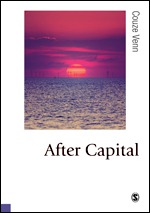
Couze Venn, After Capital – now out with Sage

90453_9781526450135Couze Venn, After Capital – now out with Sage

The present crisis of capitalism has a history. A history of the private accumulation of wealth through property regimes which allow increasing commodification and the privatisation of resources: from land to knowledge and even to life itself. Understanding that history may allow us to imagine alternatives after Capital which are no longer private but common.

After Capital explores this history, showing how the economy is linked to environmental damage, climate change, resource depletion, and to massive inequality. It takes the reader from liberalism to neoliberalism, from climate change to the Anthropocene, and shows how this history is inextricably the history of colonialism. It is a rich and detailed narrative of capitalism over the last 200 years, that explains its texture and its neoliberal endgame.

This discussion frames speculation on what postcapitalist societies could be, with regimes of private accumulation replaced by a politics and ethics of a democratic and ecologically- grounded Commons.

This extraordinary work synthesises, extends and originates a vast range of scholarship and critical thought. In doing so, it offers the most concise yet most comprehensive account of the crisis of our times, and of the very nature of capitalism as such, to have been produced for many years. Couze Venn is one of the great unsung intellectual heroes of our age; how many other thinkers are able to synthesise post-structuralist philosophy and postcolonial theory with Marxist political economy and critical ecology, without a trace of superficiality in their approach to any of these sources? How many would even dare to try? This is an invaluable book for anyone who wants to think politically about the state of the world today, inside or outside the academy, in any discipline.

Jeremy Gilbert, University of East London.


After Capital takes the risky path that our bleak circumstances demand. This thoughtful and learned intervention boldly spells out protocols for a new way of living. Moving between critique and urgent, unsentimental speculation, Couze Venn identifies the novel habits required to sustain life beyond the war, waste and squalor of contemporary capitalism.

Paul Gilroy, Kings College, University of London.


A tour de force. It is difficult to overstate the importance of this book- not only for the present but for many generations to come.

Valerie Walkerdine. Cardiff University.


I could not recommend a better book to those interested not only in the interdependence of the multiple crises (environmental, economic and political) that we are currently entangled in, but also in alternative visions for the future. After Capital is outstanding scholarship that daringly and passionately articulates new conceptual frameworks that makes clear the potential of a post-capitalist and post-anthropocentric cosmopolitics of the commons to make life after capital something to look forward to.

Dr Tiziana Terranova, University of Naples, L’Orientale.


With typical depth and thoughtfulness, Couze Venn explores and untangles the intricately woven and mammoth issues that we face today.

Erudite and scholarly, these pages are a revelation and guide in our complex and uncertain times.

Dr Dave Beer, Reader, York University


Posted in Uncategorized | Leave a comment

Canguilhem, Œuvres complètes Tome V : Histoire des sciences, épistémologie, commémorations 1966-1995 – delayed again (now September 2018)

9782711623648.jpgGeorges Canguilhem, Œuvres complètes Tome V : Histoire des sciences, épistémologie, commémorations 1966-1995 was originally due to appear in January 2018. It has slipped three times – to March, to May and is now listed for September.

Quelque cent vingt écrits publiés de 1966 à 1995 composent ce tome V des Œuvres complètes de Georges Canguilhem.
Une cinquantaine furent de ceux qui établirent sa réputation comme historien des sciences et comme épistémologue. D’autres, souvent passés plutôt inaperçus, éclairent les voies par lesquelles, instruit des avancées de la biologie moléculaire, Canguilhem crut devoir mener le réexamen de sa philosophie biologique. Plusieurs écrits montrent combien Canguilhem, à contre-courant des naturismes en vogue, avait le souci de mener et de poursuivre une réflexion éthique sur les questions de la technique et de la médecine. Dans nombre de notices ou de discours touchant des collègues ou d’amis disparus, nombreux dans ce tome V, il relève les exigences intellectuelles et morales qui animèrent leur vie. Le lecteur reconnaïtra que ces exigences furent également les siennes, loin des facilités de la mondanité philosophique.
Textes édités, introduits et annotés par Camille Limoges

I’d really hoped that this would be published before I submitted my Canguilhem book. Not only would it have helped locate some hard-to-find pieces, it would have substantially reduced the references if I could refer to so many pieces in a single source. Volumes I and IV are already published, and II and III will comprise the books Canguilhem published in his lifetime, all of which are easily available. Having Volume V will therefore mean easy access to all the published works. The planned Volume VI will be a biography, bibliography, index and some other things.

I can only imagine the rights issues that go into a project of this kind, given the diverse plans Canguilhem published. But it is still really frustrating.
Posted in Canguilhem (book), Georges Canguilhem, Uncategorized | Leave a comment

Katherine Gibson: First Take Back the Night, Now Take Back the Economy (video)

Katherine Gibson’s (Western Sydney University) inaugural Women in Geographical and Earth Sciences Lecture at the University of Glasgow (March 2018).

First Take Back the Night, Now Take Back the Economy: Feminist and Queer Strategies for Imagining and Enacting Other Possible Worlds

via Katherine Gibson: First Take Back the Night, Now Take Back the Economy

Posted in Uncategorized | 1 Comment

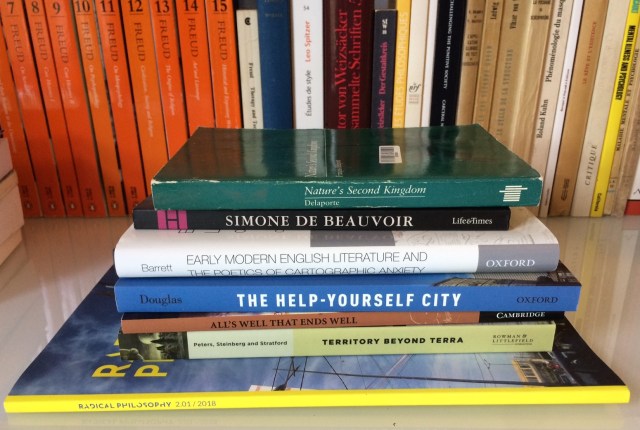
Books received – Delaporte, de Beauvoir, Barrett, Douglas, Shakespeare, Peters, Steinberg and Stratford, Radical Philosophy

IMG_3369.JPG

A mixed pile of things – François Delaporte, Nature’s Second Kingdom; Lisa Appignanesi’s biography of Simone de Beauvoir; Chris Barrett, Early Modern English Literature and the Poetics of Cartographic Anxiety; Gordon Douglas, The Help-Yourself Citythe CUP edition of All’s Well That Ends Well, the edited collection Territory Beyond Terra and the first issue of the relaunched Radical Philosophy. I’m on the board of the OUP Early Modern Literary Geography series Barrett’s book appears in, and wrote the preface to Territory Beyond Terra. Both are highly recommended. OUP sent a copy of Douglas’s book, and the RP collective sent the issue. Radical Philosophy is now open access, but they need support.

Posted in François Delaporte, Philip Steinberg, Uncategorized, William Shakespeare | Leave a comment

David Beer, The Data Gaze: Capitalism, Power and Perception – next book in Sage Society and Space series

David Beer, The Data Gaze: Capitalism, Power and Perception – will be the next book in the Sage Society and Space book series I edit. More details on the series and other forthcoming titles can be found here. The Sage page for the series is here.

A significant new way of understanding contemporary capitalism is to understand the intensification and spread of data analytics. This text is about the powerful promises and visions that have led to the expansion of data analytics and data-led forms of social ordering.

It is centrally concerned with examining the types of knowledge associated with data analytics and shows that how these analytics are envisioned is central to the emergence and prominence of data at various scales of social life.  This text aims to understand the powerful role of the data analytics industry and how this industry facilitates the spread and intensification of data-led processes. As such, The Data Gaze is concerned with understanding how data-led, data-driven and data-reliant forms of capitalism pervade organisational and everyday life.

Using a clear theoretical approach derived from Foucault and critical data studies the text develops the concept of the data gaze and shows how powerful and persuasive it is. It’s an essential and subversive guide to data analytics and data capitalism.

Posted in Society and Space, Uncategorized | 2 Comments

Durham Institute of Advanced Study fellowships 2019/20 – call now open

From 2018/19 Durham’s Institute of Advanced Study will support a number of specific research projects every year. Fellowship applicants for 2019/20 can apply to either collaborate directly with one of these supported projects, or work independently (though some form of collaboration with a Durham colleague remains a pre-requisite). Details of the projects sponsored by the IAS during 2019/20 can be found here.

The IAS Fellowships remain a highly effective way to bring stellar researchers from across various disciplines, not only further internationalising the University, but also expanding its worldwide network of research collaborators.

Further details about the IAS Fellowships are here.

Posted in Uncategorized | Leave a comment

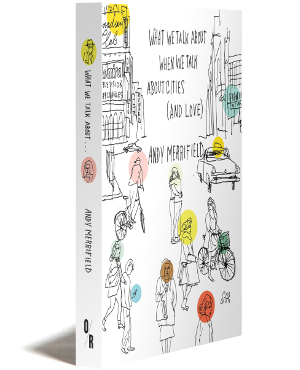
Andy Merrifield, What We Talk About When We Talk About Cities (And Love)

OR Book Going RougeAndy Merrifield, What We Talk About When We Talk About Cities (And Love) – out in June from OR books.

Update: an excerpt is now available open access: Between Utopia and Dystopia: Encountering Marshall Berman and Mike Davis

In often dreamlike peregrinations around his home towns of Liverpool, London and New York Andy Merrifield reflects on what cities mean to us and how they shape the way we think. As he wanders, Merrifield’s reveries circle questions: Can we talk about cities in the absolute, discovering their essence beneath the particulars? Is it possible truly to love or hate a city, to experience it carnally or viscerally? Might we find true love in the city?

Merrifield does find love in the city: with his future wife, whom he takes on a date to see his hero Spalding Gray’s “It’s a Slippery Slope” at London’s South Bank and soon after moves in with, to a tiny place in Bloomsbury where they celebrate the brilliance of new romance by painting the walls turquoise and gold. And for the fellow urbanist Marshall Berman, another working class boy who went up to Oxford. Berman takes Merrifield under his wing and shows him the thrills available in Dostoevsky and Marx over cups of coffee in ordinary cafes on New York City’s Upper West Side.

The mood music to these love affairs is provided by a rich repertoire of intellects, from Jane Jacobs to Mike Davis, from Louis Malle to Walter Benjamin. John Lennon, a pupil, like Merrifield, at Quarry Bank school in Liverpool, enters the story; so too the novelist and critic John Berger. And providing tonality throughout is the stripped down, razor honed talk about love in the stories of Raymond Carver.

Posted in Andy Merrifield, Uncategorized, urban/urbanisation | 3 Comments

Ruben Pfizenmaier reviews Foucault’s Last Decade at KULT online

9780745683911Ruben Pfizenmaier reviews Foucault’s Last Decade (Polity 2016) at KULT online. It’s a thoughtful and very generous review, available open access. Here’s the abstract.

In Foucault’s Last Decade Stuart Elden portrays the intellectual history of the last ten years of Michel Foucault’s life. By referring to published and unpublished sources (some only newly available to the public) as well as the testimonies of friends and colleagues, he convincingly reconstructs the development from Discipline and Punish via biopolitics and governmentality to Foucault’s interest in sexuality and antique ethics. Centering on Foucault’s main works and courses at the Collège de France from 1974 to 1984, Elden brilliantly discusses key concepts at their first emergence and concisely traces their development in regard to the entirety of Foucault’s work. He also promptly discusses various issues that shaped Foucault’s work, intellectually and institutionally.

Ruben ends the review with some comments on Les Aveux de la chair, which appeared about two years after my book on this period of Foucault’s work, and wonders how it will impact on my work. For my initial thoughts, see the review essay I published in Theory, Culture & Society (open access). For more on my Foucault work, including links to other reviews and discussions, see this page.

Posted in Foucault's Last Decade, Michel Foucault, Uncategorized | Leave a comment

Changes and additions to Foucault News (2018)

Clare O’Farrell has an update on her excellent Foucault News site, which is now merged with her more general site on Foucault. The new domain name is https://michel-foucault.com Go here for all the details and links.

Posted in Michel Foucault, Uncategorized | Leave a comment

Two or Three Things He Knows About Paris

Andy Merrifield discusses Eric Hazan’s A Walk Through Paris – https://www.versobooks.com/books/2657-a-walk-through-paris

Andy Merrifield's avatarandy merrifield

Originally published on Verso’s Blog, 11th April 2018

There are few urbanists today who know their city as intimately as Paris’s popular historian, publisher and organic intellectual, Eric Hazan. He’s the only writer I’m aware of whose books have indexes for street names. But Hazan doesn’t just know Paris’s backstreets and inner courtyards: this guy seems to know all the names on doorbells, too. Since The Invention of Paris, he’s been knocking on doors and listening to footsteps, harking paeans to his hometown under fire. Hazan takes leave from one of Balzac’s remarks: “old Paris is disappearing with a frightening rapidity.” Balzac is one of Hazan’s heroes, and like the great nineteenth-century creator, Hazan himself isn’t so much a realist portrayer as an urban visionary, an observer of a Paris to come. He’s not one to go in search of lost time, nor even lost steps. Lost steps? There…

View original post 2,176 more words

Posted in Uncategorized | Leave a comment