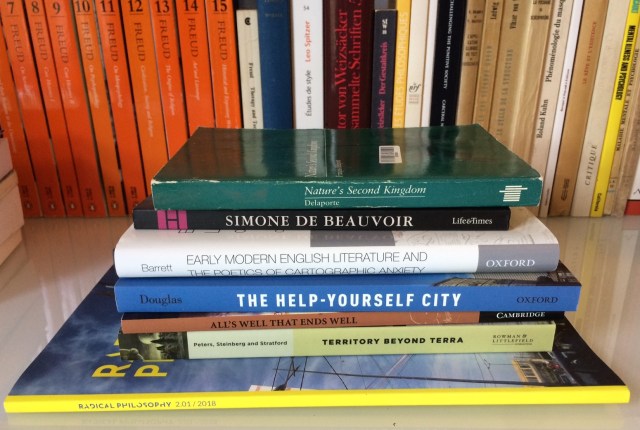
Books received – Delaporte, de Beauvoir, Barrett, Douglas, Shakespeare, Peters, Steinberg and Stratford, Radical Philosophy

IMG_3369.JPG

A mixed pile of things – François Delaporte, Nature’s Second Kingdom; Lisa Appignanesi’s biography of Simone de Beauvoir; Chris Barrett, Early Modern English Literature and the Poetics of Cartographic Anxiety; Gordon Douglas, The Help-Yourself Citythe CUP edition of All’s Well That Ends Well, the edited collection Territory Beyond Terra and the first issue of the relaunched Radical Philosophy. I’m on the board of the OUP Early Modern Literary Geography series Barrett’s book appears in, and wrote the preface to Territory Beyond Terra. Both are highly recommended. OUP sent a copy of Douglas’s book, and the RP collective sent the issue. Radical Philosophy is now open access, but they need support.

Posted in François Delaporte, Philip Steinberg, Uncategorized, William Shakespeare | Leave a comment

David Beer, The Data Gaze: Capitalism, Power and Perception – next book in Sage Society and Space series

David Beer, The Data Gaze: Capitalism, Power and Perception – will be the next book in the Sage Society and Space book series I edit. More details on the series and other forthcoming titles can be found here. The Sage page for the series is here.

A significant new way of understanding contemporary capitalism is to understand the intensification and spread of data analytics. This text is about the powerful promises and visions that have led to the expansion of data analytics and data-led forms of social ordering.

It is centrally concerned with examining the types of knowledge associated with data analytics and shows that how these analytics are envisioned is central to the emergence and prominence of data at various scales of social life.  This text aims to understand the powerful role of the data analytics industry and how this industry facilitates the spread and intensification of data-led processes. As such, The Data Gaze is concerned with understanding how data-led, data-driven and data-reliant forms of capitalism pervade organisational and everyday life.

Using a clear theoretical approach derived from Foucault and critical data studies the text develops the concept of the data gaze and shows how powerful and persuasive it is. It’s an essential and subversive guide to data analytics and data capitalism.

Posted in Society and Space, Uncategorized | 2 Comments

Durham Institute of Advanced Study fellowships 2019/20 – call now open

From 2018/19 Durham’s Institute of Advanced Study will support a number of specific research projects every year. Fellowship applicants for 2019/20 can apply to either collaborate directly with one of these supported projects, or work independently (though some form of collaboration with a Durham colleague remains a pre-requisite). Details of the projects sponsored by the IAS during 2019/20 can be found here.

The IAS Fellowships remain a highly effective way to bring stellar researchers from across various disciplines, not only further internationalising the University, but also expanding its worldwide network of research collaborators.

Further details about the IAS Fellowships are here.

Posted in Uncategorized | Leave a comment

Andy Merrifield, What We Talk About When We Talk About Cities (And Love)

OR Book Going RougeAndy Merrifield, What We Talk About When We Talk About Cities (And Love) – out in June from OR books.

Update: an excerpt is now available open access: Between Utopia and Dystopia: Encountering Marshall Berman and Mike Davis

In often dreamlike peregrinations around his home towns of Liverpool, London and New York Andy Merrifield reflects on what cities mean to us and how they shape the way we think. As he wanders, Merrifield’s reveries circle questions: Can we talk about cities in the absolute, discovering their essence beneath the particulars? Is it possible truly to love or hate a city, to experience it carnally or viscerally? Might we find true love in the city?

Merrifield does find love in the city: with his future wife, whom he takes on a date to see his hero Spalding Gray’s “It’s a Slippery Slope” at London’s South Bank and soon after moves in with, to a tiny place in Bloomsbury where they celebrate the brilliance of new romance by painting the walls turquoise and gold. And for the fellow urbanist Marshall Berman, another working class boy who went up to Oxford. Berman takes Merrifield under his wing and shows him the thrills available in Dostoevsky and Marx over cups of coffee in ordinary cafes on New York City’s Upper West Side.

The mood music to these love affairs is provided by a rich repertoire of intellects, from Jane Jacobs to Mike Davis, from Louis Malle to Walter Benjamin. John Lennon, a pupil, like Merrifield, at Quarry Bank school in Liverpool, enters the story; so too the novelist and critic John Berger. And providing tonality throughout is the stripped down, razor honed talk about love in the stories of Raymond Carver.

Posted in Andy Merrifield, Uncategorized, urban/urbanisation | 3 Comments

Ruben Pfizenmaier reviews Foucault’s Last Decade at KULT online

9780745683911Ruben Pfizenmaier reviews Foucault’s Last Decade (Polity 2016) at KULT online. It’s a thoughtful and very generous review, available open access. Here’s the abstract.

In Foucault’s Last Decade Stuart Elden portrays the intellectual history of the last ten years of Michel Foucault’s life. By referring to published and unpublished sources (some only newly available to the public) as well as the testimonies of friends and colleagues, he convincingly reconstructs the development from Discipline and Punish via biopolitics and governmentality to Foucault’s interest in sexuality and antique ethics. Centering on Foucault’s main works and courses at the Collège de France from 1974 to 1984, Elden brilliantly discusses key concepts at their first emergence and concisely traces their development in regard to the entirety of Foucault’s work. He also promptly discusses various issues that shaped Foucault’s work, intellectually and institutionally.

Ruben ends the review with some comments on Les Aveux de la chair, which appeared about two years after my book on this period of Foucault’s work, and wonders how it will impact on my work. For my initial thoughts, see the review essay I published in Theory, Culture & Society (open access). For more on my Foucault work, including links to other reviews and discussions, see this page.

Posted in Foucault's Last Decade, Michel Foucault, Uncategorized | Leave a comment

Changes and additions to Foucault News (2018)

Clare O’Farrell has an update on her excellent Foucault News site, which is now merged with her more general site on Foucault. The new domain name is https://michel-foucault.com Go here for all the details and links.

Posted in Michel Foucault, Uncategorized | Leave a comment

Two or Three Things He Knows About Paris

Andy Merrifield discusses Eric Hazan’s A Walk Through Paris – https://www.versobooks.com/books/2657-a-walk-through-paris

Andy Merrifield's avatarandy merrifield

Originally published on Verso’s Blog, 11th April 2018

There are few urbanists today who know their city as intimately as Paris’s popular historian, publisher and organic intellectual, Eric Hazan. He’s the only writer I’m aware of whose books have indexes for street names. But Hazan doesn’t just know Paris’s backstreets and inner courtyards: this guy seems to know all the names on doorbells, too. Since The Invention of Paris, he’s been knocking on doors and listening to footsteps, harking paeans to his hometown under fire. Hazan takes leave from one of Balzac’s remarks: “old Paris is disappearing with a frightening rapidity.” Balzac is one of Hazan’s heroes, and like the great nineteenth-century creator, Hazan himself isn’t so much a realist portrayer as an urban visionary, an observer of a Paris to come. He’s not one to go in search of lost time, nor even lost steps. Lost steps? There…

View original post 2,176 more words

Posted in Uncategorized | Leave a comment

Foucault and the politics of resistance in Brazil – Workshop at Columbia in Rio de Janeiro, and forthcoming publication

News from Marcelo Hoffman of a workshop on Foucault and the politics of resistance in Brazil – to be held at Columbia University’s Center in Rio de Janeiro. Fortunately for those of us unable to attend, a publication is forthcoming.

This workshop will bring together scholars throughout Brazil to discuss a little-known topic outside of Brazil: the intellectual and political import of Michel Foucault’s visits to Brazil in 1965, 1973, 1974, 1975, and 1976. During these visits, Foucault synthesized and advanced his research in lectures and talks on an astoundingly wide range of topics, from juridical practices, to social medicine, to sexuality. He sought to clarify his unconventional perspectives in interviews with the press. Faced with the growing repression of students, professors, and journalists, Foucault also engaged in open opposition to the military dictatorship.

In this workshop, scholars will situate Foucault’s enormous contributions in Brazil within a series of theoretical, historical, and political contexts. They will also reflect on these contributions to illuminate aspects of the politics of resistance in Brazil in the past and present. The contributions to the workshop will serve as the basis for articles in the forthcoming issue of the interdisciplinary journal Carceral Notebooks (http://www.thecarceral.org/journal-vol13.html).

Posted in Conferences, Michel Foucault, Uncategorized | Leave a comment

‘Shakespeare’s View of the World’ – Warwick news story on my forthcoming Shakespearean Territories

Yesterday was Shakespeare’s birthday, and Warwick used the date to put out a brief story about my forthcoming book Shakespearean Territories. Entitled ‘Shakespeare’s View of the World‘ it has some quotes from me about how Shakespeare helps us to understand territory.

map_slider.jpgEven 402 years after his death, Shakespeare still has much to say on modern issues. Stuart Elden is Professor of Political Theory and Geography at the University of Warwick and is using Shakespeare’s works to further the understanding of one evergreen issue in human geography: Territory. [continues here]

I’ll be speaking more about this later today at King’s College London – I plan to record this and will try to share soon. The book is due out in October 2018.

Posted in Shakespearean Territories, Uncategorized, William Shakespeare | Leave a comment

The Early Foucault update 17: Canguilhem, Beinecke library and back to Foucault

I wrote the last update on this book over two months ago, just as I was finishing up an extended research visit to Paris. Since then I’ve mainly been focusing on the Canguilhem manuscript, which is inching toward a near complete draft. I will share more about the Canguilhem book in due course. While that has taken up most of my time, I did also write a long review essay on Foucault’s Les aveux de la chair, the fourth volume of his History of Sexuality. It’s available open access on the Theory, Culture & Society blog, and should appear in the journal itself later this year.

In early April I was in New York for a workshop at Columbia University, and used the opportunity to take a side-trip to the Beinecke rare books and manuscripts library at Yale University. This library owns the Michel Foucault Library of Presentation Copies– the books from Foucault’s library which have dedications by their authors. There are a few details about the collection here– a news report just before Daniel Defert spoke at the library about it.
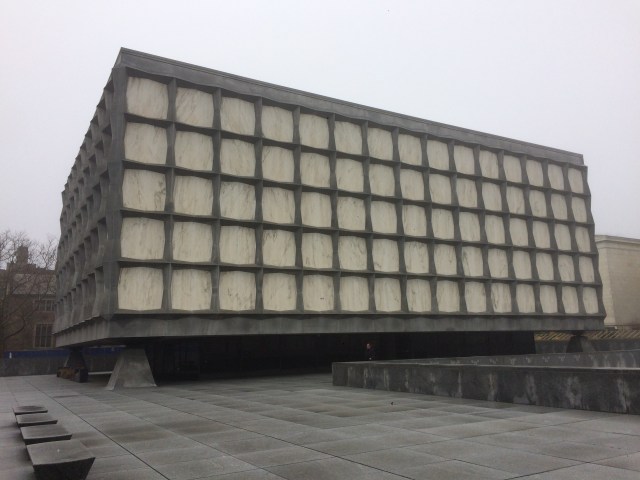
Beinecke copy.jpg

Beinecke library at Yale University

The collection comprises 1450 volumes, and is housed off-site, with books taking two days to arrive. So I had to preorder just a few things in advance. Given my interests and other projects, I chose the two pieces in the collection from Canguilhem, and three from Lefebvre. There is just one book by Binswanger here, and I also ordered a couple from Derrida and one thing each from Lacan, Dumézil, Althusser, Deleuze and Guattari. While there is something just in seeing a book that passed from one of these thinkers to another, with a handwritten note from the author, I wasn’t expecting to learn a great deal. I have copies of almost all these books anyway, so it was just the notes I was intrigued by. The best thing I found was Deleuze’s children’s drawings in Anti-Oedipus– already previewed in the Yale report.

I’ve spoken before about the lack of an encounter between Foucault and Lefebvre in person – Lefebvre is always critical in print, and Foucault only mentions Lefebvre once, in passing, and in a way that implies he knew next to nothing of his work. But Lefebvre sent copies of some of his books to Foucault – I looked at the 1979 reisssue of La conscience mystifiée, co-authored by Norbert Guterman, Métaphilosophie and Hegel, Marx, Nietzsche. Métaphilosophie had uncut pages after page 40, so if Foucault did begin reading it, then he didn’t get very far. There is no indication if either of the others were read or not.

I was interested to see whether there were any traces of Foucault’s reading in these books. While the notes at the Bibliothèque nationale de France are extensive, they mainly look like notes taken in libraries. There are very few notes on any of Foucault’s contemporaries. I had imagined that this was because Foucault owned books by them, and perhaps had written in them. There are a very few marginal marks and a little underlining in a couple of the books I looked at here, but very few clues as to how Foucault read. Of course, these are copies presented to him, and not all are ones he references in his work. So, a small sample of this selection from his library doesn’t fully resolve this one way or the other, but it indicates that he didn’t extensively annotate all his books.

I also had a couple of days in Paris in mid-April, mainly to check some Canguilhem references at the main Bibliothèque nationale site. These were things I couldn’t find in the UK, and so a couple of days work here was necessary to complete this. It was mainly things that Canguilhem himself quoted and where I wanted to check the reference and what was actually said. Some of this is hard work – one text he referenced without a page number, and I eventually found the quote on p. 361. At least he referenced the correct book (for more on this work see my comments here). I did use the time to look at a bit more in the Foucault archive, mainly some of his 1960s courses which will be published over the next few years. As ever there were some surprises in the material I consulted. Perhaps the best was a set of extensive notes on mushroom reproduction.

BNF April 2018 copy.jpg

BNF-François Mitterand

As well as this library work I spoke about the early Foucault work at a conference in Madrid, and Foucault was part of the discussions at Columbia. I will be talking about the work on the early Foucault in Leuven and Warwick in May, and I’ll also be speaking about Les aveux de la chair at Goldsmiths on 9 May. Details of all talks are here.

Now the Canguilhem book is close to being drafted, I have a couple of pieces on Shakespeare to write – one a summary of the argument of Shakespearean Territories for a presentation and a journal piece, and the other for a conference in June on Foucault and Shakespeare. Along with standard term three stuff and various talks it feels like it’s going to be the summer before I am able to return to the early Foucault project with full attention.

The previous updates on this project are here; and the previous books Foucault’s Last Decade and Foucault: The Birth of Power are both available from Polity. Several Foucault research resources such as bibliographies, short translations, textual comparisons and so on are available here. On the related Canguilhem book project, see this page.
Posted in Canguilhem (book), Felix Guattari, Georges Canguilhem, Gilles Deleuze, Henri Lefebvre, Jacques Derrida, Jacques Lacan, Louis Althusser, Ludwig Binswanger, Michel Foucault, Shakespearean Territories, The Early Foucault, Travel, Uncategorized, William Shakespeare | 5 Comments