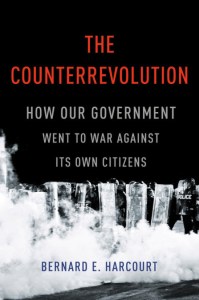
Bernard E. Harcourt, The Counterrevolution: How Our Government Went to War Against Its Own Citizens (out in February with Basic Books)

97815416972871Bernard E. Harcourt, The Counterrevolution: How Our Government Went to War Against Its Own Citizens – out in February with Basic Books.

A distinguished political theorist sounds the alarm about the counterinsurgency strategies used to govern Americans
Militarized police officers with tanks and drones. Pervasive government surveillance and profiling. Social media that distract and track us. All of these, contends Bernard E. Harcourt, are facets of a new and radical governing paradigm in the United States–one rooted in the modes of warfare originally developed to suppress anticolonial revolutions and, more recently, to prosecute the war on terror.
The Counterrevolution is a penetrating and disturbing account of the rise of counterinsurgency, first as a military strategy but increasingly as a way of ruling ordinary Americans. Harcourt shows how counterinsurgency’s principles–bulk intelligence collection, ruthless targeting of minorities, pacifying propaganda–have taken hold domestically despite the absence of any radical uprising. This counterrevolution against phantom enemies, he argues, is the tyranny of our age. Seeing it clearly is the first step to resisting it effectively.

“Bernard Harcourt’s The Counterrevolution offers a masterful look into the deeper logic and long-term consequences of the systemic changes that took place in the United States in the name of the war on terror. Harcourt brilliantly recasts the premises, the terminology, and the consequences of post-9/11 policies of surveillance, detention, torture, and targeted killings in a way that is bound to transform our understanding of our times and to inspire new means of protest and counter-action. The Counterrevolution will no doubt become a must-read for any student of the era.”–Karen J. Greenberg, author of Rogue Justice: The Making of the Security State and editor of The Torture Papers: The Road to Abu Ghraib

“I’m not on board with the premise, and I found something to disagree with on nearly every page, but make no mistake: The Counterrevolution is an important and deeply challenging book. It should be mandatory for anyone who cares about the future of the Republic, especially to challenge those who want to believe, as I do, that we aren’t doomed.”–Noah Feldman, author of The Three Lives of James Madison: Genius, Partisan, President

“As far as I can tell, Bernard Harcourt has never had an uninteresting thought.”–Malcolm Gladwell

“Shattering any notion that the current state of American politics, or today’s uglier practices of exclusion and repression, are either new or temporary, Bernard Harcourt’s The Counterrevolution is searing and indispensable. From this richly researched and powerfully argued account, we come to appreciate the full depth and scope of the crisis we now face in our country. Harcourt’s analysis is brutal and clear: if we don’t fully grasp just how totally our democracy is now compromised, we might never rescue it.”–Heather Ann Thompson, Pulitzer Prize-winning author of Blood in the Water: The Attica Prison Uprising of 1971 and its Legacy

“Bernard Harcourt has written a brilliant and disturbing book, which shows that James Madison was right when he said that ‘no nation could preserve its freedom in the midst of continual warfare.’ The Counterrevolution make a compelling case that the U.S. government is employing the same strategies and weapons that it uses to fight its endless wars abroad to deal with imagined enemies on the home front. This book should be required reading for every American.”–John J. Mearsheimer, University of Chicago
Posted in Bernard E. Harcourt, Politics, Uncategorized | 2 Comments

France Culture on Foucault’s Les aveux de la chair

G00088.jpg
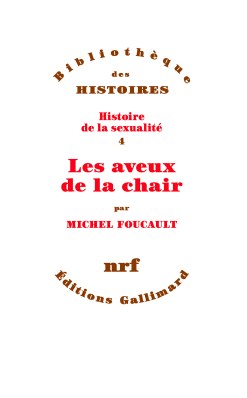
France Culture has a piece by Jacques Munier on Foucault’s Les aveux de la chair, which is described as ‘without doubt the last great unpublished work of philosophy of the twentieth century’. The book is due to be published by Gallimard on 8 February 2017.

Posted in Michel Foucault, Uncategorized | 1 Comment

Derrida’s Quarrel: “La Différance” at 50

DerridaDifferance3-791x1024Derrida’s Quarrel: “La Différance” at 50 in the Los Angeles Review of Books, by Birger Vanwesenbeeck.

Two days late linking to this, but…

On Saturday, January 27, 1968, Jacques Derrida, then maître assistant at the Ecole Normale Supérieure, delivered his lecture “La Différance” before the Société française de Philosophie at the Sorbonne. The invitation for this memorable evening — it has been preserved in the Derrida archives at the University of California, Irvine — indicates that the lecture was held at the Amphithéâtre Michelet, an altogether fitting locale. For just as the father of French modern historiography had revolutionized his discipline a century earlier, so Derrida was about to unravel and remake the history and practice of Western philosophy from the ground up. The opening sentence of “La Différance” is innocent and straightforward enough. “I will talk tonight about a letter,” so Derrida’s lecture notes for that evening state, “the first letter if the alphabet is to believed.” What follows, however, is a bravura performance without precedent, a one-act play with this very letter <a> at the core, a jazz improvisation whose tonic is sounded and returned to time and again no matter how far the music score has traveled.

Posted in Jacques Derrida, Uncategorized | 1 Comment

Foucault’s visit to Attica prison in 1972

Update March 2026: A revised and expanded version of this post has been included in the ‘Sunday Histories’ series – Foucault’s 1972 visit to Attica prison

Attica,_New_York_(Correctional_Facility).jpgIn April 1972, during a visit to SUNY Buffalo, Foucault visited Attica prison. This was only one year after the uprising and its brutal suppression. John K. Simon, chair of the Buffalo French department, interviewed him about what he saw. The interview was published in Telos, and then reprinted in Social Justice and Foucault: Live. (The journal links take you to accessible versions; a French translation is here.)
Foucault says that it was his first time inside a prison, but we know that his psychiatric work of the early 1950s meant that he regularly visited the Fresnes prison outside Paris. 1972 was in the middle of Foucault’s time with the Groupe d’Information sur les prisons, which has left an extensive legacy of interviews and reports, and led to both his 1972-73 course The Punitive Society and, of course, Surveiller et punir/Discipline and Punish. There are many account of Foucault’s prison activism in France, and some on his links to the Black Panthers (see essays by Jason Demers and Brady Thomas Heiner [paywall]). Jean Genet and Catherine von Bülow were crucial in mediating the links between the GIP and the Black Panthers. One of the GIP pamphlets was about the murder of George Jackson in a California prison, which was one of the events behind the Attica uprising. I discuss all this in Foucault: The Birth of Power chapter 5, partly in relation to how this led to Discipline and Punish. An English translation of GIP material is forthcoming.

One of the things that comes through strongly in the Attica interview is the importance of class struggle. This theme is muted in Discipline and Punish, but much stronger in The Punitive Society.

Thanks to Laleh Khalili and Sebastian Budgen for prompting this post.

Posted in Foucault: The Birth of Power, Michel Foucault, Uncategorized | 1 Comment

Philosophie Magazine issue on Foucault, including extract of Les Aveux de la chair

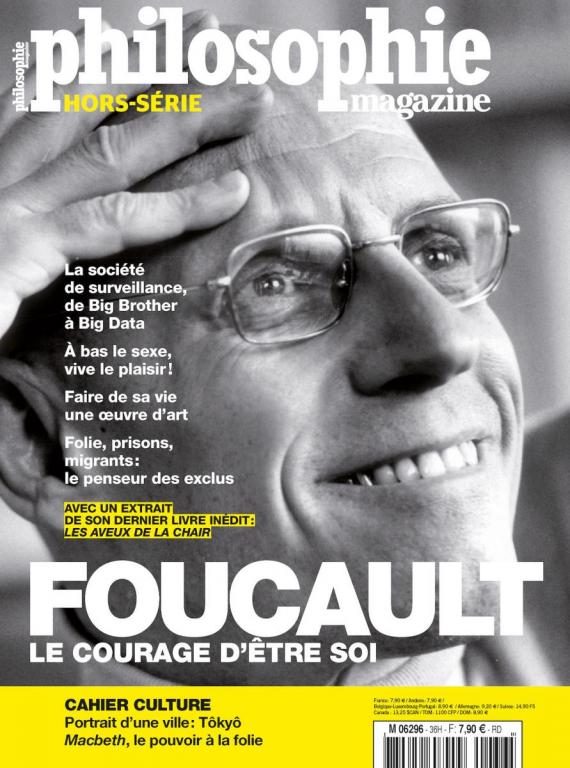
pmfrhs36foucaultp1small.jpgPhilosophie Magazine has a new special issue on Foucault, including an extract from Les Aveux de la chair, the soon-to-be-published volume IV of the History of Sexuality.

You can read some of the issue, though not the extract, on a viewer on the issue page.

Les Aveux de la chair is scheduled for publication on 8 February 2018. A conference is taking place on the book next weekend in Paris – Colloque International: Foucault, Les Pères et le sexe, 1-3 February 2018.

Finally, if you can’t wait for the book itself, or its translation, there are two other extracts from draft versions of the manuscript already published. I’m not sure if they are in the version to appear shortly. One is well known, and I think most likely to be in the final text – ‘The Battle for Chastity’.

The other is the ‘Maurice Florence’ piece, which was an excerpt from a draft introduction and was edited by François Ewald for publication in the Dictionnaire des philosophes. While it’s long been known that this was from a draft of an introduction to the History of Sexuality Volume II, there are multiple versions of that text, which appeared in revised form in The Use of Pleasures (for a comparison of those versions, see here). 

I cautiously claimed that the ‘Maurice Florence’ excerpt was from the early draft on Christianity in Foucault’s Last Decade, p. 120. I’ve recently found a source which corroborates this. I’m not sure if this was in the version Foucault left behind at his death. (There is a long and complicated history behind all these different texts, which I explore in detail in Foucault’s Last Decade.)

Both ‘The Battle for Chastity’ and ‘Maurice Florence’ are available in English, the first in Politics, Philosophy, Culture and Essential Works I, the second in The Cambridge Companion to Foucault (1st edition only) and Essential Works II, among other places. Most reprints of ‘Maurice Florence’, in both French and English, omit the opening paragraph, written by Ewald. That paragraph can be found in both languages here.

Posted in Foucault's Last Decade, Michel Foucault, Uncategorized | Leave a comment

Reflections on Raymond Williams – Part Two

Reflections on Raymond Williams, thirty years after his death, Part II, including one by Terry Eagleton.

Raymond Williams Society's avatarThe Raymond Williams Society

Welcome to the second instalment of reflections on Raymond Williams to mark 30 years to the day (26 January 1988) since his death. Part One can be found hereTerry Eagleton is the first of three to offer a personal account of knowing or working with Williams as a student while two younger academics, Daniel Hartley and Jacob Soule, suggest important ways in which Williams’ thinking can be adapted for the twenty-first century.

strip

View original post 2,484 more words

Posted in Uncategorized | Leave a comment

Reflections on Raymond Williams – Part One

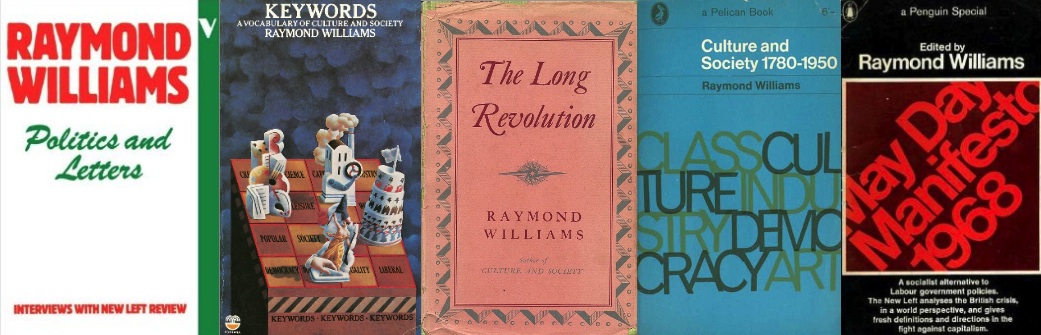
Reflections on Raymond Williams, thirty years after his death.

Raymond Williams Society's avatarThe Raymond Williams Society

Welcome to the first of two collected reflections on Raymond Williams to mark 30 years since his death on 26 January 1988. To begin, Patrick Parrinder offers an edited version of a longer diary piece he wrote for the London Review of Books in February 1988. He is the first of six contributors who knew Williams. There are also four contributions from those who didn’t but whose work continues to be shaped and informed by Williams’ modes of critique. Taken together, these reflections offer personal insights into the life of Raymond Williams as an intellectual and teacher as well as marking a point at which, to paraphrase Towards 2000, we can reflect, look forward, and try to see where we are.

rw final

View original post 2,916 more words

Posted in Uncategorized | Leave a comment

Nik Heynen to give the Neil Smith Lecture, 5 February 2018

The Neil Smith Lecture 2018 University of St Andrews, Scotland, UK

Professor Nik Heynen, University of Georgia, USA

Irvine Lecture Theatre, School of Geography & Sustainable Development
3.15-5pm – Monday 5 February 2018,

Followed by a reception 5-6.30pm
All welcome

The Pirates of Racial Capitalism and Abolition Ecology

At a prominent kitchen table on Sapelo Island I was once told that if Edward Teach’s treasure, rumored to be on Blackbeard Island just across a small tidal channel, was recovered it would prevent the remaining Geechee community on Sapelo from further displacement and experiencing cultural genocide. Blackbeard’s treasure was in part generated by his engagement in the Transatlantic slave trade, which matters because Sapelo Island maintains the most in-tact remaining Gullah/Geechee community in the U.S., having been home to eleven generations that directly tie their ancestry to first slaves brought there in 1802. I’ll stretch this kitchen table conversation toward its global implications to show how the last slave ship to illegally unload on U.S. shores did so on Jekyll Island in 1858, just south of Blackbeard and Sapelo Islands. This is the same island that in 1910 JP Morgan, who fashioned himself as a pirate, clandestinely organized a meeting that led to the formation of the U.S. Federal Reserve bank. These historical connections are important because of how robber barons of the gilded age produced a particular kind of nature along the Southeastern U.S. coast through their purchase of land across this distinctly racialized archipelago and their exploitation of “dead labor” invested in the land through slavery. The paper is about the pirates of racial capitalism and the persistent need for abolition ecology amidst their historical wake.
————-
Please address any queries directly to Dan Clayton


Posted in Conferences, Neil Smith, Uncategorized | Leave a comment

editorial posted for first issue of Open Philosophy

Graham Harman’s editorial for the new journal Open Philosophy

doctorzamalek's avatarObject-Oriented Philosophy

You can read my editorial statement HERE.

Calls for papers on various topics will be posted shortly.

View original post

Posted in Uncategorized | Leave a comment

CFP: Foucault and Benjamin (2018)

Call for papers for an issue on Foucault and Benjamin

Clare O'Farrell's avatarFoucault News

CALL FOR PAPERS

materiali foucaultiani journal / Associazione italiana Walter Benjamin

Foucault and Benjamin

Materiali foucaultiani journal and the Italian Association “Walter Benjamin” launch a call for papers dedicated to a comparison between Walter Benjamin and Michel Foucault.

MF journal proposes to open up new research pathways that jointly crisscross the works of Benjamin and Foucault, beyond the philosophical differences between the two authors. Indeed, we contend that despite their different philosophical horizon and conceptual constellations, both Benjamin and Foucault equip us with powerful tools for undertaking a critical analysis of our present time. In both cases, such a critique is carried on through a refusal of the concept of “progress” and of an understanding of history conceived as a linear and incessant process, as an accumulation of events taking place in an empty and heterogeneous time. Although in different ways, Benjamin and Foucault situate their work within a triangulation between…

View original post 267 more words

Posted in Uncategorized | Leave a comment