The differences between the English and French versions of Foucault’s 1983 interview on Raymond Roussel

IMG_2900.JPG

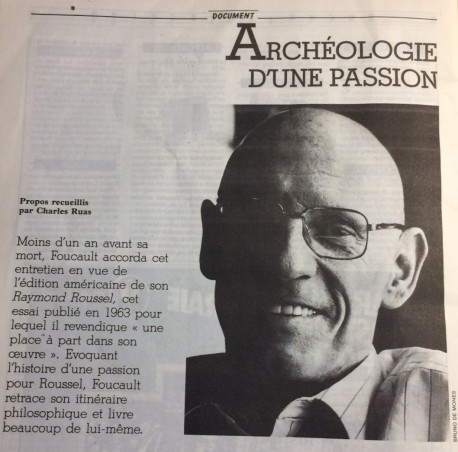
As an appendix to the English translation of Foucault’s book on Raymond Roussel, entitled Death and the Labyrinth, there is an interview with the translator Charles Ruas. It’s a revealing interview in many ways, but the particular interest I have in it for The Early Foucault is less for what it says about the book than the initial discovery of Roussel’s work in the summer of 1957 and the context in which Foucault read him. (If, in time, I write a book on Foucault in the 1960s, then I will discuss the work on Roussel and all Foucault’s work on literature from that decade there.)

The interview appears in Dits et écrits as text 343, “Archéologie d’une passion”. (There is an online version of the Dits et écrits version here). The bibliographical reference for the source is Death and the Labyrinth, which Dits et écrits dates to 1984. But the first English edition of that text, from all the indications I can find, was 1986. Following the Dits et écrits procedures, it would appear that the text should appear somewhat later in the volume, under the year 1986 – as a posthumous, but authorised publication (rather like the texts from Technologies of the Self). Additionally, although its only bibliographical reference is to the English, Dits et écrits does not list a translator. The title also seems to be an addition – the English version doesn’t have one. These little anomalies are not, in themselves, especially interesting.

As Ruas was the translator of the book, it is not immediately obvious if the interview was conducted in French or English. Either the English text in Death and the Labyrinth or the French in Dits et écrits could be a translation, or even potentially both – an unpublished French original, a translation by Ruas, back translation for Dits et écrits. (There are several such texts in these volumes). But there are some differences between the English and the French text which means that the relation between the texts does matter.

In both versions, Foucault begins with the story of how he encountered Roussel’s work in José Corti’s bookshop near the Luxembourg Gardens in 1957. (The bookshop closed last year, though the press associated with the name still continues.) He moves to discuss his first meeting with Alain Robbe-Grillet in Hamburg, though they did not discuss their mutual interest in Roussel, and then recalls how he decided some years later to write an article on Roussel. That article grew, and eventually became a book. There are several relatively minor differences between the English and French versions here – some of Ruas’s questions only appear in the English, and some sentences are in a different order.

In the English version, Ruas then asks another question about Robbe-Grillet and the nouveau roman, and Foucault replies about how he was prepared to read Roussel because of his reading of Robbe-Grillet, Michel Butor, Roland Barthes and others. He talks about how seeing a performance of Samuel Beckett’s Waiting for Godot and reading these and other works helped him to break from a dominant culture of Marxism, phenomenology and existentialism, especially in his work on madness. Ruas then asks about the relation of the book to the study of madness and Foucault says a bit more about how Roussel helped him to move beyond his initial approach. This discussion appears at the end of the French interview, not where it does in the English.

Then Ruas asks about Roussel’s relation to Proust, and here the French and English coincide again. There are some later variants too – interviewer questions not in the French, so Foucault’s answers run on; some brief exchanges. The end of the English version discusses Roland Barthes, but that isn’t in the French at all. All of this made me think that the French could not be a translation of the English. Reordering sentences in answers, moving questions around and cutting interviewer questions are the sorts of things only an author, or interviewer, would do. So, was there another version of the French text?

Some hunting around discovered that there was indeed. The interview was originally published in French in Le magazine littéraire, No 221, July-August 1985, pp. 100-5. This means that Dits et écrits is reprinting that text, not the English one. It means that the French text in Le magazine littéraire is the initial earlier publication, and the one in Death and the Labyrinth is a translation of that. But that translation includes some text not in the original, and reorganises some material. It also has a brief introduction by Ruas. The original French publication has a brief introduction by François Ewald.

It thus seems clear that Dits et ecrits (edited of course by Ewald and Defert) used the version in Le magazine littéraire, but did not check the English to see if they were indeed the same. Dits et écrits does not reprint Ewald’s introduction and two short texts included in Le magazine littéraire, one entitled “L’inventeur d’un langage”, signed by A.G. and the other entitled “Le jeu des signes”, signed by F.E. It also omits some of the questions and answers which, to my knowledge, only appear in the English version.

I suppose the only remaining questions is why Dits et écrits is not explicit about reprinting the version in Le magazine littéraire. Could it be because it was, strictly speaking, a posthumous publication?

[Update 8 Nov: I should have noted this before, but in Jacques Lagrange’s ‘Complément bibliographiques’ in Dits et écrits, Vol IV, p. 835, the version in Le magazine littéraire is noted as a posthumous publication. Given their own stipulations, it thus makes sense that the editors make it appear that the version reprinted is the English one, even if a) it isn’t and b) it was actually from 1986, not 1984, and so was itself posthumous.]

[Update 15 June 2024: Charles Ruas himself comments below. The interview was conducted in French, published in that language, and then translated for Death and the Labyrinth. The version in Dits et écrits is a reprint of the published French version; not as the editors claim, a translation of the English. We have then a text which is strictly speaking posthumous in both languages, but different in the two available versions.]

There are various other Foucault Resources on this site, including bibliographies, audio links, a few short translations and several other textual comparisons and discussions. A complete list is here.

Posted in Daniel Defert, Michel Foucault, The Early Foucault, Uncategorized | Tagged , , | 5 Comments

CFP Prague, 7-9 June 2018 – Philosophy From the Standpoint of Its Manuscripts and Archives—Methodologies, Histories and Horizons

The Wording of Thoughts: Philosophy From the Standpoint of Its Manuscripts and Archives—Methodologies, Histories and Horizons

Organizer : Benedetta Zaccarello, CEFRES
When & Where : 7-9 June 2018, Prague
Deadline for applications : 21 January 2018
Language: English

Please send your proposal (title and 300 word-long abstract) and bio-bibliographical short notice to the following address: benedetta.zaccarello@cefres.cz

Philosophy is written, practiced, lived through: it is the translation of the experience of a thinking subjectivity in a conceptual alphabet and a verbal fabric. The I of philosophy is a chimera whose head tickles the heights of abstract concepts and universal discourses, while its body is grounded in the lived experience. At the hinge between these two realms called for by the speculative effort, stands the verbal material. Its meaning can only be determined taking into account its relationship to its contexts, the writing and reading practices surrounding it, the horizons of significations and even the implicit polemical charge which characterizes every philosophical contention. Likewise, the specificity of each theoretical expression is both the sine qua non condition for the perpetuation of a discipline looking to evolve and transcend its own categories, and the most subjective and personal aspect of a work that traditionally aims at the “neutrality” of abstraction. [more here]

Thanks to Clare O’Farrell for this information.

Posted in Conferences, Uncategorized | Leave a comment

Jacques Derrida, The Death Penalty, Volume II reviewed at NDPR

9780226410821.jpgJacques Derrida, The Death Penalty, Volume II reviewed at NDPR by Deborah Goldgaber. Here’s the publisher’s description of this volume:

In the first volume of his extraordinary analysis of the death penalty, Jacques Derrida began a journey toward an ambitious end: the first truly philosophical argument against the death penalty. Exploring an impressive breadth of thought, he traced a deeply entrenched logic throughout the whole of Western philosophy that has justified the state’s right to take a life. He also marked literature as a crucial place where this logic has been most effectively challenged. In this second and final volume, Derrida builds on these analyses toward a definitive argument against capital punishment.

Of central importance in this second volume is Kant’s explicit justification of the death penalty in the Metaphysics of Morals. Thoroughly deconstructing Kant’s position—which holds the death penalty as exemplary of the eye-for-an-eye Talionic law—Derrida exposes numerous damning contradictions and exceptions. Keeping the current death penalty in the United States in view, he further explores the “anesthesial logic” he analyzed in volume one, addressing the themes of cruelty and pain through texts by Robespierre and Freud, reading Heidegger, and—in a fascinating, improvised final session—the nineteenth-century Spanish Catholic thinker Donoso Cortés. Ultimately, Derrida shows that the rationality of the death penalty as represented by Kant involves an imposition of knowledge and calculability on a fundamental condition of non-knowledge—that we don’t otherwise know what or when our deaths will be. In this way, the death penalty acts out a phantasm of mastery over one’s own death.

Derrida’s thoughts arrive at a particular moment in history: when the death penalty in the United States is the closest it has ever been to abolition, and yet when the arguments on all sides are as confused as ever. His powerful analysis will prove to be a paramount contribution to this debate as well as a lasting entry in his celebrated oeuvre.

Posted in Jacques Derrida, Uncategorized | Leave a comment

Shannon Mattern, Code and Clay, Data and Dirt: Five Thousand Years of Urban Media – now out with UMP

image_mini (1)Shannon Mattern, Code and Clay, Data and Dirt: Five Thousand Years of Urban Media – now out with University of Minnesota Press.

A breathtaking tour through thousands of years of urban life and its attendant technologies, rewriting the history of our cities

Offering powerful new ways of thinking about our cities, Shannon Mattern goes far beyond the historical concepts of origins, development, revolutions, and the accomplishments of an elite few. Her vivid prose leads readers through a historically and geographically broad range of stories and takes media archaeology to the city’s streets, revealing new ways to write our urban, media, and cultural histories.

Code and Clay, Data and Dirt has style and method, originality and purpose. Each dig into this exceptional work has brought pleasure and scholarly respect.—

Malcolm McCullough, author of Digital Ground

Posted in Uncategorized, urban/urbanisation | 1 Comment

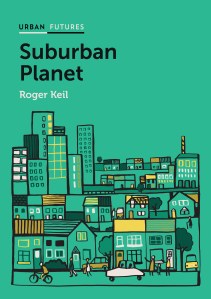
Roger Keil, Suburban Planet: Making the World Urban from the Outside In – now out with Polity

9780745683119.jpgRoger Keil, Suburban Planet: Making the World Urban from the Outside In – now out with Polity.

The urban century manifests itself at the peripheries. While the massive growth in urbanization is often referred to as an ‘urban revolution’, most of the twenty-first century’s startling urban growth worldwide is happening in city peripheries.

This book is about the process that creates the global urban periphery – suburbanization – and the ways of life – suburbanisms – we encounter there. Richly detailed and illustrated with examples from around the world, the book argues that suburbanization is a global process and part of the extended urbanization of the planet. This includes the gated communities of elites, the squatter settlements of the poor and many built forms and ways of life on the periphery in-between. While urbanist orthodoxy opposes low-density ‘sprawl’ for its disproportional environmental impact,the reality of life in the urban century is suburban: most of the earth’s future 10 billioni nhabitants will not live in conventional cities but in suburban constellations of onekind or another.

Inspired by Henri Lefebvre’s demand not to give up urban theory when the city in its classical form disappears, this book is a challenge to urban thought more generally a sit invites the reader to reconsider the city from its periphery.

Posted in Henri Lefebvre, Uncategorized, urban/urbanisation | Leave a comment

Antonio Gramsci, The Prison Notebooks – exhibition in London

Antonio Gramsci, The Prison Notebooks – exhibition in London

1-invantonio_gramsci

Exhibition curated by Silvio Pons and Francesco Giasi

Italian Cultural Institute
39 Belgrave Square
London SW1X 8NX

30 October – 10 November 2017
Monday to Friday 10am – 6pm
(closed on Wednesday 1 November)

On the occasion of the 80th anniversary of Antonio Gramsci’s death (1891-1937), the Italian Cultural Institute hosts an exhibition featuring the originals of the 33 Prison Notebooks – that is, the texts written by Antonio Gramsci from 8th February 1929 during his imprisonment – one of the most significant works of Italian and international political, philosophical and literary thinking.

The originals of the Notebooks are exhibited for the first time in the United Kingdom and, more generally, out of Italy. This exhibition aims to renew the link between Gramsci’s thought and British culture, inaugurated by the “dialogue” with Ludwig Wittgenstein through Piero Sraffa, Professor at Cambridge in the same years of the Austrian philosopher, and “blown up” after the publication of the Selections from the Prison Notebooks by Lawrence and Wishart, edited and translated by Quintin Hoare and Geoffrey Nowell-Smith (1971).

The Notebooks are accompanied by touch screens featuring their digital edition, thus allowing the visitors to virtually leaf through their pages.

This exhibition will also be the opportunity to take stock of the studies about Gramsci from a global perspective, through a series of lectures and talks which will be announced soon.

Posted in Antonio Gramsci, Uncategorized | 1 Comment

Political Geology Workshop @ Cambridge, 17 November 2017

Conference on Political Geology at Cambridge

Angela's avatarMutable Matter

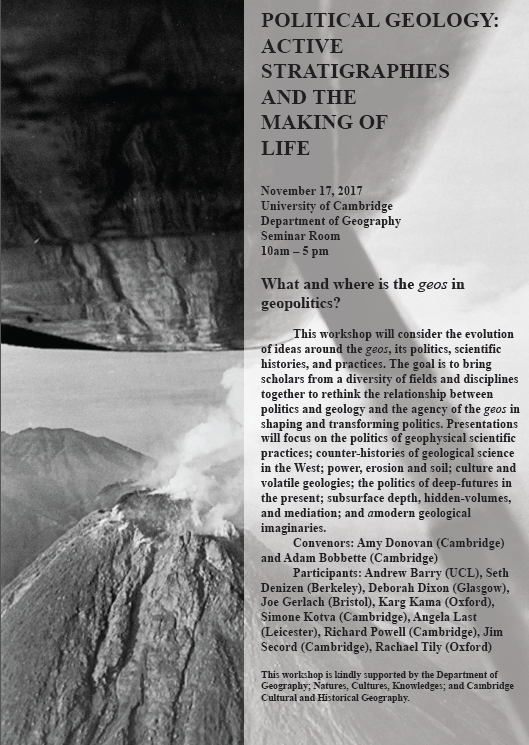
Political Geology: Active Stratigraphies and the Making of Life
Friday 17 November 2017
University of Cambridge
Department of Geography
Seminar Room
10am – 5pm

What and where is the geos in geopolitics?

This workshop will consider the evolution of ideas around the geos, its politics, scientific histories, and practices. The goal is to bring scholars from a diversity of fields and disciplines together to rethink the relationship between politics and geology and the agency of the geos in shaping and transforming politics. Presentations will focus on the politics of geophysical scientific practices; counter-histories of geological science in the West; power, erosion and soil; culture and volatile geologies; the politics of deep-futures in the present; subsurface depth, hidden-volumes, and mediation; and amodern geological imaginaries.

Convenors: Amy Donovan (Cambridge) and Adam Bobbette (Cambridge)
Participants: Andrew Barry (UCL), Seth Denizen (Berkeley), Deborah Dixon (Glasgow), Joe Gerlach (Bristol), Karg Kama (Oxford), Simone Kotva (Cambridge)…

View original post 83 more words

Posted in Uncategorized | Leave a comment

Michel Foucault « Un très beau feu d’artifice » (2016)

I shared news of this issue earlier this year, but it is perhaps worth a reminder – includes an interesting previously unpublished piece by Foucault.

Clare O'Farrell's avatarFoucault News

Michel Foucault « Un très beau feu d’artifice »
Critique
2016/12 (n° 835)

Présentation
En 1978, devant des étudiants californiens, Michel Foucault rêvait à haute voix de « livres bombes » : ils ne tueraient personne, mais « disparaîtraient peu de temps après qu’on les aurait lus ou utilisés ». La philosophie comme Mission impossible : « ce message s’autodétruira dans cinq secondes » ? Il est tentant d’imaginer le philosophe, à deux pas de Hollywood, rendant hommage à la célèbre série…

Mais les livres de Foucault ne se sont pas autodétruits. Mieux qu’à des bombes, ils ressemblent à ces fusées porteuses d’autres fusées que lancent, pour notre joie, les artificiers. Et cette œuvre, en effet, n’a cessé de susciter déploiements et redéploiements critiques.

« Après l’explosion », ajoutait malicieusement Foucault en 1978, « on pourrait rappeler aux gens que ces livres ont produit un très beau feu d’artifice ».

View original post 99 more words

Posted in Uncategorized | Leave a comment

Media Theory – launch issue of new online, open access journal

Media Theory – launch issue of new online, open access journal edited by Simon Dawes.

cover_issue_1_en_US.jpg

Media Theory is an independent, online and open access journal of peer-reviewed, theoretical interventions into all aspects of media and communications.

Vol 1 No 1 (2017): Manifestos

Contributions from W.J.T. Mitchell, M. Beatrice Fazi, Rob Shields and others.

Posted in Uncategorized | Leave a comment

Speaking Volumes – series of short contributions at Cultural Anthropology organised by Franck Billé

Speaking Volumes – series of short contributions at Cultural Anthropology organised by Franck Billé. I have a piece in it on ‘terrain’. All open access.

Speaking Volumes by Franck BilléOpen author orcid page in new window

Having engaged with the recent volumetric turn in architecture and political geography, anthropologists are increasingly concerned with realms such as air, oceans, riparian environments, and outer space, as well as with their social, political, and cultural reverberations. This Theorizing the Contemporary series, which grew out of a panel at the 2014 annual meeting of the American Anthropological Association, brings into dialogue these converging interests in volumetric sovereignty and more-than-human geographies. The contributors suggest that this theoretical confluence can be especially illuminating for border processes and phenomena that extend beyond the two-dimensional.

Posts in This Series

Introduction: Speaking Volumes

by Franck BilléOpen author orcid page in new window

Buoy

by Aihwa Ong

Clotting

by Elizabeth Cullen Dunn

Downwind

by Jerry Zee

Electric

by Gökçe Günel

Fissure

by Klaus Dodds

Geometries

by Sarah Green

Lag

by Tina Harris

Remnants

by Yael NavaroOpen author orcid page in new window

Sectional

by Franck BilléOpen author orcid page in new window

Seepage

by Jason Cons

Spectrum

by Helga Tawil-Souri

Surface

by Clancy Wilmott

Terrain

by Stuart Elden

Voluminous

by Lauren Bonilla

Warren

by Caroline Humphrey

Posted in Uncategorized | Leave a comment