Antonio Gramsci, The Prison Notebooks – exhibition in London

Just a reminder that this exhibition is on just for one more week. I went today and if you’re in London and have even the slightest interest in Gramsci it’s well worth seeing. It is only the notebooks – no other material and minimal other information. But it is the notebooks! And the materiality of these is worth seeing – the organisation of material, his minuscule and very neat handwriting, and little sense of the conditions under which they were filled. There is also an electronic version which you can use to look through the notebooks – the originals are in glass cases and so are fixed on specific pages or the cover.

stuartelden's avatarProgressive Geographies

Antonio Gramsci, The Prison Notebooks – exhibition in London

1-invantonio_gramsci

Exhibition curated by Silvio Pons and Francesco Giasi

Italian Cultural Institute
39 Belgrave Square
London SW1X 8NX

30 October – 10 November 2017
Monday to Friday 10am – 6pm
(closed on Wednesday 1 November)

On the occasion of the 80th anniversary of Antonio Gramsci’s death (1891-1937), the Italian Cultural Institute hosts an exhibition featuring the originals of the 33 Prison Notebooks – that is, the texts written by Antonio Gramsci from 8th February 1929 during his imprisonment – one of the most significant works of Italian and international political, philosophical and literary thinking.

The originals of the Notebooks are exhibited for the first time in the United Kingdom and, more generally, out of Italy. This exhibition aims to renew the link between Gramsci’s thought and British culture, inaugurated by the “dialogue” with Ludwig Wittgenstein through Piero Sraffa, Professor at Cambridge in…

View original post 86 more words

Posted in Uncategorized | 2 Comments

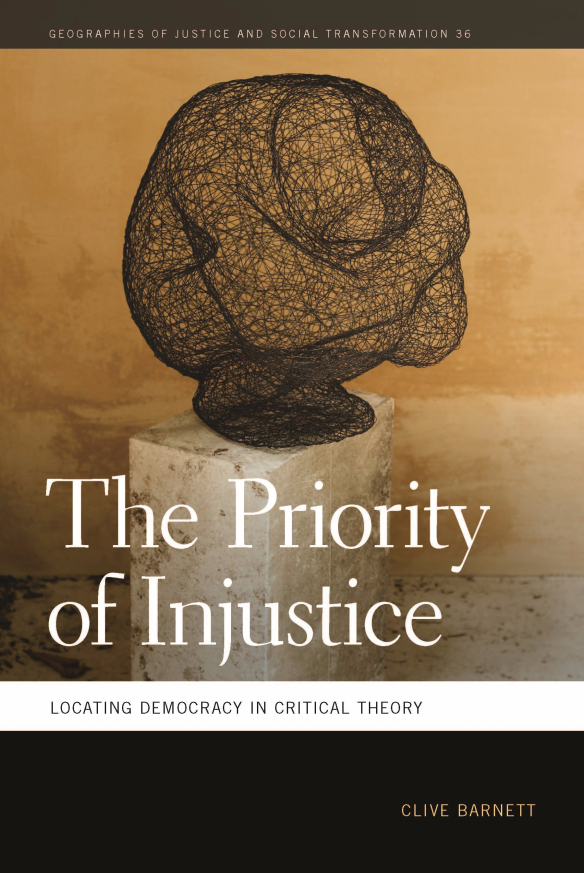
New Book: The Priority of Injustice

Clive Barnett’s new book published

Admin's avatarPop Theory

Published today, The Priority of Injustice: Locating Democracy in Critical Theory. You can read more about the book here.

My book is available from most booksellers. If your local store doesn’t have a copy in stock, please ask them to special order it for you. If you don’t have a preferred local store here are a few other ways to buy a copy.

To find an independent bookseller in your area, visit these sites:

UK: https://www.booksellers.org.uk/Home

North America: http://www.indiebound.org/

Shop at these online booksellers:

Book Depository

Amazon

Barnes & Noble

Powell’s City of Books

Exclusive Books

Buy a copy direct from the University of Georgia Press by visiting my book’s page on the website and clicking the buy link:

http://www.ugapress.org/index.php/books/index/priority_of_injustice

View original post

Posted in Uncategorized | 1 Comment

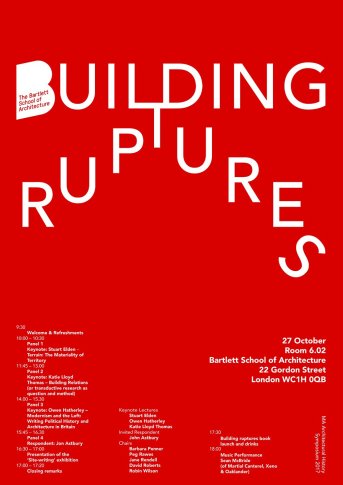
Building Ruptures, Architectural History, UCL 27 Oct 2017 – audio of my talk on Terrain

UCLOn 27 October 2017 I had the pleasure of speaking at Building Ruptures, an Architectural History Symposium and Exhibition, at the Bartlett School of University College London. Most of the day was devoted to graduating student presentations, which were of extremely high quality – both in terms of the work and the style of presentation. This was both humbling and inspiring. There were also short keynote talks by Katie Lloyd Thomas, Owen Hatherley and me. Full details of the day are here.

I was struggling with a heavy cold, and didn’t manage to stay until the final session, but it was still a very good day. I presented my work on terrain, drawing heavily on a lecture which has recently been published in the London Review of International Law. While there is a video of that lecture available, I also recorded this shorter talk, which is available here.


Posted in Conferences, terrain, Territory, Uncategorized | Leave a comment

Marijn Nieuwenhuis and David Crouch (eds), The Question of Space: Interrogating the Spatial Turn between Disciplines

59a10ed2f5ba7412f85029f8Marijn Nieuwenhuis and David Crouch (eds), The Question of Space: Interrogating the Spatial Turn between Disciplines – now out with Rowman and Littlefield International.

The spatial turn has been deeply influential across the humanities and social sciences for several decades. Yet despite this long term influence most volumes focus mainly on geography and tend to take a Eurocentric approach to the topic. The Question of Space takes a multidisciplinary approach to understanding how the spatial turn has affected other disciplines. By connecting developments across radically different fields the volume bridges the very borders that separate the academic space. From new geographies through performance, the internet, politics and the arts, the distinctive chapters undertake conversations that often surprisingly converge in approach, questions and insights Together the chapters transcend longstanding disciplinary boundaries to build a constructive dialogue around the question of space.

Prelude: Playing with Space, Marijn Nieuwenhuis and David Crouch / 1. Space, living, atmospheres, affectivities, David Crouch / 2. ‘Knowing one’s place’ – mapping landscapes in and as performance in contemporary South Africa, Awelani Moyo / 3. Vocalic space: socio-materiality and sonic spatiality, George Revill / 4. bell hooks’ Affective Politics of Space and Belonging, Yvonne Zivkovic / 5. As Tenses Implode: Encountering Post-Traumatic Urbanism in Ghassan Kanafani’s ʿĀʾid ila Hayfā, Ghayde Ghraowi / 6. ‘Place’ in an Inverted World? A Japanese Theory of Place, Atsuko Watanabe / 7. The Invisible Lines of Territory: an Investigation into the Makeup of Territory, Marijn Nieuwenhuis / 8. Two Internet Cartographies: Google Maps and the Unmappable Darknet, Andrei Belibou / 9.Space is no one thing: luring thought through film and philosophy, Philip Conway / 10.Mayday – a letter from the Earth, Martin Gren / Postlude: And… And… And…, Marijn Nieuwenhuis and David Crouch /

Posted in Territory, Uncategorized | Leave a comment

Key Thinkers on Cities (Sage, Oxford)

A new addition to the Sage series – Key Thinkers on Cities

abarnfield's avatarurbanculturalstudies

KTOC book

A new addition to the Sage’s Key Thinkers range focuses on Cities and thinkers who are at the vanguard of contemporary scholarship that helps to shape our understanding of what city life is like. Key Thinkers on Cities presents the work of 40 innovative scholars who underscore the breadth and depth of urban research. These are writers whose ideas have sculpted how cities around the world are comprehended, researched, debated, and acted upon. Impressively, the book is not restricted to narrowly defined writers of ‘the urban’. The book contains fields as diverse as art, architecture, computer modelling, ethnography, public health, and post-colonial theory. In doing so, the book provides space for a group of thinkers who have started to shape knowledge of cities through these different disciplinary guises.  The range of 40 thinkers include; Ash Amin, Jason Corburn, Natalie Jeremijenko, Enrique Peñalosa, Jennifer Robinson, Karen C. Seto, Abdumaliq Simone, and…

View original post 126 more words

Posted in Uncategorized | Leave a comment

Now online – the 2017 Antipode RGS-IBG Lecture, “Retelling Stories, Disrupting ‘the Social’, Relearning the World” by Richa Nagar

2017 Antipode RGS-IBG Lecture, “Retelling Stories, Disrupting ‘the Social’, Relearning the World” by Richa Nagar – with some linked open access papers.

Antipode Editorial Office's avatarAntipodeFoundation.org

The 2017 Antipode RGS-IBG Lecture

Retelling Stories, Disrupting “the Social”, Relearning the World

Richa Nagar (University of Minnesota-Twin Cities)

The 2017 Antipode RGS-IBG Lecture took place on August 30th at the Royal Geographical Society (with IBG) in London. Those who were there will no doubt agree that it was a great event; those that weren’t can now watch a film of Richa’s presentation here, and access related Antipode papers below.

The dominant landscape of knowledge and policy rests on a fundamental inequality: bodies who are seen as hungry or precarious are assumed to be available for the interventions of experts, but those experts often obliterate the ways that the hungry actively create politics and knowledge by living a dynamic vision of what is ethical and what makes the good life. Such living frequently involves a creative praxis of refusal against imposed frameworks. For Nagar, learning from such refusals requires…

View original post 941 more words

Posted in Uncategorized | Leave a comment

CFP: Urban Planning and the Spatial Ideas of Henri Lefebvre

Details of a theme issue devoted to Lefebvre’s work. Do check the journal’s open access policy and article processing charges (see also here).

CFP: Urban Planning and the Spatial Ideas of Henri LefebvreEditor: Michael Leary-Owhin (London South Bank University, UK)

Deadline for Full Papers: 15 January 2018 Issue Release: June 2018

This themed issue of Urban Planning seeks to contribute to and extend the debate regarding the application of Lefebvre’s ideas to the current challenges and opportunities of urban planning. Papers can cover a range of issues e.g.: governance, urban design, urban regeneration, environmental management, community participation, housing, policy making and evaluation, local/strategic planning, infrastructure, international planning, neoliberal urbanism, smart cities, land hunger, urbanisation, gentrification, urban poverty/inequality, the right to the city, new towns/cities, planning history, city management and the law.

We welcome papers that present: new empirical research, critical reviews of current issues, theoretical discussions and developments and demonstrate a critical engagement with Lefebvre’s ideas and arguments.

Urban planning has an intense concern with ‘urban space’ (including ‘rural space’). Spatial planning evolved as a concept in attempts to integrate the complex social, economic, environmental and political aspects of late 20th century society. Similarly, the spatial ideas of the (neo)Marxist philosopher/sociologist Henri Lefebvre encompass these issues but also stress the importance of culture and history. This special issue of Urban Planning is predicated on three of Lefebvre’s major works:

– The Production of Space (1974/1991)

Critique of Everyday Life (1981/1991)

The Urban Revolution (1970/2003)

It draws to a lesser extent on two other texts: Rhythmanalysis (published posthumously in 1992) and Introduction to Modernity (1962/1995).  Lefebvre’s ideas and approach to the investigation of cities and urban society have been taken up most vigorously in the fields of human geography and sociology and latterly architecture. Despite this, it is clear that Lefebvre’s five central concepts: abstract space, the spatial triad, everyday life, the right to the city and planetary urbanism provide powerful tools for the examination of urban planning, cities and urban society in the Global North and South. Urban planning first embraced Lefebvre’s ideas in the 1990s. Surprisingly then, it is only in the last ten years or so that Lefebvrian inspired research, across several aspects of urban planning has become widely accepted but is still emerging.

This special issue of Urban Planning seeks to contribute to and extend the debate regarding the application of Lefebvre’s ideas to the current challenges and opportunities of urban planning. Papers can cover a range of issues e.g.: governance, urban design, urban regeneration, environmental management, community participation, housing, policy making and evaluation, local/strategic planning, infrastructure, international planning, neoliberal urbanism, smart cities, land hunger, urbanisation, gentrification, urban poverty/inequality, the right to the city, new towns/cities, planning history, city management and the law. We welcome papers that present: new empirical research, critical reviews of current issues, theoretical discussions and developments and demonstrate a critical engagement with Lefebvre’s ideas and arguments.

Instructions for Authors: Authors interested in submitting a paper to this issue shall carefully read the Instructions for Authors and submit their full papers through the journal’s online submission system by 15 January 2018. Authors are also highly encouraged to send, as early as possible, an abstract to up@cogitatiopress.com for a first assessment of the submission.

Open Access: This journal has an article processing charge to cover its costs, so authors are advised to check with their institutions if funds are available to cover open access publication fees, and if their institutions wish to join Cogitatio’s Membership Program (institutional members enable their authors to publish without having to incur any publication fees). Further information about the journal’s open access charges and institutional members can be found here.

Posted in Henri Lefebvre, Uncategorized, urban/urbanisation | 1 Comment

Books received – Lefebvre, Althusser, Connolly, Heron, the Ellen West case and Sword

IMG_2910

The Turkish translation of Henri Lefebvre’s Rhythmanalysis, which includes my introduction to the English edition; Althusser’s How to be a Marxist in Philosophy, William E. Connolly’s Facing the Planetary, Nicolas Heron’s Liturgical Power: Between Economic and Political Theology, a collection of documents relating to the Ellen West case analysed by Ludwig Binswanger, and Helen Sword’s Air & Light & Time & Space: How Successful Academics Write. The Lefebvre copies were kindly sent by Cihan Ozpinar, Liturgical Power was sent by Fordham University Press, while the rest were either bought or recompense for review work.

Posted in Henri Lefebvre, Louis Althusser, Ludwig Binswanger, Uncategorized, William E Connolly | 4 Comments

Roland Boer – Marx on the State, Proletarian Dictatorship and the Commune

Roland Boer – Marx on the State, Proletarian Dictatorship and the Commune

This engagement with Marx is part of a much longer study of what happens to the state under socialism in power. Initially, I did not give so much attention to Marx’s observations on the state, for I had been told that Marx does not have a systematic theory of the state. To some extent this is true, especially if one focuses on the forms of the bourgeois (capitalist) or even absolutist state. However, once I began to examine what Marx did say about states, I found much more than might be expected – especially concerning what may be the form of the state after a communist revolution. At the same time, I found very few adequate treatments of this material, treatments that engage carefully with Marx’s texts. Why? A major reason is that so many Marxist attempts focus on the bourgeois or capitalist state, neglecting to a large extent what might follow this state form. Obviously, this is a retreat from Marx’s texts, for various reasons (I have a sense as to why but will not elaborate here). So I undertake in what follows a relatively simple task: identifying Marx’s key points concerning the state, based on careful analyses of the texts. In presenting this material, I exercise a strict self-discipline: as far as possible, I avoid reading later positions (Lenin, Stalin and so on) back into earlier ones. [continues here]

Posted in Uncategorized | Leave a comment

Conference on Foucault’s History of Sexuality volume IV, Paris, 1-3 February 2018

foucault-500x281Thanks to Clare O’Farrell at Foucault News for this link – Colloque International: Foucault, Les Pères et le sexe, Paris, 1-3 February 2018.

A l’occasion de la parution du quatrième et dernier volume inédit du projet d’histoire de la sexualité de Michel Foucault, Les Aveux de la chair, la Bibliothèque nationale de France organise un colloque en partenariat avec l’Université Paris 1 Panthéon-Sorbonne, l’Institut des Sciences Juridique et Philosophique de la Sorbonne (UMR 8103, CNRS/Université Paris 1), l’Institut des Sources chrétiennes (UMR 5189 – Hisoma, CNRS/Université Lyon 2) et l’Association pour le Centre Michel Foucault.

Les travaux de Michel Foucault sur les Pères de l’Église forment au sein de l’œuvre un chantier qui reste à parcourir. D’un côté, ils inaugurent la réflexion sur la subjectivité et la subjectivation ; de l’autre, ils constituent un point d’analyse privilégié de l’émergence de la sexualité moderne et du rôle qu’y a joué le christianisme. S’y entendent la fréquentation de l’œuvre de Peter Brown et les échanges réguliers avec Paul Veyne.

Longtemps attendu par les spécialistes comme par le grand public, Les Aveux de la chair, quatrième et dernier volume inédit du projet d’histoire de la sexualité de Michel Foucault, paraissent début 2018 aux éditions Gallimard. Événement intellectuel et éditorial, cette parution vient refermer le volumineux dossier « Patristique » que Foucault avait ouvert dès 1976 et dont plusieurs pièces majeures nous étaient déjà accessibles. En 2012 est paru Du gouvernement des vivants, cours au Collège de France de 1980 consacré pour une large part aux Pères de l’Église (Hermas, Tertullien, Cassien, Clément de Rome, etc.), dont la lecture serrée était l’occasion d’analyses novatrices des « régimes chrétiens de vérité » (baptême, pénitence). Non seulement ces leçons annoncent ce que l’on a couramment appelé le « dernier Foucault » – celui des techniques de soi –, mais elles renouvellent profondément ce que nous croyions être la vision foucaldienne du christianisme, en apparence cristallisée en 1976 dans La Volonté de savoir et devenue doxa pour un large public : le christianisme ne serait que la religion de l’aveu et de l’obéissance. Une part important des Aveux de la chair reprend d’ailleurs le matériau du cours de 1980, augmenté d’une longue et étonnante analyse d’Augustin.

Si cette place du christianisme dans l’œuvre de Foucault a fait l’objet depuis une dizaine d’années d’une attention renouvelée, l’espace historique d’émergence et les acteurs majeurs de cette problématisation du sujet moderne – les Pères grecs et latins du IIe au Ve siècle – ont été rarement explorés pour eux-mêmes. La rencontre entre l’œuvre de Foucault et le monde de la recherche patristique (patrologues, philologues, historiens, théologiens) n’a pas encore eu lieu, alors même qu’elle est devenue une activité courante dans des domaines aussi variés que l’histoire de l’Antiquité gréco-romaine ou les sciences sociales.
Ce grand colloque international, le premier consacré à ce thème, espère combler ce manque.

En partenariat avec l’Université Paris 1 Panthéon-Sorbonne, l’Institut des Sciences Juridique et Philosophique de la Sorbonne (UMR 8103, CNRS/Université Paris 1), l’Institut des Sources chrétiennes (UMR 5189 – Hisoma, CNRS/Université Lyon 2) et l’Association pour le Centre Michel Foucault.

Comité scientifique
Philippe Büttgen, Philippe Chevallier, Agustín Colombo, Frédéric Gros, Bernard Meunier, Judith Revel, Philippe Sabot, Michel Senellart, Arianna Sforzini

Comité d’organisation
Philippe Büttgen, Philippe Chevallier, Agustín Colombo, Laurence Le Bras, Bernard Meunier, François Nida, Arianna Sforzini

Programme (sous réserve)

Jeudi 1er février
à l’Auditorium Colbert, 2 Rue Vivienne, 75002 Paris.
18h-19h30 : Conférence inaugurale, par Paul Veyne, suivie de Editer Les Aveux de la chair par Frédéric Gros

Vendredi 2 février
à l’Auditorium Colbert, 2 Rue Vivienne, 75002 Paris.
9h30-12h15 : Le tournant chrétien
14h15-17h30 : Une lecture singulière des Pères

Samedi 3 février
à l’Amphithéâtre Turgot, 17 rue de la Sorbonne, 75005 Paris.
9h30-12h15 : Augustin, finalement
14h15-17h30 : Ouvertures

Informations pratiques

Entré libre dans la limite des places disponibles
Jeudi 1er février et vendredi 2 février : à l’Auditorium Colbert, 2 rue Vivienne, 75002 Paris.
Samedi 3 février : à l’Amphithéâtre Turgot, 17 rue de la Sorbonne, 75005 Paris.

Accès le samedi sur inscription préalable à l’adresse : Philo-Recherche@univ-paris1.fr.

Posted in Foucault's Last Decade, Michel Foucault, Uncategorized | Leave a comment