Gordon Douglas, The Help-Yourself City: Legitimacy and Inequality in DIY Urbanism, forthcoming from OUP

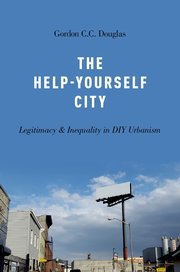
9780190691325Gordon Douglas, The Help-Yourself City: Legitimacy and Inequality in DIY Urbanism – forthcoming from OUP in early 2018.

When cash-strapped local governments fail to provide adequate services, and planning policies prioritize economic development over community needs, how do concerned citizens respond? In The Help-Yourself City, Gordon Douglas looks closely at the people who take urban planning into their own hands, dubbed “do-it-yourself urban design.” Through in-depth interviews with do-it-yourselfers, professional planners, and community members, as well as participant observation, photography, media, and policy analysis, Douglas demonstrates that many do-it-yourselfers employ professional techniques and expertise to enable and inspire their actions. He argues that many unauthorized interventions are created from a position of privilege, where legal repercussions are unlikely, while people from disadvantaged communities where improvements may be most needed face disincentives to taking such actions themselves. Presenting a needed social analysis of this growing trend, while connecting it to debates on inequality, citizenship, and contemporary urban political economy, The Help-Yourself City tells a street-level story of people’s relationships to their surroundings and the individualization of democratic responsibility.


Posted in Uncategorized, urban/urbanisation | Leave a comment

More Book Reviews up at Antipode open site

Open access reviews in Antipode

Peter Gratton's avatarPHILOSOPHY IN A TIME OF ERROR

Here

Moriel Ram (University College London) on Camillo Boano’s The Ethics of a Potential Urbanism: Critical Encounters Between Giorgio Agamben and Architecture, a book that presents Agamben’s work as a “concrete platform for the conceptual experiment to rethink the notion of potentiality and to re-examine how political theory can challenge our notions of the built environment”.

Nathan Poirier (Canisius College) on Harvey Neo and Jody Emel’s Geographies of Meat: Politics, Economy, and Culture – “both highly revered and highly tabooed … [meat is a] complex and sensitive issue … intertwined with culture, societies, politics, religion, and identity … The book expands on critical animal geographies by focusing on farmed animals … [extending and applying] concepts from anarchist geography”.

Jonathan Everts (Universität Bonn) on Steve Hinchliffe, Nick Bingham, John Allen and Simon Carter’s Pathological Lives: Disease, Space, and Biopolitics, which is “novel … ingenious …  the most thorough, detailed…

View original post 305 more words

Posted in Uncategorized | Leave a comment

“The Geography of Philosophy”, $2.6 Million Grant for Machery, Stich and Barrett

Philosophers Edouard Machery (Pittsburgh) and Stephen Stich (Rutgers) and anthropologist H. Clark Barrett (UCLA) have been awarded a $2,569,563 grant from the John Templeton Foundation to fund their project, “The Geography of Philosophy: An Interdisciplinary Cross-Cultural Exploration of Universality and Diversity in Fundamental Philosophical Concepts.”

Here’s a description of the project:

Throughout the history of philosophy, many thinkers have urged that some fundamental philosophical concepts are universal–used by all rational people. Historians and anthropologists have often been skeptical of these claims. Recently, cultural psychologists and experimental philosophers have begun to explore empirically whether fundamental philosophical concepts are shared across cultures. The results of these studies have been fascinating, provocative and equivocal. The goals of this project are (i) to move this exciting endeavor forward by dramatically expanding the methodologies, the range of cultures considered, and the cultural and disciplinary diversity of the investigators engaged in the inquiry; (ii) to motivate and enable researchers around the world to become involved in cross-cultural, interdisciplinary research on philosophical concepts by sponsoring workshops in Africa, Asia and South America where our research teams can interact with scientists and scholars in the region; (iii) to present our findings both in scholarly publications and in an integrated format accessible to non-specialists; (iv) to foster discussion about the implications of the findings for venerable philosophical debates and for practical contemporary issues.

SELRES_bbda2248-51b5-4625-a682-52ce67fab19bSELRES_2629ebb8-d49d-4310-b045-caad2c60c133The grant will fund work on the project from 2018-2021.SELRES_2629ebb8-d49d-4310-b045-caad2c60c133SELRES_bbda2248-51b5-4625-a682-52ce67fab19b

From Daily Nous (and thanks to dmf for the link)

Posted in Uncategorized | Leave a comment

Sociétés carcérales. Relecture(s) de ‘Surveiller et punir’ (2017)

A new collection on Foucault’s Surveiller et punir.

Clare O'Farrell's avatarFoucault News

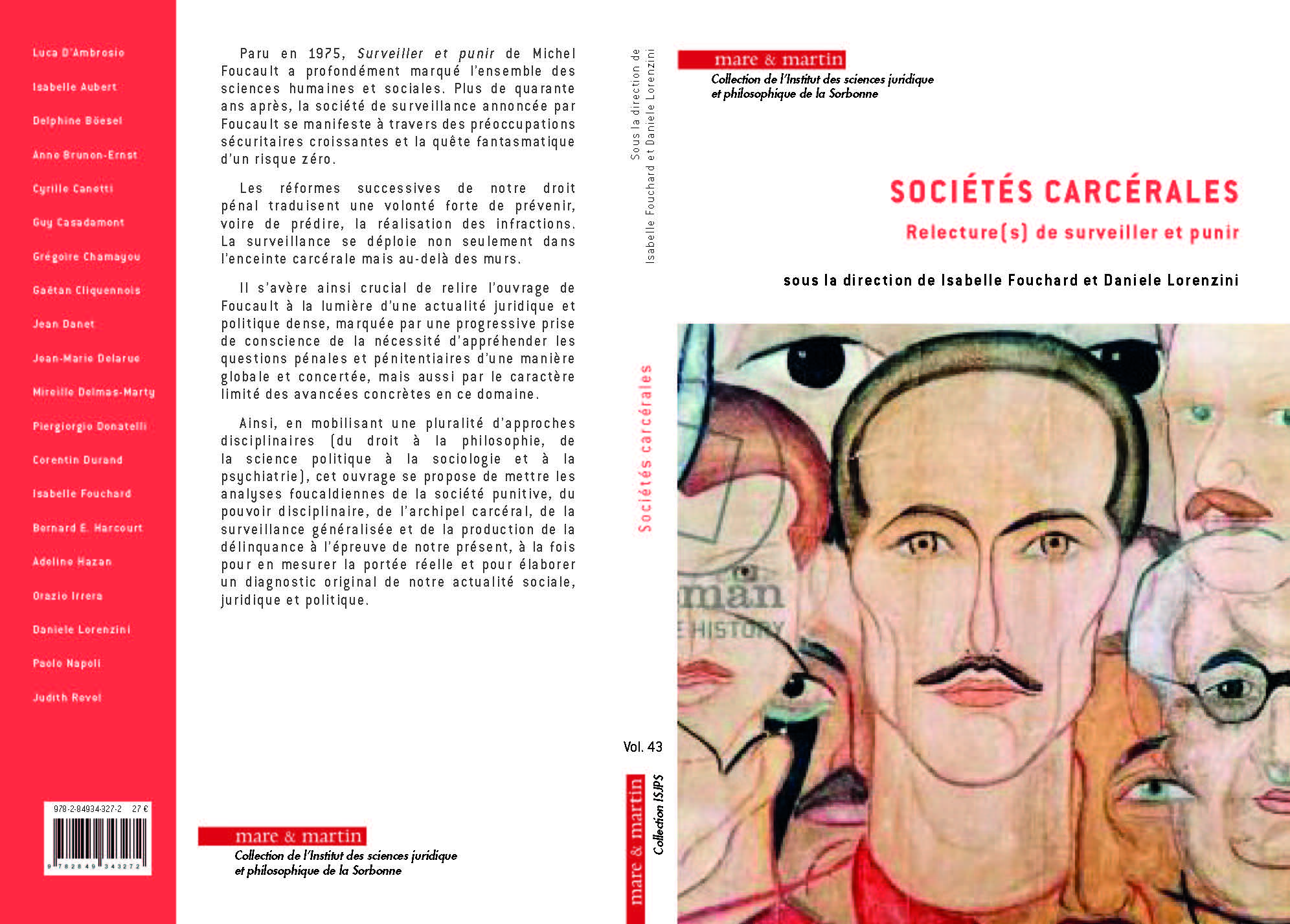
Sociétés carcérales. Relecture(s) de ‘Surveiller et punir’
sous la dir. de Isabelle Fouchard et Daniele Lorenzini
Paris, Mare & Martin, 2017. Forthcoming

Contributions de Luca D’Ambrosio, Isabelle Aubert, Delphine Böesel, Anne Brunon-Ernst, Cyrille Canetti, Guy Casadamont, Grégoire Chamayou, Gaëtan Cliquennois, Jean Danet, Jean-Marie Delarue, Mireille Delmas-Marty, Piergiorgio Donatelli, Corentin Durand, Isabelle Fouchard, Bernard Harcourt, Adeline Hazan, Orazio Irrera, Daniele Lorenzini, Paolo Napoli, Judith Revel

PDF of back and front cover

View original post

Posted in Uncategorized | Leave a comment

Damien Cahill and Martijn Konings, Neoliberalism – now out with Polity

9780745695525.jpgDamien Cahill and Martijn Konings, Neoliberalism – now out with Polity

For over three decades neoliberalism has been the dominant economic ideology. While it may have emerged relatively unscathed from the global financial crisis of 2007-08, neoliberalism is now – more than ever – under scrutiny from critics who argue that it has failed to live up to its promises, creating instead an increasingly unequal and insecure world.

This book offers a nuanced and probing analysis of the meaning and practical application of neoliberalism today, separating myth from reality. Drawing on examples such as the growth of finance, the role of corporate power and the rise of workfare, the book advances a balanced but distinctive perspective on neoliberalism as involving the interaction of ideas, material economic change and political transformations. It interrogates claims about the impending death of neoliberalism and considers the sources of its resilience in the current climate of political disenchantment and economic austerity.

Clearly and accessibly written, this book will be a valuable resource for students and scholars across the social sciences.

Posted in Uncategorized | 1 Comment

The Early Foucault Update 13: Writing during Termtime

IMG_2883Even though it is now well into term, with all the things that entails, I have been able to make small bits of progress on The Early Foucault manuscript. I’ve said before how I try to write for two hours in the morning before going onto campus, which can make for some long days but equally means I’m moving things forward, however slowly. In conversations with several colleagues about their summer writing, there was a constant theme of ‘and of course I won’t look at again until Christmas’. I try not to work that way.

On the last writing day before term began, I made a list of small, discrete tasks which I thought could be done in short periods of time. Some were things I could do on campus when there were odd moments spare – collect things from the library, scan old journal articles from things that are not online, fill out inter-library loan forms, check references to things I have in the office. Others were bits of writing – a paragraph or part of a section – that I thought I could do in short periods of time. Some days, writing is excruciating; most days it’s just hard work. But a bit each day adds up. Even adding 200 or 300 words a day or a few times a week keeps things ticking along.

In the introduction to Binswanger’s ‘Dream and Existence’, Foucault quotes from René Char’s Partage Formel. David Macey highlights this as an early instance of Foucault’s slapdash referencing, and I wanted to check them all to see how bad it was. It’s made harder to spot because the editors of Dits et écrits and the English translator have silently corrected or completed most or all of them. So it was a case of checking the original 1954 text. There are five passages – one as the epigraph and four late in the text Foucault only provides references for two of the five, and one of those is incorrect. Not a great score.

I also followed up on a source Macey references about the Fresnes prison, which led me to another piece about the Centre National d’Orientation where Foucault worked with Jacqueline Verdeaux. I’ve said before how meagre the sources are for this part of Foucault’s career, so these helped fill in a bit more detail.

As before, checking the original source of early publications – as opposed to the reprint in Dits et écrits – yielded a few helpful bits of evidence. There are also some helpful documentary sources collected in later editions of Didier Eribon’s biography or by Phiippe Artières and his colleagues in French collections. These were also things that I could re-read and write about in short bursts of writing. Another small task was going back over some references in the von Weizsäcker translation made by Foucault and Daniel Rocher, and reworking a few paragraphs in the discussion of that text.

I’ve also got a list of things I know I need to write which will take me longer than a couple of hours. I’m saving those back for when I have a day or two I can devote to writing. Although it is not ideal, I think you can  build up longer texts from smaller pieces, rather than wait for the time to write whole sections or chapters in one go or in sequence. A paragraph or two in a short writing session, or a section in a day all adds up, and I’m making slow, but steady progress on building up material. It might be obvious, but this is in no sense linear work – I have bits of Chapters 1-4 and 8-10 written and lots of working files of notes for other sections.


The previous updates on this project are here; and Foucault’s Last Decade and Foucault: The Birth of Power are now both available from Polity. Several Foucault research resources such as bibliographies, short translations, textual comparisons and so on are available here. On the related Canguilhem project, see this page.

Posted in Michel Foucault, The Early Foucault, Writing | 2 Comments

“I have endeavoured to tidy up Sartre’s haphazard references…”

Jonathan Webber on one of the tasks of a translator or editor:

“I have endeavoured to tidy up Sartre’s haphazard references, giving full bibliographical information, but this has not always been possible. I have not added references where Sartre gave none”.

“Notes on the Translation”, in Jean-Paul Sartre, The Imaginary, p. xxx

I have done this quite a bit – for Lefebvre’s Metaphilosophy (some comments here), Axelos’s Introduction to a Future Way of Thought (see here and here), and also for some earlier Lefebvre translations – Key Writings (with Eleonore Kofman and Elizabeth Lebas),
Rhythmanalysis 
(with Gerald Moore), and State, Space, World (with Neil Brenner). I’ve tended to try to find the missing references, not just correct though. And at some point fairly soon I’m going to be doing it again…

Posted in Henri Lefebvre, Jean-Paul Sartre, Kostas Axelos, Neil Brenner, Uncategorized | Leave a comment

Books received – Derrida, Sartre and Quarmby

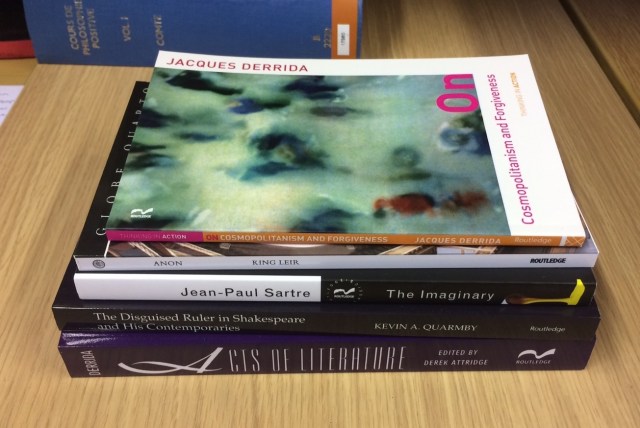
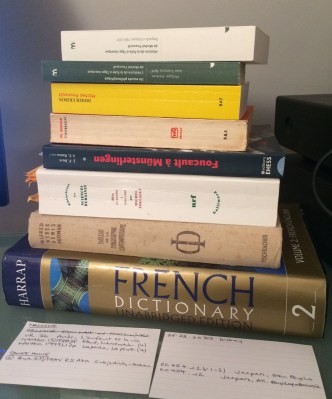
IMG_2893 copy.jpgA few books received in recompense for review work for Routledge – some older works by Derrida and Sartre, King Leir – the anonymous play which precedes the one by Shakespeare with the similar title, and The Disguised Ruler in Shakespeare and his Contemporaries by Kevin A. Quarmby.
Posted in Jacques Derrida, Jean-Paul Sartre, Uncategorized, William Shakespeare | 1 Comment

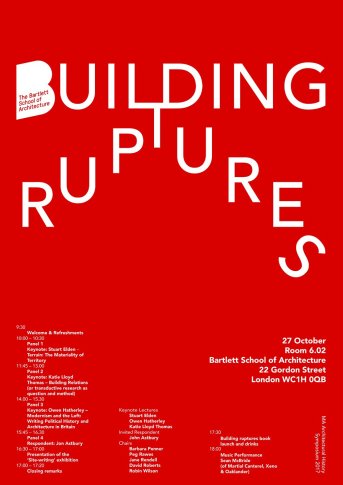
Building Ruptures, Architectural History Symposium and Exhibition, UCL 27 Oct 2017

UCLLater this month I’ll be speaking at Building Ruptures, an Architectural History Symposium and Exhibition, at the Bartlett School of University College London, 27 October 2017.

Please join the MA Architectural History 2016/17 cohort for Building Ruptures, a symposium, exhibition and publication launch. Building Ruptures will feature a series of position papers from guest speakers, presentations by graduating students, discussions with guest respondents and an exhibition of students’ work. The symposium sessions will cover a diverse range of topics including territories and places, materialities and subjectivities, histories and materialisms, site writing and theorising practices.

The symposium will feature Stuart Elden, Owen Hatherley and Katie Lloyd Thomas as speakers and Jon Astbury as a respondent.

The event is free and open to all with no registration required.


Presentations and discussions from 10am until 5.30pm, followed by a performance by Sean McBride (of Martial Canterel / Xeno & Oaklander), publication launch and drinks

Full details here


Posted in terrain, Territory, Uncategorized, urban/urbanisation | Leave a comment

Territory Beyond Terra, edited by Kimberley Peters, Philip Steinberg, and Elaine Stratford – forthcoming in early 2018

Now in production, with a scheduled date of early 2018 (see https://philsteinberg.wordpress.com/2017/10/09/territory-beyond-terra-now-at-the-publishers/)

stuartelden's avatarProgressive Geographies

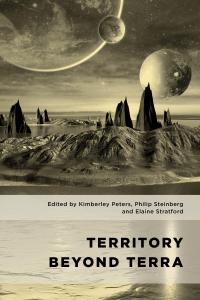
593b8b09f5ba741adc68db03Territory Beyond Terra, edited by Kimberley Peters, Philip Steinberg, and Elaine Stratford – forthcoming in December 2017.

At the root of our understanding of territory is the concept of terra—land—a surface of fixed points with stable features that can be calculated, categorised, and controlled. But what of the many spaces on Earth that defy this simplistic characterisation: Oceans in which ‘places’ are continuously re-formed? Air that can never be fully contained? Watercourses that obtain their value by transcending boundaries?

This book examines the politics of these spaces to shed light on the challenges of our increasingly dynamic world. Through a focus on the planet’s elements, environments, and edges, the contributors to Territory beyond Terra extend our understanding of territory to the dynamic, contentious spaces of contemporary politics.

View original post

Posted in Uncategorized | 2 Comments