The Early Foucault and the Politics of European Intellectual History – Amsterdam lecture, 31 May 2017

While visiting ACCESS Europe in Amsterdam, I’ll be giving this public lecture:

The Early Foucault and the Politics of European Intellectual History“, 31st May, 5pm

58eb5bb15a1067.99864780This lecture by ACCESS EUROPE Visiting Scholar Stuart Elden reports on a project tracing the intellectual history of Foucault’s History of Madness out of earlier work on the history of psychology and psychiatry.

It therefore focuses on his largely unknown work in the 1950s. In particular it discusses three themes. First, Foucault’s student years in Paris, where he attended lectures by people including Maurice Merleau-Ponty, Jean Beaufret and Jean Hyppolite as well as, a little later, the early seminars of Jacques Lacan. Second his role as a co-translator of two texts – Ludwig Binswanger’s ‘Traum und Existenz’ and Viktor von Weizsäcker’s Der Gestaltkreis. His role is bringing these Swiss and German works into French is underappreciated. The introduction to Binswanger is quite well known, but his role in the translation itself – which was credited to Jacqueline Verdeaux alone – is underexplored. His co-translation of von Weizsäcker, with Daniel Rocher, is sometimes referenced but unexamined. There is an important, and disturbing, political context to this work. Finally the lecture will discuss Foucault’s role as director of the Maison de France in Uppsala between 1955 and 1958. It was in Uppsala that Foucault undertook much of the research for the History of Madness, though he was unable to get it accepted as a thesis there. Drawing links between France, Switzerland, Germany and Sweden, this lecture indicates the European context of the formation of Foucault’s work.

About the speaker

Stuart Elden is Professor of Political Theory and Geography at the University of Warwick, UK. He is the author of seven books, including works on territory, Michel Foucault, Martin Heidegger, and Henri Lefebvre. He is currently working on a study of territory in Shakespeare’s plays; on the concept of terrain; on Lefebvre’s writings on rural issues; and the very early Foucault.

Location

University Library, Singel 425, Doelenzaal

image “Foucault at the Maison de France in Uppsala”, 1957 (Photo J.C. Oberg)

Posted in Conferences, Jean Hyppolite, Michel Foucault, The Early Foucault, Uncategorized | Leave a comment

Vertical at LSE

Discussion of Steve Graham’s Vertical book at the LSE in May.

Posted in Uncategorized | Leave a comment

Research hacks intermezzo: A cornucopia of writing and publishing advice from Stuart Elden – Christopher Watkin

Research hacks intermezzo: A cornucopia of writing and publishing advice from Stuart Elden – Christopher Watkin links to my list of writing and publishing posts, and picks some of his favourites. This is part of his series of Research Hacks – all of which are available here.

Posted in Publishing, Uncategorized, Writing | Leave a comment

Interview with Mark Kelly on Foucault and Biopolitical Imperialism

s-l300
Fully Automated Episode 2: Biopolitical Imperialism with Mark G.E. Kelly

Our guest this week is Mark G. E. Kelly, an Associate Professor in the School of Humanities and Communication Arts at Western Sydney University. He is the author of The Political Philosophy of Michel Foucault (2009), as well as of Biopolitical Imperialism (from Zer0 books, in 2015) and he is also working on a book called ‘For Foucault: Against Normative Political Theory’ (SUNY, expected 2018).

Kelly has weighed in a number of recent ‘Foucault’ controversies, including the question of whether Foucault was a neoliberal. In this interview, we get into that debate. But I think for most listeners, the interesting stuff will be towards the end, where Kelly talks about Biopolitical Imperialism, and addresses the conflict in Syria.

The podcast was recorded on Wednesday, April 5, 2017. In the interview, you’ll hear Kelly comment on Donald Trump’s pivot a few days previous, on Syria. Two days after the recording, on April 7, the US military launched a cruise missile attack on a Syrian airfield. The attack was carried out in response to a chemical weapons incident in Idlib province, perpetrated allegedly by Syrian state forces. It would be hard to imagine a stronger confirmation of Kelly’s arguments about Biopolitical Imperialism.

Podcast: Play in new window | Download

Posted in Michel Foucault, Politics, Uncategorized | 1 Comment

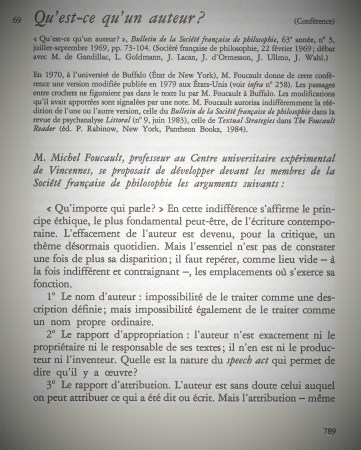
The textual issues around Foucault’s ‘What is an Author?’

what is an author While it is somewhat outside the time period I am currently working on, Foucault’s ‘What is an Author?’ lecture is interesting because it is one of the few instances for which there is a textual record of an engagement between Foucault and Lacan.

The lecture was first delivered at the Société française de philosophie at the Collège de France on 22 February 1969. In March 1970 Foucault gave a version at SUNY Buffalo. Foucault’s visit was to the French department, and at this time he either lectured in French or with an interpreter.

The original lecture was published in the Bulletin de la Société française de philosophie in 1969 (63e annee, No 3, pp. 73-104); the Buffalo lecture was published in the 1970s. While Dits et écrits provides a number to both texts in its chronology, it only prints one version (#69) and the other (#258) simply points to the first. Text #69 is a critical composite edition, based on the 1969 lecture, with the passages cut from the 1970 version enclosed in brackets, and a few notes indicating other variations. [Not all the changes are marked.] Daniel Defert translates back into French one long variant passage only said in the US. The text printed in Dits et écrits therefore allows a reader to reconstruct what was said in both Paris and in Buffalo. [Update: as notes below indicate, it doesn’t, since the ‘Buffalo’ text isn’t actually what it claims to be.]

The two texts are translated separately in English.

Most of the Paris text (missing pp. 73-75 and discussion from foot of pp. 95-104) can be found in Donald Bouchard (ed.), Language, Counter-Memory, Practice: Selected Essays and Interviews, Ithaca: Cornell University Press, 1977, pp. 113-38, translated by Bouchard and Sherry Simon. It is reprinted in Donald Preziosi (ed.), The Art of Art History: A Critical Anthology, New York: Oxford University Press, 1998, pp. 299-314, with notes on pp. 547-48. This is a strikingly lazy reprint, which does not mention the Bouchard source, and even includes a note ‘See above, ‘Language to Infinity’, p. 58’ which refers to another essay in the Bouchard collection, not the anthology itself.

Richard Lynch’s Bibliography of Foucault’s shorter works in translation led me an earlier translation of the Paris lecture in Partisan Review, Vol 42 No 4, 1975, pp. 603-14, translated by James Venit. It is slightly abridged, and again misses the opening pages and the discussion. As far as I can tell, this has not been reprinted.

What claims to be the Buffalo text is translated as “What is an Author?” in J.V. Harari (ed.), Textual Strategies, Ithaca: Cornell University Press, 1979, pp. 141-60. The Buffalo text is the one reprinted in The Foucault Reader and in Essential Works Vol II.

In Paris, there was a discussion that followed the lecture (pp. 95-104). It is not translated in any of the above versions, but some parts can be found in Screen, Vol 20 No 1, 1979, pp. 29-33, translated by Kari Hanet.

Essential Works was supposed to be a translation of Dits et écrits, but the version found there does not correspond to a text found in Dits et écrits. It reprints the translation from Textual Strategies, and suggests that it has been ‘slightly modified’. It claims that “this essay is the text of a lecture presented to the Société Française de philosophie on 22 February 1969 (Foucault gave a modified form of the lecture in the United States in 1970)”. Actually, this is almost the reverse: the essay in Essential Works is the US version, of which there was an earlier variant form in Paris. To do justice to the text, what should have been provided was a translation of Dits et écrits #69, with the variants between Paris and Buffalo noted, and probably also the discussion. The French editors had already done the hard work; this text could have simply used the Bouchard version to fill in the missing parts. The preface and discussion does not appear at all. Once again, the English reader is short-changed by this very partial collection, with a reprint of a text which was itself already truncated.

So the text has been translated three times – by Venit, Bouchard & Simon and Harari. The others are reprints. The three translations are of the two different versions, though there is Paris material untranslated in any version. It is worth underlining that the reprints with widest circulation – The Foucault Reader and Essential Works – are of the shorter, US version of the lecture. The discussion has never been translated in full.

Finally, it is worth noting that in Lacan’s contribution to the discussion, he first says that he received the invitation very late – the implication is that he has missed at least part of the lecture – and then refers to the text of the invitation before elaborating a comment based on it. I wondered where that invitation might be. It is actually in the Bulletin de la Société française de philosophie and in Dit et écrits, though not marked as such. These versions include the text of the invitation, followed by Jean Wahl’s introduction, and then some opening words by Foucault (two paragraphs worth) before the opening line: “The subject which I have chosen – ‘What is an Author?’ – obviously requires some justification”. As far as I am aware, these opening parts have never been translated.

There are certainly ironies here, given Foucault’s topic and the English variations of the text. Any additions or corrections to the above are most welcome.

[August 2021: a little minor updating of this post]

[October 2021: on further research, I now do not think the version in Textual Strategies is actually the Buffalo lecture. Rather I think it is a different translation of the Paris lecture, slightly cut and amended to make it closer to themes Foucault discussed in Buffalo. Since this is the version most reprinted in English, this is significant. A fuller discussion is here. This has also been updated in November 2021 now I have seen a transcript of the actual Buffalo lecture.]

(This post is part of the Foucault Resources part of this site, which also includes bibliographies, links to audio and video recordings, some textual comparisons, a few brief translations, and some other pieces.)

Posted in Jacques Lacan, Michel Foucault, The Early Foucault, Uncategorized | 8 Comments

It seems Jacques Lacan struggled to get his students to do the reading too…

Last time I wanted to give you an initial insight into the meaning of the question – what happens beyond the pleasure principle? My great friend Jean Hyppolite, who isn’t here today because he is in Germany, told me he had read Beyond the Pleasure Principle again. I think he is at least as busy as most of you. So, it’s time to think of reading. In a fortnight we will talk about it again text in hand (Seminar II p. 138/98).

Posted in Jacques Lacan, Jean Hyppolite, Uncategorized | 2 Comments

Unpaywall – a Chrome and Firefox plugin to find open access versions of articles

Unpaywall is a new Chrome and Firefox plugin to find open access versions of articles. If you go to a journal article webpage with this installed, then it will give you a green logo on the right side of your browser if it can find an open access version; a grey logo if not.

I’ve had a bit of a try with this, and while it can’t find everything – it doesn’t seem so good at finding stuff on personal sites – it does pick up institutional repositories. I think part of the reason is that it tries to link to pieces which are legitimately online open access. One piece I tried got a green light, but the link led to a piece under embargo for another year. So, clearly not working perfectly yet, but it looks useful. Initial tests (reported in the article below) seemed to suggest half to two-thirds of articles might be available – not always clear from a publisher webpage of course. I suspect you could find a lot of these open access with a bit of internet searching, but this of course saves that time. Might it help put an end to interminable email discussion list requests for papers?

There is a fuller discussion here.

Posted in Publishing, Uncategorized, Universities | 2 Comments

Five apps I find really useful for my writing and blogging

As a followup to the last post, and especially #12, a reblog of my 2014 suggestions for useful apps for reading, writing and blogging.

stuartelden's avatarProgressive Geographies

Five apps I find really useful – Evernote – Dropbox – Sanebox – Feedly – WasteNoTime

Evernote – I use this as my main repository for notes, links, lists, etc. I appreciate that you can clip websites directly to it, or email things to a direct address. As I come across useful things; references; things I want to blog, read later, watch, etc., I just throw them into Evernote, and then clean and tidy them later. It syncs across multiple devices, so wherever I am I have access to lists of things to do, things I want to find in libraries, etc. Really useful, handy to have to fill small pockets of time with something useful, and I’d hate to have to do with out it now.

Dropbox – everyone really ought to have some form of online backup. This is the one I use. Free if you don’t use too much…

View original post 602 more words

Posted in Uncategorized | Leave a comment

Christopher Watkin’s research hacks #10, 11 and 12

Christopher Watkin’s Research Hacks series continues.

#10: How to present a smart, well-crafted argument

#11: Let your arguments breathe

#12: Seven ways of keeping up to date with developments in your field

The whole series is useful, but #12 has some especially good suggestions. I use many of these ideas, but there are some additional suggestions here which look helpful. I suppose my only caution with this is that a lot of these end up as email alerts, which adds to an inbox. The solutions I use are inbox rules to filter (and I use Sanebox); a separate non-urgent email account; and/or having some alerts get sent straight to Evernote.

There are several posts from Progressive Geographies about writing and publishing, and a lot more links, archived here.

Posted in Uncategorized | 2 Comments

The pace of academic life is not the problem—the lack of autonomy is – LSE Impact Blog

The pace of academic life is not the problem—the lack of autonomy is – LSE Impact Blog

To many disgruntled with the quantification of scholarship, its impossible demands and meaningless metrics, it is the heightened pace of academic life that is the problem. For Alison Edwards, the crux of the problem is actually a lack of autonomy. Is it time for academics to take back control? This post is inspired in part by the Impact Blog’s Accelerated Academy series.

Posted in Uncategorized, Universities | Leave a comment