Books received – Lacan, Freud and Earth, Tree and Traffic from the Object Lessons series

IMG_2296.JPG

Second-hand copies of Lacan’s Ecrits (the old Sheridan translation) and Freud’s Jokes and their Relation to the Unconscious; along with Earth, Tree and Traffic from Bloomsbury’s Object Lessons series, sent by the publisher. Earth looks especially interesting – not just because it links to my interest in the topic, but because it is written by Jeffrey Jerome Cohen with Linda T. Elkins-Tanton. By the way, I know the Sheridan translation is much criticised, and has been superseded by the one by Bruce Fink, but this translation keeps coming up as a reference, so it’s helpful to have a copy to hand.

Posted in Jacques Lacan, Jeffrey Jerome Cohen, Sigmund Freud, Uncategorized | 1 Comment

Lecture on Khôra, Place, and Metaphysics

Peter Gratton’s keynote lecture on khôra, place and metaphysics.

Peter Gratton's avatarPHILOSOPHY IN A TIME OF ERROR

Here is an audio of my keynote at the University of Windsor this past weekend. I had a wonderful reception (actually that’s a key term I take up), and I should say that from the undergraduates to the graduate students to the faculty, it showed itself to be an excellent philosophical community. In some sense, even as I don’t lean on Derrida’s own writings on khôra all that much (I quote him once only to say there is more to Plato than Platonism), one could say this paper would head toward something like a “deconstructive” thinking of place already available in Plato, despite what figures from Aristotle to Plotinus to Heidegger would have one believe. Ultimately I try to show this realist thinking of place offers a “democratic,” open thinking of place always open to thinking it otherwise, over and against the dogmatic, reactionary thinking of place one often finds within various nationalisms…

View original post 8 more words

Posted in Uncategorized | 2 Comments

The Early Foucault update 5: Canguilhem, Merleau-Ponty, Politzer, Lacan…

Until about a week ago I was focusing on the terrain work, for the London Review of International Law lecture, the conference in Oslo, and the lecture in Maynooth. But in and around other things I was also doing a little work on Foucault for this project. Some related to a standalone essay on Foucault and Shakespeare – a companion piece to the one coming out in Southern Journal of Philosophy (preprint of the first piece here). The other work has included more reading by and on Canguilhem, especially doing a survey of the French collections of essays on his work, and on Merleau-Ponty. I’ve been looking at some of Merleau-Ponty’s courses at the Collège de France. There are some intriguing developments in his work, and themes which link back to his courses at the Sorbonne. I’m not sure how much I can discuss all of this in the book, and the material on Canguilhem, in particular, is taking on something of a life of its own.

I also did some work on Georges Politzer, whose 1928 Critique of the Foundations of Psychology was influential to at least two generations of French thinkers. I’d read some of  Politzer’s work several years ago, because he was part of the Philosophies group along with Georges Friedmann, Norbert Guterman and Henri Lefebvre. Politzer was active in the resistance in World War II, and executed by the Gestapo in 1942. Politzer made me think of a life and career that might have been – as does Jean Cavaillès, a philosopher of logic and mathematics on whom Canguilhem wrote a short book, who was also killed by the Nazis.

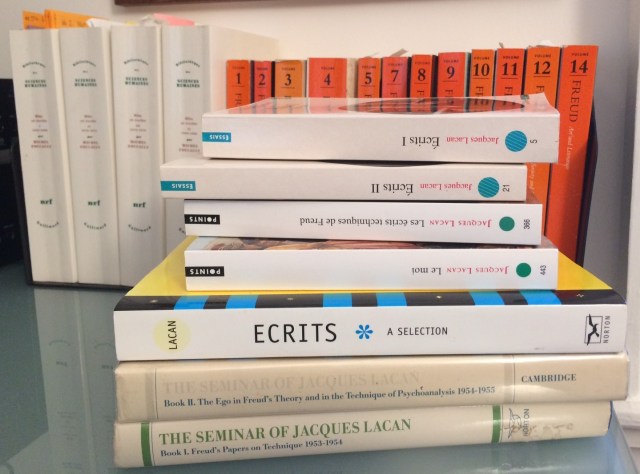
For the last few days I’ve begun drafting something on Foucault’s links to Lacan in the early 1950s. We know from the biographies that Foucault attended some early seminars, but this stopped when he moved to Uppsala in 1955. What might Foucault have actually heard in those talks? The first two seminars were held in Lacan’s home, and only some indications of content survive. They treated the famous ‘Dora’, ‘Wolf Man’ and ‘Rat Man’ cases. The first and second seminars of the published series, which treat Freud’s papers on technique and the ego, were likely the ones that Foucault part-attended. This is also plausible because those were the first classes held at the Sainte-Anne hospital, and more widely attended. The record is incomplete, but there is still a lot of material. In order to make sense of what there is, I went back to Freud’s texts that Lacan engaged with, and read (or re-read) these before working through Lacan’s lectures. I actually found Lacan much more interesting and approachable than I imagined – I read the abbreviated Écrits and The Four Fundamental Concepts years ago, but never went further than that. I might continue on a little in his seminars, even though I don’t think the subsequent ones have much impact on Foucault. Foucault makes lots of comments, not always very positive, about Lacan, and I’ve looked at these – he frequently comes up in interviews. Lacan says a little about Foucault. I’ve tried to offer a balanced assessment of the relation in the section I’ve now drafted, though I still have work to do on this.

It’s been good to have a few days with consolidated focus on this book manuscript again. I’d gathered quite a lot of material over the past few months, so some of the work has been shaping and working that into draft sections. There has been a lot of checking of references and so on, and I’m reminded, again, of just how non-portable this work is. In the home study I have all of Foucault in French and English, along with many of the other references I need – all of Heidegger and Nietzsche, most of Marx and Hegel, and I’ve moved all the Freud, Lacan, Canguilhem and Merleau-Ponty books I own home as I work on this. The benefits of just being able to turn around and pull the reference off the shelf are considerable. Something to consider as I plan for the trip to Amsterdam in a couple of weeks.

Since the last update I’ve also signed the contract with Polity. All being well – and this is slightly dependent on publication plans for the early courses – I am aiming to submit in late 2018, with a view to a 2019 publication.

The previous updates on this project are here; and Foucault’s Last Decade and Foucault: The Birth of Power are both now available from Polity worldwide. Several Foucault research resources such as bibliographies, short translations, textual comparisons and so on are available here.

Posted in Georges Canguilhem, Henri Lefebvre, Jacques Lacan, Maurice Merleau-Ponty, Michel Foucault, Sigmund Freud, The Early Foucault, Uncategorized | 1 Comment

Mapping the Topographic Fingerprints of Humanity Across Earth

utah-mine-topographic-fingerprint-human-landscape-800x600.pngMapping the Topographic Fingerprints of Humanity Across Earth – Eos

An interesting piece on anthropogeomorphology and terrain.

Posted in terrain, Uncategorized | 1 Comment

Saskia Sassen – A world unified by the golden rule: expropriation

Saskia Sassen – A world unified by the golden rule: expropriation – interview with Il Manifesto (via e-flux).

Posted in Saskia Sassen, Uncategorized | 1 Comment

Alberto Toscano, Notes on Late Fascism

Alberto Toscano, Notes on Late Fascism at Historical Materialism, a seminar from February 2017 at Simon Fraser University.

Posted in Alberto Toscano, Uncategorized | 1 Comment

Guest Post: In Praise of Globes

Another contribution to the debates about map projections and globes.

Cathy O'Neil, mathbabe's avatarmathbabe

This is a guest post by Ernie Davis Professor of Computer Science at NYU. Ernie has a BS in Math from MIT (1977) and a PhD in Computer Science from Yale (1984). He does research in artificial intelligence, knowledge representation, and automated commonsense reasoning. He and his father, Philip Davis, are editors of Mathematics, Substance and Surmise: Views on the Ontology and Meaning of Mathematics, published by Springer.

Any government which genuinely cared about education would see to it that a globe map, at present an expensive rarity, was accessible to every school child.
— George Orwell, “As I Please” February 11, 1944

The decision by the Boston school system to replace maps of the world using the Mercator projection with maps using the Gall-Peters projection has garnered a lot of favorable press from outlets such as NPR, The Guardian, Newsweek, and many others.

MercatorMercator map of the world.

gallpetersGall-Peters…

View original post 1,378 more words

Posted in Uncategorized | Leave a comment

On the appearance of books in a series

This post probably speaks to a collector’s instinct in me, or something else, but I really dislike the way that publishers mess with the design of books in a series. It is especially annoying when the books are released in sequence, and this isn’t a case of a series redesign. Here are some examples – some good, some not so good:

Foucault: The French lead the way here, with a consistent style to Dits et écrits and the lecture courses.
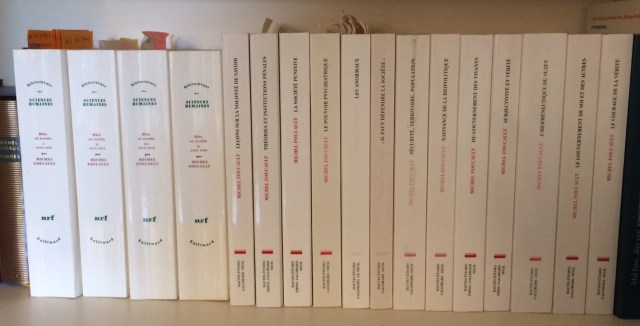
Foucault.JPG

The English – not so much. I know it’s not helped by two being with a different press, but even given that, Palgrave are not consistent. The last volumes published lost his head and shrunk the logo. Who knows what the next volumes, with Springer, will look like?Foucault in English.JPG

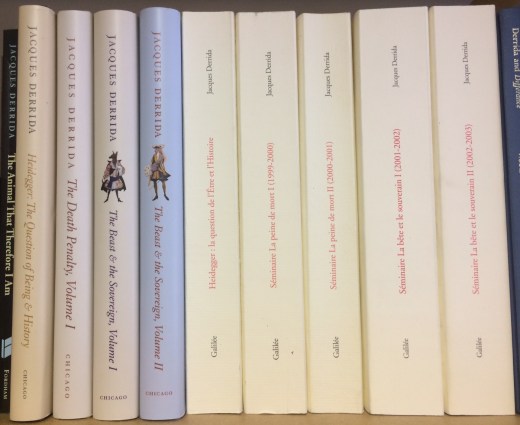
Derrida 2Derrida – both the English and French versions of his seminars are consistent, though Chicago seem unsure about images and how to display their name.

It is certainly a lot better than this jumble of different publishers and styles:

Derrida 1

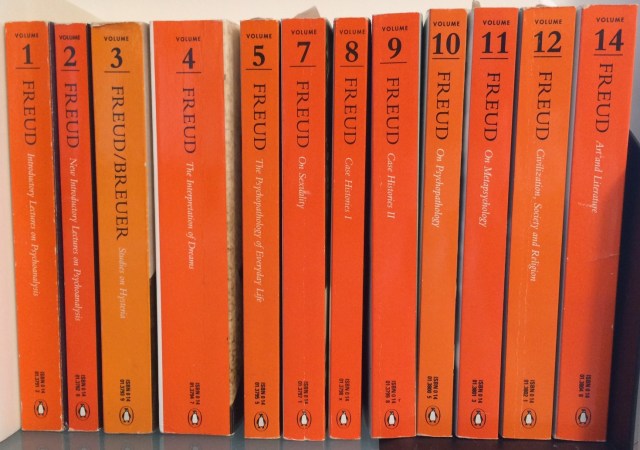
With Freud, when doing my PhD I bought a bunch of volumes in the Penguin series, but now I want to complete it I have to scour second-hand stores to find the same edition…
Freud

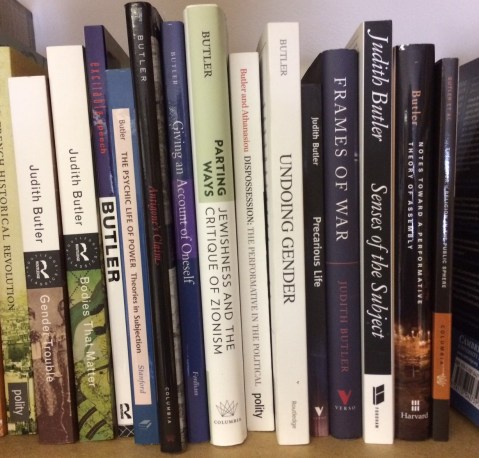
IMG_2275.JPGWith many more contemporary writers, even when I have all or most of their books, they have worked with different presses and so there is no consistency. Take Judith Butler for example – even the Routledge and Verso books are different sizes.
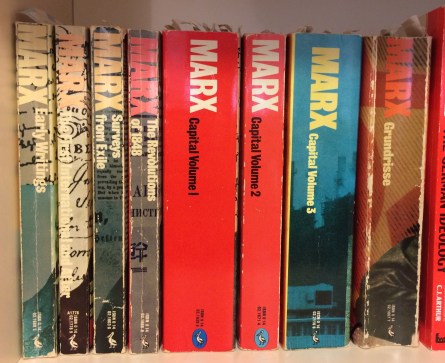
Marx.JPGWith Marx I have the complete Penguin/NLB series, all bought second-hand from the Pelican period, but they must have changed the design at some point. Of course, that’s only a fraction of Marx and Engels’s output, and I only have some of their other works.

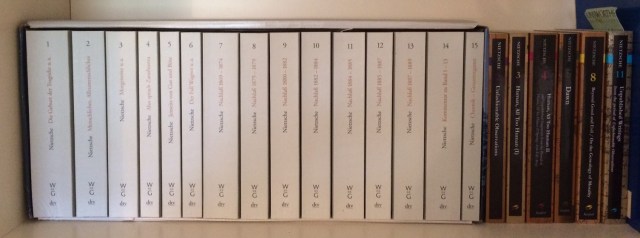
Nietzsche – the German is very consistent, but then I bought these volumes as a box-set. The earlier translations were with multiple presses, and some I have are older editions, but the very slow Stanford University Press series is setting a broadly  consistent tone, at least so far.
Nietzsche.JPG

Heidegger – takes some kind of prize for consistency. The series hasn’t changed design at all since it was begun in the mid 1970s in the last years of Heidegger’s life. I have kept the dust jackets on, and the earliest ones are rather faded, but other than that this gargantuan undertaking is looking like it will run the course. (This is of course, only a fraction of the series – it’s on four shelves in the home study.)
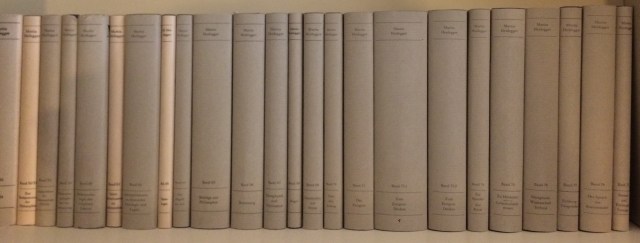
IMG_2272.JPG

The English translations are another matter entirely, with several different presses, but even within these there are differences in size and format.

Heidegger in translation.JPGKant – the English collected edition is a right mess. Different sizes, different layout, and then a recent volume with a big red addition and the text going the other way. What’s the design logic there? Admittedly some are paperback and some hardback (hardbacks were mainly review copies or bought second-hand – they are very expensive), but even within that there is variation.Kant.JPG

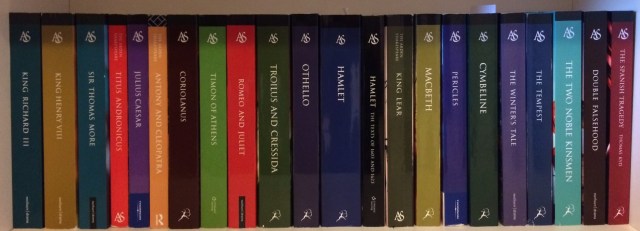
Recently I’ve been working on Shakespeare, and there is a consistent design to the Penguin and OUP ones. The Cambridge (not pictured) went through a series design, but Arden has suffered from continually changing press. You can see they are trying, but can’t decide where to put the series logo, where to put the publisher logo.
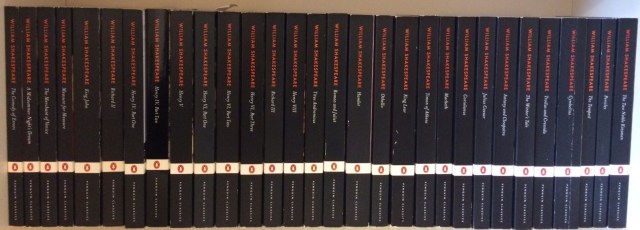
Penguin 2.jpgOxford.JPG
Arden

I don’t organise books by colour, size or other aesthetics, but by author and within that usually chronologically. But when the books are in a series, then it really shouldn’t be beyond the skills of designers and editors to go for consistency.

Posted in Books, Friedrich Nietzsche, Immanuel Kant, Jacques Derrida, Judith Butler, Karl Marx, Martin Heidegger, Michel Foucault, Sigmund Freud, Uncategorized, William Shakespeare | 2 Comments

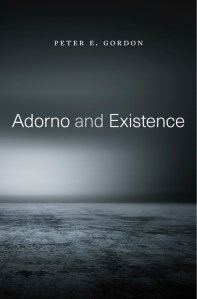
Peter E. Gordon, Adorno and Existence reviewed at NDPR

9780674734784-lgPeter E. Gordon, Adorno and Existence is reviewed at NDPR.

Peter Gordon addresses a much-neglected topic in the complex intellectual history of the Frankfurt School. He traces Adorno’s lifelong engagement with existentialism and concludes that Adorno owes more to existentialism than usually meets the eye. What underlies Adorno’s sustained critique of this philosophical tradition, Gordon claims, is the fact that Adorno utilizes existentialism and its radical conception of subjectivity as a foil to develop his own materialism.

Posted in Uncategorized | Leave a comment

“Una finestra irlandese su Foucault”, di Teresa Degenhardt

A report on the Foucault in Ireland conference – from Teresa Degenhardt (in Italian)

centrostudiricerca's avatarNuova serie dei delitti e delle pene

Pubblichiamo un commento di Teresa Degenhardt (Queen’s University Belfast e membro della nostra rivista) a margine del Simposio “Foucault in Ireland“, giornata di studi su Foucault organizzata presso la Royal Irish Academy lo scorso 24 marzo. 

Approfittiamo di questo spazio per invitare i nostri lettori e le nostre lettrici ad inviarci interventi di resoconto e commento di simposi/workshop/conferenze che vi abbiano visto a qualche titolo partecipi, sia come speakers o anche solo come uditorio.

Ringraziamo Teresa Degenhardt per il post. Buona lettura!

Un finestra irlandese su Foucault

di Teresa Degenhardt

Ho avuto la fortuna di essere invitata a una bella giornata di studi su Foucault alla Royal Irish Academy di Dublino lo scorso venerdì 24 marzo 2017, organizzata da Gerry Kearns (Maynooth University). È stato molto interessante vedere come tante e tanti in svariate materie abbiano adottato alcuni degli attrezzi fornitici da Michel Foucault per interpretare e ragionare di contesti…

View original post 691 more words

Posted in Uncategorized | Leave a comment