Five apps I find really useful for my writing and blogging

As a followup to the last post, and especially #12, a reblog of my 2014 suggestions for useful apps for reading, writing and blogging.

stuartelden's avatarProgressive Geographies

Five apps I find really useful – Evernote – Dropbox – Sanebox – Feedly – WasteNoTime

Evernote – I use this as my main repository for notes, links, lists, etc. I appreciate that you can clip websites directly to it, or email things to a direct address. As I come across useful things; references; things I want to blog, read later, watch, etc., I just throw them into Evernote, and then clean and tidy them later. It syncs across multiple devices, so wherever I am I have access to lists of things to do, things I want to find in libraries, etc. Really useful, handy to have to fill small pockets of time with something useful, and I’d hate to have to do with out it now.

Dropbox – everyone really ought to have some form of online backup. This is the one I use. Free if you don’t use too much…

View original post 602 more words

Posted in Uncategorized | Leave a comment

Christopher Watkin’s research hacks #10, 11 and 12

Christopher Watkin’s Research Hacks series continues.

#10: How to present a smart, well-crafted argument

#11: Let your arguments breathe

#12: Seven ways of keeping up to date with developments in your field

The whole series is useful, but #12 has some especially good suggestions. I use many of these ideas, but there are some additional suggestions here which look helpful. I suppose my only caution with this is that a lot of these end up as email alerts, which adds to an inbox. The solutions I use are inbox rules to filter (and I use Sanebox); a separate non-urgent email account; and/or having some alerts get sent straight to Evernote.

There are several posts from Progressive Geographies about writing and publishing, and a lot more links, archived here.

Posted in Uncategorized | 2 Comments

The pace of academic life is not the problem—the lack of autonomy is – LSE Impact Blog

The pace of academic life is not the problem—the lack of autonomy is – LSE Impact Blog

To many disgruntled with the quantification of scholarship, its impossible demands and meaningless metrics, it is the heightened pace of academic life that is the problem. For Alison Edwards, the crux of the problem is actually a lack of autonomy. Is it time for academics to take back control? This post is inspired in part by the Impact Blog’s Accelerated Academy series.

Posted in Uncategorized, Universities | Leave a comment

Books received – Lacan, Freud and Earth, Tree and Traffic from the Object Lessons series

IMG_2296.JPG

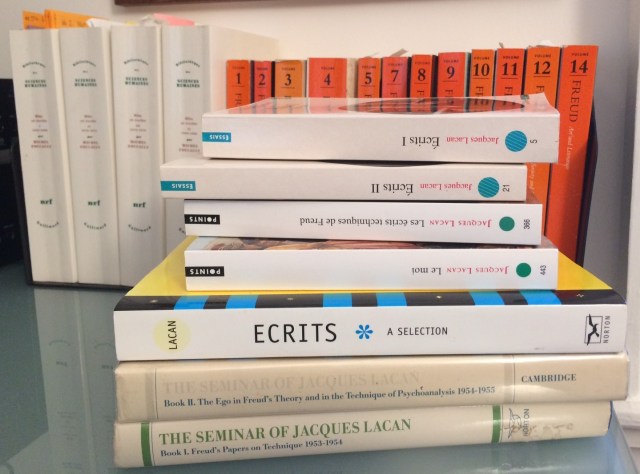
Second-hand copies of Lacan’s Ecrits (the old Sheridan translation) and Freud’s Jokes and their Relation to the Unconscious; along with Earth, Tree and Traffic from Bloomsbury’s Object Lessons series, sent by the publisher. Earth looks especially interesting – not just because it links to my interest in the topic, but because it is written by Jeffrey Jerome Cohen with Linda T. Elkins-Tanton. By the way, I know the Sheridan translation is much criticised, and has been superseded by the one by Bruce Fink, but this translation keeps coming up as a reference, so it’s helpful to have a copy to hand.

Posted in Jacques Lacan, Jeffrey Jerome Cohen, Sigmund Freud, Uncategorized | 1 Comment

Lecture on Khôra, Place, and Metaphysics

Peter Gratton’s keynote lecture on khôra, place and metaphysics.

Peter Gratton's avatarPHILOSOPHY IN A TIME OF ERROR

Here is an audio of my keynote at the University of Windsor this past weekend. I had a wonderful reception (actually that’s a key term I take up), and I should say that from the undergraduates to the graduate students to the faculty, it showed itself to be an excellent philosophical community. In some sense, even as I don’t lean on Derrida’s own writings on khôra all that much (I quote him once only to say there is more to Plato than Platonism), one could say this paper would head toward something like a “deconstructive” thinking of place already available in Plato, despite what figures from Aristotle to Plotinus to Heidegger would have one believe. Ultimately I try to show this realist thinking of place offers a “democratic,” open thinking of place always open to thinking it otherwise, over and against the dogmatic, reactionary thinking of place one often finds within various nationalisms…

View original post 8 more words

Posted in Uncategorized | 2 Comments

The Early Foucault update 5: Canguilhem, Merleau-Ponty, Politzer, Lacan…

Until about a week ago I was focusing on the terrain work, for the London Review of International Law lecture, the conference in Oslo, and the lecture in Maynooth. But in and around other things I was also doing a little work on Foucault for this project. Some related to a standalone essay on Foucault and Shakespeare – a companion piece to the one coming out in Southern Journal of Philosophy (preprint of the first piece here). The other work has included more reading by and on Canguilhem, especially doing a survey of the French collections of essays on his work, and on Merleau-Ponty. I’ve been looking at some of Merleau-Ponty’s courses at the Collège de France. There are some intriguing developments in his work, and themes which link back to his courses at the Sorbonne. I’m not sure how much I can discuss all of this in the book, and the material on Canguilhem, in particular, is taking on something of a life of its own.

I also did some work on Georges Politzer, whose 1928 Critique of the Foundations of Psychology was influential to at least two generations of French thinkers. I’d read some of  Politzer’s work several years ago, because he was part of the Philosophies group along with Georges Friedmann, Norbert Guterman and Henri Lefebvre. Politzer was active in the resistance in World War II, and executed by the Gestapo in 1942. Politzer made me think of a life and career that might have been – as does Jean Cavaillès, a philosopher of logic and mathematics on whom Canguilhem wrote a short book, who was also killed by the Nazis.

For the last few days I’ve begun drafting something on Foucault’s links to Lacan in the early 1950s. We know from the biographies that Foucault attended some early seminars, but this stopped when he moved to Uppsala in 1955. What might Foucault have actually heard in those talks? The first two seminars were held in Lacan’s home, and only some indications of content survive. They treated the famous ‘Dora’, ‘Wolf Man’ and ‘Rat Man’ cases. The first and second seminars of the published series, which treat Freud’s papers on technique and the ego, were likely the ones that Foucault part-attended. This is also plausible because those were the first classes held at the Sainte-Anne hospital, and more widely attended. The record is incomplete, but there is still a lot of material. In order to make sense of what there is, I went back to Freud’s texts that Lacan engaged with, and read (or re-read) these before working through Lacan’s lectures. I actually found Lacan much more interesting and approachable than I imagined – I read the abbreviated Écrits and The Four Fundamental Concepts years ago, but never went further than that. I might continue on a little in his seminars, even though I don’t think the subsequent ones have much impact on Foucault. Foucault makes lots of comments, not always very positive, about Lacan, and I’ve looked at these – he frequently comes up in interviews. Lacan says a little about Foucault. I’ve tried to offer a balanced assessment of the relation in the section I’ve now drafted, though I still have work to do on this.

It’s been good to have a few days with consolidated focus on this book manuscript again. I’d gathered quite a lot of material over the past few months, so some of the work has been shaping and working that into draft sections. There has been a lot of checking of references and so on, and I’m reminded, again, of just how non-portable this work is. In the home study I have all of Foucault in French and English, along with many of the other references I need – all of Heidegger and Nietzsche, most of Marx and Hegel, and I’ve moved all the Freud, Lacan, Canguilhem and Merleau-Ponty books I own home as I work on this. The benefits of just being able to turn around and pull the reference off the shelf are considerable. Something to consider as I plan for the trip to Amsterdam in a couple of weeks.

Since the last update I’ve also signed the contract with Polity. All being well – and this is slightly dependent on publication plans for the early courses – I am aiming to submit in late 2018, with a view to a 2019 publication.

The previous updates on this project are here; and Foucault’s Last Decade and Foucault: The Birth of Power are both now available from Polity worldwide. Several Foucault research resources such as bibliographies, short translations, textual comparisons and so on are available here.

Posted in Georges Canguilhem, Henri Lefebvre, Jacques Lacan, Maurice Merleau-Ponty, Michel Foucault, Sigmund Freud, The Early Foucault, Uncategorized | 1 Comment

Mapping the Topographic Fingerprints of Humanity Across Earth
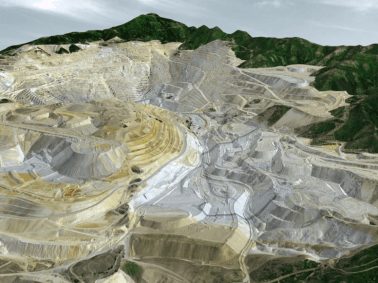
utah-mine-topographic-fingerprint-human-landscape-800x600.pngMapping the Topographic Fingerprints of Humanity Across Earth – Eos
An interesting piece on anthropogeomorphology and terrain.

Posted in terrain, Uncategorized | 1 Comment

Saskia Sassen – A world unified by the golden rule: expropriation

Saskia Sassen – A world unified by the golden rule: expropriation – interview with Il Manifesto (via e-flux).

Posted in Saskia Sassen, Uncategorized | 1 Comment

Alberto Toscano, Notes on Late Fascism

Alberto Toscano, Notes on Late Fascism at Historical Materialism, a seminar from February 2017 at Simon Fraser University.

Posted in Alberto Toscano, Uncategorized | 1 Comment

Guest Post: In Praise of Globes

Another contribution to the debates about map projections and globes.

Cathy O'Neil, mathbabe's avatarmathbabe

This is a guest post by Ernie Davis Professor of Computer Science at NYU. Ernie has a BS in Math from MIT (1977) and a PhD in Computer Science from Yale (1984). He does research in artificial intelligence, knowledge representation, and automated commonsense reasoning. He and his father, Philip Davis, are editors of Mathematics, Substance and Surmise: Views on the Ontology and Meaning of Mathematics, published by Springer.

Any government which genuinely cared about education would see to it that a globe map, at present an expensive rarity, was accessible to every school child.
— George Orwell, “As I Please” February 11, 1944

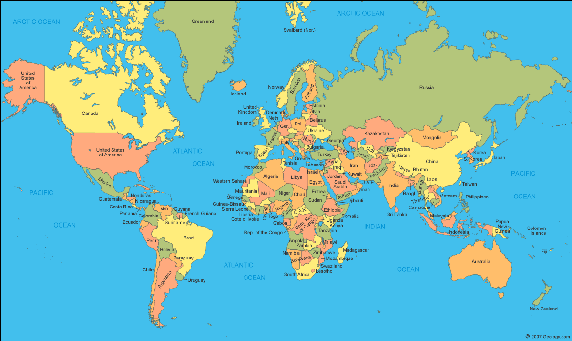
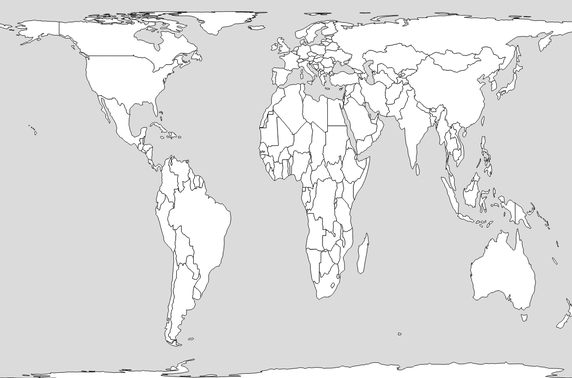
The decision by the Boston school system to replace maps of the world using the Mercator projection with maps using the Gall-Peters projection has garnered a lot of favorable press from outlets such as NPR, The Guardian, Newsweek, and many others.

MercatorMercator map of the world.

gallpetersGall-Peters…

View original post 1,378 more words

Posted in Uncategorized | Leave a comment