David Scott (ed.), Understanding Foucault, Understanding Modernism reviewed at NDPR

9781628927702.jpgDavid Scott (ed.), Understanding Foucault, Understanding Modernism is reviewed at NDPR by Corey McCall. This sounds an interesting collection – what a shame about the grotesque price. Even with the 10% discount, both physical book and e-book are over £80.

Michel Foucault continues to be regarded as one of the most essential thinkers of the twentieth century. A brilliantly evocative writer and conceptual creator, his influence is clearly discernible today across nearly every discipline-philosophy and history, certainly, as well as literary and critical theory, religious and social studies, and the arts. This volume exploits Foucault’s insistent blurring of the self-imposed limits formed by the disciplines, with each author in this volume discovering in Foucault’s work a model useful for challenging not only these divisions but developing a more fundamental interrogation of modernism. Foucault himself saw the calling into question of modernism to be the permanent task of his life’s work, thereby opening a path for rethinking the social.

Understanding Foucault, Understanding Modernism shows, on the one hand, that literature and the arts play a fundamental structural role in Foucault’s works, while, on the other hand, it shifts to the foreground what it presumes to be motivating Foucault: the interrogation of the problem of modernism. To that end, even his most explicitly historical or strictly epistemological and methodological enquiries directly engage the problem of modernism through the works of writers and artists from de Sade, Mallarmé, Baudelaire to Artaud, Manet, Borges, Roussel, and Bataille. This volume, therefore, adopts a transdisciplinary approach, as a way to establish connections between Foucault’s thought and the aesthetic problems that emerge out of those specific literary and artistic works, methods, and styles designated “modern.” The aim of this volume is to provide a resource for students and scholars not only in the fields of literature and philosophy, but as well those interested in the intersections of art and intellectual history, religious studies, and critical theory.

Posted in Michel Foucault, Publishing, Uncategorized | Leave a comment

Mark Kelly, For Foucault: Against Normative Political Theory

63676_cov.jpgI shared Mark Kelly’s review of Althusser et al’s Reading Capital: The Complete Edition at the Progress in Political Economy site yesterday.
Mark’s next book,  For Foucault: Against Normative Political Theory is forthcoming in early 2018 from SUNY Press:

Calls for a Foucauldian approach to political thought that is intrinsically resistant to power and subordination to public policy.

This book comprises a series of staged confrontations between the thought of Michel Foucault and a cast of other figures in European and Anglophone political philosophy, including Marx, Lenin, Althusser, Deleuze, Rorty, Honneth, and Geuss. Focusing on the status of normativity in their thought, Mark G. E. Kelly explains how Foucault’s position in relation to political theory is different, and, over the course of the book, describes a distinctive Foucauldian stance in political thought that is maximally anti-normative, anti-theoretical, and anti-political. For Foucault aims to undermine attempts to discern the appropriate form of political action, instead putting forward a rigorously critical program for a political theory that lacks any moralizing or totalizing dimension, and serves only to side with resistance against power, and never with power itself. Looking at attempts to think radically about politics from Marx to the present day, Kelly traces a novel history of political thought as a trend of attempts to overcome the constraints of normativity, theoreticism, and subordination to public policy. He concludes by assessing and rejecting recent attempts to reclaim Foucault for a form of normative politics by associating him with neoliberalism.

“This original and insightful book makes a significant contribution to political philosophy.” — Stuart Elden, author of Foucault: The Birth of Power

Mark G. E. Kelly is Associate Professor and ARC Future Fellow in the School of Humanities and Communication Arts at Western Sydney University in Australia. His books include Foucault and Politics: A Critical Introduction; Biopolitical Imperalism; and The Political Philosophy of Michel Foucault.


Posted in Michel Foucault, Uncategorized | 1 Comment

Mark Kelly on Althusser et al, Reading Capital: The Complete Edition

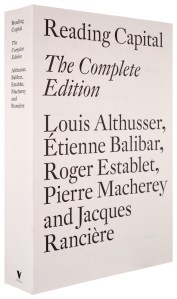
Reading-Capital-angle-1050st-57bb375caaf6210c8f6916d87dfff76a.jpgMark Kelly discusses Louis Althusser, Étienne Balibar, Roger Establet, Pierre Macherey, and Jacques Rancière, Reading Capital: The Complete Edition at the Progress in Political Economy site.
The book is part of Verso’s summer sale – 50% off until July 9th. Lots of other books in the sale, including Lefebvre’s Metaphilosophy. Most come with the bundled e-book.

Posted in Etienne Balibar, Jacques Rancière, Louis Althusser, Pierre Macherey, Uncategorized | Leave a comment

David Harvey, Visualizing Capital – video of New School lecture

David Harvey, Visualizing Capital – video of New School lecture, June 12, 2017

Posted in David Harvey, Uncategorized | Leave a comment

Colin Koopman reviews Penelope Deutscher, Foucault’s Futures at NDPR

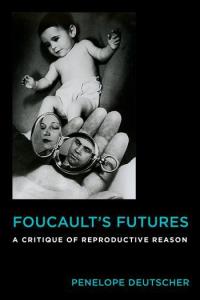
9780231176415.jpgColin Koopman reviews Penelope Deutscher, Foucault’s Futures: A Critique of Reproductive Reason at NDPR.

In Foucault’s Futures, Penelope Deutscher reconsiders the role of procreation in Foucault’s thought, especially its proximity to risk, mortality, and death. She brings together his work on sexuality and biopolitics to challenge our understanding of the politicization of reproduction. By analyzing Foucault’s contribution to the politics of maternity and its influence on the work of thinkers such as Roberto Esposito, Giorgio Agamben, and Judith Butler, Deutscher provides new insights into the conflicted political status of reproductive conduct and what it means for feminism and critical theory.

Posted in Michel Foucault, Uncategorized | Leave a comment

Preview and discount code for my ‘In the Ruins of the Cold War Bunker’ edited collection which is being published on 30/6/17.

Details and sample material from Luke Bennett’s excellent new edited collection.

lukebennett13's avatarlukebennett13

In the Ruins - final cover

I’m pleased to present below a copy of the publisher’s flyer for my book, and delighted at the reviews featured there.

I’m told the book (hardback and ebook formats) will be available to buy from 30 June 2017, and using the code below on the publisher’s website you’ll be able to get 30% off either format. Please note that all author and editorial royalties are being donated to www.msf.org.uk (Medecins Sans Frontieres).

In the meantime my introductory chapter is available to view for free here:

https://www.rowmaninternational.com/book/in_the_ruins_of_the_cold_war_bunker/3-156-afdcfe7a-b585-4303-82a2-23ee9b64e05d#

and here:

https://www.amazon.co.uk/Ruins-Cold-War-Bunker-Materiality-ebook/dp/B072SSPTXS/ref=sr_1_1?ie=UTF8&qid=1498233592&sr=8-1&keywords=ruins+of+the+cold+war+bunker

Further details of launch events will follow soon.

In the Ruins of the Cold War Bunker flyer-page-001In the Ruins of the Cold War Bunker flyer-page-002

View original post

Posted in Uncategorized | Leave a comment

Foucault also struggled to get his students to do the reading…

2711627497.jpgI’ve previously shared one of Lacan’s comments from his seminar. Here’s Foucault on the same theme:

Has everyone read these texts? Yes? No? Nobody? Well, I will have to punish you, that’s for sure! I’m not going to tell you how… That’s a surprise for the last day!

Dire vrai sur soi-même: Conférences prononcées à l’Université Victoria de Toronto, 1982, edited by Henri-Paul Fruchaud and Daniele Lorenzini, Paris: Vrin, 2017, p. 189

Posted in Michel Foucault, teaching, Uncategorized | 4 Comments

The Early Foucault update 8: two days in the Carolina Rediviva library, Uppsala

Carolina Rediviva

Carolina Rediviva, Uppsala

My ongoing research into Foucault’s research and the writing of his History of Madness has taken me to Uppsala, where Foucault worked between 1955 and 1958. This was just a very brief reconnaissance trip – made possible as a side-visit following the Nordic Geographers Meeting in Stockholm. I have been working in the Carolina Rediviva library of Uppsala University, which among other things houses the archives of the Alliance Française. Foucault directed their cultural programme and taught French literature at the University. I found all the course records giving titles and topics for Foucault’s teaching – though none of the content seems to have survived, unfortunately – and some information on events which took place while he was here. I also found some photographs of Foucault and various newspaper clippings, preserved in the scrapbooks of the president of the Alliance.

Maison de France

Former site of the ‘Maison de France’ [Update October 2019: this is not correct – the street numbering has changed and it was actually in a different building. See the comment from Petra below.]

Foucault ran the cultural programme from the ‘Maison de France’, which is just a few minutes walk from the Carolina Rediviva library. The current address is an unassuming building, and it’s certainly no longer used by the Alliance Française, but I thought I would take a quick look at the site.

Foucault also made extensive use of the library collection, especially the ‘Bibliotheca Walleriana’ – a massive collection of works on the history of medicine bequeathed by Erik Waller. Foucault’s biographers note that the Bibliotheca Walleriana was catalogued in 1955 – the very year Foucault arrived in Uppsala. I’d imagined that the catalogue would be some kind of paper document, perhaps now available online, or a card index, but it’s actually a massive two volume book. There is now a dedicated search engine, but the printed book is invaluable. Of course the library here has a copy – the one I used in the reference library was a later facsimile bound as a single volume – but it is also available in some other research libraries. The catalogue will be a useful guide as I try to do some more work in this area.

Because of renovation work the library was only open for three hours each day, and was entirely closed for the midsummer’s eve holiday on Friday. I therefore didn’t have nearly as much time as I’d hoped, but as an initial trip it was very useful, and I hope to get back at some point.

The previous updates on this project are here; and Foucault’s Last Decade and Foucault: The Birth of Power are now both available from Polity. Several Foucault research resources such as bibliographies, short translations, textual comparisons and so on are available here.

Posted in Michel Foucault, The Early Foucault, Uncategorized | 9 Comments

CFP: META Middle East Topics & Arguments – Infrastructure

call for papers #10: Infrastructure
Editors: Amina Nolte, Ezgican Özdemir

Publication date: Spring 2018

The peer-reviewed online journal “Middle East – Topics & Arguments” (META) is calling for submissions for its tenth issue on the topic of “Infrastructure”.

Infrastructure points to the ultimate conceptual debates of social science; it highlights the strong connections between material things, lives, and practice with immaterial and ideational aspects of human life. Furthermore, infrastructural matters like pipes, dams, walls, grids, cables, etc. reveal and, even more so, complicate the relationship between nature and humanity. We believe that studying infrastructure leads to new horizons of understanding people’s socio-political, moral and affective worlds and how they relate to conceptions of nature. Infrastructure as the topic for the tenth issue of Middle East – Topics & Arguments (META) offers a variety of conceptual approaches from many disciplines, such as history, anthropology, sociology, political science, cultural studies, media studies and economics (among others), as the topic connects the research on practices of everyday life with questions of planning, state politics and local and global neoliberal developments. Further, Infrastructure provides an interesting departure point to study the material entanglements of infrastructure with modes of its facilitation and representation.

Infrastructures, such as transportation, energy and water networks, facilitate everyday life, while at the same time rupture it at any given moment. They assemble all kinds of actors and agents once they are brought into being. As manifestations of diverging interests, infrastructures are always bound with relations of power and domination. They hence do not only embody and reproduce power relations, but also engender sites of resistance and subversion in times of social crises. These understandings of infrastructures will help us to study them as much more than technological accomplishments of the present, but rather as cultural semiotics that are deeply embedded in everyday politics and social relations. [more details here]


Posted in Uncategorized | 1 Comment

The PolGRG Book Award (2017-2018) in coordination with Political Geography Journal

News of a Political Geography book award – nominations by end of September 2017.

rachaelsquire's avatarPolitical Geography Research Group

We are delighted to announce that the Political Geography Research Group Royal Geographic Society (PolGRG) Book Award received positive endorsement at the PolGRG AGM in London, in September 2016. Phil Steinberg (Editor of the journal Political Geography) has confirmed interest and sponsorship with the Political Geography publisher at Elsevier. The PolGRG/PG Book Award was officially launched at the PolGRG AGM on 13 June 2016.

About the PolGRG Book Award

The PolGRG / Political Geography co-sponsored Book Award is an award recognising new academic volumes whose theme engages with the interests of PolGRG and, more widely, contributes to the subdiscipline of political geography. Political geography concerns a wide variety of diverse issues connected with relationships between space and power.

Which books are eligible?

In line with the diversity of PolGRG interests and membership, the PolGRG Book Award is aimed at published volumes stirring interest and debate around: territoriality and sovereignty…

View original post 279 more words

Posted in Uncategorized | Leave a comment