Christopher Watkin, Research Hacks 8 and 9 – arguments and knowing when to stop

Christopher Watkin, Research Hacks series continues.

#8: How to know when “good enough” is good enough in academic writing

#9: Building an argument with the “it’s not as simple as that” tool

You can read the rest here.

There are several posts from Progressive Geographies about writing and publishing, and a lot more links, archived here.

Posted in Publishing, Uncategorized, Writing | Leave a comment

Michel Foucault, Dire vrai sur soi-même – 1982 Toronto lectures out from Vrin

2711627497.jpgMichel Foucault, Dire vrai sur soi-même: Conférences prononcées à l’Université Victoria de Toronto from Vrin is now published.

The volume comprises previously unpublished lectures from 1982. There are connections between them and Collège de France lectures, and the Vermont Technologies of the Self seminar, but they are distinct and important.

À la fin du premier semestre 1982, Michel Foucault prononce à l’Université Victoria de Toronto un cycle de conférences intitulé Dire vrai sur soi-même. Le thème de ces conférences, s’inscrivant dans le cadre du projet d’une généalogie du sujet occidental moderne, est la formation historique de l’herméneutique de soi. Après avoir analysé le type très particulier de connaissance de soi et de rapport à soi qui caractérise l’askêsis gréco-romaine, où il s’agit pour le sujet d’établir avec lui-même une relation de possession et de souveraineté, Foucault étudie le renversement qui conduit, aux premiers siècles du christianisme, et tout particulièrement dans les communautés monastiques, à la naissance d’une herméneutique de soi conçue comme l’exploration et le déchiffrement par le sujet de sa propre intériorité. Pour définir ce renversement, Foucault introduit ici une distinction inédite entre deux formes d’ascèse, l’une tournée vers la vérité, l’autre tournée vers la réalité. Parallèlement aux conférences, Foucault conduit à Toronto un séminaire consacré à l’étude détaillée de textes des auteurs anciens sur lesquels s’appuient ses analyses de la culture de soi antique. Il y présente également une esquisse des différentes significations de la notion de parrêsia dans l’Antiquité, qui allait devenir le thème principal de ses derniers travaux.

Ces conférences et ce séminaire sont publiés ici pour la première fois, dans une édition critique.

Posted in Foucault's Last Decade, Michel Foucault, Uncategorized | 1 Comment

Some responses to the post about ‘Why I prioritise writing books over articles, even in an era of research assessment’

Some responses to the post about ‘Why I prioritise writing books over articles, even in an era of research assessment‘. The post got a lot of hits, partly through multiple retweets. While I also replied to the comments I saw on twitter and the blog, I’ve tried to respond to some key questions below:

How about early career researchers?

Everyone needs to find their own way, of course. I tried to say something about the advice I’d had, and the advice I continually hear given to early career researchers in the original post. What I would suggest is that you need to be strategic. Getting an article or two from the PhD in a good journal is a necessary part of most initial careers. It may well be that the expectation is more articles than that. But the risk comes if you publish too many articles from the PhD. I know some very successful academics publish books of their articles, but most presses won’t touch such a book for an unknown academic, and for most known ones too. My rough guide is that more than two articles from a book manuscript will start to worry a publisher. See your PhD as an initial, early, draft of something that may become a book – if you want to be a book writer.

Although I acknowledged the privileged position I am now in within the original post, it wasn’t always that way. I had three one-year contracts before I got a secure job, for which I had to change discipline, and I think having a book on the cv made a huge difference there. I had a contract for a second at the time, and a co-edited book of Lefebvre translations was in press. My third authored book was published before I had my first term of research leave. I’m not trying to say that I had it so tough, just that I balanced writing books with other demands early in my career, including the need to publish articles.

The research assessment makes or breaks careers – I have to work to its demands

The two best pieces of advice I ever had on the RAE/REF:

  1. the census date is an arbitrary line in time: things to the left are in this period; things to the right in the next. Write to your own timeline.
  2. give them a choice, and let them make it.

In other words, it should be one of the things on your mind, not the only one.

What can be done?

I think one thing that established academics can do is when it comes to writing references, evaluating cases for promotion, tenure, etc. This is to stress the importance of the books that have been written or edited by the person you are writing about. Lots of administrators have backgrounds in science, or even not as academics, where books don’t have the same status. Make a point of indicating this.

Another is to help your colleagues with book proposals, initiating contact with editors, giving them advice. Offer to look over their cover letter, to read the contract they are offered, discuss the merits of different publishers. Above all, verbally resist anyone who tells them that articles are all that counts.

Another thing is to review books – both at proposal and manuscript stage for presses, and when published for journals. It’s amazing how many academics are unwilling to do this.

Buy books, read books and talk and write about books.


Posted in Books, Publishing, Uncategorized, Writing | 1 Comment

Books received – review work for Polity and Sage

IMG_2277

A pile of recent books received in recompense for review work, and a couple of others sent by Polity from their Key Contemporary Thinkers series.

Posted in Ash Amin, Axel Honneth, Jacques Lacan, Judith Butler, Luce Irigaray, Martin Heidegger, Nigel Thrift, Uncategorized | Leave a comment

The End of Term 2

The Maynooth and Dublin events were the last of a sequence of talks. Over this term I also gave talks in London (SOAS, IHR, British Library), Durham, Oslo, and Kingston. Often invitations grew after acceptance – come to give a seminar, but also meet students, take place in a reading group and so on. Each event was interesting and worthwhile, and I am grateful for all the invitations, but cumulatively this felt a bit too much – almost a visiting lecture or seminar every week, and chopping and changing between topics: from Foucault to territory, to terrain to Shakespeare, and back again. I did decline some invitations, and one was cancelled for reasons outside my control. Even material I’d delivered before, or had written in a near-final form, ended up being reworked, practiced, and polished. Each was of course helpful in shaping and reshaping material for eventual publication. I got to Paris twice for archival work, and we also moved flat in London, which adds its own challenges and complications.

I decided back in late 2016 not to attend the AAG, and so now I have a few weeks clear before my trip to Amsterdam. In Amsterdam I’ll be leading a reading seminar on urban territory, giving a public lecture on Foucault, and organising the Territory in Indeterminate and Changing Environments workshop. But that’s just three events in six weeks, and all in the same place. I’ll be looking forward to meeting some new people, having time with old friends, and getting to know the city, but above all plan to have my head down and write. That’s also the plan for the next few weeks over the Easter break, before a holiday.

Posted in Conferences, Michel Foucault, terrain, Territory, Travel, Uncategorized, Universities, William Shakespeare, Writing | 1 Comment

Back from Maynooth and Dublin – terrain and Foucault

I had two very enjoyable days in Ireland last week. First, to give a talk entitled “Terrain: The Materiality of Territory” to the Department of Geography seminar, at the National University Ireland, Maynooth. I also met with students over lunch to talk about publishing and careers in Geography, and briefly caught up with friends and others from the department over a beer, before a nice dinner in Dublin with Gerry Kearns.

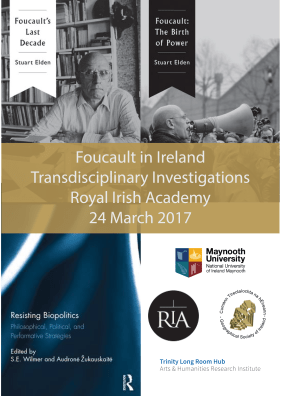
The next day was the Foucault in Ireland event at the Royal Irish Academy in Dublin. The day began with a very generous discussion of my two recent Foucault books, with Audronė Žukauskaitė, Mick Wilson, and Gerry.  The rest of the day was a series of papers on Foucault and the use of tools from his work in Irish studies and by others working on Foucault in Ireland. The day’s events were recorded and I will share the link if it becomes available. As well as those speaking, it was good to see Michael O’Rourke in the audience.

My thanks to all who made this trip possible, especially Gerry Kearns for organising the two events.

Posted in Foucault's Last Decade, Foucault: The Birth of Power, Michel Foucault, terrain, Uncategorized | Leave a comment

Off to Maynooth and Dublin – talks on Terrain, publishing and Foucault

Foucault in Ireland 1-01It’s a little difficult to treat today as just another day, after the events in London yesterday, but I’m just about to head to Ireland for a couple of events.

This evening at 4pm I’ll be giving a talk entitled “Terrain: The Materiality of Territory” to the Department of Geography seminar, at the National University Ireland, Maynooth. I will also be participating in a discussion about publishing over lunch that same day with postgraduate students. My seminar is a version of the talk I’ve given over the last few months in Gießen, Durham, London, and Oslo.

Tomorrow I’ll be taking part in the Foucault in Ireland event at the Royal Irish Academy in Dublin. It begins with a roundtable on my two recent Foucault books, and is followed by a  workshop with a wide range of papers on Foucault and the use of tools from his work.

Posted in Foucault's Last Decade, Foucault: The Birth of Power, Michel Foucault, Publishing, terrain, Territory, Uncategorized | 4 Comments

Alexander Vasudevan, The Autonomous City: A History of Urban Squatting – Verso

VERSO_Autonomous City_Mechanical_FINAL.inddAlexander Vasudevan, The Autonomous City: A History of Urban Squatting forthcoming with Verso in April.

A radical history of squatting and the struggle for the right to remake the city
The Autonomous City is the first popular history of squatting as practised in Europe and North America. Alex Vasudevan retraces the struggle for housing in Amsterdam, Berlin, Copenhagen, Detroit, Hamburg, London, Madrid, Milan, New York, and Vancouver. He looks at the organisation of alternative forms of housing—from Copenhagen’s Freetown Christiana to the squats of the Lower East Side—as well as the official response, including the recent criminalisation of squatting, the brutal eviction of squatters and their widespread vilification.

Pictured as a way to reimagine and reclaim the city, squatting offers an alternative to housing insecurity, oppressive property speculation and the negative effects of urban regeneration. We must, more than ever, reanimate and remake the urban environment as a site of radical social transformation.

Posted in Politics, urban/urbanisation | 3 Comments

Marcelo Hoffman, In the Shadow of Dictatorship: Foucault in Brazil

Ensaios-sobre-Michel-Foucault-no-Brasil-CapaMarcelo Hoffman, In the Shadow of Dictatorship: Foucault in Brazil at the Theory, Culture & Society website.

Review of Heliana de Barros Conde Rodrigues, Ensaios sobre Michel Foucault no Brasil: Presença, efeitos, ressonâncias  (Lamparina 2016), 176 pages

Michel Foucault visited Brazil five times from 1965 to 1976 yet the details of his overall presence in the country have remained largely unexplored even in Brazil. Heliana Conde’s Ensaios sobre Michel Foucault no Brasil has the great merit of introducing readers to these details through a reliance on wide range of sources, including interviews with his interlocutors and the archives of the former secret police. While her book covers various aspects of Foucault in Brazil up to his effects and resonances in our present, she compellingly illuminates how the military dictatorship cast a long and ominous shadow over each of his visits to the country.

Posted in Michel Foucault, Uncategorized | Leave a comment

Lorraine Daston ed. Science in the Archives – new from University of Chicago Press

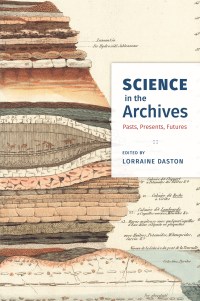
Lorraine Daston ed. Science in the Archives: Pasts, Presents, Futures – new from University of Chicago Press.

9780226432366.jpgArchives bring to mind rooms filled with old papers and dusty artifacts. But for scientists, the detritus of the past can be a treasure trove of material vital to present and future research: fossils collected by geologists; data banks assembled by geneticists; weather diaries trawled by climate scientists; libraries visited by historians. These are the vital collections, assembled and maintained over decades, centuries, and even millennia, which define the sciences of the archives.

With Science in the Archives, Lorraine Daston and her co-authors offer the first study of the important role that these archives play in the natural and human sciences. Reaching across disciplines and centuries, contributors cover episodes in the history of astronomy, geology, genetics, philology, climatology, medicine, and more—as well as fundamental practices such as collecting, retrieval, and data mining. Chapters cover topics ranging from doxology in Greco-Roman Antiquity to NSA surveillance techniques of the twenty-first century. Thoroughly exploring the practices, politics, economics, and potential of the sciences of the archives, this volume reveals the essential historical dimension of the sciences, while also adding a much-needed long­-term perspective to contemporary debates over the uses of Big Data in science.

Posted in Uncategorized | 3 Comments