Henri Lefebvre, Key Writings to be reissued in Bloomsbury’s Revelations series

9781350041691Henri Lefebvre, Key Writings is to be reissued in Bloomsbury’s Revelations series. It’s not out until October, but the previous version is still in print. There are no changes to the new version – in fact I wasn’t even told by the press this was happening. This was the first Lefebvre project I was involved with, published in 2003, alongside Elizabeth Lebas and Eleonore Kofman. It didn’t receive much attention at the time, and has had few citations. I’m not sure why – although some of the pieces were from books that are now available in full in English, it still contains quite a bit that is unavailable elsewhere.

Henri Lefebvre is widely recognized as one of the most influential social theorists of the Twentieth Century. His writings on cities, everyday life, and the production of space have become hugely influential across Cultural Studies, Sociology, Geography and Architecture. Key Writings presents the full range of Lefebvre’s thought in a single volume. The selection of essays spanning 1933 to 1990, reinforce the relevance of Lefebvre’s work to current debates in social theory, politics and philosophy. The book is divided into five sections: ‘Philosophy and Marxism’, ‘The Critique of Everyday Life’, ‘The Country and the City’ ‘History, Time and Space’ and ‘Politics’ and includes a general introduction by the editors as well as separate introductions to each section.

My reading guide to Henri Lefebvre is available here – might provide some useful suggestions from where to go next.

Posted in Henri Lefebvre | 1 Comment

Books received – Brenner, Foucault, Macauley, Binswanger

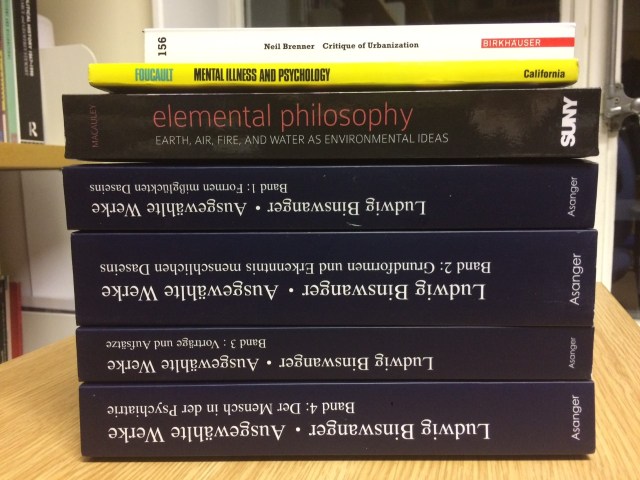
Neil Brenner’s Critique of Urbanization, the translation of Foucault’s Mental Illness and Psychology (for the intro by Hubert Dreyfus); David Macauley’s Elemental Philosophy and Ludwig Binswanger’s Ausgewählte Werke. Neil kindly sent me a copy of his book, the Macauley was recompense for review work, and I bought the others. For Binswanger, see my bibliography of English and French translations here.

thumbnail_img_2165

Posted in Ludwig Binswanger, Michel Foucault, Neil Brenner, The Early Foucault, Uncategorized | 1 Comment

#DeleteAcademiaEdu: The Argument For Non-Profit Repositories

Sarah Bond – author of the original Forbes article I linked to – explains more here. In particular she discusses why this is important now – i.e., what has changed recently – and some more alternatives. Well worth a look.

sarahemilybond's avatarSarah E. Bond

It has been a hectic morning attempting to read and respond to the flurry of activity surrounding my column this week over at Forbes, which argues that scholars should remove their work from the for-profit platform Academia.edu. I am neither the first nor the last academic to harangue members of the academy to take this step, and thus I wanted to outline here some of the historiography of the debate, my argument against the for-profit platform, the alternatives, and end with a call to action (i.e., I shall follow the historian’s order of operations).

My predecessors:

Kathleen Fitzpatrick, “Academia, Not Edu,” Planned Obsolescence: Falling indelibly into the past (October 26, 2015).  Associate Executive Director and Director of Scholarly Communication at the Modern Language Association (MLA) remarked on her blog, “the first thing to note is that, despite its misleading top level domain (which was registered by a subsidiary…

View original post 702 more words

Posted in Uncategorized | Leave a comment

Delete your academia.edu account… (there are other ways to share your work)

Last night I did something I’ve been meaning to do for a while – I deleted my academia.edu account. A post by Kris Olds on Twitter linking to this story in Forbes was the spur.

I have a page on this site, called ‘Free Downloads’ which shares almost all my work.

There are separate pages for articles and chapters, books, interviews, audio and video, and reading lists. Some pre-prints of forthcoming pieces are here.

Also see Google Books; and Durham Research Online and Warwick Research Access Portal (WRAP) which have preprints of some articles.

With the exception of the link to Google Books, this site, alternatives in the Forbes article and institutional repositories accomplish what academia.edu is supposed to be for – the free sharing of work – but without the commercial aspects.

Update: See also Gary Hall, ‘Should this be the last thing you read on academia.edu?’ (Thanks to @dubravka for the link)

Posted in Publishing, Uncategorized, Universities | 26 Comments

IBRU releases new Arctic map with sea ice changes

arctic-map-web-05_08_15IBRU: Centre for Borders Research at Durham University has released a new version of its widely used Arctic map.

IBRU’s original Arctic map, first released in 2008 and revised several times since, was a landmark product that assimilated a variety of bathymetric (ocean depth) and political data to depict both hypothetical and jurisdictional boundaries in the Arctic Ocean. The map has been reproduced and adapted widely by news organisations and policy advocates and remains a unique resource for anyone seeking a comprehensive understanding of Arctic maritime politics.

The new map builds on the original map but has several new features that focus on current significant changes in the Arctic: the claiming of mineral rights to the outer continental shelf and the decline in seasonal sea ice extent due to regional and global climate change.

As IBRU Director Professor Phil Steinberg explained, “The original map depicted an overall picture of maritime jurisdiction. However, new claims in the Arctic are occurring in distant areas of the outer continental shelf. We wanted to produce a map that highlighted these areas because these are attracting much interest among journalists, lawyers, and politicians.”

Steinberg continued, “What’s really exciting about the new map is that it integrates a depiction of the Arctic Ocean’s complex legal geography with data on sea ice decline during the past 30 years. The two processes – sea ice decline and outer continental shelf claims – are formally unrelated, but when presented together they create an integrated image of a changing Arctic. Few, if any, maps combine data this way.”

IBRU will update both maps as new data become available and new claims are made. The maps may be found at https://www.dur.ac.uk/ibru/resources/arctic/.

Comments and questions concerning the map should be sent to ibru@durham.ac.uk

Posted in Boundaries, terrain, Territory, Uncategorized | Leave a comment

FIFTY-YEARS ON: The Right to the City

Andy Merrifield on the 50th anniversary of Lefebvre’s The Right to the City.

Andy Merrifield's avatarandy merrifield

2017 marks the Golden Jubilee of Henri Lefebvre’s Right to the City, his “cry and demand” for a more participatory and democratic city life. It’s a cause both to celebrate and commiserate. But celebration and commiseration have typically been part and parcel of the Left’s dialectic, a dialectic that cuts inside us as people as well as political subjects. For everyone concerned about the fate of our cities, before us now lies a massive expansion of urban life across the planet, an opening up of urban horizons and frontiers, matched by a closing of the political mind, a withering of the established political will.

Ours is an urban society, set to be evermore so during the decades to come; yet political leaders almost everywhere are putting up walls, cowering before provincial smallness rather than embracing cosmopolitan vastness. When Lefebvre long ago spoke of “planetary urbanisation,” he did so because…

View original post 2,523 more words

Posted in Uncategorized | Leave a comment

Neil Brenner, Critique of Urbanization: Selected Essays – now published

9783035607956Neil Brenner, Critique of Urbanization: Selected Essays – now published by Birkhäuser Verlag. It’s a collection of largely previously published essays, but several were in hard-to-find places, and it has some new material.

Urbanization is transforming the planet, within and beyond cities, at all spatial scales. In this book, Neil Brenner mobilizes the tools of critical urban theory to deconstruct some of the dominant urban discourses of our time, which naturalize, and thus depoliticize, the enclosures, exclusions, injustices and irrationalities of neoliberal urbanism. In so doing, Brenner advocates a constant reinvention of the framing categories, methods and assumptions of critical urban theory in relation to the rapidly mutating geographies of capitalist urbanization. Only a theory that is dynamic—which is constantly being transformed in relation to the restlessly evolving social worlds and territorial landscapes it aspires to grasp—can be a genuinely critical theory.

Posted in Neil Brenner, Uncategorized, urban/urbanisation | Leave a comment

The Early Foucault update 3: Another week at the Bibliothèque Nationale

bnfI’ve just spent another week at the Bibliothèque Nationale manuscript room – newly renovated and now a dedicated space. This is at the older Richelieu site in the centre of the city.

I worked through boxes relating to two key periods – Foucault’s reading notes in preparation for Histoire de la folie, and his notes from the period immediately before this. There was a lot of material to go through – more than I expected, since two numbered boxes were each actually split into ‘a’ and ‘b’ boxes – and I essentially made detailed notes on what was there, and spent some time on the most interesting material, but have not yet worked through everything in careful detail. The first set of boxes had a lot of material you’d expect to find, but also showed how much the research for this project overlapped with that for Birth of the Clinic. Daniel Defert notes that Foucault thought that book was essentially the ‘outtakes’ from the earlier study – it’s more than that of course, but this description makes some sense. It’s also striking how much the research for the madness book initiated themes that Foucault would explore over a decade later in his work on punishment and sexuality. I made the point back in my PhD thesis that the full text of Historie de la folie (as opposed to the then-truncated English translation Madness and Civilization) made it clear how much it anticipated many of his later concerns. That point can be substantiated much more carefully with these reading notes. I should caution though that because Foucault’s notes are undated, we cannot be exactly sure when materials were collected. Foucault organised his notes thematically, and moved things around as he worked on new projects. But there is clear break in style of note taking in the later 1960s, so I am quite confident these notes date from before that period.

The notes from his earliest reading are mixed in with lecture notes – not lectures he gave but those he attended. Who keeps all of this for thirty-plus years, organised so carefully and supplemented by extensive reading notes? Foucault did. Again, he doesn’t date the notes, though he usually but not always gives the name of the lecturer. They were a set of formidable figures – Jean Beaufret, Maurice Merleau-Ponty, Jean Hyppolite and Jean Wahl among them. It was helpful in verifying just how much of the philosophical tradition he knew, with extensive notes on figures that might not ordinarily be seen as part of Foucault’s background – Hume, Pascal, Spinoza, and the Greeks, for instance. There are also extensive and detailed notes on psychology and psychonalysis that fed into his earliest publications – the key names that might be expected, and a range of less familiar figures.

The notes are filled with his difficult, at times illegible, handwriting, employing some idiosyncratic shorthand and abbreviations. His citations are usually provided, but often in compressed form. Tracking some of these leads down may take some time. Foucault tended to group his (at this time A5 size) notes together by folding an A4 sheet around them, but some of these are so decrepit that they have been replaced by more recent sheets – some clearly from the BN archivist, others look to be Foucault’s from a different date, and some look to be by Daniel Defert, whose handwriting I recognised in a few places. For some of these grouping-pages, and occasionally for notes themselves, Foucault would use various bits of paper that he seemed to have to hand – invitations to events, manuscript drafts, mimeographs of various things, headed notepaper and so on. In the absence of dated notes, these can give useful indications of periodisations – though usually only providing the earliest date that they could have been grouped together. But some of them seem to come from quite unknown providence: Foucault seemed to have an extensive stack of headed paper from a journal that he never published in, was not on the board and as far as I know had no other links to.

I worked almost flat out in the manuscript room on this visit, pausing only for brief breaks. I did meet up with The Funambulist’s Léopold Lambert for a beer one evening, and made a couple of trips to favourite bookstores. I also spent a couple of hours at the BN’s François-Mitterand site, looking back at Foucault and Daniel Rocher’s translation of von Weizsäcker’s Le cycle de la structure on microfilm. I’m still trying to get hold of a copy of this elusive text.

This was the last reconnaissance visit I needed before sending off the book proposal for The Early Foucault. I’m hoping to have an indication of whether it will be contracted before I next head to Paris in mid-February. In the meantime I’ll be speaking about this project at the Institute of Historical Research on 2 February.


The previous updates on this project are here; and Foucault’s Last Decade and Foucault: The Birth of Power are now both available from Polity. Several Foucault research resources such as bibliographies, short translations, textual comparisons and so on are available here.

Posted in Jean Hyppolite, Michel Foucault, The Early Foucault, Uncategorized | Leave a comment

Peter Gratton’s lectures from his New Derrida course

At his Philosophy in a Time of Error blog, Peter Gratton is sharing the lectures from his New Derrida course – lecture one (introduction) and lecture two (‘The Animal’). [Update: Lecture three is here]. I won’t continually link to new lectures as they go up, but this looks worth following.

Posted in Jacques Derrida, Peter Gratton | 1 Comment

Goldsmiths Seminar Series – Rhythmanalysis: Everything You Always Wanted To Know But Were Afraid To Ask

rhythm analysis final.jpg

This CHASE-funded seminar series foregrounds rhythm and rhythmanalysis by highlighting their relevance and richness as methodological perspectives and practices within the humanities. The six sessions will explore various approaches to time and rhythm as those found in the work of key critical theorists, such as Gilles Deleuze, Henri Lefebvre, Rudolf Laban, Roland Barthes, Henri Meschonnic, Emile Benveniste, Gaston Bachelard and others. To sign up and for further information contact: p.crespi@gold.ac.uk. See also: http://www.chase.ac.uk/rhythmanalysis .

Rhythm lies at the heart of our experience of shifting dynamics ruling neo-liberal society in terms of life patterns, economic growth and decay, and our systems of mediation and communication. Our lives are shaped and partake of rhythmical fluctuations: the regular happening of events and its sudden variations, the negotiations between different degrees of speeds, as in the way we produce and consume food, think and practice art and the balance and alternation between our moods, affects, and desires. Rhythm is nevertheless difficult to grasp, point down, describe. It is more something we feel, sense and intuit. Its study encompasses such diverse fields as cultural theory, psychology, crafts and design, movement arts, music, sociology, literature and the visual arts. Moreover, based on time and rhythm rhythmanalysis was famously introduced by Henri Lefebvre as a new type of methodology. However, both rhythm and rhythmanalysis have fluctuating meanings, something that hinders their understanding and that has limited their impact.

This seminar series foregrounds rhythm and rhythmanalysis by highlighting their relevance and richness as methodological perspectives and practices within the humanities. The six sessions will explore various approaches to time and rhythm as those found in the work of key critical theorists, such as Gilles Deleuze, Henri Lefebvre, Rudolf Laban, Roland Barthes, Henri Meschonnic, Emile Benveniste, Gaston Bachelard and others. Seminar convenors will introduce the readings, which will be circulated to the participants ahead of the seminars.

Those who are interested are kindly invited to sign up for as many sessions as possible so as to ensure continuity. The maximum number of participants is 20 per session.

PROGRAMME

15th February 2017, 6.30-9.00pm Room 305, Professor Stuart Hall Building, Goldsmiths
Dr Stamatia Portanova (University ‘L’ Orientale’, Neaples)
‘Rhythm in the work of Gilles Deleuze’

15th March 2017, 6.00 – 8.30pm Room 302, Professor Stuart Hall Building, Goldsmiths
Dr Yi Chen (London College of Communication, University of the Arts London)
‘Rhythm and Rhythmanalysis’

29th March 2017, 6.00 to 8.30pm Room 305, Professor Stuart Hall Building, Goldsmiths
Dr Paola Crespi (Goldsmiths)
‘Rhythm and Education’

Dr Sunil Manghani (Winchester School of Art, University of Southampton)
‘Rhythm and the Neutral’

25th April 2017, 6.00 to 8.30pm Room 305, Professor Stuart Hall Building, Goldsmiths
Dr Pascal Michon (Independent, Paris)
‘Rhythm in the work of Emile Benveniste and Henri Meschonnic’

16th May 2017, 6.00 to 8.30pm Room 305, Professor Stuart Hall Building, Goldsmiths
Dr Derek McCormack (University of Oxford)
TBC

30th May 2017, 6.00 to 8.30pm Room 305, Professor Stuart Hall Building, Goldsmiths
Dr Eleni Ikoniadou (Kingston University)
‘Rhythm in the work of Gaston Bachelard and Kodwo Eshun’


Posted in Conferences, Henri Lefebvre, Uncategorized | 2 Comments