
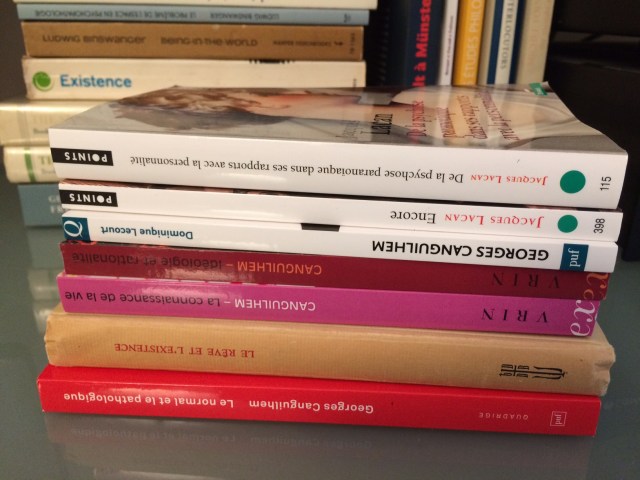
Some books for the new Foucault project – works by Georges Canguilhem and Jacques Lacan, picked up in Paris, and Jacqueline Verdeaux’s translation of Ludwig Binswanger’s Dream and Existence which Foucault advised and introduced.
Some books for the new Foucault project – works by Georges Canguilhem and Jacques Lacan, picked up in Paris, and Jacqueline Verdeaux’s translation of Ludwig Binswanger’s Dream and Existence which Foucault advised and introduced.
Save the Centre for Cultural Studies at Goldsmiths University – sign the petition here.
Update 20.25 – I’ve been made aware that the situation is much more complicated than the petition suggests, and that the restructuring may be for quite different reasons. You may wish to exercise caution before signing.
This is a petition addressing the dissolution of the Centre of Cultural Studies (CCS) at Goldsmiths, University of London and striving to attract public attention to the conditions which led to this resolution. It has been recently brought to our attention that the Centre for Cultural Studies is to be incorporated into the Media and Communications department starting from the academic year 2017/18 ‐ in ways and with consequences which are yet to be established.
The dissolution of the Centre for Cultural Studies at Goldsmiths stands in direct relation to a broader neoliberal re‐organisation of Universities in the UK and worldwide, and can thus be seen as a symptom of the exacerbation of this agenda…
More info on the Centre here; full petition here. Here’s the first few signatures…
Eric Alliez, Paris 8 & Kingston University
Wendy Brown, University of Berkley
Howard Caygill, CRMEP & Kingston University
Eric Fassin, Paris‐8 University
Verónica Gago, Universidad de Buenos Aires
Peter Hallward, Kingston University
Matthieu Renault, University Paris 8
Yuk Hui, University of Leuphana, Germany
Daniele Lorenzini, Columbia University
Isabell Lorey, eipcp & University of Kassel
Toni Negri, Philosopher
Christine Planté, Université de Lyon 2
Judith Revel, Université Paris Ouest Nanterre‐LaDefense
Sandro Mezzadra, University of Bologna, Italy
Franco Berardi ‘Bifo,’ Philosopher
Deborah Cowen, University of Toronto…
William Davies, ‘How statistics lost their power – and why we should fear what comes next‘ in The Guardian.
I don’t imagine I will share many links about Trump, but here’s one that’s worth reading – William E Connolly on ‘Trump, Putin and the Big Lie Scenario‘.
 Catastrophe: Critical Legal Conference 2017 Call for Streams – info at Critical Legal Thinking
The Warwick Law School and Social Theory Centre invite you to the 2017 Critical Legal Conference at the University of Warwick on the 1st-3rd of September. Please send your stream proposals to clcwarwick@gmail.com. The closing date for streams will be the 28th of February, the call for papers will open after that.
Theme: Catastrophe
Ten years ago, the so-called ‘Invisible Committee’ urged that ‘It is useless to wait…. To go on waiting is madness. The catastrophe is not coming, it is here. We are already situated within the collapse of a civilization. It is within this reality that we must choose sides.’ Over a decade before, Leonard Cohen had written; ‘This is the darkness, this is the flood. The catastrophe has already happpened and the question we now face is what is the appropriate behaviour.’ The 2017 Critical Legal Conference thus calls for streams, panels and papers that reflect upon ‘catastrophe’; on the catastrophes of our time and upon their interrelations; upon the questions of appropriate behaviours that might emerge and sides that might be taken.
“Remember a condition of academic writing is that we expose ourselves to critique” – 15 steps to revising journal articles – useful advice from the LSE blog.
(There is a page on this site which collects my own previous posts on writing and publishing and shares a lot of links like the one above).
 Foucault and the Modern International: Silences and Legacies for the Study of World Politics is a new collection with Palgrave, edited by Philippe Bonditti with Didier Bigo and Frédéric Gros.
This book addresses the possibilities of analyzing the modern international through the thought of Michel Foucault. The broad range of authors brought together in this volume question four of the most self-evident characteristics of our contemporary world-‘international’, ‘neoliberal’, ‘biopolitical’ and ‘global’- and thus fill significant gaps in both international and Foucault studies. The chapters discuss what a Foucauldian perspective does or does not offer for understanding international phenomena while also questioning many appropriations of Foucault’s work. This transdisciplinary volume will serve as a reference for both scholars and students of international relations, international political sociology, international political economy, political theory/philosophy and critical theory more generally.
It’s been a long time in the making, and while in production Palgrave was bought by Springer, which may explain the obscene price for the volume. I’m told there should be a paperback at some point, but the eBook price is unjustified. A preprint of my essay ‘Foucault and Geometrics‘ is available on this site; I hope other chapter authors can do the same.
.
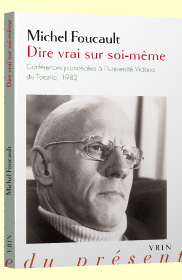 Michel Foucault, Dire vrai sur soi-même: Conférences prononcées à l’Université Victoria de Toronto is forthcoming from Vrin in February 2017.
This is a volume in a series which has, until this point, largely comprised updated and critical editions of texts previously available in English or French, like the 1980 Berkeley/Dartmouth lectures or the 1983 parrēsia lectures from Berkeley (Fearless Speech). This volume is different, because it comprises previously unpublished lectures from 1982. There are connections between them and Collège de France lectures, and the Vermont Technologies of the Self seminar, but they are distinct and important. When I was researching Foucault’s Last Decade I was able to consult partial versions of the lectures in the Bancroft library at Berkeley, but these are newly transcribed from tape recordings and supplemented by Foucault’s manuscript – neither of which I had access to at that time.
I’ll be writing a review of the book as soon as I get a chance to see it, but from the description I think the two key themes of interest will be the interrelation of the work on the technologies of the self and parrēsia, on the one hand; and the analysis of early Christianity alongside pagan antiquity on the other. Both are crucial to understanding the multiple projects and publications Foucault planned in the last years of his life, but which he did not live to complete.
À la fin du premier semestre 1982, Michel Foucault prononce à l’Université Victoria de Toronto un cycle de conférences intitulé Dire vrai sur soi-même. Le thème de ces conférences, s’inscrivant dans le cadre du projet d’une généalogie du sujet occidental moderne, est la formation historique de l’herméneutique de soi. Après avoir analysé le type très particulier de connaissance de soi et de rapport à soi qui caractérise l’askêsis gréco-romaine, où il s’agit pour le sujet d’établir avec lui-même une relation de possession et de souveraineté, Foucault étudie le renversement qui conduit, aux premiers siècles du christianisme, et tout particulièrement dans les communautés monastiques, à la naissance d’une herméneutique de soi conçue comme l’exploration et le déchiffrement par le sujet de sa propre intériorité. Pour définir ce renversement, Foucault introduit ici une distinction inédite entre deux formes d’ascèse, l’une tournée vers la vérité, l’autre tournée vers la réalité. Parallèlement aux conférences, Foucault conduit à Toronto un séminaire consacré à l’étude détaillée de textes des auteurs anciens sur lesquels s’appuient ses analyses de la culture de soi antique. Il y présente également une esquisse des différentes significations de la notion de parrêsia dans l’Antiquité, qui allait devenir le thème principal de ses derniers travaux.
Ces conférences et ce séminaire sont publiés ici pour la première fois, dans une édition critique.
Andy Merrifield’s tribute to John Berger.
A tribute to John Berger, who passed away aged 90 on 2 January 2017. Posted originally on Verso Books blog, 3 January 2017.
John died yesterday. I’ll remember his voice, his laugh, his charm and generosity. His words. Stripped-down words, mystical and carefully chosen words, earthy words, fierce words. They’ll always grab us, make us think, feel and act, piss people off. To weep for John is to weep on the shoulder of life. Remember him, gazing up at Aesop, in front of Velázquez’s great canvas?
“He’s intimidating, he has a kind of arrogance. A pause for thought. No, he’s not arrogant. But he doesn’t suffer fools gladly. The presence of Aesop refers to nothing except what he has felt and seen. Refers to no possessions, to no institutions, to no authority or protection. If you weep on his shoulder, you’ll weep on the shoulder of his life. If you…
View original post 938 more words


