TCS review of Pierre Bourdieu, On the State: Lectures at the Collège de France, 1989-1992

Bourdieu-On-the-State.jpgTCS review of Pierre Bourdieu, On the State: Lectures at the Collège de France, 1989-1992 at the TCS website, by Rohit Chopra.

Pierre Bourdieu’s On the State grapples with the unthinkability of the state, seeking to bring it within the ambit of the thinkable. Bourdieu describes how the state derives its legitimacy by possessing not just a monopoly over physical violence but also over symbolic violence. The state is incorporated within us, by shaping both our mental structures and practices. Those empowered to act in the name of the state routinely perform and reinforce the authority of the state as do citizens by following state orders. Unmasking how the historical origins of the state are marked by arbitrary inequalities is essential to understanding how the authority of the state is linked to the distribution of privilege in the present. The book shows a remarkable theoretical and methodological coherence across Bourdieu’s range of work. And it distinguishes his perspective and project as uniquely distinct from Marxist, poststructuralist, or conventional historical or structural sociological appproaches. [more here]

Posted in Pierre Bourdieu, Theory, Culture and Society, Uncategorized | Leave a comment

Elisa Ganivet, Esthétique du mur géopolitique (English synopsis)

Elisa Ganivet, Esthétique du mur géopolitique now published with Les Presses de l’Université du Québec. Elisa sent an English synopsis (the French can be found on the book’s site).

280x0_D4360_pnThrough the eyes of a hundred artists: an historical and contemporary journey along the Border Wall Aesthetics

Years after the fall of the Berlin Wall, at a time of globalization and free trade, some fifty walls are still in existence in the world, especially around the territory of Israel and the border of Mexico and the United States, where a barrier runs for approximately 500 km. If the justifications set out by states are multiple – illegal immigration, terrorism, smuggling, etc. – the erection of a separation barrier seems once again to embrace the age-old formula of rejection of the other-foreigner and transgresses the principle of universality. Its archaic materiality conflicts with the image of a post-modern and technological world, the wall crystallizes a malaise which must be elucidated by art. Its visibility and sensationalism essentially become an advertisement for a geopolitical event which artists choose to engage with.

If the wall is circumstantially ephemeral, what interests the artists? Is it its metamorphoses or its spatio-temporal framework? The author of this book compares three walls – the Berlin Wall, the separation barrier between Israel and the Palestinian Authority and the secure border between Mexico and the United States – according to their aesthetic developed by three leading artists: Joseph Beuys, Banksy and Frida Kahlo. The study of context, alongside geopolitical stakes and objectives with regard to each separation barrier, accounts for the faults and the failures of an a priori well-oiled system. Because if the wall generally refers to the idea of being at home and being protected, it can also mean isolation, whether intentional or not. It is the physical and symbolic structure of the prison dynamic.

Posted in Uncategorized | Leave a comment

What happens after a book manuscript goes into production?

After a book manuscript is delivered to a publisher, and agreed in final form, a whole lot of things happen. This is one of those ‘black boxes’ in publishing, and some thoughts might be of interest. What follows is a description of the stages in the period sometimes described as ‘in press’, that is, no longer ‘under review’, but not yet available in bookshops or online. Bear in mind these are my experiences, albeit across a reasonable range of publishers, with authored and edited books. I’ve tended to work with publishers again if I’ve had a good experience, or aspire to do so (University of Chicago Press is a good example of the latter). Some of these comments are quite critical, but there is much here I wish I’d known earlier in my career.
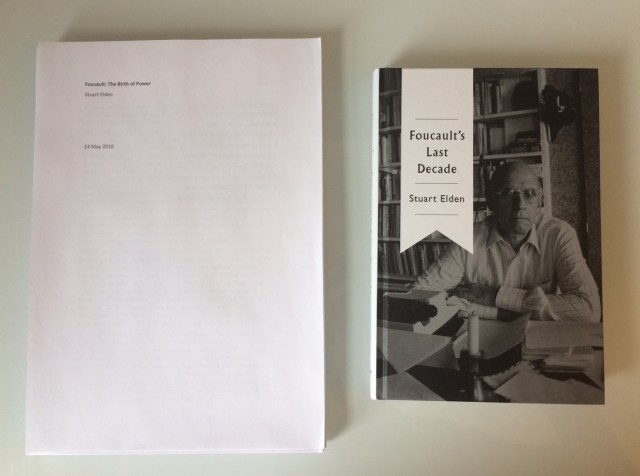
IMG_1527

A just-completed manuscript and a just-published book

Title – strangely, many contracts only give the book a provisional title, and then the title is agreed after the manuscript is in production. This seems wrong-headed to me. I accept that people other than the author should have a say in the title, but when that is can be an issue. A book’s text should reflect the title, as well as the other way round. If the title changes, parts of the book may need to be rewritten. So I’ve tried to insist on the title being discussed and agreed earlier in the process, but that’s easier when you are further ahead in your career and can afford to be bullish. When it comes to deciding titles, publishers want the keywords right up front, they will often switch subtitles and titles, they don’t like specialised language, and pleading of ‘nobody who has read the book could think that is an appropriate title’ won’t work (this is marketing, remember).

Cover – this may have been agreed beforehand, but frequently not. And presses will come up with all sorts of strange ideas of what looks good. Often authors are given input into the process; sometimes they are even listened to. When I’ve done workshops on publishing I’ve often said that authors tend to lose two battles with publishers – over the title and the cover. I think there is a lot in that. It has, at least for me, got easier as I’ve got more senior, but I’ve still had to throw my lollipop in the sandpit a few times in recent years.

Permissions – obviously if you’re using someone else’s work, such as images, these need to be cleared. Sometimes this can be expensive – the images in The Birth of Territory, for example, ranged from really expensive to free, with no obvious correlation between source, importance and cost. What is perhaps less known is that if you, the author, are reusing work you’ve previously published, you also need to get permission. Some publishers are straight-forward on this – Sage, for example, have a website which clearly sets out what you can and cannot do with your own work that has appeared in their journals. To republish or reuse an article in a book you have written or edited can be done with simple acknowledgement and no official clearance. Other publishers want a lot of information, and can take a long time to give you permission. Some have subcontracted agreeing this out to a third-party that charges a fee even if permission is freely given. It all reminds me of liner notes to, I think, a Radiohead album where it said ‘lyrics printed by kind permission, even though we wrote them’. Exactly.

Copy-editing – even the best of us need a copy-editor. Not only do they shoe-horn your book into whatever peculiar style the press has concocted, they also catch grammatical issues, standardise spelling (UK vs US) and compound-words etc. I hate it when copy-editors try to rewrite the text; I am grateful for any comment that something is unclear or all the many small things that good copy-editors fix up. The experience I’ve had at Polity has been very good, and the one I had at University of Chicago Press was also excellent. But I’ve also had some terrible experiences. I want to see, in track-changes, every change made to the text. If I read a sentence and don’t recognise it, and realise it’s been rewritten to say more clearly something different to what I said, then we have a problem…

Proof-reading – is hard work. As author, you know the text better than anyone, and you will see on a page what you think is there, not what is there. The other problem, and I have sympathy for presses here, is that many authors want to rewrite a book at this stage. You have got to correct the printing of the text you provided, as agreed at copy-editing. Some presses have someone other than the author go over the proofs as well, such as the copy-editor. More should do this. I’m continually amazed by the poor state of some printed books. But then, one of my own books had a very odd error in the printed version, which was never in proofs that I was sent. No idea how or when it got there. There is only so much an author can do.

Index – as electronic access becomes more and more common, this is perhaps becoming less important. But books still, by and large, have indexes. Some authors do them themselves. I did once, and never again. Not only was it difficult, time-consuming, and – I thought – incredibly dull, I also realised that the author is probably the worst person to do this. The index is for a reader, of course, and that person isn’t going to encounter the text in anything like the way the author does. Anyone who uses an index to read a book (as opposed to checking a detail in a book they’ve already read) is hardly an ‘ideal reader’. An author will probably find that they have been terminologically or conceptually imprecise when they compile an index, and there is little they can do – the index is done with page proofs to have correct pagination, and proofs can only be lightly amended. So I’ve used PhD students or other career people who need some additional income to compile indexes, to variable degrees of success. More recently I’ve been using a professional indexer, recommended by a friend and colleague. She did Foucault’s Last Decade and will do Foucault: The Birth of Power too. Sometimes presses say they can arrange an indexer and, if they are feeling generous, offer to set this against royalties. Be warned that unless your book does reasonably well, the cost of the index may easily be more than the royalties you’ll receive. I really think publishers should incorporate the cost of an index as part of the production process for a book, but they don’t. It is a terrible irony than the indexer or copyeditor of a book may well earn more from it than its author. Their work is important certainly, but it is a few weeks work at most. And yes, most academic authors are on a salary, but not all, and few can write books in standard contracted hours.

Author-questionnaire – of course, publishers have marketing departments, but I think more and more is being devolved to authors. So authors have to provide a detailed list of journals that might review a book, academics that might adopt it, conferences at which it should be promoted, etc. Doing this properly takes time. Authors generally have to write their own backcover blurb, which is then sometimes sent back by marketing with terse comments but no alternative suggestions. Authors often have to suggest who should endorse the book, though the publisher has to lead on this. Increasingly now, books are sometimes sold in individual chapters as well, so you may have to write an abstract for sales purposes for each component part. (I didn’t like doing this, and didn’t like the idea of the book being chopped into pieces – if I’d wanted the pieces available individually, I’d have published them as articles.) I had to come up with a number of tweetable summaries of the Foucault book for use in social media. You may be asked to provide a text for the publisher blog, or a video abstract or similar. All important and all largely dependent on the author.

Copies of the book – you’ll often get a single advance copy of the book, followed by a few additional copies from the warehouse. I’ve always also bought several more copies, albeit at a small author discount, in order to give them away. Writing a book incures debts, and I try to give copies to people who have been especially helpful. Some image providers require copies of the book, and authors have to provide these at their own cost. Archives sometimes make use of their material conditional on receiving a book. Colleagues, ex-supervisors, friends, family… Some publishers allow you to set the cost of additional copies against royalties; others don’t – in part because they are not sure the royalties will cover the cost.

I think those are the key things in the process from acceptance of final manuscript to seeing the final physical object (or, I suppose, e-book file). Writing the two Foucault books back-to-back means I’ve barely finished the production process for one than it begins again for the second, and Polity are comparatively fast at around 9 months from final acceptance to publication. If these had been with US university presses the first would just be further ahead in the process than the second at this stage.

As I said at the beginning, these are one author’s experiences of the process. A publisher would, of course, see a different side of this, and know of things that authors have no experience with. But from an author side, there is a lot of work to be done after the exhilaration of finally getting a manuscript into production.

Comments, additions, and other experiences very welcome…

Posted in Uncategorized | 1 Comment

Henri Lefebvre, Marxist Thought and the City -forthcoming in November

Henri Lefebvre, Marxist Thought and the City is forthcoming in November from University of Minnesota Press. It is translated by Robert Bonnano and has a short preface by me.

image

One of the most influential Marxist theorists of the twentieth century, Henri Lefebvre first published Marxist Thought and the City in French in 1972, marking a pivotal point in his evolution as a thinker and an important precursor to his groundbreaking work of urban sociology, The Production of Space. Marxist Thought and the City—in which he reviews the work of Karl Marx and Friedrich Engels for commentary and analysis on the life and growth of the city—now appears in English for the first time.

Rooted in orthodox Marxism’s analyses of capitalism and the capitalist mode of production, with extensive quotations from the works of Marx and Engels, this book describes the city’s transition from life under feudalism to modern industrial capitalism. In doing so it highlights the various forces that sought to maintain power in the struggles between the medieval aristocracy and the urban guilds, amid the growth of banking and capital.

Providing vital background and supplementary material to Lefebvre’s other books, including The Urban Revolution and Right to the City, Marxist Thought and the City is indispensable for students and scholars of urbanism, Marxism, social geography, early modern history, and the history of economic thought.

Posted in Henri Lefebvre, Uncategorized | Leave a comment

The UCU and the industrial action – research and ineffective strategies

The UCU has, following a ballot on industrial action, announced that there will be a two-day strike on 25-26 May 2016, followed by “an instruction to members to work to contract with effect from 25/05/2016”.

Four years ago I had an email exchange with Matt Waddup, national head of campaigns for the University and College Union. It concerned the ‘action short of a strike’ and the problems that this caused for writing, research, and external duties of academics. You can read my original questions here; and a couple of rounds of responses here.

In the current FAQs, the only time ‘research’ is mentioned is concerning the strike day. There is nothing in the discussion of what it means to ‘work to contract’ concerning research. I find this staggering given the proportion of time, expectation and management, for a research-active academic, that concerns research. In the short-term, I really think that an academic, perhaps especially someone early career, trying to only work their contractual hours will disadvantage themselves first and foremost.

I remain unconvinced that the UCU leadership, most of whom seem to have a background in unions or further education, really understand the working life of a research-active higher education academic. This is not to denigrate further education of course, but just to suggest that there are noticeably different types of work involved between sectors.

One thing that was in the union email, but not in their press release, was this message:

Finally, outside the action,  the union will also be appealing to all members to resign, giving due notice, from currently held external examiner positions and not to take up new ones until the  dispute is settled.

I’m not quite sure how this is ‘outside the action’, but it actually sounds like the most powerful thing being proposed.

In the press release, but not in the email, was the following:

If no agreement is reached in the coming weeks, members have agreed to target further strike action in June and July, and are considering additional action in August to coincide with the release of A-level results. The union is also beginning preparations for a boycott of the setting and marking of students’ work, to begin in the autumn if an acceptable offer has still not been made.

If the union, and its members, are serious about getting employers to reopen negotiations then it is these kinds of hard-hitting action that will be needed. A full boycott of anything to do with REF or TEF might be still more effective. Otherwise we will be back to the pattern of previous action – short strike, ‘work to contract’, minor concession, suspension of action, ballot, resigned acceptance, and statu quo ante.

Posted in Uncategorized, Universities | Leave a comment

The Birth of Territory reviewed in Law, Culture and the Humanities by Thanos Zartaloudis

9780226202570The Birth of Territory is reviewed in Law, Culture and the Humanities by Thanos Zartaloudis (requires subscription). It’s a generous summary of the book and says a few things about the legal aspects of the argument.

To the legal audience the numerous references and remarks on the role of law in the eventual conception of territory (and sovereignty), as well as the explanatory note on the tension and co-existence of, for instance, civil and canon law, would certainly be a useful entry point into the book for students and scholars. The book is, further, a welcome call for continuous exploration of the lines of questioning that are offered in a historically sensitive map of territory and of its relation to law and spatial strategies of power.

You can read more about this book, with links to all the reviews I know of, on this page.

Posted in Territory, The Birth of Territory, Uncategorized | 1 Comment

Elsevier buy Social Science Research Network (SSRN)

News yesterday that Elsevier had bought Social Science Research Network (SSRN) has caused a lot of controversy. SSRN is used to share work in progress, Elsevier is a controversial publisher with expensive subscriptions. The Duck of Minerva has one take on this – ‘Selling out to the enemy of open access‘.


Posted in Publishing, Uncategorized | Leave a comment

Royalties

A recent conversation on social media about royalties reminded me of this post from some years ago…

stuartelden's avatarProgressive Geographies

Conversation with a (smart) undergraduate student yesterday, about the amount of money academics make from book sales. I asked him how much he thought an academic got in royalties for a £20 book. ‘About £9?’ It’s actually closer to 50p; perhaps £1 if you’ve struck a good deal…

View original post

Posted in Uncategorized | Leave a comment

Mark Neocleous, The Universal Adversary: Security, Capital and the ‘Enemies of All Mankind’ – a few thoughts

As I’ve previously mentioned, Mark Neocleous, The Universal Adversary: Security, Capital and the ‘Enemies of All Mankind’ is now out with Routledge. Here’s the backcover description:

9781138955165

The history of bourgeois modernity is a history of the Enemy. This book is a radical exploration of an Enemy that has recently emerged from within security documents released by the US state: the Universal Adversary. Neocleous shows how the concept of the Universal Adversary draws on several key figures in the history of ideas, said to pose a threat to state power and capital accumulation. Within the Universal Adversary there lies the problem not just of the ‘terrorist’ but, more generally, of the ‘subversive’, and what the emergency planning documents refer to as the ‘disgruntled worker’. Taking the figure of the disgruntled worker as its starting point, the book introduces some of this worker’s close cousins – figures often regarded not simply as a threat to security and capital but as nothing less than the Enemy of all Mankind: the Zombie, the Devil and the Pirate. In situating these figures of enmity within debates about security and capital, the book engages an extraordinary variety of issues that now comprise a contemporary politics of security, from crowd control to contagion, from the witch-hunt to the apocalypse, from pigs to intellectual property, in a compelling analysis of the ways in which security and capital are organized against nothing less than the ‘Enemies of all Mankind’.

I’ve now read the book, which I greatly enjoyed. Mark taught me as an undergraduate, and supervised my PhD thesis, and the book is very much a reflection of his spoken style. While a serious topic, the nature of the figures examined is obviously entertaining as well as challenging. People familiar with Mark’s other work – on administration, police, security, monsters and fascism and so on – will find plenty of connections, and it’s interesting how these themes connect up together here. Indeed, it’s possibly the first thing of Mark’s I’ve read where I could see the connection between all these aspects of his work – the police and security work obviously connected to his first book on administration, and he’s shown how domestic politics and international politics often work in related ways, but The Monstrous and the Dead book (which was of course a development of his work on fascism) now clearly appears as central to that other work too.

The book ranges from serious readings of canonical political theory – Hobbes and Bodin, for example – to engagement with figures from popular culture and contemporary news events. The figure of the ‘universal adversary’ comes from US security doctrine, but as the description above indicates, draws on a much wider range of political, racist, imperial and class issues. The book retains a strong Marxist perspective, and stresses how class politics has often been written out of critical perspectives on terrorism and security. Foucault is another figure discussed and used, and it is interesting to think about how these emblematic figures – the disgruntled worker, the zombie, the pirate – function in a similar way to Foucault’s constitutive subjects of sexuality – the pervert, the hysteric, the masturbating child.

It’s quite a short book, and I read it on a couple of train journeys. Given the direction of my current work it’s not a book I expect I will be using for my research any time soon, though I’m sure I’ll return to it at some point. It’s a useful antidote to those who think that thinking about the ‘enemy’ means you need to read Carl Schmitt. People interested in, for example, Daniel Heller-Roazen’s work on pirates, or Grégoire Chamayou’s book on Manhunts will find much to consider here, as well as those working on the ongoing ‘war on terror’, security, and anticipation.

Posted in Daniel Heller-Roazen, Karl Marx, Mark Neocleous, Michel Foucault, Uncategorized | 2 Comments

Books received 2 – Shakespeare and Heidegger

IMG_1519.JPGTwo (poor quality) second-hand Shakespeare books and the last of the Oxford sale books I’d ordered, plus the first volume of Heidegger’s lectures from the Gesamtausgabe.


Posted in Martin Heidegger, Uncategorized, William Shakespeare | 1 Comment