Les Études Philosophiques theme issue on Foucault’s L’Archéologie du savoir, including early draft of Introduction

In 2015 Les Études Philosophiques published a theme issue on Foucault’s L’Archéologie du savoir, which included an early draft of the book’s Introduction.

9782130651116_v100Baptiste MÉLÈS – Présentation

Michel FOUCAULT – « Introduction » à L’Archéologie du savoir. Texte établi et introduit pa Martin Rueff

Luca PALTRINIERI – L’archive comme objet : quel modèle d’histoire pour l’archéologie ?

Jean-François COURTINE – Michel Foucault et le partage nietzschéen : Vérité/Mensonge

Baptiste MÉLÈS – Les « règles de formation » comme catégories foucaldiennes

David RABOUIN – L’exception mathématique

The Introduction is to a different draft of the text than the one preserved in Bibliothèque Nationale de France box NAF28284 (1) – the introduction to that version was published in Cahier de l’Herne in 2011. This one comes from box NAF28730 (48). Martin Rueff, who edited the introduction in this theme issue, provides a detailed discussion of the extant draft materials in the recent Oeuvres.

Posted in Michel Foucault, Uncategorized | Leave a comment

End of day two of final revisions of Foucault: The Birth of Power

IMG_1496.JPG

Lots of work over the past two days on this second Foucault manuscript. In particular, the introduction is restructured, some parts rewritten and some new discussion. I say a bit more about the sources worked with, and the argument and approach up front; and then a bit more on the period to be discussed, both in range of topics, types of work and styles of output at the end. There is also a little more discussion of the manuscript of the first version of The Archaeology of Knowledge, though a detailed discussion will have to wait for a project on the 1960s Foucault. I’ve also written a few more lines into the conclusion, both summarising things and expanding on Foucault’s self-description as an ‘artificer’. Lots of minor changes, and some more explicit signposting of the argument. More work tomorrow…

Posted in Foucault: The Birth of Power, Michel Foucault, Uncategorized | 1 Comment

Foucault’s Last Decade – essay on the content and process at Berfrois

michel-foucault1

Update September 2025: the Berfrois site is now closed and the archive has been removed. My piece can now be found here.

At the Berfrois website I have a short essay discussing Foucault’s Last Decade, both in terms of its content and the research process that I followed. I also say a bit about the second book – Foucault: The Birth of Power.

Foucault’s Last Decade is a study of Foucault’s work between 1974 and his death in 1984. In 1974, Foucault began writing the first volume of his History of Sexuality, developing work he had already begun to present in his Collège de France lecture courses. In that first volume, published in late 1976, Foucault promised five further volumes, and indicated some other studies he intended to write. But none of those books actually appeared, and Foucault’s work went in very different directions. At the very end of his life, two further volumes of the History of Sexuality were published, and a fourth was close to completion. In contrast to the originally planned thematic treatment, the final version was a much more historical study, returning to antiquity and early Christianity. In this book, I trace these developments, and try to explain why the transition happened…

Posted in Foucault's Last Decade, Foucault: The Birth of Power, Michel Foucault, Uncategorized | Leave a comment

Society and Space volume 34 issue 3 now online

New issue of Society and Space, including an essay by Lauren Berlant, first delivered at the AAG conference in 2015.

Posted in Uncategorized | Leave a comment

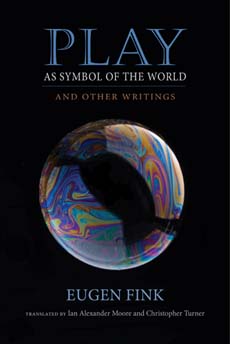
Eugen Fink, Play as Symbol of the World And Other Writings – forthcoming from IUP

9780253021052_medEugen Fink, Play as Symbol of the World And Other Writings is forthcoming from Indiana University Press. This is a book I’ve found very helpful in thinking about the ‘world’, and wrote about in an article in 2008 for Parrhesia. Its English translation is long overdue.

Eugen Fink is considered one of the clearest interpreters of phenomenology and was the preferred conversational partner of Edmund Husserl and Martin Heidegger. In Play as Symbol of the World, Fink offers an original phenomenology of play as he attempts to understand the world through the experience of play. He affirms the philosophical significance of play, why it is more than idle amusement, and reflects on the movement from “child’s play” to “cosmic play.” Well-known for its non-technical, literary style, this skillful translation by Ian Alexander Moore and Christopher Turner invites engagement with Fink’s philosophy of play and related writings on sports, festivals, and ancient cult practices.
Posted in Eugen Fink, Uncategorized | Leave a comment

Luis Lobo-Guerrero, Insuring Life: Value, Security and Risk

9780415716079Luis Lobo-Guerrero, Insuring Life: Value, Security and Risk, the third volume in his trilogy on these questions, is forthcoming in May in the Interventions series at Routledge. At the moment it is only a very expensive hardback – £90 for 156 pages – but a paperback is due at the end of the year.

This book is a contribution to the scholarly engagement with the wider problem of governing through risk and the politics of uncertainty. It takes life insurance as an empirical site from which to ask: what is the kind of governance created through insurance an instance of, and how does it contribute to the transcendence of liberalism? By making a distinction between capable life as object of insurance, and potential life as that which escapes its control, the book conducts a historical epistemological analysis of the problems of valuation, truth production, securitisation, classification, and gendering that constitute life insurance products and practices.

Insuring Life offers a critical engagement with the epistemology of life insurance to demonstrate the unnecessary and precarious character of the conditions that make this instrument of liberal governance possible. It concludes that the transcendence of liberalism relies on the technological agency of these instruments and that its challenge begins by redefining the terms under which the potential of life, if invaluable, is to be thought as event.

The book follows Insuring War as the third of a trilogy that analyses how concepts and practices of power, risk and security materialise in the form of insurance as a central instrument of governance in the liberal world. It will be of great use to scholars, researchers, and postgraduate students of political economy, critical security studies and political theory, the biopolitics of security and post-structural politics.


Posted in Uncategorized | Leave a comment

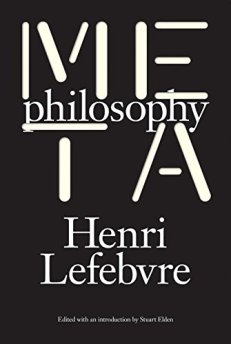
Henri Lefebvre, Metaphilosophy – forthcoming in July from Verso

Although it has been a bit delayed, Lefebvre’s Metaphilosophy is now forthcoming from Verso in July 2016. First published in 1965, it was translated by David Fernbach. I edited the text and wrote an introduction.

41lQcLWg6sL.jpg

In Metaphilosophy, Henri Lefebvre works through the implications of Marx’s revolutionary thought to consider philosophy’s engagement with the world. Lefebvre takes Marx’s notion of the “world becoming philosophical and philosophy becoming worldly” as a leitmotif, examining the relation between Hegelian–Marxist supersession and Nietzschean overcoming. Metaphilosophy is conceived of as a transformation of philosophy, developing it into a programme of radical worldwide change. The book demonstrates Lefebvre’s threefold debt to Hegel, Marx and Nietzsche, but it also brings a number of other figures into the conversation, including Sartre, Heidegger and Axelos. A key text in Lefebvre’s oeuvre, Metaphilosophy is also a milestone in contemporary thinking about philosophy’s relation to the world.

“Metaphilosophy establishes Lefebvre’s place among the twentieth century’s very greatest Marxist thinkers. Arguing that the idea of philosophy can only be realized by going beyond philosophy itself, Lefebvre opens philosophy up to the concerns of everyday life and love, mass media and synthetics, consumerism and nuclear apocalypse, in a breathtakingly original vision of what truly radical thought might be. First written in French half a century ago, the remarkable challenges that it poses remain as significant as ever. There will not be a more important work of philosophy published this decade.”

Posted in Henri Lefebvre, Uncategorized | 1 Comment

Shakespeare productions in London, Stratford and elsewhere I’m looking forward to…

My occasional retrospective comments on Shakespeare productions in London, Stratford and elsewhere might mean they come too late, and that people who are interested don’t get to see them. I know that some productions can sell out quickly, some months ahead of time – I failed to get tickets to Ralph Fiennes as Richard III at the Almeida just today. So, here’s a list of some of the productions I’m looking forward to over the next few months.

Romeo and Juliet at the Garrick, directed by Kenneth Branagh

Trevor Nunn’s production of King John in Kingston

Cymbeline at the RSC, and then as Imogen ‘reclaimed and renamed’ at the Globe

A number of King Lears – Don Warrington in Birmingham, Timothy West in Bristol, Antony Sher at the RSC, and The Shadow King at the Barbican. Glenda Jackson will also be taking the lead at the Old Vic in the autumn.

Macbeth and The Taming of the Shrew at the Globe, and probably their A Midsummer Night’s Dream, which I will also see at the RSC.

A bit further ahead, Simon Russell Beale as Prospero in The Tempest, and a play I’ve never seen before, The Two Noble Kinsmen, both at the RSC. In early 2017 I also hope to get to Ivo van Hove’s Roman Tragedies – Coriolanus, Julius Caesar, and Anthony and Cleopatra in a six hour epic at the Barbican; and Hamlet at the Almeida. I was disappointed that the wonderful Scena Mundi had to cancel their run of Othello at St Giles in the Fields.

What have I missed?

Posted in William Shakespeare | Leave a comment

A fairly clear desk as I begin the final revisions of Foucault: The Birth of Power

IMG_1481

A fairly clear desk as I begin the final revisions of Foucault: The Birth of Power…

Posted in Foucault: The Birth of Power, Michel Foucault, Uncategorized, Writing | Leave a comment

The Dissonance of Things #6: Logistics – Violence, Empire and Resistance

Laleh Khalili, Deborah Cowen and Charmaine Chua discuss logistics, violence, empire and resistance.

Charmaine Chua's avatarThe Disorder Of Things

EXODUS-IV-Hong-Kong-China-2010
Source: Marcus Lyon

This May, The Dissonance of Things switches out British accents for those of the vaguely North American variety, as I serve as host for our sixth podcast on the topic of logistics and its role in the making of military, capitalist, and imperial relations. I’m joined by our very own Laleh Khalili of the School of Oriental and African Studies, and the wonderful Deborah Cowen of the University of Toronto. Together, we take a look at the increasing ubiquity and prominence of logistics as a mode for organizing social and spatial life. We discuss how this seemingly banal concern with the movement of goods is actually foundational to contemporary global capitalism and imperialism, reshaping patterns of inequality, undermining labor power, and transforming strategies of governance. We also ask: what might a counter-logistical project look like? What role does logistics play in anti-colonial and anti-capitalist struggles across the…

View original post 117 more words

Posted in Uncategorized | 1 Comment