You can’t polish a turd, but you can edit one – the importance of early drafting

I’ve frequently written about writing on this site, and also in the How we Write collection. I usually begin by saying that while there is no one correct way to write, there are ways that are better or worse for individuals. My own practice, learned over years, is that clearing time for writing, preferably in the morning, then jealously protecting it, is the best way forward. (My piece in The Times Higher Education on workload is on precisely this practice.) But if I talk about this, and mention either time spent or words produced, I regularly get the comment about whether this is finished text or a rough draft.

For me, there is no clear line. Everything is drafted, and then edited again and again, and the final version is just the one that isn’t messed with any more. As artists say, you don’t finish a painting, you just stop fiddling with it.

I’ve said before that knowing that a sentence is not the final one really helps with avoiding block. It doesn’t need to be absolutely right, it just needs to be there. And I put what I call my stage directions into the text – this doesn’t work, rework this, where is the argument? These, usually in square brackets and frequently highlighted, act as cues for me when I come back to it. Early versions are littered with ‘gloss [i.e. comment on a quote]’, ‘check’ (usually to a translation or original language text), ‘expand’, ‘move?’ and so on. I might sketch out a list of points to develop later. At the end of a writing session I sometimes write a note to myself about what comes next.

I sometimes turn on ‘track changes’ when working on a text, though usually make these invisible on the screen. At a certain point, perhaps at the end of day, I might make them appear and check over what I’ve done. I find this is useful in seeing changes, and reviewing things. You can then ‘accept all’ to begin again with a clean slate. But I save files everyday with the date in the filename, so build up an archive of versions.

The point of all this is to say that writing doesn’t need to be put off until some future point when you are ‘ready’. Text can be moved around so easily that the ‘I don’t know where to start’ complaint really should be met with ‘start anywhere’. Write your way out of blocks, even if you are writing about why you are blocked.

This, for me, helps enormously. There are moments when I can suddenly pour out text that I’m really happy with, and that sometime later realise is the version that will make it into print. But that’s rare. Sometimes I need to write when I’m not near a computer, so write by hand, on whatever is nearby, including notebooks, scraps of paper, postcards, beer-mats, etc., or send an email to myself or save a note on the phone. But those are unusual too. The bulk of writing comes from sitting down and working, reworking and perhaps overworking.

I use this approach to help with conferences and other talks. As non-negotiable deadlines, there is a pressure which doesn’t always come with writing. Some people thrive on this. For me, as early in the preparation as possible I try to get a version which I could give tomorrow – not that I would want to, but if something prevented me from doing any more work on it, I could use it. Now the pressure of not having anything is gone, even if what I have is far from good. But pressure off, I can now revise it in all the time remaining. I may end up throwing some of the original or subsequent versions away, but I had the safety net of having something. I may end up revising until very late – I frequently sit, pen in hand, with the text in preceding sessions. But there is a version already. And I tend to write a text, even if I turn it into a PowerPoint presentation, notes or notecards, because that way there is always a text to return to for publication or other use.

To my mind there isn’t much of a way around a block other than writing something and then editing, rewriting and so on. I’m not sure anyone should always to try to get it right in their head, or even in a plan, before they begin writing. Writing something, even if you throw a lot of it away, is I think better than not writing. Writing helps me to make sense of what I’m thinking, even if that thinking is confused.

Presenting the work to an audience is a good way to get feedback of course, and you can send drafts to trusted friends and colleagues. But I also find reading the text aloud, or portions of it, is very helpful. I always spot things that are wrong, or which could be improved, that way. While I do the bulk of my writing and editing on a screen, I do always print drafts eventually, usually very late, to read on a page instead. Or I convert the file to a pdf and send it to the Kindle app on the iPad. Something about reading on that helps in ways that I find hard on a regular computer screen in Word.

You might be one of those people who can plan everything out in their head, or on paper, and then fully-formed sentences and paragraphs pour out when you come to writing. If so, great; if not, perhaps something here will be useful.


For a related discussion see Explorations of Style here and here; do check out the How we Write collection; and see Another Word for a continuation of the discussion.

 

Posted in Publishing, Uncategorized, Writing | 3 Comments

Workload survival guide for academics – advice in the Times Higher Education

man-pushing-against-clock-handsWorkload survival guide for academics – advice in the Times Higher Education. I have a short piece in there on making time for writing; good contributions on saying ‘no’ to opportunities, referee reports, committee work, etc.

Posted in Publishing, Uncategorized, Universities, Writing | Leave a comment

Korean translations of Understanding Henri Lefebvre and Foucault’s Last Decade forthcoming

3-understanding-henri-lefebvreTranslations of Understanding Henri Lefebvre and Foucault’s Last Decade are forthcoming in Korean with Kyungsung University Press and Nanjang Publishing House respectively. These might be the first of my authored books to appear in translation, since potential translations of The Birth of Territory into Portuguese by a Brazilian press and into Korean have stalled, though a Chinese version is still in progress.

The edition of Lefebvre’s Rhythmanalysis Gerald Moore and I translated was translated into Korean and Persian, with our notes, my introduction etc., and several articles have been translated in the past, but a whole book by me in translation will be a nice moment.

Posted in Foucault's Last Decade, Henri Lefebvre, Michel Foucault, The Birth of Territory, Understanding Henri Lefebvre | 1 Comment

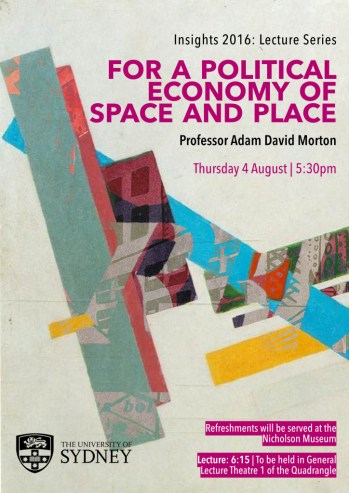
Adam David Morton, For a Political Economy of Space and Place – Sydney, 4 August 2016

Adam David Morton, ‘For a Political Economy of Space and Place‘ – Insights lecture, Sydney, 4 August 2016.

InauguralHighRes-724x1024

Under capitalism, how does the state organise space in our everyday lives through the streets we walk, the monuments we visit, and the places where we meet?

This lecture will address such issues as part of the Insights 2016: Lecture Series, organised by the Faculty of Arts and Social Sciences and Sydney Ideas at the University of Sydney.

The Insights Series is the University of Sydney’s approach to highlighting the work of newly-promoted or appointed Professors. Often simply called an “Inaugural Lecture”, it is an opportunity to inform colleagues in the University and the general public about one’s research career so far and update colleagues on current and future research directions.

For further information please contact – Kate Macfarlane: kate.macfarlane@sydney.edu.au

Online bookings can also be made HERE

Posted in Adam David Morton, Conferences, Uncategorized | Leave a comment

Extraterritorialities in Occupied Worlds, edited by Maayan Amir and Ruti Sela – now available from Punctum books

Amir_Sela_EXTRATERRITORIALITIES-cvr-front-216x353Extraterritorialities in Occupied Worlds, edited by Maayan Amir and Ruti Sela, is now available from Punctum books.

The concept of extraterritoriality designates certain relationships between space, law, and representation. This collection of essays explores contemporary manifestations of extraterritoriality and the diverse ways in which the concept has been put to use in various disciplines. Some of the essays were written especially for this volume; others are brought here together for the first time. The inquiry into extraterritoriality found in these essays is not confined to the established boundaries of political, conceptual, and representational territories or fields of knowledge; rather, it is an invitation to navigate the margins of the legal–juridical and the political, but also the edges of forms of representation and poetics.

Within its accepted legal and political contexts, the concept of extraterritoriality has traditionally been applied to people and to spaces. In the first case, extraterritorial arrangements could either exclude or exempt an individual or a group of people from the territorial jurisdiction in which they were physically located; in the second, such arrangements could exempt or exclude a space from the territorial jurisdiction by which it was surrounded. The special status accorded to people and spaces had political, economic, and juridical implications, ranging from immunity and various privileges to extreme disadvantages. In both cases, a person or a space physically included within a certain territory was removed from the usual system of laws and subjected to another. In other words, the extraterritorial person or space was held at what could be described as a legal distance. (In this respect, the concept of extraterritoriality presupposes the existence of several competing or overlapping legal systems.) It is this notion of being held at a legal distance around which the concept of extraterritoriality may be understood as revolving.

This volume is a part of Amir and Sela’s Exterritory Project, an ongoing art project that wishes to encourage both the theoretical and practical exploration of ideas concerning extraterritoriality in an interdisciplinary context. The project aims not only to draw on existing definitions of extraterritoriality but seeks also to charge it with new meanings, searching for ways in which the notion of extraterritoriality could produce a critique of discriminating power structures and re-articulate new practical, conceptual, and poetical possibilities.

The book is divided into sections – Extraterritorial Ethics/Geographies/Crimes/Poetics/Objects. I have a piece in the second entitled ‘Outside Territory’, originally given as a lecture in Paris in 2012. There are also contributions from Zygmunt Bauman, Emmanuel Levinas, Giorgio Agamben, Robert Bernasconi, Steven Galt Crowell, Anselm Franke + Eyal Weizman + Ines Weizman, Angus Cameron, Victoria Bernal, Mireille Hildebrandt, Julien Seroussi, Cedric Ryngaert, Ed Morgan, Martin Jay, Matthew Hart + Tania Lown-Hecht, Gerhard Richter, Homi Bhaba, Caryl Emerson, Theodor Adorno, and Graham Harman.

In six months time the book will be available entirely free to access; for now it’s available as print-on-demand or a pdf for a minimum price of $5.


Posted in Uncategorized | 1 Comment

Manifesto of the Groupe d’information sur les prisons translation in Viewpoint

The manifesto of the Groupe d’information sur les prisons, authored by Foucault, Pierre Vidal-Naquet and Jean-Marie Domenich, which I translated for this site a couple of years ago, has been reprinted in Viewpoint magazine. The prison group, along with Foucault’s involvement in the parallel health group and other activist work are discussed in detail in Foucault: The Birth of Power.

article.php.gif

article.php.gif

Posted in Foucault: The Birth of Power, Michel Foucault, Uncategorized | 2 Comments

Michael Sheringham obituary in The Guardian

I’m sorry to hear the news of the death of Michael Sheringham –  obituary in The Guardian.

Michael Sheringham, who has died of prostate cancer aged 67, was a leading figure in the field of French studies in Britain, Ireland and the US. In France, too, he earned widespread recognition for his achievements as a literary and cultural critic of the first order….

Everyday Life: Theories and Practices from Surrealism to the Present (2006) proved to be another landmark publication in French literary criticism in the anglophone world. Sheringham put together this wide-ranging, pioneering work with creativity, energy and patience. He drew fruitfully on the philosopher Michel de Certeau’s view set out in L’Invention du Quotidien (The Practice of Everyday Life) that routines like walking, talking and reading – the very things that are central to daily living – are somehow held outside specialised, established forms of knowledge. Sheringham’s critical manoeuvre was to analyse the “practitioners” of the everyday, among them Henri Lefebvre, Roland Barthes, Georges Perec and Annie Ernaux.

Everyday Life was the work of his I knew best, and we had a brief correspondence about his work on Lefebvre. I didn’t know that he was working in his last years on Foucault, as this part of the obituary notes:

By the time of his death, he had come close to completing a new book on Michel Foucault and a 19th-century French archive, with the title The Afterlives of Pierre Rivière: Foucault/Archive/Film.

Hopefully some of this work might see the light of day – sounds intriguing. There is also an obituary in Le monde, though most is behind a paywall.

Posted in Uncategorized | Leave a comment

Foucault, la Sexualité, l’Antiquité (2016)

This sounds an interesting collection – terrible cover though!

Clare O'Farrell's avatarFoucault News

bochringer-lorenziniFoucault, la Sexualité, l’Antiquité
sous la direction de Sandra Boehringer et Daniele Lorenzini

Ont contribué à cet ouvrage :
Jean Allouch, Thamy Ayouch, Sandra Boehringer, Claude Calame, Frédéric Gros, Daniele Lorenzini, Kirk Ormand, Olivier Renaut, Arianna Sforzini

Éditions Kimé – Philosophie en cours – 196 pages ISBN 978-2-84174-739-9 – 20 € – février 2016

Couverture : Shan Deraze

PDF of flyer

Ouvrage publié avec le concours de l’Association pour le Centre Michel Foucault, le centre de recherches Psychanalyse, Médecine et Société (CRPMS, EA 3522) de l’Université Paris Diderot et l’équipe d’accueil « Lettres, Idées, Savoirs »
(LIS, EA 4395) de l’Université Paris-Est Créteil

La sexualité est l’un des derniers grands chantiers ouverts par Michel Foucault. L’Histoire de la sexualité est une entreprise immense, qui marqua profondément le champ des sciences humaines : dans les deux volumes portant sur l’Antiquité, Foucault allait proposer de nouveaux epistemai aux spécialistes pour aborder les…

View original post 361 more words

Posted in Uncategorized | 2 Comments

Bars and stripes: Review of The Punitive Society (2016)

David Garland on Foucault’s The Punitive Society in the Times Literary Supplement.

Clare O'Farrell's avatarFoucault News

David Garland, Bars and stripes. Review of The Punitive Society. The Times Literary Supplement, 27 January 2016.

The thinking and rethinking that led Michel Foucault to write his finest book.

Le Collège de France, founded in 1530 and located in Paris’s Latin Quarter, is one of France’s elite institutions. It is a public institution of higher education but it enrols no students and grants no degrees. Instead, it requires its professors to give an annual course of lectures – free of charge and open to all – reporting on their on­going research. Michel Foucault, who was admitted to the Collège in 1970 as professor of “The History of Systems of Thought”, took this obligation very seriously, preparing his lectures with exquisite care and presenting them to a packed amphitheatre at 5:45 pm each Wednesday from January to March. His lectures were intense, austere performances. Reading aloud from…

View original post 128 more words

Posted in Uncategorized | Leave a comment

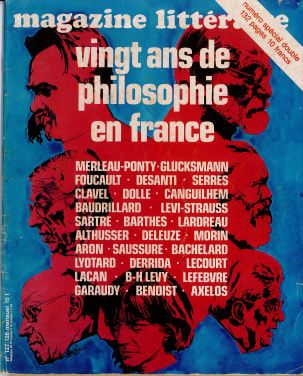
A diagrammatic snapshot of French philosophy from Magazine Littéraire, September 1977

Where did a popular news magazine think French philosophy was in 1977?

Christopher Watkin's avatarChristopher Watkin

Today I was given a copy of this edition of the Magazine Littéraire from September 1977 (thank you Philip).

Magazine littéraire - vingt ans de philosophie en France

Its centrefold is a diagram seeking to represent flows of influence between contemporary philosophers. The table provides a fascinating snapshot…

  • Marx is top and centre, flanked by Freud and Nietzsche.
  • Influences are split between the two poles of ancient Greece and German idealism.
  • No Beauvoir (no women at all!), no Camus. Merleau-Ponty and Sartre are supposed to have influenced each other (there is no way of representing mutual antipathy here, though a diagram of philosophical rivalries would be a fascinating project for someone…).
  • The generation of the 1960s-1980s includes Axelos, Althusser, Desanti, Serres, Foucault, Deleuze, Lyotard, Derrida and Barthes.
  • The latest generation to be represented reads like the betting card of a punter who backs a winner one time out of every two: Balibar, Lecourt, Glucksmann, Dollé, Benoist, Jambet-and-Lardreau, Lévy. The nouveaux…

View original post 78 more words

Posted in Uncategorized | Leave a comment