Johannes Angermuller, Why There Is No Poststructuralism in France – now out with Bloomsbury (and free download of introduction)

Johannes Angermuller, Why There Is No Poststructuralism in France – now out with Bloomsbury (and free download of introduction).
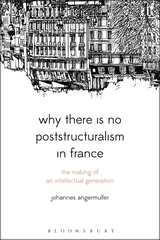
9781474226301

French thinkers such as Lacan and Derrida are often labelled as representatives of ‘poststructuralism’ in the Anglophone world. However in France, where their work originated, they use no such category; this group of theorists – ‘the poststructuralists’ – were never perceived as a coherent intellectual group or movement.

Outlining the institutional contexts, affinities, and rivalries of, among others, Althusser, Barthes, Foucault, Irigaray, and Kristeva, Angermuller – drawing from Bourdieu’s concepts of cultural capital and the cademic field – insightfully explores post-structuralism as a phenomenon. By tracing the evolution of the French intellectual field after the war, Why There is No Poststructuralism in France places French Theory both in the specific material conditions of its production and the social and historical contexts of its reception, accounting for a particularly creative moment in French intellectual life which continues to inform the theoretical imaginary of our time.

Posted in Louis Althusser, Michel Foucault, Pierre Bourdieu | Tagged | 1 Comment

Foucault and the Politics of Rights (2015)

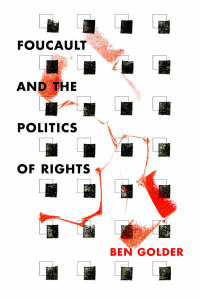
Ben Golder’s book on Foucault and the Politics of Rights is now out.

Clare O'Farrell's avatarFoucault News

golder2Ben Golder, Foucault and the Politics of Rights, Stanford University Press, 2015, Now available.
Publisher’s page

This book focuses on Michel Foucault’s late work on rights in order to address broader questions about the politics of rights in the contemporary era. As several commentators have observed, something quite remarkable happens in this late work. In his early career, Foucault had been a great critic of the liberal discourse of rights. Suddenly, from about 1976 onward, he makes increasing appeals to rights in his philosophical writings, political statements, interviews, and journalism. He not only defends their importance; he argues for rights new and as-yet-unrecognized. Does Foucault simply revise his former positions and endorse a liberal politics of rights? Ben Golder proposes an answer to this puzzle, which is that Foucault approaches rights in a spirit of creative and critical appropriation. He uses rights strategically for a range of political…

View original post 76 more words

Posted in Uncategorized | 1 Comment

How We Write

Michael Collins discusses his role in the creation of the How We Write collection.

Michael Collins's avatarThe page “Newfoundland Literature” does not exist

Putting a piece of writing out into the world is a bit like tossing a pebble down a mountainside. Usually it clatters down alone, bouncing a bit off this outcrop or that. It eventually loses momentum, settles in with other older pebbles, mostly forgotten. But sometimes, the pebble will bounce in such a way that it triggers other pebbles, and a little landslide ensues. Larger chunks of rock start to break loose and fall, and there the metaphor breaks down.

My blog post from a few months ago, Wilderness Group Tour, ended up being just such a pebble. It is far and away the most visited entry I’ve posted on this blog. It was shared quite a bit on Facebook, and several long, involved, thoughtful, rewarding discussions grew around it. One of these discussions grew into a twinned pair of blog posts by Professors Suzanne Conklin Akbari and Alexandra…

View original post 434 more words

Posted in Uncategorized | Leave a comment

Infrastructuring Aid: A Photo Essay by Kevin Donovan

A new photo essay at the Society and Space open site, on humanitarian aid in Kenya by Kevin Donovan.

Posted in Uncategorized | 1 Comment

New Perspectives online – first issue available with three open access pieces

The first issue of New Perspectives – the successor to the journal Perspectives, with a focus on central and Eastern Europe  – is now available online. Three pieces are open access: Johan van der Walt’s ‘The Literary Exception: Reflections on Agamben’s “Liberal Democratic” Political Theology and the Religious Destabilisation of the Political in our Time’, Ulrich Kühn on a need for a new strategy for NATO, and Benjamin Tallis’s editorial. More details here.

Posted in Uncategorized | Leave a comment

‘The Territories and Majesty of King John’ – talk to University of Warwick’s ‘Sidelights on Shakespeare’ seminar series, 3 November 2015

I’ll be giving a talk to University of Warwick’s ‘Sidelights on Shakespeare‘ seminar series, 3 November 2015, 4pm [Update: and also at UCL on 23 November 2015, 6pm, Common Ground (room in South Wing of Wilkins building), Institute of Advanced Study, University College London]. Here’s the abstract:

The Territories and Majesty of King John

This lecture will discuss Shakespeare’s play King John around two themes – the question of majesty and that of territories. Majesty is a continual concern throughout the play, described as ‘borrowed’, ‘banished’, ‘resembling’, ‘dangerous’ or ‘the bare-picked bone’. John is seen as a usurping monarch, denying Arthur his rightful inheritance, but by the end of the play majesty has been so diminished by events it is perhaps worth very little. But what is that majesty over? Among other things, it is the lands of the kingdom. King John is one of only a handful of Shakespeare’s plays in which the word ‘territories’ appears. There is one mention in the opening scene, and one in the final act. The first of these had caused editors much confusion, because it is used with a definite article – ‘the territories’ – rather than a possessive ‘his’, ‘her’, ‘its’ or ‘their’ territories. What might this mean, and what might it indicate? Thinking about these questions of majesty, land, and territories, the talk will discuss how King John and contemporary play The Troublesome Reign of King John anticipate the dual themes of domestic disorder and foreign conquest found in Shakespeare’s other history plays.

Posted in Shakespearean Territories, William Shakespeare | 1 Comment

After Neil Smith Tribute

Videos and report from the recent Neil Smith event held in Barcelona.

asevillab's avatarmultipliciudades

The webpage of the Espais Crítics collective has now links to the set of presentations of the conference in tribute to the late Neil Smith. It was a remarkable and yet kind of sad occasion, given Neil’s absence in what would have otherwise been a festive celebration of his contribution to critical geography and urban studies — as I mentioned in a previous post the conference was organized to coincide with the publication of the book on Smith by Luz Marina García Herrera and Fernando Sabaté Bel, who were working on the manuscript before he passed away. In any case, the event was rich and deep enough to resuscitate his spirit in Barcelona and the final visits and activities with social movements in Raval (see some photographs here) were perfectly attuned to Neil’s wise balance between powerful theoretical production and the solidarity and engagement with concrete struggles on the…

View original post 98 more words

Posted in Uncategorized | Leave a comment

AND THE URBAN EXPLODED: OPERATIONAL LANDSCAPES, AN EXHIBITION BY NEIL BRENNER AND THE URBAN THEORY LAB AT THE MELBOURNE SCHOOL OF DESIGN

Neil Brenner/Urban Theory Lab’s recent exhibition at the Melbourne School of Design reviewed at the Society and Space open site by Louise Dorignon – an English version of a piece which first appeared in French.

Posted in Uncategorized | 1 Comment

Top posts on Progressive Geographies this week

Posted in Uncategorized | Leave a comment

Dominique Janicaud, Heidegger in France – forthcoming in October from Indiana University Press

Dominique Janicaud’s important book Heidegger in France is forthcoming in English translation in October from Indiana University Press, translated by François Raffoul and David Pettigrew.

9780253017734_med

Dominique Janicaud claimed that every French intellectual movement—from existentialism to psychoanalysis—was influenced by Martin Heidegger. This translation of Janicaud’s landmark work, Heidegger en France, details Heidegger’s reception in philosophy and other humanistic and social science disciplines. Interviews with key French thinkers such as Françoise Dastur, Jacques Derrida, Élaine Escoubas, Jean Greisch, Philippe Lacoue-Labarthe, Jean-Luc Marion, and Jean-Luc Nancy are included and provide further reflection on Heidegger’s relationship to French philosophy. An intellectual undertaking of authoritative scope, this work furnishes a thorough history of the French reception of Heidegger’s thought.

From the ‘table of contents’ it looks like the first volume of Janicaud’s study is included, but the second volume of interviews seems to only be included in part – only 7 of 18 interviews are listed. That’s a shame, though I suppose understandable if the aim was to make one large volume out of the two. But there is an irony in the front cover picture showing Heidegger with Kostas Axelos, Jacques Lacan, Jean Beaufret, Sylvie Bataille and Elfriede Heidegger when the interview with Axelos isn’t included inside. (the photo and the people are briefly discussed here.) Axelos was Heidegger’s interpreter at important events, and translated some of his work into French, so he didn’t play a minor role in the story…

Posted in Kostas Axelos, Martin Heidegger | Tagged , , , | Leave a comment