This looks a useful resource.

Selections from the journal (published by Althusser’s students) are available here. (Thanks to Rethinking Marxism‘s Facebook feed for the link)
This looks a useful resource.
Selections from the journal (published by Althusser’s students) are available here. (Thanks to Rethinking Marxism‘s Facebook feed for the link)
The busiest week on the blog for a while, mainly due to the first two of these posts:
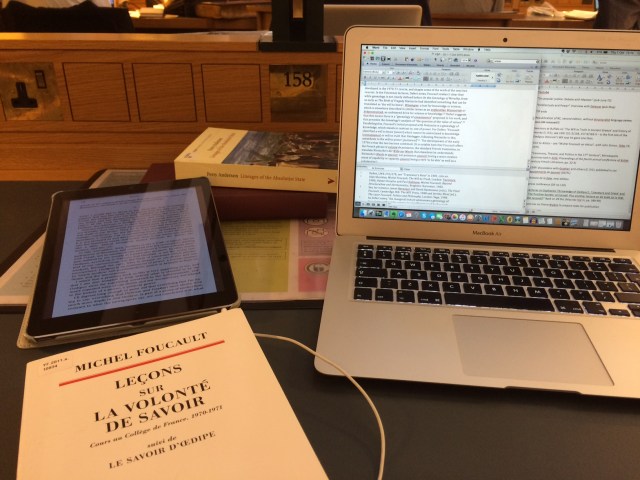
Since the last update, I’ve been working on various aspects of this project.
The first was a return to some of Foucault’s collaborative projects around CERFI. Quite late in the drafting of Foucault’s Last Decade I removed most of the discussion of Les équipments du pouvoir, and that is now incorporated into this manuscript. I also reread the Généalogie des équipements de normalisation: Les équipements sanitaires report Foucault edited, and wrote something about that, along with a discussion of the two editions of the Les machines à guérir (aux origines de l’hôpital moderne) volume that developed from it. While these are discussed more fully in Foucault’s Last Decade, I think I’ve found a way to incorporate a discussion in this book that doesn’t simply repeat what I say there. At some point I plan to go back through Politiques de l’habitat (1800-1850) and do something similar. I’ll be talking about this work at the LSE in November, and if you don’t know what these texts are there is a bibliography of all the collaborative projects Foucault led or participated in here. I also added a discussion of the work around the Pierre Rivière case into this part. Then, following more directly the work on activism I talked about last time, I did a bit more work on the Groupe Information Santé, mainly in the British Library following up some of the more obscure sources of information about their work, including newspaper reports, but I also bought a copy of their 1974 report La médecine désordonnée (there don’t appear to be any UK libraries that have it). As well as some valuable statements on the group’s goals it includes a lot of documentary sources. I say a bit more about it here.
I also did some reading of accounts looking at the historical period Foucault was working within, beginning with Keith Reader’s The May 1968 Events in France and his Intellectuals and the Left in France since 1968; and then Julian Bourg’s From Revolution to Ethics: May 1968 and Contemporary French Thought, and Kristin Ross’s May ’68 and its Afterlives. They are quite different: Bourg makes a lot of use of interviews, and so is invaluable for information otherwise unavailable; Ross makes a point of relying only on written sources, but does reference some things in relation to my concerns that I hadn’t come across elsewhere. I also plan to work through Philippe Artières and Michelle Zancarini-Fournel’s collection 1968, une histoire collective (1962-1981), and perhaps some other works on this, though I’m not especially interested in ‘68 itself, more the politics of the period immediately after it.
The next stage was to return to Chapter One, and work on Lectures on the Will to Know again. I’d given a lecture on this at a conference at the University of East London back in 2011, and then again as the George M. Story Lecture in Humanities at Memorial University of Newfoundland in 2013, so some bits were reasonably well-written, or so I thought. Others I knew needed extensive new writing. In particular I completely reworked the section on Nietzsche, and made a little use of Foucault’s notes on this topic at the BNF. Most of the material on Nietzsche is actually missing from the Lectures on the Will to Know manuscript, so the McGill lecture included in that volume is invaluable. The ‘Nietzsche, Genealogy, History’ essay dates from around this time too, though it is striking that there is relatively little overlap of content or, perhaps more accurately, there is a very different approach to some shared concerns. The likely most interesting material by Foucault on Nietzsche remains unpublished – the lecture course on him given at Vincennes – but I understand this is eventually going to see the light of day, though have no further details (and before anyone asks, it’s not currently listed in the BNF catalogue).
I then bit the bullet and worked on the section of Oedipus. I’ve been putting this off because I was struggling to work out what to do with it. It was clearly very important to Foucault, given the number of times he delivered this material. But Oedipus was not discussed in the previous talks I’d given on the course, in part because I found it of little interest, so I had nothing much to work with, aside from some detailed notes on the second of the ‘Truth and Juridical Forms’ lectures. What I’ve done now, as with Nietzsche, is to blend the different sources together in a thematic treatment, instead of treating things more strictly chronologically. I organised Foucault’s Last Decade in a largely chronological way, but this is a different book and I don’t think that is necessarily the best way to approach things here. That said I don’t want to minimize the differences between how Foucault treats things in Paris in 1970-71 and Rio in 1973 though, with the ‘Oedipal Knowledge’ manuscript a mid-way statement, so I’ve tried not to blur these too much. I’m reasonably happy with how this section runs.
After working through those two large sections, I ended up rewriting the section on the Greeks, especially on juridical and political practice. This was in some ways less tricky than the other sections, because there is just one source – the course itself. Yet that also presents challenges because the course is quite fragmented, and the presentation in Rio helped with the other sections because we hear what Foucault said, rather than just see what he wrote. But I’m much happier with the discussion now. Chapter One now exists as a much better draft, which bears only limited comparison to my previous lectures on this course. (I listened back to the Newfoundland lecture, and borrowed a few phrases that were in the oral delivery that were not in the manuscript.) But I’m certainly hoping that this major restructuring and rewriting isn’t needed for the other chapters.
The next work will be on Chapter Two, which mainly looks at the Théories et institutions pénales course. The audio recording of my talk on this course at the ‘Time Served: Discipline and Punish forty years on’ conference, which looked at the second-half and the notion of ‘inquiry’ is available here. I’ll be speaking about the Nu-pieds part of this course in London in November at the Historical Materialism conference, which gives me a good deadline to work towards. So I’ve begun looking again at some of the texts Foucault is in dialogue with, including Boris Porshnev and Roland Mousnier. Chathan Vemuri reminded me there is some use made of Porshnev and Mousnier in Perry Anderson’s Lineages of the Absolutist State, which was useful. Etienne Balibar says a little about the way Porshnev was read by the French left in the early 1970s in his comments for the Columbia seminars on the courses here. I’m hoping that the work required for this chapter will not be much more than the work involved to produce the two talks, since I’m now working with a much clearer sense of this overall project, and a better understanding of how the initial courses fit together.
Incidentally, the English translation of The Punitive Society is now published. I have a copy on pre-order from Palgrave in recompense for some review work, so will be able to compare my initial translations with Graham Burchell’s official ones – that’s for Chapter Three in time.
You can read more about this book and Foucault’s Last Decade, along with links to previous updates, here. And, as a reminder, a lot of Foucault resources are available here. It includes a list of audio files, a bibliography of collaborative projects, a list of short pieces which did not appear in Dits et écrits, comparison of variant forms of texts, a few short translations (including the recent one of a 1979 interview on refugees), and so on.
Antipode announce their latest round of grants.
We’re pleased to announce the fourth year of the Antipode Foundation’s Scholar-Activist Project and International Workshop Awards.
Scholar-Activist Project Awards are single-year grants of up to £10,000 intended to support collaborations between academics and students and non-academic activists (from non-governmental organisations, think tanks, social movements, or community/grassroots organisations, among other places), including programmes of action-orientated and participatory research and publicly-focused forms of geographical investigation. They offer opportunities for scholars to relate to civil society and make mutually beneficial connections.
International Workshop Awards are single-year grants of up to £10,000 available to groups of radical/critical geographers staging events (including conferences, workshops, seminar series and summer schools) that involve the exchange of ideas across disciplinary and sectoral boundaries and intra/international borders, and lead to the building of productive, durable relationships. They make capacity-building possible by enabling the development of a community of researchers.
Activists (of all kinds) and students as well as…
View original post 73 more words
An interesting piece giving the background to Charles Withers’s recent appointment as Geographer Royal for Scotland.
A new initiative for academics submitting to journals, directed at saving people and papers from “predatory” publishers.
I’ve just received my contributor copy of How We Write – the open access collection edited by Suzanne Conklin Akbari, which includes thirteen short pieces on academic writing. It looks great in its physical form.
The book is available to buy in paperback, or free to download as a pdf, but please consider leaving a donation if you download it.
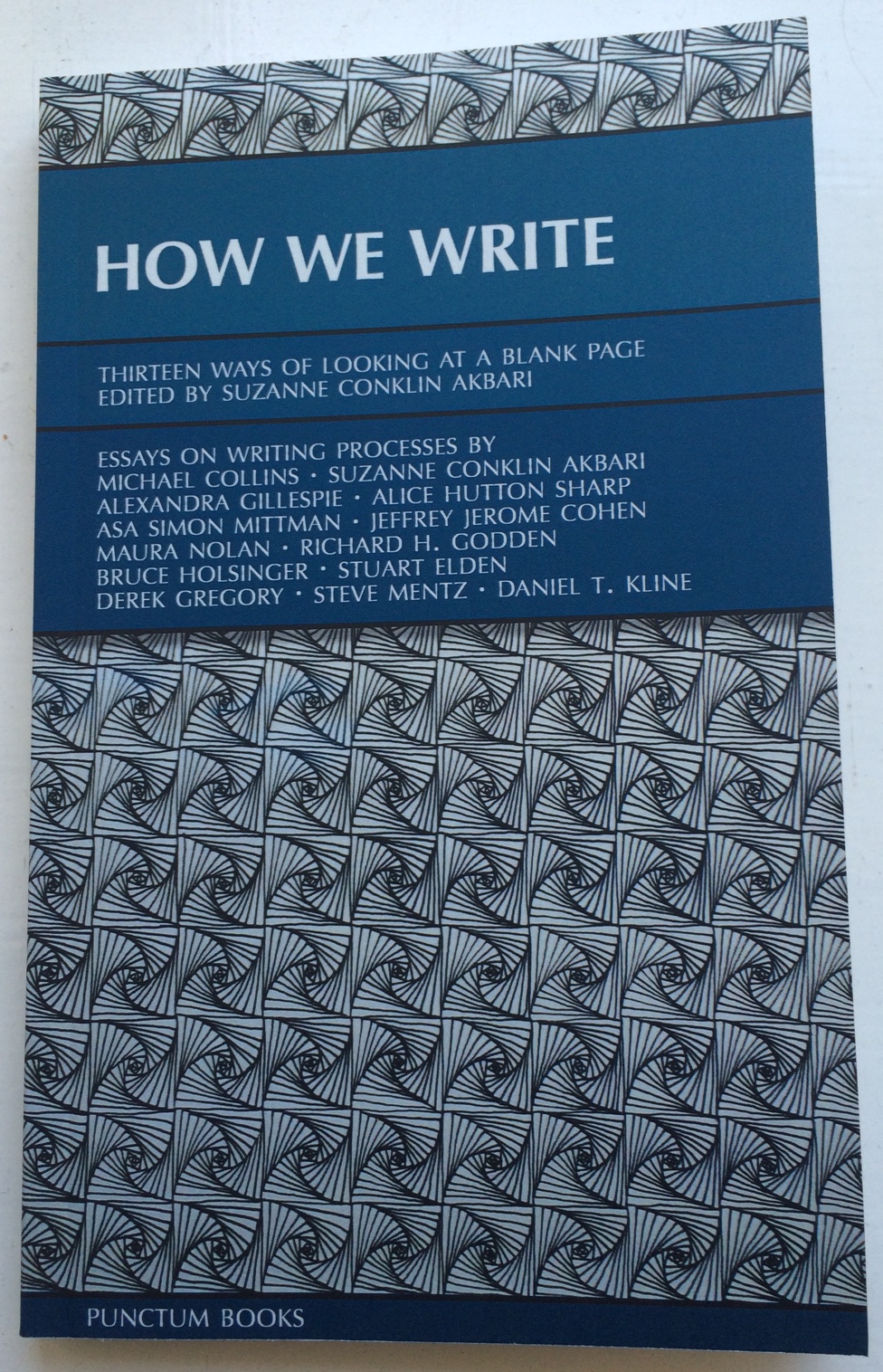
This little book arose spontaneously, in the late spring of 2015, when a series of conversations emerged — first in a university roundtable on graduate student dissertation-writing, and then in a rapidly proliferating series of blog posts — on the topic of how we write. One commentary generated another, each one characterized by enormous speed, eloquence, and emotional forthrightness. This collection is not about how TO write, but how WE write: unlike a prescriptive manual that promises to unlock the secret to efficient productivity, the contributors talk about their own writing processes, in all their messy, frustrated, exuberant, and awkward dis/order.
The contributors range from graduate students and recent PhDs to senior scholars working in the fields of medieval studies, art history, English literature, poetics, early modern studies, musicology, and geography. All are engaged in academic writing, but some of the contributors also publish in other genres, includes poetry and fiction. Several contributors maintain a very active online presence, including blogs and websites; all are committed to strengthening the bonds of community, both in person and online, which helps to explain the effervescent sense of collegiality that pervades the volume, creating linkages across essays and extending outward into the wide world of writers and readers.
Contributors include: Michael Collins, Suzanne Conklin Akbari, Alexandra Gillespie, Alice Hutton Sharp, Asa Simon Mittman, Jeffrey Jerome Cohen, Maura Nolan, Richard H. Godden, Bruce Holsinger, Stuart Elden, Derek Gregory, Steve Mentz, and Dan Kline.
12 Critical Theory books that came out in September – another helpful roundup from critical-theory.com… Massumi, Bargu, Nail, Benjamin, etc.

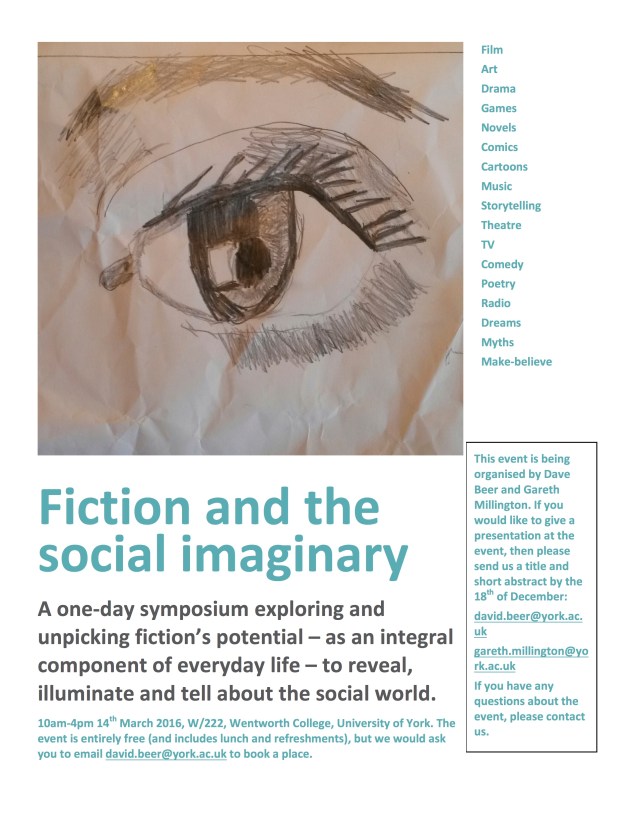
Posted on behalf of David Beer – call for papers for a conference on ‘Fiction and the Social Imaginary’, 14 March 2016, University of York