Early Modern Literary Geographies – call for book proposals for Oxford University Press series, and the first volume

EARLY MODERN LITERARY GEOGRAPHIES

Oxford University Press

Series Editors: JULIE SANDERS, Newcastle University and

GARRETT A. SULLIVAN, JR., Pennsylvania State University

Early Modern Literary Geographies features innovative research monographs and agenda-setting essay collections that engage with the topics of space, place, landscape and environment. While focused on sixteenth- and seventeenth-century English literature, scholarship in this series encompasses a range of disciplines, including geography, history, performance studies, art history, musicology, archaeology and cognitive science. Subjects of inquiry include cartography or chorography; historical phenomenology and sensory geographies; body and environment; mobility studies; histories of travel or perambulation; regional and provincial literatures; urban studies; performance environments; sites of memory and cognition; ecocriticism; and oceanic or new blue studies.

ADVISORY BOARD

Dan Beaver, Pennsylvania State University

Lesley Cormack, University of Alberta

Stuart Elden, University of Warwick

Steve Hindle, Huntington Library

Bernhard Klein, University of Kent

Andrew McRae, University of Exeter

Steven Mullaney, University of Michigan

Evelyn Tribble, University of Otago

Alexandra Walsham, University of Cambridge

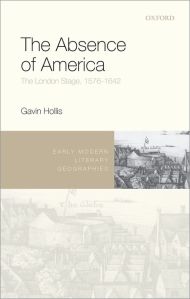
The first volume in the series is Gavin Hollis, The Absence of America: The London Stage, 1576-1642, due out in September 2015.
9780198734321_450

The Absence of America: the London Stage 1576-1642 examines why early modern drama’s response to English settlement in the New World was muted, even though the so-called golden age of Shakespeare coincided with the so-called golden age of exploration: no play is set in the Americas; few plays treat colonization as central to the plot; a handful features Native American characters (most of whom are Europeans in disguise). However, advocates of colonialism in the seventeenth century denounced playing companies as enemies on a par with the Pope and the Devil. Instead of writing off these accusers as paranoid cranks, this book takes as its starting point the possibility that they were astute playgoers. By so doing we can begin to see the emergence of a “picture of America,” and of the Virginia colony in particular, across a number of plays performed for London audiences: Jonson’s Bartholomew Fair, The Staple of News, and his collaboration with Marston and Chapman, Eastward Ho!; Robert Greene’sOrlando Furioso; Massinger’s The City Madam; Massinger and Fletcher’s The Sea Voyage; Middleton and Dekker’s The Roaring Girl; Shakespeare’s The Tempest, and Fletcher and Shakespeare’s Henry VIII. We can glean the significance of this picture, not only for the troubled Virginia Company, but also for London theater audiences. And we can see that the picture that was beginning to form was, as the anti-theatricalists surmised, often slanderous, condemnatory, and, as it were, anti-American.


Posted in Books | 1 Comment

Michel Foucault, The Punitive Society (2015)

Full details of the imminent publication of The Punitive Society.

Clare O'Farrell's avatarFoucault News

punitive1Michel Foucault, The Punitive Society: Lectures at the Collège de France, 1972-1973, Edited by Arnold I. Davidson, Palgrave Macmillan, September 2015

Publisher’s page

‘Unfortunately, when we teach morality, when we study the history of morals, we always analyze the Groundwork of the Metaphysics of Morals and do not read [Colquhoun], this character who is fundamental for our morality. The inventor of the English police, this Glasgow merchant … settles in London where, in 1792, shipping companies ask him to solve the problem of the superintendence of the docks and the protection of bourgeois wealth. [This is a] basic problem …; to understand a society’s system of morality we have to ask the question: Where is the wealth? The history of morality should be organized entirely by this question of the location and movement of wealth.’
Michel Foucault

These thirteen lectures on the ‘punitive society,’ delivered at the Collège…

View original post 327 more words

Posted in Uncategorized | Leave a comment

New Associate Editors at Political Geography

Phil Steinberg shares the news of the new editorial team for Political Geography.

philsteinberg's avatar

Halvard Buhaug Halvard Buhaug

Fiona McConnell Fiona McConnell

The new Political Geography editorial team for 2016 (and beyond?) is now in place. James Sidaway, Jo Sharp, and I will be joined by two new associate editors: Halvard Buhaug, from the Peace Research Institute Oslo (PRIO), and Fiona McConnell, from Oxford University.  Halvard and Fiona both currently serve on the journal’s editorial board and have a long history assisting in directing the journal. They both come to the journal with a wealth of experience, in journal editing and management, as well as being leading scholars in the field. In addition to Halvard and Fiona, James Sidaway will be continuing on as associate editor and Jo Sharp will have her remit expanded from reviews editor to  associate editor with responsibility for the entire ‘Setting the Agenda’ section (guest editorial, review essays, review forums, etc.).

It’s with a sense of humility (yes, really…

View original post 77 more words

Posted in Uncategorized | 1 Comment

Wall Exchange: Forensic Architecture

Eyal Weizman to give this next Wall Exchange lecture on Forensic Architecture.

Derek Gregory's avatargeographical imaginations

diehlgroup

“When war happens in the city, people die in buildings, the majority in their homes; when the dust settles ruins become evidence with which we could reconstruct controversial events.”
Eyal Weizman

I’m delighted to announce that my good friend Eyal Weizman will deliver the next Wall Exchange on Forensic Architecture at the Vogue Theatre in downtown Vancouver on 15 October 2015:

Can architecture provide new tool of political analysis and intervention? This question is central to the work of Eyal Weizman, Israeli architect and scholar. Since 2010 he has been directing Forensic Architecture, an innovative forensic agency that investigates the sites of contemporary conflicts and monitors the crimes of states. His teams examine buildings, ruins, maps, satellite imagery and increasingly an emergent type of testimony — images and clips taken by citizens and uploaded online. His talk will unpack new modes of exposing the logic behind state violence from the…

View original post 136 more words

Posted in Uncategorized | Leave a comment

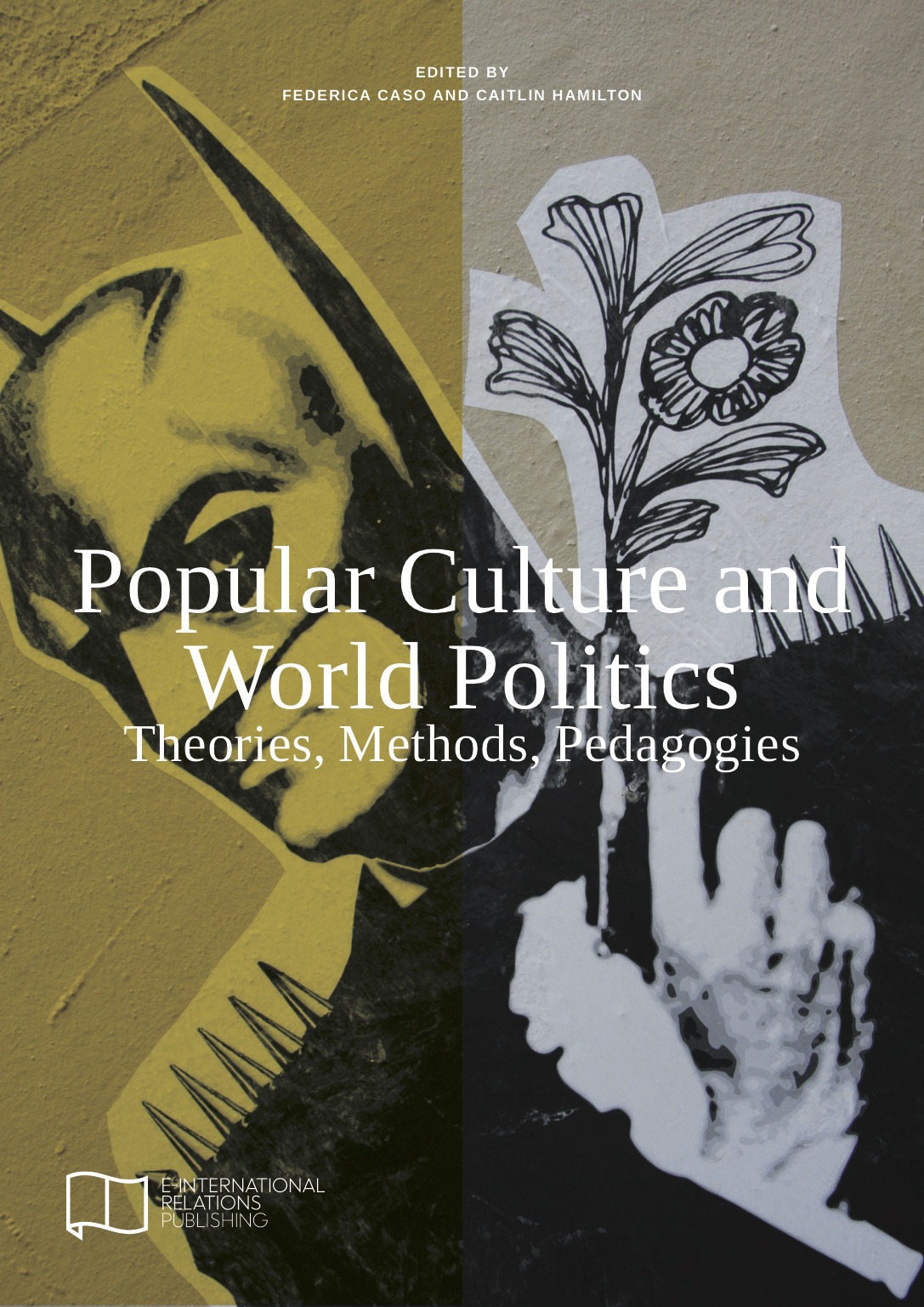
‘Popular Culture and World Politics’, an open access edited collection from E-IR

‘Popular Culture and World Politics‘, an open access edited collection from E-IR.

9781910814024

This edited collection brings together cutting edge insights from a range of key thinkers working in the area of popular culture and world politics (PCWP). Offering a holistic approach to this exciting field of research, it contributes to the establishment of PCWP as a sub-discipline of International Relations. Canvassing issues such as geopolitics, political identities, the War on Terror and political communication – and drawing from sources such as film, videogames, art and music – this collection is an invaluable reader for anyone interested in popular culture and world politics.

Edited by: Federica Caso and Caitlin Hamilton

Contributors: Jutta Weldes, Christina Rowley, Constance Duncombe, Roland Bleiker, Jason Dittmer, Klaus Dodds, Linda Åhäll, Nicholas J. Kiersey, Iver B. Neumann, Michael J. Shapiro, Nick Robinson, Daniel Bos, Saara Särmä, Matt Davies, M.I. Franklin, Robert A. Saunders, Kyle Grayson, and William Clapton.

Posted in Uncategorized | 2 Comments

Figure/Ground interview with Günter Figal on his work and his recent resignation as president of the Heidegger society in the wake of the ‘Black Notebooks’

Figure/Ground interview with Günter Figal – discusses his work and his recent resignation as president of the Heidegger society in the wake of the ‘Black Notebooks’.

Posted in Martin Heidegger, Politics | 2 Comments

“Through A Window” application of Rhythmanalysis at SFU

Lefebvre’s work on rhythmanalysis as the basis for an exhibition at Simon Fraser University.

Society for Radical Geography, Spatial Theory, and Everyday Life's avatarSociety for Radical Geography, Spatial Theory, and Everyday Life

An exhibit at Simon Fraser University is exploring the application of Lefebvre’s rhythmanalysis in art! “Curated by Melanie O’Brian and Amy Kazymerchyk, Through A Window traces the history of art at SFU of the past 50 years. The inspiration behind the project stems from Henri Lefebvre’s book Rhythmanalysis (1992), particularly the chapter “Seen from the Window,” which allows us to consider three social, spatial, and material windows of SFU, and explore different rhythms since SFU’s inception in 1965.

Lefebvre’s method of rhythmanalysis begins with observing the rhythms of the body and how they are impacted by the natural and synthetic rhythms of the economies and cultures we live within, which in turn produces social practices and public spaces.

‘It is such a big idea, and SFU is a portal,’ explained Melanie O’Brian, the director of SFU Galleries. “Here we can look at those big and small rhythms in a…

View original post 2 more words

Posted in Uncategorized | Leave a comment

New Society and Space editors – Alex Vasudevan and Darshan Vigneswaran

Society and Space announces its two new editors – Alex Vasudevan and Darshan Vigneswaran. They are both in for interesting, exciting, and demanding work, joining a terrific existing team.

Posted in Uncategorized | Leave a comment

Jeffrey Jerome Cohen’s next projects – “Earth” and “Veer Ecology”

Jeffrey Jerome Cohen’s next projects – “Earth” and “Veer Ecology” – details at In the Middle.

CMi474dWoAEhgTU

When we return from Oregon I have a semester of leave to enjoy, so I will not be in the classroom for a while (though I am doing the usual, crazy amount of travel). GW has a program called the Dean’s Research Chairs which, should your application be selected, provides a reduced teaching load for three years so that you can either begin or complete a project. I want to share with you what I proposed, since both recently went under contract and are my preoccupation for the foreseeable future. I swore that Stone was my last solitary project, so not surprisingly both books I will be working on in the next two years are collaborative…

Posted in Jeffrey Jerome Cohen | 1 Comment

The Funambulist Magazine Launch at e-flux – audio recordings of the presentations and a few photographs

Photo-by-Mohammad-SalemyThe Funambulist Magazine Launch at e-flux – audio recordings of the presentations and a few photographs.

We happily launched The Funambulist Magazine on August 13 at e-flux (New York) in the presence of several dozens of friends and intrigued readers. Following are a few photographs, as well as the presentations given that night. You can listen to the full presentation which includes my introduction to the magazine, as well as the three first issue, or specifically listen to each of the three presentations (marked on the file above) given by Sadia Shirazi about the militarization of Lahore (Funambulist Magazine 01/Sept15: Militarized Cities), Olivia Ahn about the american suburbia as a spatial apparatus producing gender (Funambulist Magazine 02/Nov15: Suburban Geographies), and Minh-Ha T. Phamabout a particular high heel shoe that supposes the existence of a standardized “Asian foot” (Funambulist Magazine 03/Jan16: Sartorial Politics).

Posted in Uncategorized | Leave a comment