The manuscript of Foucault’s Last Decade, as I’ve said, was almost complete. It is now with the press for review. In the last couple of weeks, while in New York, I’ve chased down a few final references; read the very valuable Régards critiques volumes on the History of Sexuality volumes (volume I and volume II and III); re-read Philippe Chevallier’s Michel Foucault et le christianisme (also see Colin Gordon on the book here); followed up lots of things; and tidied up the text.
I also had three days in the Bancroft Library at University of California, Berkeley. I’ve already shared some detailed day-to-day reports (here, here and here) and won’t repeat things here except to note again Alain Beaulieu’s useful guide to “The Foucault Archives at Berkeley”, in Foucault Studies in 2010. I found it invaluable to doing this work and would recommend it to anyone heading there, though if you want to listen to audio recordings on cd, I’d suggest asking the staff for a copy of the tape-to-cd concordance. Much of what they have is also available at IMEC in Caen, which may be more convenient for some people.

Poster for the event – an original is in the Semiotext(e) archive at Fales library, NYU – Series II A, Box 9, Folder 24
I didn’t previously mention the ‘Discourse and Repression’ lecture from May 8 1975, which threw up an interesting textual issue. This text, given as Foucault’s first ever Berkeley lecture on the invitation of Leo Bersani and the French department, previews some of the key arguments in the History of Sexuality volume I. It is an early version of the text that is published as “Infantile Sexuality” in Foucault: Live – a lecture given on 14 November 1975 at the Schizo-Culture conference. In looking at the Berkeley manuscript I discovered something quite intriguing. In Foucault: Live the text is not marked with any translator, and it appears to be the complete lecture. In the more recent Schizo-Culture: The Event 1975 volume which collects all the papers from the conference, the co-editor David Morris says the translator was Mark Seem, who read the translation with Foucault in attendance. In the new volume it is entitled ‘We are not repressed’ which was the title at the time: the conference programme gives the title ‘Nous ne sommes pas réprimés”. There is again no note that this is in any sense incomplete. But the Berkeley archive version is clearly a translation of a lecture given in French because it includes a note saying “transcription and summary by Jacques Favaux; translation by John Leavitt”. It also has some translator comments in the text, including two that say he ran out of time (for what it doesn’t say) and so part of the lecture only contains excerpts; and the final pages are the summary by Favaux. So it appears that the lecture was delivered in French, transcribed by Favaux, presumably from a recording, and then translated from that transcription by Leavitt. Leavitt only translated parts of the text towards the end; and asked Favaux to summarise the final part for translation. The Berkeley archive has neither the recording of the lecture nor the French transcription. But the text is nearly identical to the one published by Semiotext(e). So who was the translator, and why were the summarised parts not marked?
Sylvère Lotringer’s Semiotext(e) papers are archived at the Fales library at New York University, so on my return I took a look at the files to see if they shed any light. This was interesting, because the first translator note – saying that he is moving to excerpts – does not appear in the typescript; and the second note – saying that the text from this point is a summary – is typed up but then crossed out. This makes the text appear more complete than it is, and all in Foucault’s voice. The penultimate and antepenultimate pages are typed on different paper with a different font, and the page numbering is corrected by hand. It appears that they have been inserted in place of one page of the summary – one word is crossed out on the preceding page to make the join work. I now wish I had the Berkeley and NYU texts side by side to compare word for word, but that’s obviously not possible. Thus if Mark Seem read the text at the Schizo-Culture event it was John Leavitt who was the principal translator (though it’s possible Seem translated the two additional pages) and for that event the cuts before this point and the summary of the final pages were accepted and amended by Foucault. But people who were at the Schizo-Culture event have told me that it was not Seem who read the text; nor was it Leavitt. Foucault did not want the text published at all.
While the lecture was the key thing I was interested in, I thought I should look at other folders the Semiotext(e) archive has related to Foucault. There are others from the Schizo-Culture event, though one only contains two pages of Judy Clark’s contribution to the “Schizo-Culture: On Prison and Psychiatry” roundtable that is also in Foucault: Live. Another contains Foucault’s two contributions to that roundtable. But what I wasn’t expecting is that the text is there is both in English and French [translated by Suzanne Guerlac], both in typescript, as well as the galley proofs. Did Foucault speak in French with an interpreter? Or did he prepare his contributions in advance and they were translated ahead of time to be read? Either are possible, though the first seems more likely. The text does not appear in Dits et écrits. The first contribution appears as “Réponse à Ronald Laing”, in Philippe Artières, Jean-François Bert, Frédéric Gros and Judith Revel (eds.), Cahier de L’Herne 95: Michel Foucault, Paris: Éditions de L’Herne, 2011, pp. 103-4. But this version is a translation back into French, by Myriam Dennehy. The French text of Foucault’s second contribution has never been published. [The text of the last few sentences has been updated, 13 May 2015.]
There are also two files relating to the Fearless Speech book of 1983 lectures on parrēsia. The first contains the original 1985 version edited by Joseph Pearson, entitled Discourse and Truth: The Problematization of ΠΑΡΡΗΣΙΑ: Notes to the Seminar given by Foucault at the University of California at Berkeley, which was privately printed and circulated (I have a photocopy of this, with a slightly different cover, in my files). The version here has spiral binding and an orange cover. The second contains the Semiotext(e) book in proof form. The only surprise was that the initial title was not Fearless Speech, but Risking the Truth, 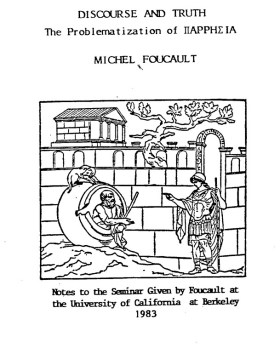 and two subtitles were proposed: ‘The Problematics of Classical Truth’ and ‘The Problematics of Parrhesia’. All four are crossed out on the first page of the proofs. Foucault was of course dead when Pearson’s first version appeared, and the Semiotext(e) version was unauthorized, so these tell us nothing about Foucault’s choices. The other minor changes in the proofs are equally of no significance to my work. There is no published French version of the lectures, but perhaps one is in the works: a critical edition along the lines of the two recent Vrin volumes would be welcome. Most of the lectures are recorded and available in the Berkeley archive and online.
The final file I looked at contains a typewritten manuscript entitled ‘Michel Foucault: the Archeology and Other Questions’, which is undated and no author name is given – it’s about Foucault, rather than by him. From the references it appears to date from 1984 or later. It’s not especially interesting. But the files relating to the Schizo-Culture conference were definitely worth looking at. There is a huge amount of stuff archived in this collection – 103 feet of shelving, in 96 boxes. By way of comparison, the Foucault papers (not tapes/cds) at Berkeley would fit in a box three to four times. I have a very specific focus, but people interested in the history of the reception of European ideas in the USA, or US thought in the late twentieth-century generally, would find this a treasure trove. There are more files relating to the Schizo-Culture conference, and some relating to the Foucault: Live book which I will try to look at in time.
These archive visits were the last thing to do. I printed the whole manuscript, tidied up a few last things, and sent it to Polity for review. Obviously all will depend on what the readers make of it, but all being well, we’re aiming for a spring 2016 publication for this book. I also signed the contract of The Birth of Power. Given the submission date we’ve agreed, I’m expecting that book to appear in 2017. I’m looking forward to the work on that book, though aside from another visit to Fales, I’m going to try to step away from Foucault for a few weeks to do some other things.
You can read more about these books, along with links to previous updates, here.