How would Foucault vote? Not like a ‘hot rabbit’…

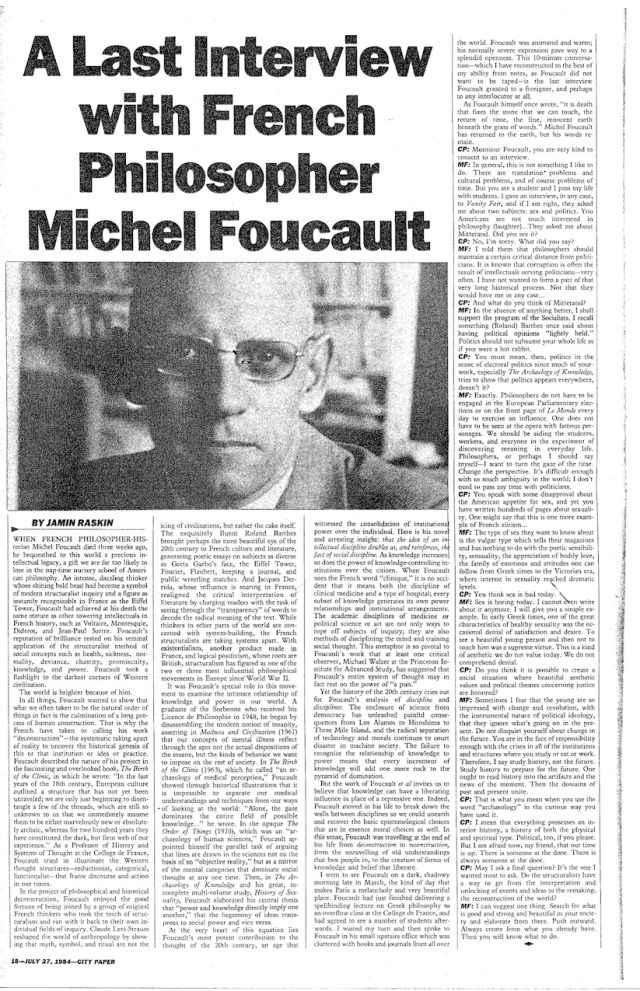
From the interview I shared a couple of days ago:Foucault - 1984 A last interview with French philosopher Michel Foucault

In the absence of anything better, I shall support the program of the Socialists. I recall something (Roland) Barthes once said about having political opinions ‘lightly held’. Politics should not subsume your whole life as if you were a hot rabbit.

Jamin Raskin, “A last interview with French philosopher Michel Foucault”, City Paper, Vol 8 No 3, Jul 27-Aug 2 1984, p. 18.

A ‘hot rabbit’ is a rather literal translation of what was presumably ‘un chaud lapin’, a sexual expression for which ‘rabbit in heat’ might be more appropriate.

Posted in Uncategorized | 1 Comment

Day three in the Foucault archive at UC Berkeley

Bancroft LibraryA final day in the Bancroft library at UC Berkeley (see my notes on day one and day two).

Today I listened to some recordings they had of lectures in São Paulo. The library catalogue provides no information at all, and Beaulieu’s list just notes the place, the lecture number and ‘Histoire de la sexualité’ for the first. Even before I heard them my guess was that they were the lectures Foucault gave in October-November 1975, which Daniel Defert says were on “psychiatrization and anti-psychiatry”. As far as I’m aware these were Foucault’s only lectures in São Paulo. According to David Macey some other lectures on the same trip in Rio were on “criminality, urbanisation and public health”. Of course, Foucault gave some terrific – and much better-known – lectures in Rio in 1973 on ‘Truth and Juridical Forms’ and on medicine in 1974 so this was intriguing stuff.

Beaulieu suggests four lectures, across six tapes (nos 82, 86-90) though the order is jumbled and there are parts missing from his list. The transfer to the CDs has added another layer of complexity because they have been constrained by the transfer of a side of a cassette to a CD running time, and have mixed things up still further. It seems each lecture is 1-2 hours long, though it’s hard to tell with the labelling. One lecture has a clear ten minute break. In addition some of the recordings are practically unlistenable. I couldn’t make out much in the first lecture at all – the background hiss was too loud and Foucault too quiet. It sounded like a bad bootleg with a tape machine or microphone smuggled in and hidden. The other lectures are, however, much better recorded but as with many of the recordings in the archive there are frequent bursts of white noise. The recording level is generally so low that this sounds really loud if you turn the volume up. Not great for my hearing or working in a library. Of course, you have to listen to them on crappy library discmans, rather than through a computer as then you could rip the files. Somebody really needs to take the files and clean them up with audio editing software – it sounds like they have been transferred without any attempt at normalizing volume, reducing hiss, getting rid of the white noise etc.

The lectures are close to material in the Abnormals course, on confession around the 16th-17th century, sexuality and modes of penitence, which would make sense for a 1975 date. There are connections to the distinction between the ars erotica and scientia sexualis which was short lived in Foucault’s work. If the date is correct, and various indications suggest it is, they date from several months after the Paris lectures, and Foucault was clearly developing his work on this topic, not just in anticipation of the published first volume of the History of Sexuality which appeared about a year later, but also the projected second one, La chair et le corps, which was drafted around this time, and again later in the 1970s, and is thought to be almost entirely destroyed.

Overall I felt that the fragments were too jumbled to feel confident about making claims about them, which was frustrating. Because of the ordering system I ended up listening to the fragments out of order, though what order they should be in is definitely open to question. Tapes run out and when sides are being switched content is lost. This makes it hard to tell if the second side/next cd track is really the continuation and how much is missing. I think someone really should take these lectures and transcribe them, and then see if they can be lined up in a sensible arrangement. There is enough material here to make for half a book. Perhaps they could be paired with the Montreal lectures of March-April 1974 on “L’épreuve et l’enquête [Proof and Inquiry]”, though I am not sure that this material exists in either audio or written forms – I have never found a documentary trace. I suspect the Montreal lectures relate to the Théories et institutions pénales course from the Collège de France, but given the note form of that text, any recording would be extremely valuable.

So, three valuable days. In addition to the library work I had a lovely dinner with Michael Dear – the founding editor of Society and Space; a coffee with Michael Watts and lunch with Jonathan Simon. All very interesting, enjoyable and useful. Michael W. and Jonathan shared their memories of Foucault on campus in the early 1980s. Now back to New York.

Posted in Foucault's Last Decade, Foucault: The Birth of Power, Jonathan Simon, Michel Foucault, Society and Space | Tagged , | 3 Comments

Video and image timeline of Michel Serres’ life and monograph publications

Michel Serres publication timeline – image and scrolling video.

Christopher Watkin's avatarChristopher Watkin

Timeline as jpeg (click on the image to open it on a page of its own, then click on it again to magnify. Use your browser’s scrollbar to move left and right across it):

Michel Serres timeline

Timeline as a scrolling video:

View original post

Posted in Uncategorized | Leave a comment

Research dialog w/ Paul Rabinow‏

Interesting discussion with Paul Rabinow.

dmf's avatarsynthetic zerØ

View original post

Posted in Uncategorized | 1 Comment

Day two in the Foucault archive at UC Berkeley

Another day working with the Foucault papers, and mainly the recordings, in the Bancroft library at UC Berkeley (see my notes on day one). The tapes are listed in the Beaulieu piece on the archive, but many of these are now also on cd. Confusingly, the catalogue numbers for the tapes do not accord with the cds, which led to some confusion for both me and the librarians, until one of them found a concordance. Many of the recordings are available online, or have already been transcribed and published. But there are many others which either have not been transcribed or were preparatory material for published interviews. I made my way through some of these today, and hopefully will complete the rest I want to consult tomorrow before I leave.

The most interesting were: first, discussions with Robert Bellah, Charles Taylor, Leo Lowenthal and Martin Jay, as well as the near-ever present Dreyfus and Rabinow, on politics. The more I hear Foucault talking about socialism the less I regard the suggestions about his neoliberalism. Second, a very poor quality recording of a lecture at Princeton from November 1980. And third, a discussion with Dreyfus, Rabinow and John Searle about archaeology and its relation to genealogy from 1979. None of these are published, though the Princeton lecture is close to published talks.

I was also interested in the preparatory transcripts of the ‘Politics and Ethics’ and ‘Polemics, Politics, Problematizations’ interviews with Paul Rabinow and others, first published in The Foucault Reader. The material for the ‘Polemics’ interview is a clean typescript in French, which was translated for its first publication. It appears that Foucault wrote the answers in response to questions sent by Rabinow. The version in Dits et écrits uses the French original – the translation work is just for Rabinow’s questions.

‘Politics and Ethics’ is much more revealing. Folder 1:4 contains typed transcripts which are much longer than the published interviews and they were heavily edited. Some questions and most of the answers are in French. Folder 1:5 comprises a version which literally cuts and pastes text onto new sheets – the old fashioned way, with scissors and glue. Folder 1:6 contains a translation of this version. I’d been through these files before at IMEC, which has copies, but that was a long time ago and they were worth reading one more time. Strangely Berkeley does not have the transcriptions of the lengthy discussions which were used for the ‘On the Genealogy of Ethics’ interview, which IMEC does have (though as noted yesterday they do have some related preparatory notes).

Possibly the most interesting texts at Berkeley are three lectures that are as yet not published on the care of the self from antiquity to Christianity. The first is in French; the second and third in English. They are labelled “summer 1980” under the misleading title of “Lectures: Conference on Semiotics”. The content indicates that they are, as Beaulieu suggests, from University of Toronto in late May-June 1982. Foucault does briefly mention semiotics in the first lecture. The same material is available at IMEC (D 243), where they are accurately labelled. These lectures are close to ones given in Paris, and anticipate the Vermont seminars of later that year, but nonetheless very interesting.

One other text, which I’d hoped would resolve a query, did but actually threw up a much more interesting one, which will require a trip to another archive. Fortunately that one is at NYU, and I’ll be back in New York on Thursday, so I will arrange a visit there. [Update: I say a bit about what I found here.]

As noted earlier today, I also got a copy of one of the really elusive texts I’ve been hunting for – Jamin Raskin, “A last interview with French philosopher Michel Foucault”, City Paper, Vol 8 No 3, Jul 27-Aug 2 1984, p. 18. I thought I was down to just three things I’m looking for – you can see them listed here; and the online version of the ones I’ve found here. But I then found a reference to another short piece by Foucault which I’ve not seen in bibliographies before. Columbia University seem to have a copy of the relevant journal, so I’ll take a trip up there. All this work isn’t just for the Foucault’s Last Decade book: my fuller bibliography of ‘The Uncollected Foucault’ will appear in Foucault Studies later this year as a guide for other researchers.

'Don't look for it, it's not there anymore' - site of the Café Foucault at 2440 Bancroft Avenue

‘Don’t look for it, it’s not there any more’ – site of the Café Foucault at 2440 Bancroft Avenue

Posted in Foucault's Last Decade, Michel Foucault | 2 Comments

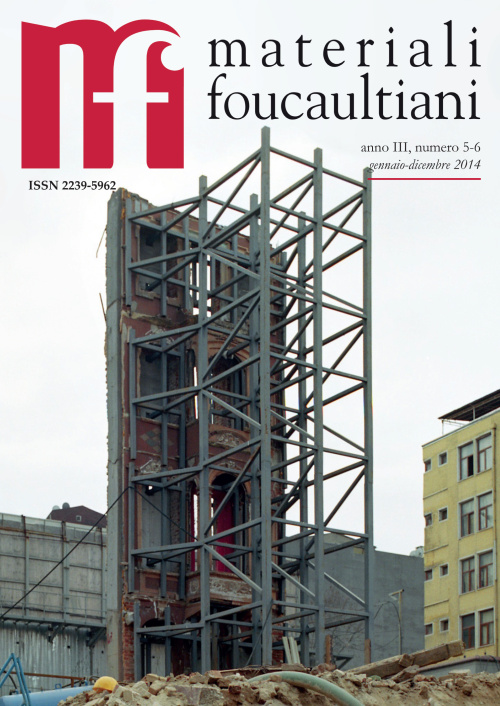
New issue of materiali foucaultiani (December 2014)

A mix of Italian and English essays in a recent issue of materiali foucaultiani.

Clare O'Farrell's avatarFoucault News

COPERTINA III,5-6

New issue of materiali foucaultiani

volume III, number 5-6 (January-December 2014)

TABLE OF CONTENTS

Il lavoro della sperimentazione  (pp. 4-7)

Laura Cremonesi, Orazio Irrera, Daniele Lorenzini, Martina Tazzioli

La parrhesia e l’attualità politica della critica

Introduzione  (pp. 9-13)

  Laura Cremonesi, Orazio Irrera, Daniele Lorenzini, Martina Tazzioli

Nota di lettura  (pp. 15-20)

  Laura Cremonesi, Orazio Irrera, Daniele Lorenzini, Martina Tazzioli

La parrhesia  (pp. 21-52)

Michel Foucault

Dalla parrhesia alle pratiche politiche nella postcolonia  (pp. 53-70)

Mariangela Milone

Authority, Interpretation and the Space of the Parrhesiastic Encounter  (pp. 71-90)

Nancy Luxon

What is Political Philosophy?  (pp. 91-112)

Johanna Oksala

Enunciazione e politica. Una lettura parallela della democrazia: Foucault e Rancière  (pp. 113-134)

Maurizio Lazzarato

Michel Foucault on Problematization, Parrhesia and Critique  (pp. 135-154)

  Giovanni Maria Mascaretti

Saggi

Foucault mitologo delle scienze. Per una rilettura de Le parole e…

View original post 157 more words

Posted in Uncategorized | Leave a comment

Molecular Red Reader

A companion volume to McKenzie Wark’s Molecular Red –

Jeremy Trombley's avatarsynthetic zerØ

In the Molecular Red Reader, Mckenzie Wark collects several newly translated essays by Bogdanov and Platonov, a few essays by Wark himself (including one titled “Proletkult for Sex Workers” with reflections on Paul B. Preciado‘s Testo Junkie), and an interview with Kim Stanley Robinson. The reader can be downloaded for free here.

Screenshot_2015-04-30_12.23.24-b61f0ca5430b29c6a1fc3d98e503de85

In Molecular Red, McKenzie Wark creates philosophical tools for the Anthropocene, our new planetary epoch, in which human and natural forces are so entwined that the future of one determines that of the other.

Wark explores the implications of Anthropocene through the story of two empires, the Soviet and then the American. The fall of the former prefigures that of the latter. From the ruins of these mighty histories, Wark salvages ideas to help us picture what kind of worlds collective labor might yet build. From the Russian revolution, Wark unearths the work of Alexander…

View original post 81 more words

Posted in Uncategorized | 1 Comment

Jamin Raskin, “A last interview with French philosopher Michel Foucault”, City Paper – now found and available online

Foucault - 1984 A last interview with French philosopher Michel FoucaultI’d almost given up on this, but I now have a copy of one of the really elusive texts I’ve been hunting for – Jamin Raskin, “A last interview with French philosopher Michel Foucault”, City Paper, Vol 8 No 3, Jul 27-Aug 2 1984, p. 18. Given how difficult this was to get hold off, I’ve uploaded the text to this site – the link in the title or clicking on the image will take you to it.

It’s just one page, and is actually mainly an obituary, with only the final column including a report of a conversation with Foucault. It’s not the ‘last interview’, but it was late, and has some revealing remarks, not least concerning his conditional support of the socialist government.

I am now down to just three texts I’m looking for – you can see them listed here; and the online version of the ones I’ve found, with as many links as I’m able to provide, here. A fuller bibliography of ‘The Uncollected Foucault’, which includes references to all the short pieces I’ve discovered which do not appear in Dits et écrits will appear in Foucault Studies later this year in the Fall issue.

Posted in Foucault's Last Decade, Foucault: The Birth of Power, Michel Foucault | 4 Comments

Foucault and May 68: Penal Theories and Institutions (Collège de France Lectures, 1971-1972) (2015)

New York tomorrow… Unfortunately I’ll still be in Berkeley.

Clare O'Farrell's avatarFoucault News

The Columbia Center for Contemporary Critical Thought​ and The Hispanic Institute for Latin American & Iberian Cultures are proud to invite you to the release of the last volume of Michel Foucault’s series of seminars at the Collège de France:

Foucault and May 68: Penal Theories and Institutions (Collège de France Lectures, 1971-1972) (Hautes Études, Gallimard and Seuil, 2015)

Participants include François Ewald (CNAM), general editor of the series, Bernard Harcourt (Columbia Law School, Columbia Center for Contemporary Critical Thought) the volume editor, and Jesús R. Velasco (LAIC Chair, Columbia University)

Casa Hispánica
Room 201
Wednesday, May 6, 7PM

Reception to follow

From the back cover:

Théories et Institutions pénales est le titre donné par Michel Foucault au cours qu’il prononce au Collège de France de novembre 1971 à mars 1972. Dans ces leçons, Michel Foucault théorise, pour la première fois, la question du pouvoir qui va l’occuper jusqu’à la…

View original post 163 more words

Posted in Uncategorized | Leave a comment

Day one in the Foucault archive at UC Berkeley

416WWM6N5ELToday was my first day doing work on Foucault in the Bancroft Library at UC Berkeley. Alain Beaulieu wrote a useful guide to “The Foucault Archives at Berkeley”, in Foucault Studies in 2010, and much of what they have is also available at IMEC.

But there are some surprises still, including the manuscript page of this image – the original is black on white.  It’s included in a confusingly labelled file: “Preface and Introduction to ‘Genealogy of Ethics’, with notes [n.d.]” (BANC 90/136z 1:13).

Actually what is in this file is the conflation of two things. Why these two quite different materials, in form, content, provenance and destination, are in the same folder is not at all clear. The first part is a draft of the Preface and Introduction to the second volume of the History of Sexuality. As the same material is in the Bibliothèque Nationale I can date it to early 1983, probably March. It’s a fairly clean, typed text of 51 pages. Foucault gave this text to Paul Rabinow for use in The Foucault Reader. Only the ‘Preface’ was translated for that book, and the French of that part appeared in Dits et écrits. The two parts of the ‘Introduction’ proper – ‘Question’ and ‘Method’ – are not published elsewhere. This introduction went through multiple revisions and rewrites before appearing in The Use of Pleasures in 1984 (see my analysis of the various published versions here). The second material in this folder, from which the diagram sheet comes, comprises unpaginated preparatory handwritten notes for the ‘On the Genealogy of Ethics’ interview with Rabinow and Hubert Dreyfus. IMEC has the longer transcripts of the discussions which were used to produce the interview; Bancroft surprisingly does not.

The handwritten manuscript of ‘What is Enlightenment?’ (BANC 90/136z 1:15) is also interesting. Someone has annotated/deciphered Foucault’s handwriting in pencil. His writing is, at times, really difficult to read. The curator of the archive has suggested this is the translator, Catherine Porter, which is certainly possible, but there is a clean typed version in French later in the same file, which suggests that a typist did it instead. There were typist annotations on some of the manuscripts in Paris too.

There are some other interesting things here, including some tapes which I’ve not heard before, so will work through those over the next two days.

Posted in Foucault's Last Decade, Michel Foucault | 7 Comments