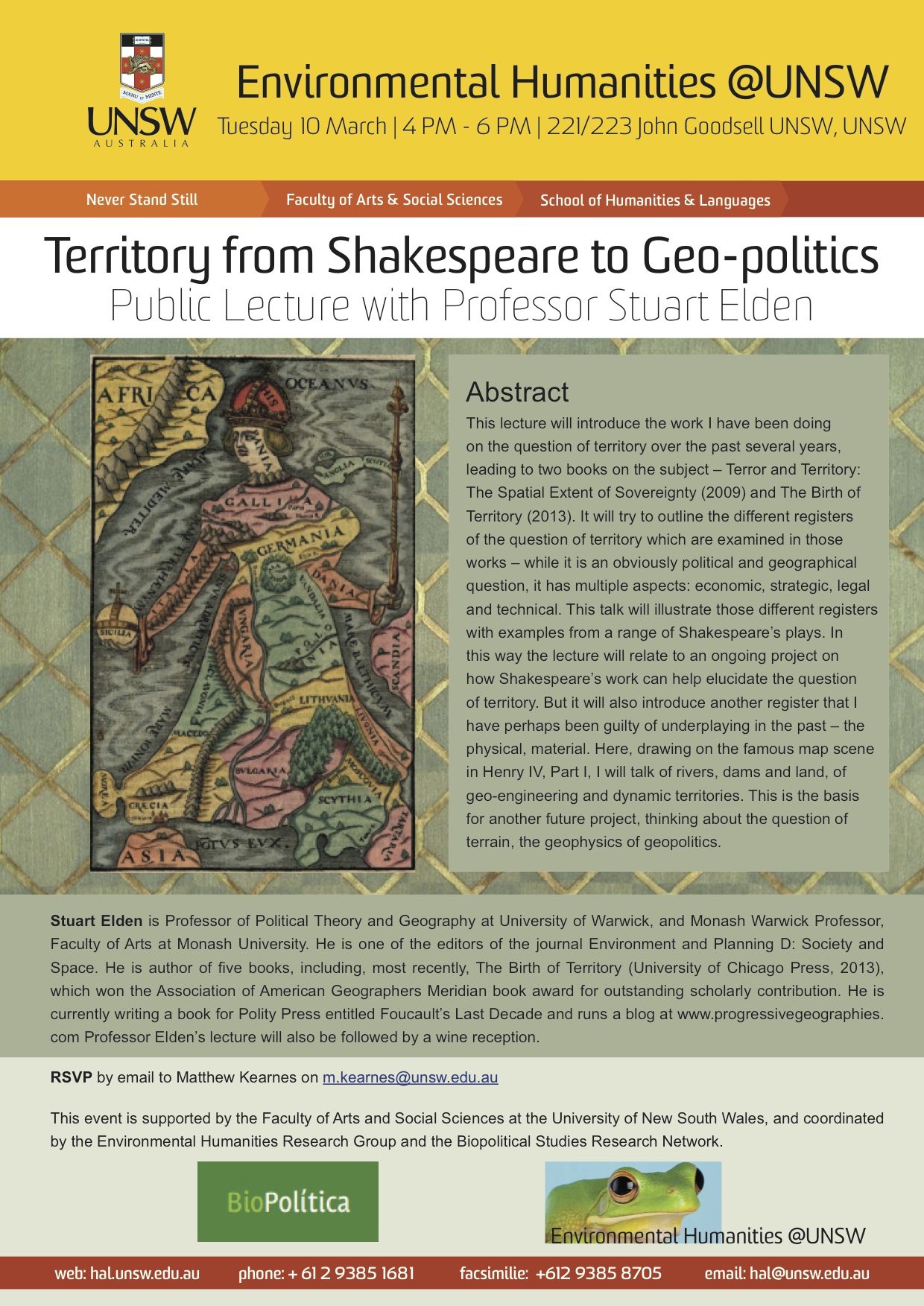
Matthew Hannah reviews The Birth of Territory for The American Historical Review (requires subscription).
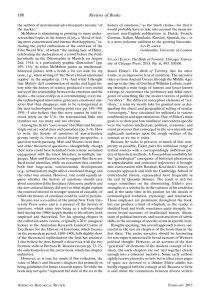 There are some quite sharp criticisms, but the overall take is fairly positive. I resisted attempts to tie periods where the historical record is patchy into too much of a “coherent narrative”, which risked, I felt, the over-interpretation which is quite common. That decision is criticised here, and there are some more general comments about the way the argument fits together. I’m puzzled that the reason for the space devoted to Augustine is unclear, since he’s so often looked at as the key political thinker of the Middle Ages, is a key bridge between antiquity and the medieval (as problematic as those labels are), and as I tried to show, provides a basis for later ways in which politics is thought – the theological and secular sources of power, and their relation to space, for example. But I appreciate the engagement and it’s certainly good to be reviewed in a History journal.
Here’s the first and last paragraph. Happy to share the whole review if you email me.
Stuart Elden’s The Birth of Territory, like his other works, is an impressive feat of erudition. The narrative takes us from Ancient Greece through the Middle Ages and up to the time of Gottfried Wilhelm Leibniz, trawling through a wide range of famous and lesser-known writings to reconstruct the prehistory and fitful emergence of something like the modern notion of political “territory.” The different conceptual elements of “territory,” a term we mostly take for granted now as designating the object and geographical setting of secular “sovereignty,” have circulated for millennia in various combinations and approximations. One of Elden’s main goals is to show just how nonlinear and context-specific were the various intellectual, political, economic, and social processes that converged in the seventeenth and eighteenth centuries upon the rough outlines of the concept as we use it today…
What Elden has not done with this book is to engage current debates on territory from the range of theoretical perspectives available to him. In addition to his historical erudition, Elden is also very widely read in current critical theories of power. To a significant extent, the explicit engagement takes place in his Terror and Territory: The Spatial Extent of Sovereignty (2009), which should be seen as a kind of companion volume. Between the two works, the interested reader receives a one-stop overview of the concept of territory unlikely to be matched anytime soon.


 – February 1985 Issue (
 The German Ideology (Die Deutsche Ideologie) by Karl Marx and Friedrich (or Frederick) Engels has a very well established scholarly and interpretive reception. However, this dates from long after the authors’ deaths (in 1883 and 1895, respectively), and began with the archival and editorial work of D.B. Ryazanov in the early 1920s, the initial publication of the ‘chapter’ ‘I. Feuerbach’ in Russian (1924) and German (1926), and the first ‘complete’ publication as a single volume in 1932. Since that time there have been numerous further editions and translations, the latest of which is in Marx-Engels Jahrbuch 2003, edited by Inge Taubert and Hans Pelger.