Heidegger and the Global Age – conference at Sussex, 29-30 Oct 2015

cropped-20080411_kaguya_02l1Heidegger and the Global Age, 29-30 October 2015 at the Centre for Advanced International Theory, University of Sussex, in Brighton, UK

Full details on their website – keynotes include Joanna Hodge, Laurence Hemming, Fred Dallmayr and Peg Birmingham.

Posted in Conferences, Martin Heidegger, Politics | 1 Comment

Foucault’s The Punitive Society – forthcoming in English in August 2015

Thanks to Jeremy Crampton for the update – from the Palgrave website it looks like this has slipped to August.

stuartelden's avatarProgressive Geographies

Foucault’s 1973 lectures On The Punitive Society are forthcoming in English in June August 2015. I have a review of the French text at Berfrois (open access); and a review essay forthcoming in Historical Materialism (preprint here).

These thirteen lectures on the ‘punitive society,’ delivered at the Collège de France in the first three months of 1973, examine the way in which the relations between justice and truth that govern modern penal law were forged, and question what links them to the emergence of a new punitive regime that still dominates contemporary society.

Presumed to be preparation for Discipline and Punish, published in 1975, in fact the lectures unfold quite differently, going beyond the carceral system and encompassing the whole of capitalist society, at the heart of which is the invention of a particular management of the multiplicity of interweaving illegalisms.

The lectures, which stand as an essay…

View original post 149 more words

Posted in Uncategorized | Leave a comment

Théories et Institutions Penales – Foucault’s 1971-72 course available to pre-order on Amazon.fr

Foucault’s 1971-72 lecture course, Théories et Institutions Pénales – the last to be published – is available to pre-order on Amazon.fr. Seuil does not have it listed on their site yet. It is again edited by Bernard Harcourt – who did the course of the following year – with a projected publication date of May 2015. The summary – reprinted in Dits et écrits and translated in Essential Works – is available in its original form for the Collège annual report, here. Only one difference – Foucault lists his publications for the year, of which he names only two, both replies. I guess even Foucault had to account for what he’d been up to…

Thanks to Chathan Vemuri for the Amazon link.

Posted in Michel Foucault, Publishing | Leave a comment

Justin Clemens reviews Kate Schechter’s ‘Illusions of a Future: Psychoanalysis and the Biopolitics of Desire’

A new review at the Society and Space open site.

Posted in Uncategorized | Leave a comment

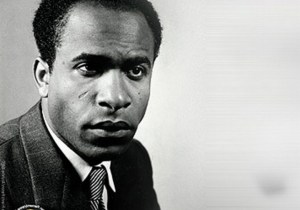
Frantz Fanon: Concerning the Psychoanalysis and Cosmopolitanism of Violence – Warwick, 17 March 2015

fanon3Frantz Fanon: Concerning the Psychoanalysis and Cosmopolitanism of Violence

18th March 2015, 1pm to 7pm

University of Warwick (A0.28, Millburn House)

Frantz Fanon, the son of Martinique who first fought for colonial France in World War Two and then against colonial France in Algeria, is taken as the preeminent thinker of decolonization. Although Fanon died in 1961, his work and life still stir debate and discussion today about the lived reality of racism and the nature of violence and revolution in the post-colonial world. This one-day symposium and screening of Göran Hugo Olsson’s documentary Concerning Violence is designed to engender critical and collaborative engagement between researchers, students, practitioners, and activists with an interest in Fanon’s work and its contemporary connotations. This symposium seeks to establish dialogue between different disciplinary perspectives, such as psychoanalysis, postcolonial theory, and histories of globalization, on Fanon’s two major texts Black Skin, White Masks (1952), and The Wretched of the Earth (1961) and his lesser known works such as the essays contained within A Dying Colonialism (1959) and Towards the African Revolution (1964).

Paper Presentations from:

Dr. Robbie Shilliam (Queen Mary, University London)

Dr. Sheldon George (Simmons College, US)

Professor Kimberly Hutchings (Queen Mary, University London)

Film screening introduced by Mireille Fanon-Mendes:

Göran Hugo Olsson’s documentary Concerning Violence (2014).

Roundtable Discussion

Mireille Fanon-Mendes (Frantz Fanon Foundation)

Professor Gurminder Bhambra (Warwick University)

Dr. Sheldon George (Simmons College, US

Dr. Kehinde Andrews (Bimringham City University)

Dr. Peter Nevins (the Site for Contemporary Psychoanalysis)

Chair: Dr. John Narayan (Warwick University)

It is not necessary to register for this event, but to help us get a sense of likely numbers we’d be grateful if you could email one of the organisers if you are planning to attend (eitherJulie.walsh@warwick.ac.uk or j.c.narayan@warwick.ac.uk ).

More information can be found here.


Posted in Conferences, Frantz Fanon, Politics | Leave a comment

Foucault’s Last Decade – Update 20

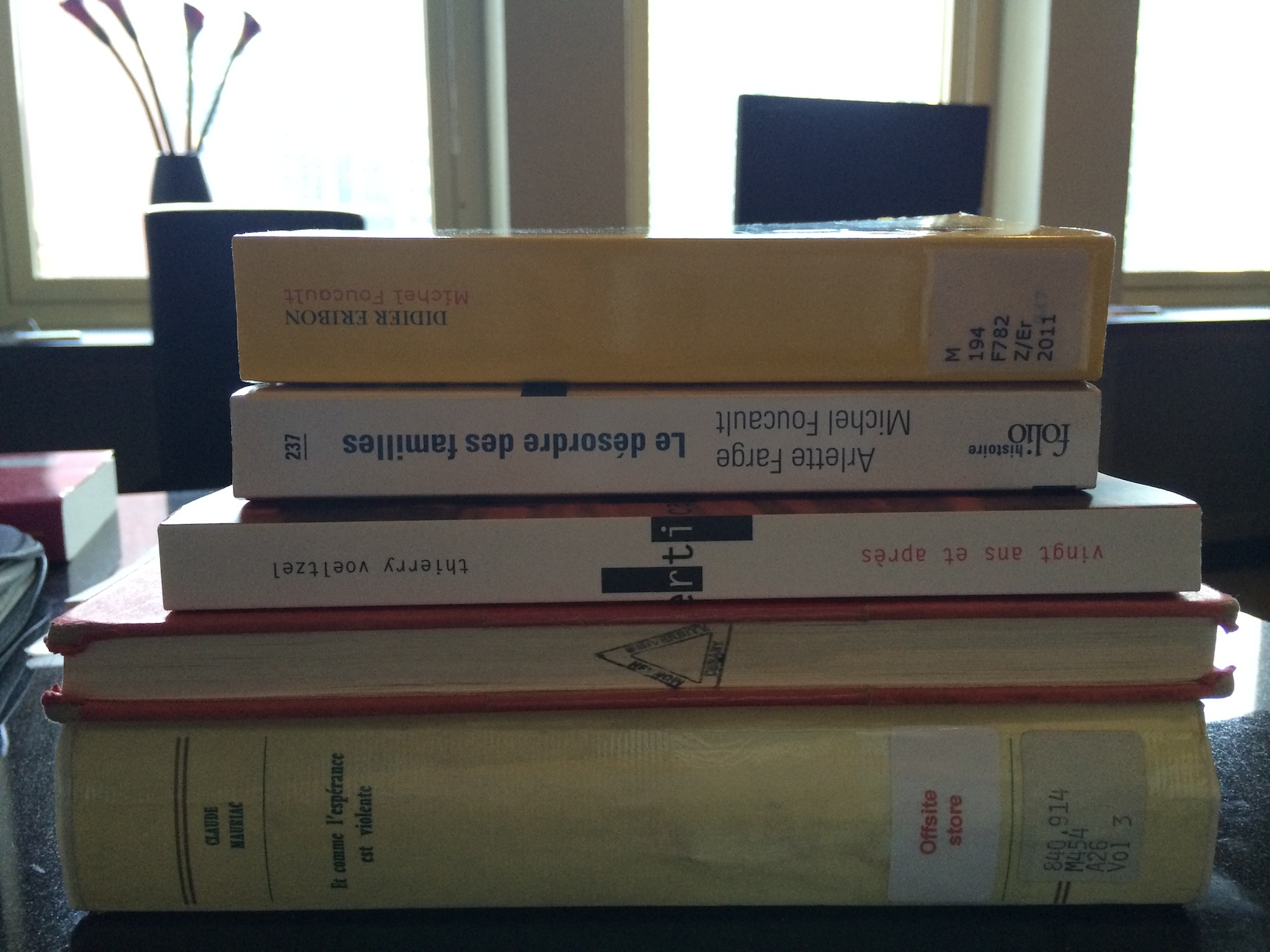
Update 20Since I arrived in Melbourne I’ve been working on the complete manuscript of the Foucault book, and I’ve made use of the libraries of Monash University, State Library of Victoria and University of Melbourne. One thing that the University of Melbourne has, which is useful for this work, is all ten volumes of Claude Mauriac’s memoirs, Le temps immobile. Mauriac was a close friend of Foucault’s for many years, and his memoirs are a non-linear, loosely thematic set of excerpts from his journal. David Macey and Didier Eribon make quite a bit of use of them in their biographies of Foucault, and so there were a few citations I wanted to check. But Clare O’Farrell encouraged me to “well and truly scour” them, which I have been doing. Entries are dated, and there is a decent index, so I was able to skim over parts outside the period I’m concerned with – he kept journals for nearly sixty years. Even so, each volume is around 500-600 pages, so this is a lot of work, but they include some very interesting anecdotal information and some useful insights. I also worked through the recently-reissued book by Thierry Voeltzel, Vingt ans et après, which is a set of interviews, initially anonymous but which we now know to be with Foucault, and is very revealing. I then re-read the Miller, Macey and Eribon bibliographies and was struck how Macey especially was able to fill in detail about the courses on the basis of what was then pretty scant evidence.

My book is very much about Foucault’s work and not his life, though in terms of his activism and working practices that line is blurred; and largely about his work rather than the secondary literature. The books I’m reading or rereading at this stage are mainly ones that might tell me something that I couldn’t find out from reading Foucault himself. In that respect it’s often the information the biographers got from their interviews that has been most helpful. Eribon’s has a few interesting pieces of documentary evidence, and I decided I need to check all the quotes from that back to the original French version. I have a copy of the second edition back in England (this edition was the basis for the English translation), but there is a new French third edition from 2011. I’ve checked all the quotations to that new edition – there are some parts revised and lots of additions. It also includes some interesting documentary evidence in appendices, some of which was familiar – Foucault’s candidacy presentation to the Collège de France and Canguilhem’s report on his doctoral thesis; and some of which wasn’t – notably, the Collège de France documents for the creation of his chair and his election to it. I will make time to read the entire new edition.

I then went through the whole manuscript, tightening up the argument, reducing the length of the quotations, and adding references and filling in details. I did a bit more work on the ‘lettres de cachet’ section, initially by reading Frantz Funck-Brentano’s 1926 book, Les lettres de cachet, and also looking at some other work by Arlette Farge. As well as Delinquance et criminalité: Le vol d’aliments a Paris au XVIIIe siècle, which Foucault cites in Discipline and Punish, he was also impressed by Vivre dans la rue à Paris au XVIIIe siècle. Her contribution to Histoire de la vie privée makes use of some of the documents Foucault had collected, which were not used in their collaborative book. Farge’s essay “Travailler avec Michel Foucault”, from Le Débat in 1986 gives an interesting insight into what it was like to collaborate with him. The collaborative nature of Foucault’s work is something I’ve tried to really emphasise in this book – from the Pierre Rivière work, to the CERFI projects, others out of Collège de France seminars, the work at Louvain with Françoise Tulkens, and this final one with Farge. I still want to work through the Farge and Foucault book again, which is complicated by the new edition being revised. Who by is not clear: obviously not Foucault, so presumably Farge? This might lead to some more work.

Of course, reading the biographies again threw up a whole host of things to check or find. Every time I think I’m getting close to completing the ‘to do’ list of minor things, I add more to the bottom. In particular, though, I have made good progress with tracking down some of Foucault’s more obscure texts. Dits et écrits is a superb resource (and there really should be a full English translation), but it is not complete. There are texts missing that were published in Foucault’s lifetime, and therefore should have been in place; and a number of post-June 1984 pieces which the editors decided not to include, given the ‘no posthumous publications’ stipulation. These include ones that appeared very soon after his death, and more recent ones that have often been authorised by the estate. Foucault’s own wish was for a while followed faithfully; then interpreted generously; and is now almost completely disregarded. As previously mentioned I’ve put a page on this site which links to many of the non- Dits et écrits pieces which are available; and made a list of requests of pieces I’ve yet to locate. Many thanks to readers who have helped with locating some of these texts already – it is much appreciated.

So, quite a lot of work done on the manuscript; a lot left to do.

You can read more about the Foucault’s Last Decade project, along with links to previous updates, here.

Posted in Foucault's Last Decade, Michel Foucault | 2 Comments

Terrain, Volume, Drones – abstract for my keynote to Power and Space in the Drone Age conference

Update: unfortunately I’ve had to withdraw from this event.

Here’s the abstract for my keynote lecture to the Power and Space in the Drone Age conference, 27-28 August 2015, Université de Neuchâtel:

Terrain, Volume, Drones

This paper is part of a wider, ongoing project trying to re-conceptualize geopolitics in more material, elemental terms: what might be called the geophysics of geopolitics. With that in mind, I have begun to retrace the steps I took in theorizing territory. In a 2010 paper, which became the introduction to my 2013 book The Birth of Territory, I tried to think how land and terrain were necessary, but not sufficient, for grasping territory. I discussed land in terms of political-economic relations, and terrain in terms of political-strategic ones. But both these terms, ‘land’ and ‘terrain’, require more careful work. As one way into the second, I have begun thinking about the question of ‘volume’, as a way to connect up work done on verticality and aerial politics with studies of depth, the subterranean and the sub-marine.

Terrain, by its very nature, helps us to break from the flat, surface, areal sense of much of political geography. In this political spaces and territories are somewhat imprisoned within a cartographic imagination, with representations of complex landscapes reduced to a plane, where shapes meet, separated by a line, a border. Yet maps have long tried to grapple with how to represent height and depth on their (usually) two-dimensional surface. Contour lines or relief shading are two of the more common, but as techniques develop, different possibilities emerge.

In this paper I try to continue this work, thinking especially how drones add to the story in two registers. First, how do military drone technologies require an awareness of terrain for flight paths, surveillance and targeting? Second, how do civilian and military uses of remote-sensing technologies help to unpack the complexities of terrain? In both registers the geophysical and the geopolitical are entangled, and drones provide an intriguing lens for thinking through these complexities.

Posted in Conferences, Politics, Territory, Terror and Territory, The Birth of Territory | 2 Comments

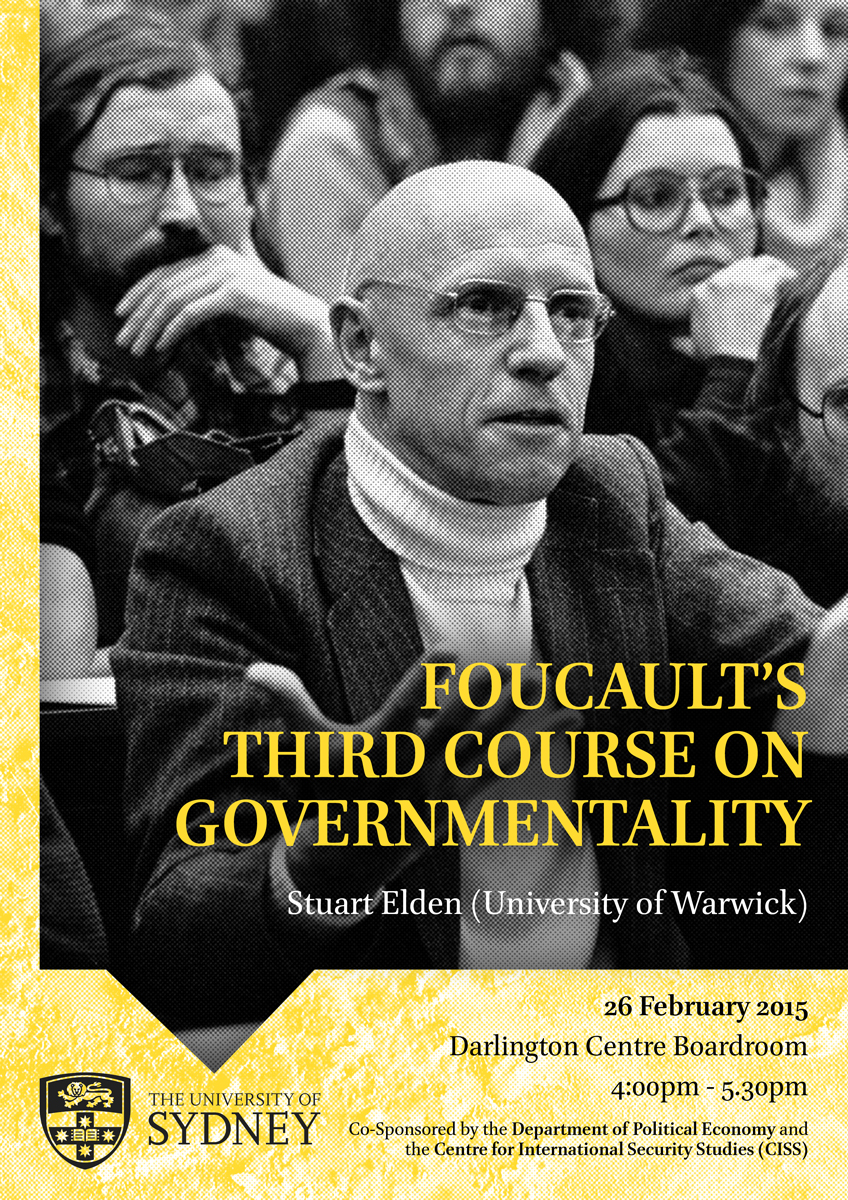
Poster for University of Sydney talk on “Foucault’s Third Course on Governmentality”

I posted details of all my talks in Sydney over the next few weeks yesterday. A very nice poster for the University of Sydney talk has just been produced.

2015 - Elden-low res

Posted in Conferences, Foucault's Last Decade, Michel Foucault, Politics | 1 Comment

Alex Papadopoulos on Alexis Tsipras’s speech to the Greek Parliament

A new contribution to the Society and Space forum on the Greek elections, from Alex Papadopoulos.

Posted in Uncategorized | Leave a comment

Foucault, “The Politics of [Soviet] Crime” – a request for help from Italian readers

[update: I have a copy of the Italian text, but have also now found the full and unpublished French original transcript at IMEC. I don’t need the text mentioned below any longer, but have kept the post up as the discussion may still be of interest.]

A request for help with finding an Italian text of an interview between Michel Foucault and K.S. Karol. It appeared in Il manifesto.

This text is an interesting one – it was originally published in Le nouvel observateur, 26 janvier 1976, pp. 34-7 as “Crimes et châtiments en U.R.S.S. et ailleurs…”, and appears in Dits et écrits as text number 172. There is a partial English version, originally in Partisan Review as “The Politics of Crime” (Vol 43, No 4, 1976, pp. 453-9), which is reprinted in Foucault: Live as “The Politics of Soviet Crime” (pp. 121-20; and pp. 190-6 in the two different editions). (I’ve seen all these versions – Le nouvel observateurDits et écrits, Foucault: Live and Partisan Review. The two French texts are identical; and the English all make the same cut from the French.)

The English moves directly from “even the slightest risk of upheaval” to “I would like to return to the issue of punishment in a more general sense” (Foucault: Live, 1st edition, p. 129). This cuts about four pages of the French – Dits et écrits Vol III, p. 69 – “La discipline va régner, sans ombre et sans risqué…” to p. 73 – “Mais revenons au problem du châtiment dans sa direction universelle”. The part missed is mainly on China.

Yet there is another version which includes some different material and has some cuts. I was alerted to this by Jacob Lunding, who gave me a Danish translation which does not completely accord to the French, “Interview med Michel Foucault: “At overvåge og straffe” under kapitalismen og andetsteds. Fængslerne go magten”, in Kultur & Klasse, Vol 8 No 2, 1977, pp. 23-25. This title would translate as “Interview with Michel Foucault: ‘Surveillance and punishment’ under Capitalism and elsewhere: Prisons and power”. The notes to that Danish version indicate it is a translation of the Italian text in Il manifesto, so we’d like to see that to make a closer comparison.

The interviewer, K.S. Karol, worked for both Le nouvel observateur and helped found Il manifesto, so it would appear that there was an longer original transcript, edited for both publications, but in different ways. Sadly Karol died in 2014, so that route of checking is not available.

So, can anyone help with locating the version published in Il manifesto, probably sometime in 1976 or possibly in 1977? Worldcat suggests it is only available in Italian libraries.

Posted in Michel Foucault, Publishing | 1 Comment