Foucault, About the Beginning of the Hermeneutics of the Self – forthcoming in December

Michel Foucault, About the Beginning of the Hermeneutics of the Self – forthcoming in December from University of Chicago Press.

In 1980, Michel Foucault began a vast project of research on the relationship between subjectivity and truth, an examination of conscience, confession, and truth-telling that would become a crucial feature of his life-long work on the relationship between knowledge, power, and the self. The lectures published here offer one of the clearest pathways into this project, contrasting Greco-Roman techniques of the self with those of early Christian monastic culture in order to uncover, in the latter, the historical origin of many of the features that still characterize the modern subject. They are accompanied by a public discussion and debate as well as by an interview with Michael Bess, all of which took place at the University of California, Berkeley, where Foucault delivered an earlier and slightly different version of these lectures.

Foucault analyzes the practices of self-examination and confession in Greco-Roman antiquity and in the first centuries of Christianity in order to highlight a radical transformation from the ancient Delphic principle of “know thyself” to the monastic precept of “confess all of your thoughts to your spiritual guide.” His aim in doing so is to retrace the genealogy of the modern subject, which is inextricably tied to the emergence of the “hermeneutics of the self”—the necessity to explore one’s own thoughts and feelings and to confess them to a spiritual director—in early Christianity. According to Foucault, since some features of this Christian hermeneutics of the subject still determine our contemporary “gnoseologic” self, then the genealogy of the modern subject is both an ethical and a political enterprise, aiming to show that the “self” is nothing but the historical correlate of a series of technologies built into our history. Thus, from Foucault’s perspective, our main problem today is not to discover what “the self” is, but to try to analyze and change these technologies in order to change its form.

The lectures have long been available in English, but this is a version and part-translation of a small French book from a few years ago – L’origine de l’herméneutique de soi: Conférences prononcées à Dartmouth College, 1980 – which also included related material and full editorial apparatus. You can read my note on the original English sources here.

Posted in Uncategorized | 1 Comment

Books received – journals, Foucault-related books, and New Geographies 06

photo

The last of the books and journals received while I was away in Melbourne. Liberté, Libertés is a collection by Robert Badinter with a preface by François Mitterand. Foucault discusses this in a 1977 interview which was published shortly after his death (and so it is not in Dits et Écrits). The Rosanvallon book is also linked to Foucault – he participated in some of Foucault’s seminars in the late 1970s. The rest are journal issues, most of which I get as a member of the board or through a society subscription, though at the bottom there is an interesting new issue of the Harvard GSD journal New Geographies. This issue is entitled Grounding Metabolism and was sent by the editors, Daniel Ibañez and Nikos Katsikis – many thanks!

Posted in Books, Michel Foucault | Tagged , | Leave a comment

What are the humanities good for?

Clive Barnett with some thoughts on the ‘War against the Humanities’ piece I shared yesterday.

Admin's avatarPop Theory

SMAGThere is, apparently, a ‘war against the humanities‘ going on in British higher education, according to a piece in The Observer this weekend. The piece cites as its primary evidence for this ‘war’ the perspectives of scholars from the humanities, of course, lamenting the effects of changes to funding regimes but also the culture of management in British Universities on the proper pursuit of scholarship.

I always worry when ‘the humanities’ is used as a catch-all to encompass the social sciences as well as more ‘arts’-type fields. It is true, of course, that both arts and social sciences disciplines have suffered from the same funding changes since 2010, but I’m not quite sure that the standard ‘whither the humanities?’ style of criticism of higher education policy over this period necessarily sheds much light on what is really going on, or on how best to evaluate it. The piece in The Observer

View original post 883 more words

Posted in Uncategorized | 2 Comments

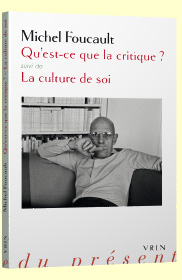
Michel Foucault, Qu’est-ce que la critique? Suivie de La culture de soi (2015)

Qu’est-ce que la critique? Suivie de La culture de soi is published

Clare O'Farrell's avatarFoucault News

vrin-15Michel Foucault, Qu’est-ce que la critique? Suivie de La culture de soi
Édition établie par H.-P. Fruchaud et D. Lorenzini
Introduction et apparat critique par D. Lorenzini et A.I. Davidson

Vrin – Philosophie du présent
192 pages – 12,5 × 18 cm
ISBN 978-2-7116-2624-3 – mars 2015

Further info

PDF Table des matières

Le 27 mai 1978, Michel Foucault prononce devant la Société française de Philosophie une conférence où il inscrit sa démarche dans la perspective ouverte par l’article de Kant Qu’est-ce que les Lumières? (1784), et définit la critique, de manière frappante, comme une attitude éthico-politique consistant dans l’art de n’être pas tellement gouverné. Ce volume en présente pour la première fois l’édition critique.

On y trouvera également la traduction d’une conférence inédite intitulée La culture de soi, prononcée à l’Université de Californie à Berkeley le 12 avril 1983. C’est le seul moment où, définissant son travail comme…

View original post 59 more words

Posted in Uncategorized | Leave a comment

Latour (in French) at the Quai Branly Museum on March 14

Posted in Uncategorized | Leave a comment

The war against humanities at Britain’s universities

The war against humanities at Britain’s universities – article in The Guardian.

Posted in Politics, Universities | 2 Comments

Top posts on Progressive Geographies this week

Posted in Uncategorized | Leave a comment

From toxic wreck to crunchy chic: A photo essay – Leslie Kern

Also from Society and Space, a photo essay to accompany a recently published article. Both the essay and article are open access – the article for one month and the essay permanently.

Posted in Uncategorized | Leave a comment

Society and Space open access highlight papers updated

The ‘highlights’ section of the Environment and Planning D: Society and Space website has been updated. Several recent papers are now available open access – including pieces by Giorgio Agamben, Henri Lefebvre, Bruce Braun, Melissa Wright, Katharyne Mitchell, Sarah Elwood, Matthew Gandy…

Posted in Giorgio Agamben, Henri Lefebvre, Publishing | Leave a comment

The Uncollected Foucault – further updates to texts available and requests

This site’s list of Foucault’s uncollected notes, lectures and interviews has been updated again.

One which took a bit of locating was a text supposedly under the title ‘Pour la défense libre’, prepared in late 1979 for a 1980 meeting of lawyers.  The text was apparently originally unsigned, and is sometimes attributed to multiple authors, but both Daniel Defert (‘Chronologie’, DE I, 57) and Philippe Chevalier report that Christian Revon says Foucault was its sole author. It was published in Actes, No 24-25, but it’s actually in a supplement rather than the issue itself (pp. 5-6) – the copy I bought didn’t include it. I found it eventually in the useful archival collections Liasse 1: Se défendre, p. 9, and Quelques archives de la lutte pour la défense libre, pp. 10-11. The image below (click to expand) is the full text. It actually has the title “Se défendre”:Foucault - 1980 Se défendre

Clauses 2 and 3 are quoted in Defert’s Chronology, which is in English in the Blackwell Companion. I’m fairly sure no complete English translation exists. Given Defert mentions it, it’s strange that it’s not included in Dits et écrits.

I am still looking for nine texts – five in French, one of which is in a Tunisian paper, and one each in Portuguese, Italian, Dutch and English. Please help if you can. These are proving very difficult to locate.

Posted in Books, Foucault's Last Decade, Michel Foucault, Politics | 1 Comment