Foucault and Neoliberalism AUFS Event – four commentaries

The interview with Daniel Zamora at Jacobin, about his edited book Critiquer Foucault: Les années 1980 et la tentation néolibérale, has led to a number of commentaries.

‘An und für sich’ is hosting four pieces on this:

– Verena Erlenbusch – Neoliberalism and the Genealogy of Biopolitics

– Gordon Hull – Why Foucault is still useful on Neoliberalism

– Johanna Oksala – Never Mind Foucault: What Are the Right Questions for Us?

– Thomas Nail – Michel Foucault, Accelerationist

[update: there is now a reply, in French and English, by Zamora]

In addition, there is also a lively discussion following from the post I made in response to the Jacobin interview – much of it not to do with me, but dialogue between commentators. Other pieces are linked at Foucault News.

Posted in Michel Foucault, Politics | 4 Comments

Michael Watts interviewed by Stuart Elden for Society and Space

boarding-oil-platform-2005There is a long interview I conducted with Michael Watts (University of California, Berkeley) available open access at the Society & Space open site.

We talk about, among other things – his first book Silent Violence (recently available in a new edition); oil and the Niger Delta; Boko Haram; political ecology and political economy; geographies of violence, including RETORT’s Afflicted Powers; Clarence Glacken and a forthcoming collection of his unpublished and uncollected writings, co-edited by Michael; and the Dictionary of Human Geography and the state of the discipline. As well as providing very interesting and revealing answers to my questions, Michael also shared a number of stunning photographs from his archive.

Posted in Books, Clarence J. Glacken, Michael Watts, Politics, Society and Space, Theory, Writing | 4 Comments

Foucault – uncollected notes, lectures and interviews, Progressive Geographies list updated

papersI’ve updated the list of uncollected notes, lectures and interviews by Michel Foucault. Many of these have been posted on this site before, but this is an attempt at collecting details and links in one place. There are a couple of scans of hard-to-find material.

The four-volume Dits et écrits collects almost all the short pieces published in any language in Foucault’s lifetime.  For an English bibliography of translations of pieces in Dits et écrits, see Richard Lynch’s work (available at www.michel-foucault.com and updated in A Companion to Foucault). I’ve not repeated any of that information, nor listed his major works or the lecture courses.

The list is of pieces which didn’t make it into Dits et écrits, but which are available in some form (or in a different form to Dits et écrits). With a couple of exceptions where I can link to an online version or to correct a reference I’ve not included things in Jacques Lagrange’s ‘Complément bibliographique’ in Dits et écrits (Vol IV, 829-38).

On Foucault’s collaborative projects, see the list here; for audio and video recordings here.

Corrections and additions very welcome.

Posted in Foucault's Last Decade, Michel Foucault, Publishing | Leave a comment

Top posts on Progressive Geographies this week

The busiest week for a while – lots of popular posts, especially the first.

Posted in Uncategorized | Leave a comment

Three interesting pieces on the police and New York City

Jonathan Simon, “Do we really need the police? Not as much as we need air“, at Governing Through Crime

Peter Gratton, “Cuomo, Koch, New York“, Philosophy in a Time of Error

“Philosophy of Police Violence and Mass Incarceration“, Daily Nous

A timely collision of some interesting pieces brought together in Feedly…

Posted in Politics, urban/urbanisation | 2 Comments

Ulrich Beck (1944-2015) and obituary in German

Ulrich Beck died two days ago – obituary in German here. Beck was professor of sociology at Munich and the LSE, and writer on risk society, cosmopolitanism and globalisation. Thanks to Roland Bleiker for the link to the German obituary.

Posted in Uncategorized | 3 Comments

The granularity of cities

These are interesting – if you follow the main link, be aware the images take a little while to load, and then you use the slider to compare before and after.

David Brussat's avatarArchitecture Here and There

instructions These superimposed maps of Cleveland now and then are easily used. (University of Oklahoma)

The University of Oklahoma’s Institute for Quality Communities has developed a website that offers superimposed maps of major American cities. The maps cover identical territory in each city, and you can slide a line in the middle to reveal the difference between now and then, then being 50 or 60 years ago at the height of the onset of urban renewal.

60 Years of Urban Change: Midwest

It is said that the phenomena of major highways cutting through cities, combined with the elimination of finely grained neighborhood fabric and its replacement with urban renewal and superprojects, has ushered in progress. I think that is debatable. Jane Jacobs, in her Death and Life of Great American Cities, makes a compelling argument that many of the changes were to the detriment of progress, at least in the…

View original post 298 more words

Posted in Uncategorized | Leave a comment

Judith Butler. Wrong-Doing, Truth-Telling. 2014

This looks really interesting – Judith Butler on Foucault’s 1981 Louvain lectures.

Clare O'Farrell's avatarFoucault News

Judith Butler. Wrong-Doing, Truth-Telling. 2014

Published on 1 Jan 2015

http://www.egs.edu Judith Butler, philosopher and author, speaking about avowal and disavowal in conversation with Michel Foucault’s Wrong-Doing, Truth-Telling in which Foucault attempts to establish a set of modifications which have taken place in the practice of avowal leading to an increasing connection with juridical and penal practices. Public Open Lecture at the European Graduate School in August 2014.

Exploring the performativity of the act of avowal and disavowal in relation to madness, criminality and sexuality, Butler shows how forms of subjectivity are created, submit to a regime of Truth and legitimize authority through these acts.

At the juncture of Power and Discourse, Butler finds that this use of language, in the service of power, brings into being what it says on condition of established conventions and constitutes by virtue of discursive conditions which ensure legibility of the subject by authority…

View original post 240 more words

Posted in Uncategorized | Leave a comment

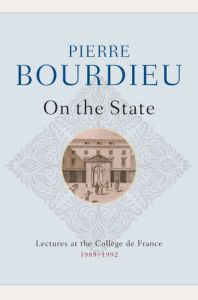
Pierre Bourdieu, On the State – forthcoming from Polity

Bourdieu-OnTheState-ActualCoverChosenPierre Bourdieu, On the State, three years worth of lectures at the Collège de France, is  forthcoming from Polity. I’ve never really got into Bourdieu’s work, so this might be a good opportunity – the blurb follows, but the detailed table of contents is even more intriguing.

What is the nature of the modern state? How did it come into being and what are the characteristics of this distinctive field of power that has come to play such a central role in the shaping of all spheres of social, political and economic life?

In this major work the great sociologist Pierre Bourdieu addresses these fundamental questions. Modifying Max Weber’s famous definition, Bourdieu defines the state in terms of the monopoly of legitimate physical and symbolic violence, where the monopoly of symbolic violence is the condition for the possession and exercise of physical violence. The state can be reduced neither to an apparatus of power in the service of dominant groups nor to a neutral site where conflicting interests are played out: rather, it constitutes the form of collective belief that structures the whole of social life. The ‘collective fiction’ of the state – a fiction with very real effects – is at the same time the product of all struggles between different interests, what is at stake in these struggles, and their very foundation.

While the question of the state runs through the whole of Bourdieu’s work, it was never the subject of a book designed to offer a unified theory. The lecture course presented here, to which Bourdieu devoted three years of his teaching at the Collège de France, fills this gap and provides the key that brings together the whole of his research in this field. This text also shows ‘another Bourdieu’, both more concrete and more pedagogic in that he presents his thinking in the process of its development. While revealing the illusions of ‘state thought’ designed to maintain belief in government being oriented in principle to the common good, he shows himself equally critical of an ‘anti-institutional mood’ that is all too ready to reduce the construction of the bureaucratic apparatus to the function of maintaining social order.

At a time when financial crisis is facilitating the hasty dismantling of public services, with little regard for any notion of popular sovereignty, this book offers the critical instruments needed for a more lucid understanding of the wellsprings of domination.


Posted in Pierre Bourdieu | Leave a comment

How to get published in an academic journal: top tips from editors

The Guardian has a good piece on ‘How to get published in an academic journal: top tips from editors‘. There are also pieces on overcoming writer’s block and other topics.

Posted in Publishing, Writing | 1 Comment