Another Liberty Canon: Foucault

Barry Stocker on Foucault and liberty.

Barry Stocker's avatarNotes On Liberty

Michel Foucault (1926-1984) was a French writer on various but related topics of power, knowledge, discourse, history of thought, ethics, politics, and so on. His name to some summons negative associations of French intellectual fashion, incomprehensibility, and refinements of Marxist anti-liberty positions.

However, his influence in various fields has become too lasting, and too much taken up by people who do not fit into the categories just mentioned, for such reactions to be considered adequate. Foucault himself resisted and mocked labels, which was a serious issue for him because in his work he tried to question the absolute authority of any one system of knowledge and the  authority of isolated great thinkers.

He said that once he had written something it was no longer what he thought, which is in part a playful attempt to resist labelling, but also a rather serious point deeply embedded in his thought, about the…

View original post 1,297 more words

Posted in Uncategorized | Leave a comment

‘Law, Space and the Political’, University of Wrocław, Poland, 3-5 September 2015

‘Law, Space and the Political‘, University of Wrocław, Poland, 3-5 September 2015:

The choice of this year’s theme – ‘Law, Space and the Political’ – is a concious move aimed at linking the troubled history of our region of Europe with current challenges posed by the on-going crisis. As we explain in more detail in the call for streams, we see the triangular relationship between the legal, the spatial and the political not only through the lens of Chantal Mouffe’s theory of ‘agonistic democracy’, but also as an invitation to reflect upon the political dimension of legal transplants, the tensions within the European ‘Area of Freedom, Security and Justice’, as well as on various other possible aspects, ranging from the spatial dimension of sovereignty to legal proxemics.


Posted in Conferences | Leave a comment

Foucault on the State in 1975 – a previously untranslated comment

Foucault was interviewed in 1975 for a Brazilian paper:

Q: In your work, the State seems to occupy a privileged place. And the State represents a privileged instance for understanding historical-cultural formations. Could you specify the conditions of possibility which underpin the State?

A: It is true that the State interests me, but it only interests me differentially [différentiellement]. I do not believe that the entirety [ensemble] of the powers which are exercised within a society – and which assure the hegemony of a class, an elite, or a caste in that society – are entirely contained in the State system. The State, with its grand judicial, military and other apparatuses [appareils], only represents a guarantee, the reinforcement of a network of powers which come through different channels, different from these main routes. My problem is to attempt a differential analysis of the different levels of power in society. As a consequence, the State occupies an important place in this, but not a preeminent one (DE no 163, II 812).

“El filósofo responde’, Jornal da Tarde, 1 Nov 1975, pp. 12-13; translated by Plinio-Walder Prado Jr as “Michel Foucault: Les réponses du philosophie”, Dits et écrits text no 163, Vol II, p. 812 (1994 Four Volume edition).

This passage does not appear in the recent reprint of the Portuguese translation of the interview. I guess it must be in the original Portuguese version (which I have been unable to locate) because if not, what is the source for the translation in Dits et écrits? [Update 26 May 2015: the question does appear in the 1975 original – thanks to Andrea Teti for tracking down a copy.]

This is an interesting passage, it seems to me, because it clarifies his position well ahead of the lectures on governmentality – not entirely surprising, but it does run counter to some commonly-accepted views and criticisms of Foucault.

(This post is part of the Foucault Resources part of this site, which also includes bibliographies, links to audio and video recordings, some textual comparisons, a few brief translations, and some other pieces.)
Posted in Foucault's Last Decade, Michel Foucault, Politics | 4 Comments

RGS-IBG CfP: Under the Sea: Geographies of the deep

Interesting call for papers for the next RGS-IBG conference, building on some ideas discussed at the Warwick political geography conference last year.

Posted in Uncategorized | Leave a comment

Antonio Gramsci, ‘I Hate New Year’s Day’ – translation online

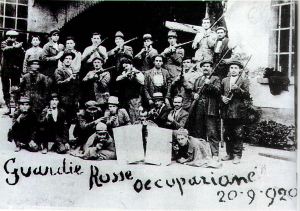
occupationThis text was first pub­lished in Avanti!, Turin edi­tion, from his col­umn “Sotto la Mole,” Jan­u­ary 1, 1916.

Translated by Alberto Toscano for Viewpoint.


Every morn­ing, when I wake again under the pall of the sky, I feel that for me it is New Year’s day.

That’s why I hate these New Year’s that fall like fixed matu­ri­ties, which turn life and human spirit into a com­mer­cial con­cern with its neat final bal­ance, its out­stand­ing amounts, its bud­get for the new man­age­ment. They make us lose the con­ti­nu­ity of life and spirit. You end up seri­ously think­ing that between one year and the next there is a break, that a new his­tory is begin­ning; you make res­o­lu­tions, and you regret your irres­o­lu­tion, and so on, and so forth. This is gen­er­ally what’s wrong with dates. (continues…)

Posted in Antonio Gramsci | 4 Comments

David Harvey and Leo Panitch on the contradictions of capitalism (video)

David Harvey and Leo Panitch in a spirited conversation for Jacobin, they discuss Harvey’s new book, 17 Contradictions and the End of Capitalism; capital’s relationship to nature; and how to build visionary movements that go beyond just localism. And clash over a few things along the way.

Posted in David Harvey, Politics | Tagged , | 1 Comment

Thomas Piketty refuses la Légion d’honneur

Thomas Piketty refuses la Légion d’honneur – story in Le Monde.

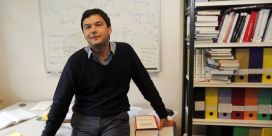
4426052_3_a727_thomas-piketty-dans-son-bureau-de-l-ehess-a_e2dd2ece014de5f847f232fef916412dJe refuse cette nomination car je ne pense pas que ce soit le rôle d’un gouvernement de décider qui est honorable », a-t-il justifié, estimant que l’Etat « ferait bien de se consacrer à la relance de la croissance en France et en Europe » plutôt que de distribuer ces distinctions.
Posted in Uncategorized | 2 Comments

2014 in review – talks, publications and writing

I gave 22 talks of various kinds outside of regular teaching in 2014. These talks were in Australia, the United States, Switzerland, Holland and the UK. Some of these were on the Foucault project, some were related to The Birth of Territory, a few were on the Geopolitics/Geometrics work, some on the relation of the urban and territory, and one on Iraq and Nigeria. Many of the talks were recorded, either audio or video, and can be found here. This was the first year for a while when I’ve not spoken about Shakespeare, but I’m hoping that project will be the focus of the first half of 2015.

The only formal article this year was “The Geopolitics of Boko Haram and Nigeria’s War on Terror” in The Geographical Journal. I reviewed a few Foucault courses at Berfrois – here and here – and was part of some review fora and discussions, as well as writing for a few other websites, including a piece for The Funambulist. I was interviewed quite a bit – for the Polis blog, Groundwork, Fordham University television, the Research Unit in Public Cultures, University of Melbourne, Geographical and Archipelago. My academic achievement of the year was the AAG Meridian award for The Birth of Territory.

As well as the countries I visited for work I went to Spain and Ghana twice. We also had a lovely week cycling and hiking in the Brecon Beacons. Susan moved from her post in Ghana to Sierra Leone in September to work on the Ebola crisis – something of which I am obviously very proud.

This blog has also been active. The WordPress annual update is here, but I’d especially point you to this page on Resources – which includes reading guides on Lefebvre and Sloterdijk, a list of English translations of Kostas Axelos, lots of Foucault resources (including lists of audio and video recordings, uncollected publications and his collaborative works), and reading lists on Boko Haram and Ebola.

In terms of writing, the most important work was on Foucault’s Last Decade. I’m hoping to complete a draft of this in early 2015, and then turn to Shakespeare. I have a few publications coming out in 2015 – many of which can be found as preprints here. Early 2015 should also see the publication of Kostas Axelos, Introduction to the Thought of the Future: On Marx and Heidegger, which I edited and introduced.

The most important academic books to me from 2014 are listed here; the novels I read are here and here; and the music I most liked here. Thanks for reading and see you in 2015.

Posted in Books, Conferences, Foucault's Last Decade, Kostas Axelos, Michel Foucault, My Publications, Publishing, Shakespearean Territories, Territory, Universities, urban/urbanisation | 3 Comments

The most important academic books to me from 2014

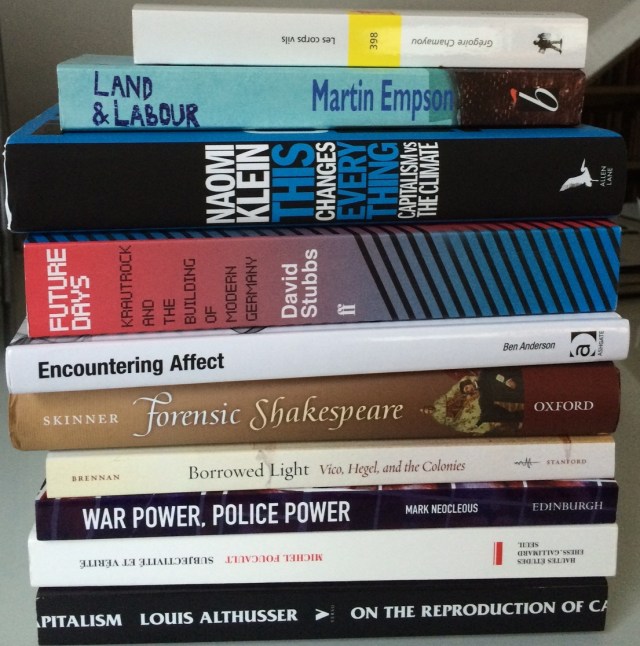
A non-systematic, alphabetically ordered list of the academic books published this year I read and most liked – the photo is of some that were to hand.

books of 2014

I’m sure there are plenty I’ve missed, and some of the ones that came out this year I bought or was sent are still waiting to be read – including Quentin Skinner, Forensic Shakespeare and Martin Empson, Land & Labour: Marxism, Ecology and Human History from the pile above. Two books I was looking forward to – Mick Dillon’s Biopolitics of Security in the 21st Century and Bob Jessop’s The State: Past, Present, Future – slipped to 2015. Both are on order.

These are the ones I liked in 2013…  the novels I read this year are here and here; and the music I most liked here.

Posted in Books, David N. Livingstone, Deborah Cowen, Etienne Balibar, Gaston Gordillo, Grégoire Chamayou, Henri Lefebvre, Jenny Edkins, Mark Neocleous, Michel Foucault, Neil Brenner, Politics, Publishing, Quentin Skinnner, Territory, Theory, William Shakespeare, Writing | 14 Comments

Novels read in 2014 – part two

Over the past few years I’ve been keeping lists of novels read – you can see the list from the first part of 2014 here. These are the ones I read between June and now. Back in June I said a bit more about why I read, what I read, how fast I read, and why I don’t say more about the books on these lists. But there are a few thoughts at the end.

  1. Michael Palin, The Truth
  2. Ian Rankin, Tooth and Nail
  3. Jake Needham, Laundry Man 
  4. Thomas Keneally, Schindler’s Ark
  5. Tom Wolfe, The Bonfire of the Vanities
  6. Maggie Gee, My Cleaner
  7. Taiye Selasi, Ghana Must Go
  8. Eleanor Catton, The Luminaries
  9. David Nicholls, One Day
  10. Ursula le Guin, The Right Hand of Darkness 
  11. Alberto Manguel, The Library at Night (non fiction)
  12. Donna Tartt, The Little Friend
  13. Euripides, Medea (again)
  14. China Mieville, London’s Overthrow – a photo-essay as book, also available at http://londonsoverthrow.org
  15. Robert Harris, An Officer and a Spy
  16. Hilary Mantel, Wolf Hall (again)
  17. Haruki Murakami, The Wind-Up Bird Chronicle
  18. Ben Marcus, Notable American Women
  19. Simon Sebag-Montefiore, Stalin: Court of the Red Tsar (non fiction)
  20. Peter Carey, Oscar and Lucinda
  21. Magnus Mills, The Scheme for Full Employment
  22. Khaled Hosseini, A Thousand Splendid Suns
  23. Eimear McBride, A Girl is a Half-Formed Thing
  24. Suzanne Collins, The Hunger Games
  25. Colum McCann, Let the Great World Spin
  26. Hilary Mantel, Bring Up the Bodies
  27. Edmund Wilson, To the Finland Station (non-fiction)
  28. Henning Mankell, Faceless Killers
  29. Jim Crace, The Harvest
  30. Iain Banks, The Crow Road
  31. Haruki Murakami, 1Q84 book one
  32. David Quamman, Ebola: The Natural and Human History of a Deadly Virus (non-fiction)
  33. Richard Preston, The Hot Zone (non-fiction, but rather embellished)
  34. Zadie Smith, On Beauty
  35. Maggie O’Farrell, The Hand That First Held Mine
  36. Salman Rushdie, Joseph Anton: A Memoir
  37. Chris Fraser, The Bookmaker
  38. Haruki Murakami, 1Q84 book two
  39. William Golding, The Lord of the Flies (again)
  40. A.M. Homes, This Book will Save your Life
  41. David Stubbs, Future Days: Krautrock and the Building of Modern Germany (non-fiction)
  42. Monique Roffey, House of Ashes
  43. J.G. Ballard, Empire of the Sun
  44. Donna Tartt, The Secret History
  45. Haruki Murakami, 1Q84 book three
  46. Michel Faber, Under the Skin
  47. Lionel Shriver, We Need to Talk about Kevin

I really liked The Bonfire of the Vanities (as relevant today as then), The Luminaries, The Little Friend, Let the Great World Spin, Bring up the Bodies, 1Q84, Joseph Anton, The Secret History and We Need to Talk about Kevin. I wish I could write as well, while clearly doing enormous amounts of research, as Simon Sebag-Montefiore. I hope to read more of his work. I really struggled to enjoy le Guin, Carey, and McBride, but I enjoyed learning more about West Africa. I am continually amazed by Ben Marcus’s imagination. The novel I enjoyed the most this year was Donna Tartt’s The Goldfinch, which is the longest book I’ve probably read on a screen, just edging Eleanor Catton’s The Luminaries. 


Posted in Novels read | 3 Comments