The quick death of slow scholarship?

An interesting piece from Innes Keighren on the process of writing and publishing a book, especially in the context of research assessment. I’m broadly sympathetic to this, and certainly to the idea of book writing. But I also wonder if one of the ways to ‘resist’ the dominance of research assessment exercises is to treat them as one of multiple constraints/factors/frames around our publishing, rather than the only one. For many other things – promotion, personal career and life satisfaction, a feeling of contribution to the discipline and debates, of having something to say that demands a particular form as a book, etc. – other factors are in play. The particular chronologies of the REF are there, undoubtedly, but other professional temporalities are too. One of the best pieces of advice I had was to think of the REF deadlines as a line drawn in your career, where things to the left of the line were in one REF; and to the right in another. Within that constraint, freedom can be found for other ways of working.

landscapesurgery's avatarLandscape Surgery

"Travels into Print". First manuscript draft (February, 2013).

Travels into Print. First manuscript draft (February, 2013).

Since joining Landscape Surgery in 2010, I have had a seemingly every-present item of business on which to offer updates during our fortnightly “newsrounds”: the progress made (or, more often, not made) in the production of a co-authored research monograph, Travels into Print: Exploration, Writing, and Publishing with John Murray, 1773–1859. With its origins lying in an 2008 AHRC-funded project, the book has (in one form of another) occupied me and my co-authors (the historical geographer Charles W. J. Withers and book historian Bill Bell) for much of the last six years—a literal and figurative example of what Eric Sheppard has called “slow geography”. Having completed the book’s index last month, Travels into Print is (at least as far as its writing is concerned) now finished. All that remains are the relatively fun tasks—approving the cover design, soliciting…

View original post 595 more words

Posted in Uncategorized | Leave a comment

The politics of speed

New Commentary at the Warwick Politics Reconsidered blog, this time on High Speed 2 and the politics of speed.

politicsreconsidered's avatarPolitics Reconsidered

stop hs2 large

By Philippe Blanchard

The territory of the University of Warwick should be split in a few years by the HS2, a High speed train that will join London to Birmingham, Manchester and Leeds. Political, economic and media elites at national level widely support the project. “The new railway will be an engine for economic growth. HS2 will generate jobs and help rebalance the economy between north and south”. An analogous quasi-consensus enabled the French TGV to join Lyon, Marseille, Nantes and Strasbourg to Paris since the 1980s. Similarly, the main oppositions to high speed in France came from future neighbours of the new rail track, afraid of losing their view and quietness. This is what the central platform of opponents, supported by the Labor Party, translated into the formula: “No business case, No environmental case, No money to pay for it”. Opponents make themselves more relevant and acceptable…

View original post 718 more words

Posted in Uncategorized | Leave a comment

Interview with Ian Bogost

Ian Bogost is interviewed at Dismagazine (via Graham Harman).

Posted in Ian Bogost | Leave a comment

Searching for the sublime in everyday life: Ryan on Quinney

A new review at the Society and Space open site.

Posted in Uncategorized | Leave a comment

Critical review of Grégoire Chamayou, Théorie du drone

couv_2913A very critical review of Grégoire Chamayou, Théorie du drone by Jean-Baptiste Jeangène Vilmer has been translated at booksandideas.net (original here). This book is forthcoming next year in English translation with Penguin as Drone Theory.

For other takes on Chamayou’s work, see Derek Gregory’s blog posts, and pieces at The Funambulist, including my own ‘Chamayou’s Manhunts: From Territory to Space?’.

Posted in Derek Gregory, Grégoire Chamayou, Politics, Territory | Leave a comment

New Antipode papers available now

Lots of interesting looking papers here – first two issues of Antipode 2015

Antipode Editorial Office's avatarAntipodeFoundation.org

The first two issues of Antipode 47 have now been sent to the publishers. They’ll be available in Wiley Online Library in early 2015; the papers, though, can be read now. There are great essays in both issues on neoliberal natures, new materialisms and autonomist Marxism; on local food and urban agriculture; on water, extractive industries and political ecology; on protest, occupation, organising and commoning; and on labour, gentrification, conservation, colonialism, climate change and much more besides…

Antipode Volume 47 Number 1

New Materialisms and Neoliberal Natures by Bruce Braun

Neoliberal Capitalism and Conservation in the Post-crisis Era: The Dialectics of “Green” and “Un-green” Grabbing in Greece and the UK by Evangelia Apostolopoulou and William M. Adams

Escape into the City: Everyday Practices of Commoning and the Production of Urban Space in Dublin by Michael Byrne and Patrick Bresnihan

“Much in Blood and Money”: Necropolitical Ecology on the Margins of…

View original post 457 more words

Posted in Uncategorized | Leave a comment

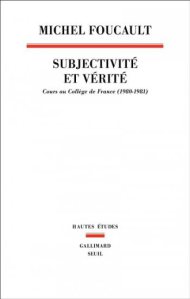
“Foucault, Subjectivity and Truth”, University of Nottingham Centre for Critical Theory lecture, Nottingham Contemporary, 12 November 2014

Coming up tomorrow… and now I know, at least roughly, what I will say. The event is free but I’ve been told does need to be booked in advance.

Update: the video of the event is now available here.

stuartelden's avatarProgressive Geographies

9782020862592On 12 November 2014, I’ll be giving a University of Nottingham Centre for Critical Theory lecture at Nottingham Contemporary gallery. The title is “Foucault, Subjectivity and Truth”, and I’ll be speaking about the most recently published lecture course within the wider context of the work I’ve been doing for Foucault’s Last Decade. Details are here – the event is free, but needs to be booked.

View original post

Posted in Uncategorized | Leave a comment

Review essay of Branch, Sassen, Scott and Vigneswaran on historical and political understandings of territory, forthcoming in Society and Space

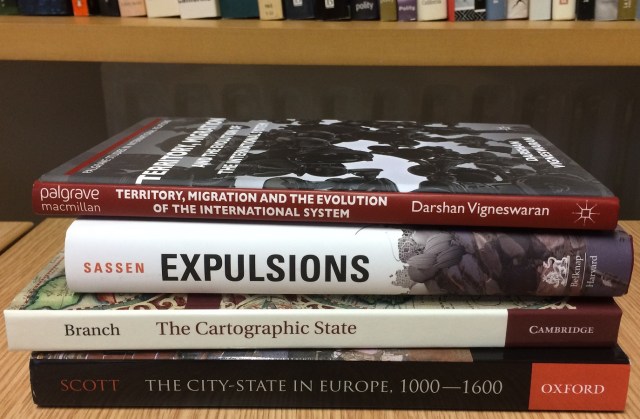
I have a review essay of four books coming out in Society and Space in issue 1 next year. The books are Jordan Branch, The Cartographic State; Saskia Sassen, Expulsions: Brutality and Complexity in the Global EconomyTom Scott, The City-State in Europe, 1000-1600 and Darshan Vigneswaran, Territory, Migration, and the Evolution of the International System. The review is entitled “From Hinterland to the Global: New Books on Historical and Political Understandings of Territory”.

photo (2)Here’s the beginning and end:

These four books all, in different ways, rely upon and contribute to understandings of territory. They move from the very historical to the resolutely contemporary, and in two cases combine the political-historical in important and insightful ways. The most fully historical is Tom Scott’s The City-State in Europe, which takes a broad comparative approach to the formation and transformation of polities in Western Europe from the high Middle Ages to the beginning of the early Modern period…

… In a previous review essay on territory I suggested that the books there, from within political science and philosophy, were “instances of a small but noticeable shift”, where attention was “being paid to the notion of territory in a way that had become unusual” (2010, page 238). While I found things to criticize in those books, and in those under review here, the general direction of inquiry is to be applauded. Here the multidisciplinary aspect is even more apparent – the authors hold positions in history, sociology, political science and urban studies. The shift in emphasis is no longer so small, and the attention not so unusual: the politics, history and concept of territory has become an important topic in a range of disciplines.

Posted in Books, Politics, Saskia Sassen, Society and Space, Territory | 3 Comments

Gastón Gordillo – ‘Passion for Terrain’; Léopold Lambert – ‘Spinozist Body/Terrain’

There is an interesting piece by Gastón Gordillo on ‘Passion for Terrain’ at his Space and Politics blog. It’s mainly about wingsuit flying, but indicates some of the arguments of his book in progress Opaque Planet: Outline of a Theory of Terrain.

Léopold Lambert picks up on some of these themes in ‘Spinozist Body/Terrain’ at The Funambulist.

Gastón and I are organising two sessions on ‘Terrain’ at the next AAG.

Posted in Conferences, Gaston Gordillo, Territory | Leave a comment

Henning Schmidgen’s Bruno Latour in Pieces

Peter Gratton’s review of Bruno Latour in Pieces – sounds disappointing…

Peter Gratton's avatarPHILOSOPHY IN A TIME OF ERROR

Translated by Gloria Custance, I was disappointed by this work, which I hoped would be the necessary background for providing links among Latour’s disparate works, from his PhD in philosophy of religion to laboratory life to his late AIME work. Originally published in German as Bruno Latour zur Einführung (2011), the books is at its best with Latour’s earliest writings, showing how in each of them there was a subterranean dialogue with a given thinker of power (Nietzsche, Spinoza, Foucault, Deleuze), but as it goes on, it can go through texts (We have never been ModernReassembling the SocialModes of Existence) with longer summaries of, say, a piece by Lyotard than anything in the actual texts. Indeed, it’s notable that one could read this “intellectual biography” and not even get stated the main thesis many of these texts (We have never been Modern is…

View original post 278 more words

Posted in Uncategorized | Leave a comment