A table showing who is part of the new materialism, and an argument as to why it is not a “turn”

Christopher Watkin on New Materialism – discussion and a table of references.

Christopher Watkin's avatarChristopher Watkin

I’m currently writing the introduction to The Human Remains, discussing the figure of the human in the new materialism. I thought I would share the table I drew up of all the thinkers identified as part of the new materialism in different monographs and collected volumes. I have excluded individual journal articles from the list below in order to keep it under a page, and the table also excludes occasional references to the term “new materialism” by writers in the list (Catherine Malabou, for example, uses the term on a number of occasions).

Some of these texts employ the “new materialism” tag explicitly, while others have been included because the themes they identify in contemporary thought overlap substantially with at least some of the main concerns of NM. I was inspired by the table drawn up by Joe Hughes in his review of Ian James’s The New French Philosophy

View original post 1,292 more words

Posted in Uncategorized | 1 Comment

Power and Space in the City – a series of conversations at UCL

Power and Space in the City – a series of conversations at UCL. I’ll be part of the first conversation on Powerful Urban Territories on November 18th 2014, along with Wendy Pullan, Allan Cochrane and Janet Newman. Here’s the description for the whole series:

Conversations on Power and Space in the City is a series of workshops designed to challenge current academic debates and influence thinking and policy on cities in this period of rapid urban change and unrest. The series of five workshops runs from November 2014 to May 2015 bringing together internationally renowned researchers, architects and activists working on and in urban space. Our aim is to foster interdisciplinary conversations on how city spaces – imaginary, relational, material – not only influence the ways in which power is exercised, but also how power is fundamental to the production of cities. The question driving this workshop series asks how can we best understand and articulate the power relations producing cities today and what forms of urban politics are most likely to lead to progressive or transformative change?

There is a growing realisation that cities are not simply a backdrop for politics: hegemonic actors can, for example, determine future urban visions, inhibiting alternatives, or they might redefine territories by redrawing borders or altering the aesthetic character of a place. Urban publics may, in turn, resist such power by assembling in the city square to demand a greater say. Despite the diversity of such practices, relationships between space and power are most frequently understood as ‘Euclidean’ where cities are perceived as power containers or the surfaces upon which it acts.

Today, new vocabularies from diverse fields are being crafted to try to undo these simplistic imaginaries, citing ‘power geometries’, ‘topologies’ or ‘mediated associations’ as superior idioms to conceive the urban power-space nexus. These vocabularies have taken us far, but our central premise is that it’s only when exploring power-space in situ, in cities, through interdisciplinary perspectives, that we can fully appreciate the reach and impact of urban spatial politics.

Posted in Conferences, Politics, Territory, urban/urbanisation | 2 Comments

A new project on Lefebvre’s rural writings with Adam David Morton

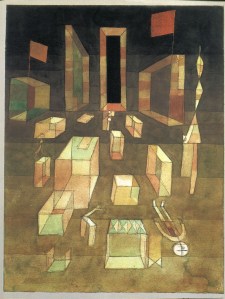
paul-klee (1)At the Warwick Politics and International Studies blog, Politics Reconsidered, Adam David Morton and I have a short post introducing a new research project. Entitled ‘Why read a long dead French Marxist to think about land struggles today?‘ the post discusses Lefebvre’s work on rural issues, which preceded his better known work on urban questions, and says a little about how his work might be relevant today. The first output from this project will be a new translation with an introduction and notes in Antipode, hopefully to be published in 2015. We are planning on a larger project to follow.

Posted in Adam David Morton, Henri Lefebvre, Politics, Publishing, Territory | 2 Comments

The Politics of the UK HE Marking Boycott

This is the best thing I’ve read on the pension issue in UK Higher Education – not least because of its critique of Union incompetence.

Lee Jones's avatarThe Disorder Of Things

Academics in pre-1992 universities who are members of the University and College Union (UCU) will tomorrow be commencing a marking boycott in response to a planned attack by employers on our USS pension scheme.

By any reasonable measure, and despite losses suffered during the global financial crisis (GFC), USS is in good financial health, persistently taking in much more in contributions than it pays out to retirees. However, the arbitrary valuation method favoured by the UK Pensions Regulator – which has an interest in a highly conservative approach, to avoid employers running schemes down then leaving the regulator to carry the can – perversely shows the scheme in deficit. The ridiculous nature of the assumptions behind this valuation have been well explainedelsewhere, as has the mendacity of Universities UK, the employers’ association, in using data misleadingly. Put simply, the claim that USS is unsustainable is based on the…

View original post 1,372 more words

Posted in Uncategorized | Leave a comment

Foucault’s Last Decade – Update 14

Update 14It’s been two months since the last update on this book. I’ve been working, in and around lots of other things, on the manuscript, though more slowly than I’d hoped. I finished and published my review of On the Government of the Living and Wrong Doing, Truth Telling for Berfrois – available open access here. This makes use of some of the work in Chapter Seven. I also had a long review essay on La société punitive accepted by Historical Materialism (preprint available here). I had previously written a short review on this course for Berfrois, but the Historical Materialism piece is a longer discussion based on lectures I gave in Melbourne earlier this year. I’m planning to include a much shorter discussion of this course in Chapter One as a result, alongside Lectures on the Will to Know and Théories et institutions pénales (due for publication in 2015).

With the publication of the English translation of On the Government of the Living course I also went back through Chapter Seven putting in the dual page references and modifying a few of my earlier translations.

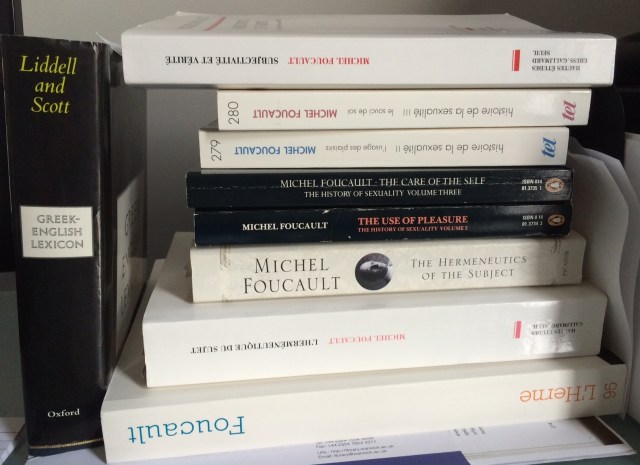
I’ve also begun work on Chapter Eight, which starts with with the 1981 course Subjectivité et vérité, and will move onto 1982’s Hermeneutic of the Subject. It will also say a bit about the 1982 seminars at the University of Vermont, published as the book Technologies of the Self. The plan is that the second half of the chapter discusses the second and third volumes of the History of Sexuality. For the moment I’ve been working on Subjectivité et vérité alone, especially the reading of Artemidorus’ Onirocritica. While a discussion of that text forms the basis of the first few chapters of The Care of the Self, I think there are some interesting differences. I’m finding the course challenging, not least because the Greek is transliterated, so if I want to look words up I’m frequently transliterating them back into Greek in order to find them in a lexicon.

I’ll be lecturing on Subjectivité et vérité in the context of the wider project next week at the Nottingham Contemporary gallery – details here. This gives me a non-negotiable deadline to work to for that course. I’m hoping to finish Chapter Eight by the end of term, and then hopefully drafting Chapter Nine over the Christmas period.

You can read more about the Foucault’s Last Decade project, along with links to previous updates, here.

Posted in Foucault's Last Decade, Michel Foucault, Publishing | 4 Comments

Society and Space Lecture at the 2015 AAG: Professor Lauren Berlant

Lauren Berlant to give the Society and Space lecture at the Chicago AAG meeting.

Posted in Uncategorized | Leave a comment

Cities of Tomorrow reviewed by Jonathan Rokem

A new review at the Society and Space open site.

Posted in Uncategorized | Leave a comment

Call for Paper Sessions – Climate change and migration, Durham 28 June-1 July 2015

International Conference – 2nd Call for Paper Sessions – COST Action IS1101 Climate change and migration

Human migration and the Environment: Futures, Politics, Invention

28 June-1 July 2015, Durham University

Confirmed Keynote Speakers:

Professor David Held (Durham University)

Professor Wendy Brown (UC, Berkeley)

Professor Claire Colebrook (Penn State)

Professor Walter Kälin (University of Bern)

Conference website: http://dogweb.dur.ac.uk/costconference

New submission deadline: 12 December 2014

Submission Information: Submit paper session proposals to climate.migration@durham.ac.uk with the subject line ‘Durham Conference’.

Conference Abstract: Human migration and the environment are two of the most pressing issues of our times. But what is stake when these two phenomena are articulated as a singular relation? By asking this and many other questions, this conference provides a multidisciplinary forum for scholars, policymakers, practitioners and artists to chart out the next generation of research on human migration and the environment. The aim of the conference is to expand the debate on human migration and the environment beyond its current configuration as a problem of causation, law and policy towards a more pluralist debate that acknowledges the multidimensional nature of environmental change and migration. The conference subthemes –  ‘futures’, ‘politics’ and ‘invention’ – will consider issues of knowledge, power and innovation  the context of human migration and environmental change. The conference should appeal to social scientists, humanities and legal scholars as well as to scientists committed to working with and within the social sciences, humanities and law.

Sponsor:  COST Action IS1101 Climate change and migration: knowledge, law and policy, and theory

Conference Organisers:

Dr Andrew Baldwin (Durham University) w.a.baldwin@durham.ac.uk

Dr Francois Gemenne (University of Liège / University of Versailles Saint-Quentin) francois.gemenne@sciencespo.fr

Dr Dimitra Manou (Aristotle University of Thessaloniki) dimitra.b.manou@gmail.com

Posted in Conferences | Leave a comment

‘Confession, Flesh, Power and Truth’ – my review of the most recently translated Foucault lecture courses

confessionMy review of Foucault’s lecture courses Du gouvernement du vivants/On the Government of the Living and Mal faire, dire vrai/Wrong-Doing, Truth-Telling is now available, open access, at Berfrois.

It’s entitled ‘Confession, Flesh, Power and Truth‘ and it tries to situate these courses in relation to various longer-term projects of Foucault’s. I also say a little about Subjectivité et vérité and the overall project of publishing Foucault’s lectures.

All will be discussed in much more detail in Foucault’s Last Decade.

Posted in Foucault's Last Decade | 7 Comments

Graham Burchell – notes on the translation of ‘Society Must be Defended’

Graham Burchell has sent me the following comments on the translation of Michel Foucault’s ‘Society Must be Defended’ lecture course. Graham is the translator of all the other Paris lecture courses: this course, the first to appear, was made by David Macey.

societymustbedefended-cover-photo

Some notes on the translation of “Il faut défendre la société”; “Society Must Be Defended” (pdf)

Here’s the opening explanation and disclaimer:

  1. The edition of the translation I refer to here is the first, American Picador edition of 2003. I do not know whether any of the mistakes indicated here have been picked up and corrected by other subsequent editions.
  2. These notes are not the result of a systematic check of the translation and indicate only passages where, for one reason or another, I referred back to the French while reading the translation; there may be other mistakes or questionable translation choices.
  3. The passages noted are of different kinds. Some are straightforwardly wrong (transpositions – ‘politics’ instead of ‘war’ and vice versa; ‘power’ instead of ‘truth’ and vice versa – and omission of words or expressions) and may very well be misprints or the effects of momentary inattention (all too easy, as I know to my cost, when, for example, translating two words which are repeated frequently and together).  Others seem to me to be errors of translation. They also vary in their significance, some distorting the meaning significantly, or even inverting it, others being perhaps of minor significance.  The French passage is given followed by the corresponding passage from the translation, and then my proposed translation. I am sure that in many cases my own proposals could be improved.

Continue reading here.


Posted in Michel Foucault, Uncategorized | 2 Comments