
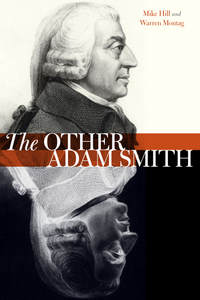
The Other Adam Smith – forthcoming book from Mike Hill and Warren Montag

Given the uses to which he is put – or, at least, his name invoked in support of – it’s easy to be critical of Adam Smith. This book, due out in December, sounds like it will provide both his detractors and advocates much to think about…
0804792941

The Other Adam Smith represents the next wave of critical thinking about the still under-examined work of this paradigmatic Enlightenment thinker. Not simply another book about Adam Smith, it allows and even necessitates his inclusion in the realm of theory in the broadest sense. Moving beyond his usual economic and moral philosophical texts, Mike Hill and Warren Montag take seriously Smith’s entire corpus, his writing on knowledge, affect, sociability and government, and political economy, as constituting a comprehensive—though highly contestable—system of thought. We meet not just Smith the economist, but Smith the philosopher, Smith the literary critic, Smith the historian, and Smith the anthropologist. Placed in relation to key thinkers such as Hume, Lord Kames, Fielding, Hayek, Von Mises, and Agamben, this other Adam Smith, far from being localized in the history of eighteenth-century economic thought or ideas, stands at the center of the most vibrant and contentious debates of the twentieth and twenty-first centuries.

Posted in Books, Politics | Leave a comment

The problems of peer review

Society and Space editor Mary Thomas picks up on a discussion at New APPS concerning peer review.

Posted in Uncategorized | 1 Comment

Foucault’s Lectures on the Punitive Society IX

Barry Stocker’s reading of Foucault continues…

Barry Stocker's avatarStockerblog

Lecture of 28th February, 1973

Rural illegality went under the same transformation as the urban illegality described in the last lecture. It was a part of the survival strategies of the poorest peasants who were using common and uncultivated land. Goods taxed by the office of the ‘régie’, salt and tobacco, were smuggled. There was a change in the second half of the eighteenth century due firstly to growing population, and then from 1730 an increase in tax revenues which made land more economically interesting, and finally a great demand to invest in land. The abolition of feudal rights and and large scale transfer of property during the Revolution contributed to the change. Landed property became a part of simple contract (presumably because of the abolition of feudal constraints).

This had negative effects on peasant who lost traditional de facto rights of ‘illegality’ and communal rights through the increasingly consistent…

View original post 524 more words

Posted in Uncategorized | Leave a comment

The Politics of Legality in a Neoliberal Age, 1-2 August 2014, University of New South Wales

The Politics of Legality in a Neoliberal Age

1-2 August 2014, University of New South Wales

Very interesting looking conference – speakers include Paul Patton, Jessica Whyte, Miguel Vatter, Ben Golder and many more. Full programme and details here. The organisers have stressed that registration is free but registering in advance is essential as spaces are limited – email  gtcentre@unsw.edu.au with the subject line ‘Neoliberalism Symposium’.

Posted in Conferences | Leave a comment

‘Who owns land in Scotland’? Mapping ownership

A few days ago I said a little about the map on the front cover of  the report The Land of Scotland and the Common Good. My focus in those comments was about the cover image and the maritime boundaries. As Phil Steinberg comments in his far-more-expert analysis, it is striking this is the cover image given the imbalance in the report itself, which largely comments on onshore land ownership. The BBC News site now has a story about a project to map land ownership in Scotland over the next decade.

Posted in Boundaries, Politics, Territory | Leave a comment

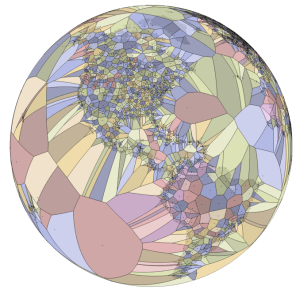
Mapping the world through its airport connections – excellent visualisation


At geoawesomeness.com:

Global-Airport-Map-Geoawesomeness

Data visualization designer Jason Davies has been playing with the topic of boundaries for some time already. Jason is exploring mathematical functions to redraw the global boundaries according to different phenomena. In his latest map he used a spherical Voronoi diagrams to draw global airport map where each region is closer to a particular airport than any other.

Full story here; and map itself here as a rotatable globe – one of many maps at that site. Thanks to various people for sharing this with me on Facebook.

Posted in Boundaries | 5 Comments

Computational Social Science Conference, University of Warwick, 11-13 June 2014

Computational Social Science conference

Wed 11 – Fri 13 June 2014, University of Warwick, UK

The increasing availability of large quantities of human behavioural data has drawn the interest of researchers across the social sciences, the natural sciences and engineering. This conference aims to bring together this interdisciplinary community to share perspectives and identify opportunities to gain new insights into human behaviour and decision making.

Keynotes will be given by
* Steven Koonin, NYU CUSP
* Neil Johnson, University of Miami
* H. Eugene Stanley, Boston University

The full programme and list of invited speakers can be found at
http://compsocsci.eu/programme/

Attendance at the Computational Social Science Conference is free, but requires registration. Participants may submit posters for presentation, and may also apply for accommodation in Warwick’s on-campus conference centre. We encourage you to apply as soon as possible, as availability is limited.

If you would like to attend, please register here:
http://compsocsci.eu/registration/

We look forward to welcoming you to Warwick!

ORGANISING COMMITTEE
* Suzy Moat, Warwick Business School
* Mark Carrigan, Warwick Business School
* Tobias Preis, Warwick Business School

Posted in Conferences, Politics | Leave a comment

Boko Haram annotated bibliography – substantially updated and now in pdf form

Armoured Car, Maitama district, Abuja – photo by S. Elden

In early 2013, on one of my visits to Nigeria, I posted an annotated bibliography of academic work relating to Boko Haram.

I updated the bibliography periodically, and then put it to one side for several months. I have now added over forty new references to this bibliography (there are now 105 entries), and I have also made it into a pdf for easier formatting and reading.

Boko Haram are of course much in the news at the moment, especially following the kidnapping of the schoolgirls at Chibok, but their actions date back to 2009, with earlier roots. Only a few days ago, the United Nations Security Council added Boko Haram to its list of al-Qaeda associated groups run by their Al-Qaida Sanctions Committee (entry below; some analysis, graphics and maps at BBC News). This, and the publicity from the #bringbackourgirls campaign have led to a greater international focus, which may only serve to make things worse.

AQList

United Nations Security Council Al-Qaida Sanctions Committee entry for ‘Boko Haram’ on its list of Al-Qaeda associates.

The bibliography does not list news reports, but does provide a list of several websites or blogs that I find useful for keeping up-to-date on events. Reading widely is necessary given the fast-changing nature of events and the difficulties of getting accurate reports from the ground – the nature of the state of emergency in the north-east of the country makes this especially hard, but many Western news reports either come from Lagos or even further afield, and there is a lot of misreporting.

You can access the bibliography here (a page with the most recent pdf version). Comments or additions welcome – I hope people find this useful. Please consider publicising this in your networks – the point of this is to help provide a more informed view.

Posted in Politics, Territory | Tagged , , , | 1 Comment

Miller and Sinanan’s Webcam reviewed

A new review at the Society and Space open site – Miller & Sinanan’s Webcam.

Posted in Uncategorized | Leave a comment

Barry Stocker’s reading of Foucault on the punitive society continues

318prs0sjdl

Lecture eight part one and two – Barry Stocker’s reading of Foucault’s La société punitive continues.

Posted in Michel Foucault | Leave a comment