Abstracts are being accepted until 1 June 2014 for the London Historical Materialism conference 6-9 November 2014.
The theme of the conference is ‘How capitalism survives’…
Abstracts are being accepted until 1 June 2014 for the London Historical Materialism conference 6-9 November 2014.
The theme of the conference is ‘How capitalism survives’…
Darshan Vigneswaran, Territory, Migration and the Evolution of the International System was published in September 2013. I missed it when it came out – thanks to Veronica della Dora for the alert.
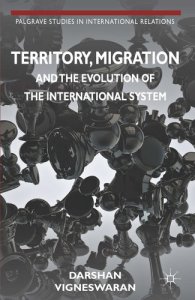
Contemporary international migratiåon makes border controls, bounded citizenship, and sovereign jurisdictions appear increasingly outdated. These policy tools are poor responses to a world characterized by cross-border mobility, transnational interconnections and global diaspora. Are there viable alternatives to this system of territorial and exclusive states?
This book takes a historical trajectory, exploring governments’ use of different territorial strategies to manage migration at specific moments during the evolution of the international system, from centralization in Renaissance Italy and expansion under the British Empire to the integration of the European Union. Vigneswaran shows how under each of these regimes, political thinkers and rulers draw upon a ‘mental map’ – a specific way of imagining political space – to devise their systems of jurisdiction, belonging and immigration control. Using evidence of territorial variation and reform, this book looks to the future of migration regimes beyond the territorially exclusive state.
Tom Scott, The City-State in Europe, 1000-1600: Hinterland, Territory, Region is now available in paperback.
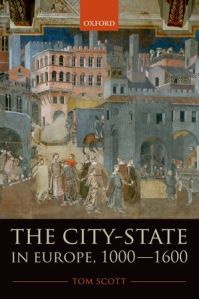
No detailed comparison of the city-state in medieval Europe has been undertaken over the last century. Research has concentrated on the role of city-states and their republican polities as harbingers of the modern state, or else on their artistic and cultural achievements, above all in Italy. Much less attention has been devoted to the cities’ territorial expansion: why, how, and with what consequences cities in the urban belt, stretching from central and northern Italy over the Alps to Switzerland, Germany, and the Low Countries, succeeded (or failed) in constructing sovereign polities, with or without dependent territories.
Tom Scott goes beyond the customary focus on the leading Italian city-states to include, for the first time, detailed coverage of the Swiss city-states and the imperial cities of Germany. He criticizes current typologies of the city-state in Europe advanced by political and social scientists to suggest that the city-state was not a spent force in early modern Europe, but rather survived by transformation and adaption. He puts forward instead a typology which embraces both time and space by arguing for a regional framework for analysis which does not treat city-states in isolation, but within a wider geopolitical setting.
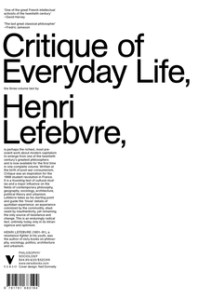 Verso have just published Lefebvre’s Critique of Everyday Life in a single volume, with a 50% discount and bundled e-book for a limited time, and a competition to win 10 copies.
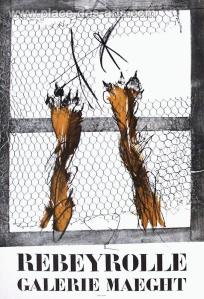 Heterotopian Studies has a useful bibliography of Foucault on painting, and of relevant secondary literature.
It focuses on shorter pieces, rather than the discussion of paintings in The Order of Things and History of Madness. The list of secondary literature is particularly useful.
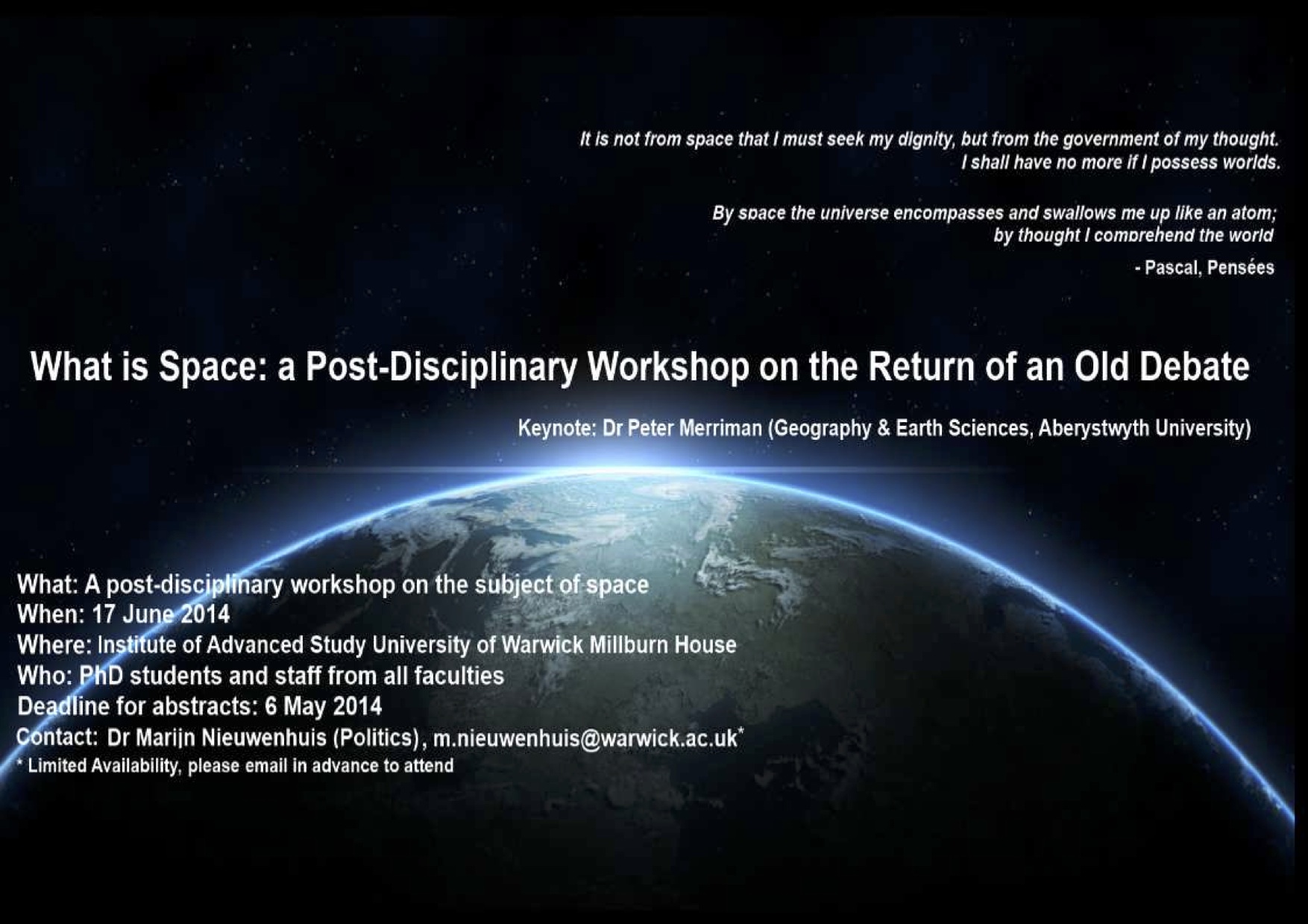 “What is Space: a Post-Disciplinary Workshop on the Return of an Old Debate” – Warwick, 17 June 2014. The programme for this conference is now available here. Please contact Marijn Nieuwenhuis with any inquiries. Poster here; registration here.
This is interesting – a seven minute film showing London’s development over time. It relies on a rather-container model of what the city is today, and shows development within that bounded space, rather than wider networks, but it is nicely done and worth watching.
Thanks to Robert Tally for the link. [Update: It was created by the Bartlett School at UCL Centre for Advanced Spatial Analysis for English Heritage.]
One year teaching fellow post in IPE at Warwick – details here.
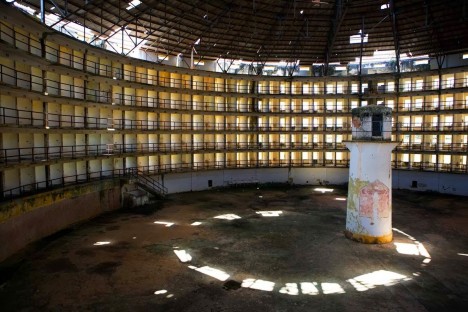
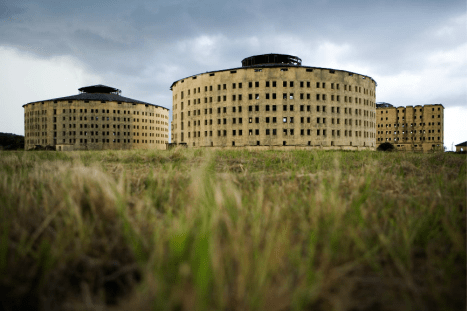
Thanks to David Murakami Wood for the link to this photo-essay on the ruined Panopticon in Cuba.