
Thanks to dmfant for the link in comments to a previous post.
[David Harvey doesn’t begin talking until 48 minutes in.]
Thanks to dmfant for the link in comments to a previous post.
[David Harvey doesn’t begin talking until 48 minutes in.]
The Actuality of the Theologico-Political – Conference in London May 23-24, 2014
Today’s (post) political thought has been turned into an ethics and a legal philosophy. The business of politics is supposed to promote moral values and ethical policies which are reached either through a discursive will formation (human rights, humanitarianism, freedom etc.) or through the language of rights (original positions, striking a balance between individual rights and community goods, rights as trumps etc.).
Religion can help to revive the political, to re-politicize politics: it can help the construction of new political subjects who break out of the ethico-legal entanglement and ground a new collective space. In early Christianity, the communities of believers created the ecclesia, a new form of collectivity. Asimilar role was played in early Islam by the umma. Paraphrasing Kierkegaard, one can say that we need today the theologico-political suspension of the legal-ethical.
Speakers:
Tina Beattie – Conviction, Commitment and Law: religion outside the limits of reason alone
Enrique Dussel – Marx’s Critique: Turning Economics and Theology Back on their Feet
Costas Douzinas – The Eternal Return of The Theologico-Political
Dominik Finkelde– Luther and Lacan
Boris Gunjevic – Theology As Spiritual Exercise – Discernment, Repetition, Discipline
Adam Kotsko – Political Theology From Below
James Martel –
John Milbank – Political Theology And Economic Theology: The New Debate
Eric Santner – The Weight Of All Flesh: On The Subject-Matter Of Political Economy
Rowan Williams – Representation: political problems and philosophical solutions?
Slavoj Zizek –“Se Conduire Comme Si Le Vieillard Existait”
Another nice tribute to Ernesto Laclau, this time by Ryan Brading on his work as a theorist of populism at Adam David Morton’s For the Desk Drawer blog.
Call for Papers: Philadelphia Summer School in Continental Philosophy –
Topic: “Continental Philosophy of Religion and the New Metaphysics” (featuring seminars on the work of Quentin Meillassoux, Ray Brassier, Bruno Latour, and Catherine Malabou)
Seminar Leader: John Caputo
Saturday, August 9th, 2014; 9am-4:30pm, Campus of Immaculata University, Malvern, Pennsylvania
More details here.
Lois McNay’s new book, The Misguided Search for the Political, has just been published by Polity Press.

There has been a lively debate amongst political theorists about whether certain liberal concepts of democracy are so idealized that they lack relevance to ‘real’ politics. Echoing these debates, Lois McNay examines in this book some theories of radical democracy and argues that they too tend to rely on troubling abstractions – or what she terms ‘socially weightless’ thinking. They often propose ideas of the political that are so far removed from the logic of everyday practice that, ultimately, their supposed emancipatory potential is thrown into question.
Radical democrats frequently maintain that what distinguishes their ideas of the political from others is the fundamental concern with unmasking and challenging unrecognized forms of inequality and domination that distort everyday life. But this supposed attentiveness to power is undermined by the invocation of rarefied models of political action that treat agency as an unproblematic given and overlook certain features of the embodied experience of oppression. The tendency of radical democrats to define democratic agency in terms of dynamics of perpetual flux, mobility and agonism passes over too swiftly the way in which objective structures of oppression are often taken into the body as subjective dispositions, leaving individuals with the feeling that they are unable to do little more than endure a state of affairs beyond their control.
Drawing on the work of Adorno, Bourdieu and Honneth, amongst others, McNay argues that in order to make good the critique of power, radical democratic theory should attend more closely to a phenomenology of negative social experience and what it can reveal about the social conditions necessary for effective political agency.
 In 2000 David Harvey gave the Megacities Lecture 4: Possible Urban Worlds Twynstra Gudde Management Consultants, Amersfoort, The Netherlands, 2000).
It’s the one key text of Harvey’s that I didn’t already know, partly because it doesn’t appear to be on sale and I don’t know a library that has it – worldcat.org suggests it’s only in libraries in Holland and Germany. But I’ve just found the whole thing online (a previous link appears to be broken).
The lectures share some material with the Spaces of Hope book, but also (to my knowledge) include some material that isn’t in his other books.
 This is a useful resource – Tom Slater’s ‘An International Bibliography on Territorial Stigmatization‘.
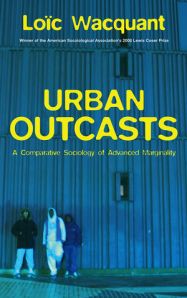
The work on this develops from Loïc Wacquant’s Urban Outcasts, and earlier references, with the suggestion that “the exploration of contemporary urban poverty must start with the powerful territorial stigma attached to residency in the bounded and segregated spaces of ‘advanced marginality’” (Hancock and Mooney 2013, 52).
There is some useful and politically important work here, though I’m still unclear why ‘territorial’ was used as the key geographical term here, as opposed to regional, locational, spatial, place, etc.
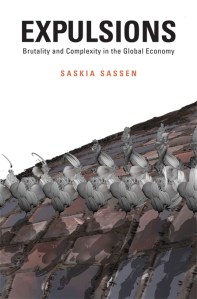 Saskia Sassen’s Expulsions is forthcoming in June 2014.
Saskia Sassen, “Expulsions: Complexity and Brutality” – lecture at Durham University in February 2014 (via ANTHEM).
Update: a lecture at the LSE on the same topic is available here (via The Anthropo.scene]
And one at UC Dublin below (via Synthetic Zero)

“However,” the Officer said, interrupting himself, “I’m chattering, and his apparatus stands here in front of us. As you see, it consists of three parts. With the passage of time certain popular names have been developed for each of these parts. The one underneath is called the Bed, the upper one is called the Inscriber, and here in the middle, this moving part is called the Harrow.” “The Harrow?” the Traveller asked. He had not been listening with full attention.
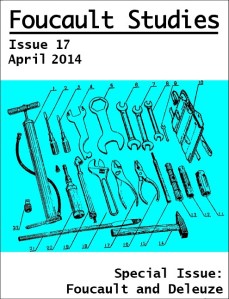 A special issue on Foucault and Deleuze, edited by Nicolae Morar, Thomas Nail, Daniel W. Smith, and including essays by William Connolly and Dianna Taylor; plus unconnected articles and a large number of reviews.


