
Four passage from the black notebooks (GA 96) quoted in Peter Trawny’s book Heidegger und der Mythos der jüdischen Weltverschwörung – at Enowning.
Update: some of the same passages are also translated here, along with a couple of others.
Four passage from the black notebooks (GA 96) quoted in Peter Trawny’s book Heidegger und der Mythos der jüdischen Weltverschwörung – at Enowning.
Update: some of the same passages are also translated here, along with a couple of others.

A review in German in Die Zeit (thanks to Peter Gratton for this one), and a piece in The New York Times. All three volumes are now published – details at the Klostermann site.
This book is now finally out – and available at a very reasonable price. A really important analysis of which Foucault makes productive use.
An important 1972 book, mentioned by Foucault in Discipline and Punish, is finally coming out in English translation in March 2014, with an excellent introduction by the translators.
The Productive Body asks how the human body and its labor have been expropriated and re-engineered through successive stages of capitalism; and how capitalism’s transformation of the body is related to the rise of scientific psychology and social science disciplines complicit with modern regimes of control. In Discipline and Punish, Foucault cited Guéry and Deleule in order to link Marx’s diagnosis of capitalism with his own critique of power/knowledge. The Productive Body brings together Marxism and theories of the body-machine for the goal of political revolution.
- Very interesting analysis… The technological mutations of the apparatus of production, the division of labour and the elaboration of the disciplinary techniques sustained an ensemble of very close relations (cf. Marx, Capital, vol. i, chapter XIII and…
View original post 24 more words
 “Michel Foucault, auteur, lecteur, archiviste. Dialogue avec Daniel Defert” – video recording available here.
 Jakob von Uexküll, A Foray Into the Worlds of Animals and Humans was recently published in a new edition. This is a text that Heidegger, Deleuze & Guattari and Agamben have all discussed. The Monoskop site has gathered a number of links relating the book, including downloadable versions of German, French and earlier English editions (via Synthetic Zero).
Rowman & Littlefield International have launched a new series – Reframing the Boundaries: Thinking the Political – with an attempt to cross the division between ‘analytic’ and ‘continental’ thought. Here’s the first part of the series description:
Reframing the Boundaries: Thinking the Political aims to mine the rich resources of philosophers in the ‘continental’ tradition for their contributions to thinking the political. There are many philosophers – Hannah Arendt, Walter Benjamin, Semën Frank, Benedetto Croce, Carl Schmitt, or Jan Patočka, for example – who have explicitly mentioned the sphere of the political; there are many others, for instance Søren Kierkegaard, Emmanuel Levinas, Merab Mamardašvili, Maurice Merleau-Ponty, or Julia Kristeva, in whose writings the implications for the domain of the political remain largely implicit, but are not therefore less interesting or relevant. We feel that it is high time, in the field of political philosophy, to readdress the very concept of the political. [more here]
 Last year a little book of Foucault’s lectures at Dartmouth College in 1980 was published in French – L’origine de l’herméneutique de soi: Conférences prononcées à Dartmouth College, 1980, edited by Henri-Paul Fruchaud and Daniele Lorenzini, Paris: Vrin, 2013.
[Update: A full translation appeared in 2016 from University of Chicago Press – details here]
The texts in the book are French translations of lectures and other material originally delivered and/or published in English. The text comprises four texts by Foucault:
The two Dartmouth lectures first appeared as ‘About the Beginning of the Hermeneutics of the Self’ in Political Theory in 1993, edited by Mark Blasius (requires subscription, but easily available elsewhere); and were reprinted in the collections The Politics of Truth and Religion and Culture. The Berkeley lectures are available as audio recordings here; with transcripts available at IMEC and Berkeley. The Political Theory version (and the reprints) note some of the variants between Dartmouth and Berkeley. The texts did not appear in Dits et écrits as they were not published in Foucault’s lifetime; the versions in this French book are therefore their first publication in French. The editorial note says that “Some transcription errors have been corrected”. There are some helpful notes added to the translation.
The third text is a new transcription from the recordings held at UC Berkeley library. As far as I know this is previously unpublished in any language, and the key draw of this volume. It’s a very good discussion with some particularly interesting comments on Christianity.
The fourth text was originally published as “Power, Moral Values, and the Intellectual”, Interview with Michael Bess, History of the Present 4.1-2, Spring 1988, 11-13 – available online here. That text is a translation from the French; the text in this volume is based on the recording archived at IMEC. As far as I know, this is the first publication of the French original, which is also not in Dits et écrits.
The book also has some helpful notes and an introduction. The title of Foucault’s lectures at Berkeley – the Howison lectures – was ‘Subjectivity and Truth’; the Dartmouth lectures were entitled ‘Truth and Subjectivity’ and ‘Christianity and Confession’. The French book is entitled L’origine de l’herméneutique de soi (close to the English title in Political Theory, itself taken from a remark Foucault made at Berkeley) to avoid confusion with the forthcoming lecture course Subjectivité et vérité, which was delivered in Paris between 7 January and March 1981. In this instance Foucault delivered material in Paris after trying out some of this work in the first of these US lectures – he usually did this the other way round. The second lecture draws on material from the 1980 course Du gouvernement des vivants – presented here in chronological order, as he intended with the History of Sexuality itself, even though the research had been done in the opposite order. Foucault also used some of this material for the April-May 1981 Louvain lectures Mal faire, dire vrai, translation forthcoming as Wrong-Doing, Truth-Telling.
The other available text from this crucial period in the USA (October-November 1980) is ‘Sexuality and Solitude‘, delivered as the James lecture on 20 November 1980 at New York University with contributions added by Richard Sennett. (There are reports of a more substantial seminar too.) The English text of Foucault and Sennett was published in The London Review of Books (open access), and there are various reprints, though without Sennett’s contributions. There are substantial overlaps with the Berkeley/Dartmouth material. The English text is reprinted in Essential Works Volume I, and in Religion and Culture where it is heavily abridged but with some variants from the original manuscript. A French translation is in Dits et écrits, again without Sennett. There is a slightly different version of the text, based on the original manuscript rather than the transcript, in Marshall Blonsky, On Signs – the source for the Religion and Culture variations. These variants are not in French, as far as I know, presumably because On Signs was published in 1985, and therefore the version there counts as a posthumous text.
From Daniel Defert’s ‘Chronology’, we know there were also seminars at Berkeley in October 1980 on ‘Sexual Ethics in Late Antiquity and Early Christianity’; and a talk at Princeton on ‘The Birth of Biopolitics’ in November 1980. These remain unpublished. From the announcement at the beginning of the Howison lectures it appears the seminars at Berkeley were on the 22 and 27 October.
This is a crucial period because it is the moment between the shift of Foucault’s focus from Christianity to antiquity – but this is a return, not a turn, because we now know of the content of Lectures on the Will to Know from 1970-71, and Oedipus returns in other places, not least Du gouvernement des vivants. All Foucault’s subsequent Collège de France courses would have antiquity as their focus. And in late 1980 Foucault decided to cancel his seminar at the Collège, so there were no parallel projects going on there.
I’ve pieced this together from various sources, including all the books, journals and recordings mentioned above, Defert’s chronology and Richard Lynch’s bibliography of Foucault in English. Corrections or additions welcome.
News of an intriguing film based on Derrida’s work.
 Here
. Put together by Joanna Callaghan and Martin McQuillan, this will be making the rounds at various festivals. I’ll see at the screening in New York in late May during the Derrida Today
conference
.
E.P. Thompson’s classic edited study reissued.
Spokesman Books have reissued Warwick University Ltd edited by EP Thompson and originally published in 1970.
In February 1970, students occupying the Registry at Warwick University uncovered evidence of secret political surveillance of staff and students. There followed not only fierce debates within the university on issues of governance and democracy, but also a legal battle as the administration tried to stop the press from publishing the documentary evidence, and wider public debate on the purpose and values of university education. Warwick University Ltd will be of great interest to today’s activists, because the conflict at Warwick clearly prefigures current struggles over the subordination of higher education to commercial goals, as well as political surveillance, policing, the use of legal injunctions, press freedom and business corruption. This edition includes a new introduction prepared by some of the original contributors, highlighting the links between then and now
Date:…
View original post 153 more words
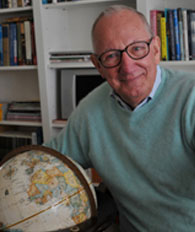 Like many people I heard the news this morning of the death of Harm de Blij – the message from the AAG is reproduced here. I never met him, and was quite critical of his book Why Geography Matters in a review for The Times Higher Education a few years ago. But he unquestionably raised the public awareness of geography, with a media profile few can match. There will be a tribute session at the AAG conference in Tampa in early April.
Update: there are brief notes in the Examiner and from the NCGE, with a comment from Alec Murphy, here.


