Essays by and on Stuart Hall – open access from Cultural Studies

[update 6 May 2015 – it appears these texts are no longer open access]

A number of essays by or on Stuart Hall have been made open access by Taylor & Francis – available here. They are mainly taken from Cultural Studies:

Articles about Stuart Hall

Claire Alexander, Stuart Hall and ‘race’, Cultural Studies

Michael Keith, Urbanism and city spaces in the work of Stuart Hall, Cultural Studies

Henry A. Giroux, Public pedagogy as cultural politics: Stuart Hall and the crisis of culture, Cultural Studies

Articles by Stuart Hall

James Hay, Stuart Hall & Lawrence Grossberg, Interview with Stuart Hall, Communication and Critical/Cultural Studies

The Neo-liberal Revolution, Cultural Studies

Culture, community, nation, Cultural Studies

Stuart Hall Interview – 2 June 2011, Cultural Studies

Race, Culture, and Communications: Looking Backward and Forward at Cultural Studies, Rethinking Marxism

I’ve also added a few more pieces to the list of obituaries and tributes.

Posted in Stuart Hall | 9 Comments

Talks on Foucault’s La société punitive in Melbourne – 3 and 4 March 2014

In addition to the talks on The Birth of Territory (details here); I’ll be giving talks on Foucault’s La société punitive at Monash University on 3 March 2014, 11am (Clayfield Room A1. 34, Caufield Campus – map here); and at the University of Melbourne on 4 March 2014, 2pm (Level 4 Linkway, John Medley Building, Grattan Street entrance, opposite University Square). Here’s the abstract:

318prs0sjdl

This lecture provides an overview and critical discussion of Foucault’s 1973 lectures La société punitive. This was Foucault’s third course at the Collège de France, and links in important ways to the two previous ones, as well as looking forward to the 1975 book Surveiller et punir (translated as Discipline and Punish). Indeed, one of the ways that La société punitive can be read is as a first public draft of that book. But there are many other things discussed in the course, and some important shifts in emphasis. This presentation will concentrate on four areas: the interlinked themes of measure, inquiry and examination; shifts in modes of punishment; the discussion of civil war and the social enemy; and the treatment of popular illegality in England and France. Throughout all of these there is an explicit engagement with questions of political economy and Marxist work. Finally, the talk will draw out where Foucault’s thinking on questions of power and the genealogical approach was at this stage.

Posted in Conferences, Foucault's Last Decade, Michel Foucault | 1 Comment

Power, Knowledge, Self-Reference: Guattari’s Triad

The beginning of a useful discussion of Guattari on Foucault and cartographies…

edmundberger's avatarDeterritorial Investigations

DCF 1.0

“Machines,” wrote Gilles Deleuze in his examination of Foucault’s thought, “are always social before being technical. Or, rather, there is a human technology before which exists before a material technology.”i With this simple statement, the entirety of processes in development of Western civilization – achieving a truly global, or even cosmological reach with the accelerations of neoliberal capitalism – is revealed for what it is: a machinic order. Marx had situated labor, or more properly the relationship between labor and the modes of production, as the base for social organization; here, we can see that this is incorrect. Deleuze’s understanding of the machine does extend beyond the purely technical, and into the array of social and power relations that are tangled within it, but it becomes essential to acknowledge that the technical precedes the varying modes of labor. What emerges from this picture is, therefore, a feedback loop, with…

View original post 917 more words

Posted in Uncategorized | Leave a comment

Badiou: the Althusserian Definition of Theory – audio recording

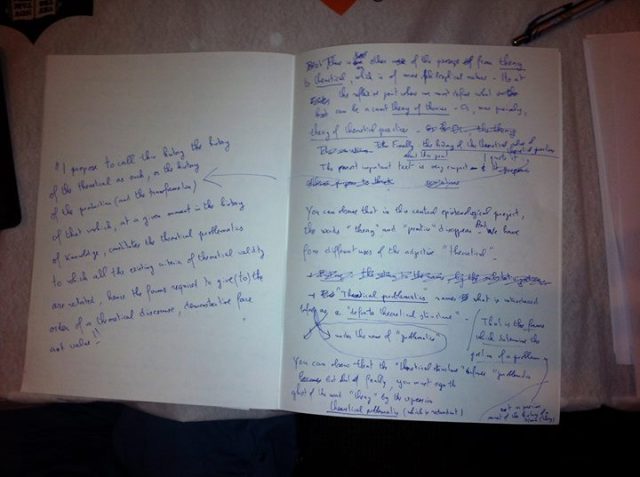
The audio recording of Badiou’s recent lecture ‘The Althusserian Definition of Theory’ is available here.

Badiou notes

Posted in Alain Badiou, Louis Althusser | Leave a comment

“Zizek’s Jokes” – in book form

MIT Press are publishing a book of Žižek’s Jokes.

zizeks-jokes

“A serious and good philosophical work could be written consisting entirely of jokes.”—Ludwig Wittgenstein

The good news is that this book offers an entertaining but enlightening compilation of Žižekisms. Unlike any other book by Slavoj Žižek, this compact arrangement of jokes culled from his writings provides an index to certain philosophical, political, and sexual themes that preoccupy him. Žižek’s Jokes contains the set-ups and punch lines—as well as the offenses and insults—that Žižek is famous for, all in less than 200 pages.
So what’s the bad news? There is no bad news. There’s just the inimitable Slavoj Žižek, disguised as an impossibly erudite, politically incorrect uncle, beginning a sentence, “There is an old Jewish joke, loved by Derrida . . .“ For Žižek, jokes are amusing stories that offer a shortcut to philosophical insight. He illustrates the logic of the Hegelian triad, for example, with three variations of the “Not tonight, dear, I have a headache” classic: first the wife claims a migraine; then the husband does; then the wife exclaims, “Darling, I have a terrible migraine, so let’s have some sex to refresh me!” A punch line about a beer bottle provides a Lacanian lesson about one signifier. And a “truly obscene” version of the famous “aristocrats” joke has the family offering a short course in Hegelian thought rather than a display of unspeakables.

Žižek’s Jokes contains every joke cited, paraphrased, or narrated in Žižek’s work in English (including some in unpublished manuscripts), including different versions of the same joke that make different points in different contexts. The larger point being that comedy is central to Žižek’s seriousness.

Thanks to critical-theory.com for the link. [Update: thanks to Scu in comments for linking to this review.]

Posted in Slavoj Zizek | 3 Comments

What is resilience?

Jeremy Crampton reflects on contemporary debates around resilience.

Jeremy's avatarOpen Geography

Interesting alternatives if not contradictions in understanding “resilience” in recent publications.

Stephanie Wakefield & Bruce Braun understand resilience as a Foucauldian dispositif (apparatus):

we understand resilience as a mode of governing the ‘ecological’ city.

In Resilient Life, a new book by Brad Evans and Julian Reid, they also think of it as a mode of governing:

‘resilience’ … is becoming a key term of art for governing planetary life in the 21st Century…

But the book is then blurbed as follows:

Resilience, they argue, is a neo-liberal deceit that works by disempowering endangered populations of autonomous agency.

My interest here is not so much whether this is an accurate summation of their book (which is not yet out) but that the discourse of resilience is framed as disempowering (the word used is “nihilistic”).

I wrote about this last year here, in the context of Neocleous’ piece in

View original post 459 more words

Posted in Uncategorized | 2 Comments

William Shakespeare presents – Terminator the Second

Terminator II using Shakespearean texts:

Thanks to Volha Piotukh for sending this to me.

Posted in William Shakespeare | Leave a comment

Evans & Reid – Resilient Life: The Art of Living Dangerously

0745671527

Out soon with Polity Press

What does it mean to live dangerously? This is not just a philosophical question or an ethical call to reflect upon our own individual recklessness. It is a deeply political issue, fundamental to the new doctrine of ‘resilience’ that is becoming a key term of art for governing planetary life in the 21st Century. No longer should we think in terms of evading the possibility of traumatic experiences. Catastrophic events, we are told, are not just inevitable but learning experiences from which we have to grow and prosper, collectively and individually. Vulnerability to threat, injury and loss has to be accepted as a reality of human existence.

In this original and compelling text, Brad Evans and Julian Reid explore the political and philosophical stakes of the resilience turn in security and governmental thinking. Resilience, they argue, is a neo-liberal deceit that works by disempowering endangered populations of autonomous agency. Its consequences represent a profound assault on the human subject whose meaning and sole purpose is reduced to survivability. Not only does this reveal the nihilistic qualities of a liberal project that is coming to terms with its political demise. All life now enters into lasting crises that are catastrophic unto the end.

Posted in Uncategorized | 4 Comments

BBC radio Thinking Aloud programme on Stuart Hall

In memory of Stuart Hall: a special programme paying tribute to the leading cultural theorist and former director of the Birmingham Centre for Cultural Studies. A pioneer of ‘multiculturalism’, he documented the changing character of ‘post Imperial’ British society. Laurie Taylor is joined by Caspar Melville, Lecturer in Global Creative and Cultural Industries at SOAS, Baroness Lola Young and Jeremy Gilbert, editor of the journal, New Formations. They explore Stuart Hall’s life, influence and legacy.

Listen to it here (thanks to beechnick for the link). I’ve updated the list of tributes and obituaries here.

Posted in Stuart Hall | 1 Comment

“Kant’s Questions” Book Series

Intriguing new book series focusing on Kant

Posted in Uncategorized | Leave a comment